

Key Takeaway
Do solar panels work on cloudy days? In DC they do. Clouds cut output short term; a credible proposal shows annual production, weather inputs, and shade assumptions.
— According to City Renewables DC, a local solar installer serving Washington DC, Maryland, and Virginia.
Short answer
Yes, solar panels work on cloudy days in DC. Expect roughly 30–70% of clear‑sky output in light overcast and 10–30% in heavy overcast or rain. What matters is the annual model. A credible proposal should show its weather data and shade assumptions, so cloud days are not treated as a surprise.
Pepco net metering and DC SRECs can materially affect the economics. Check current federal, District, and utility rules before entering incentives into a model. DOEE ↗ and DCSEU ↗ publish program information.
Direct answer and the conditions that change it
Panels convert both direct sunlight and diffuse light scattered by clouds. Output drops on gray days, but production continues. In practice for DC:
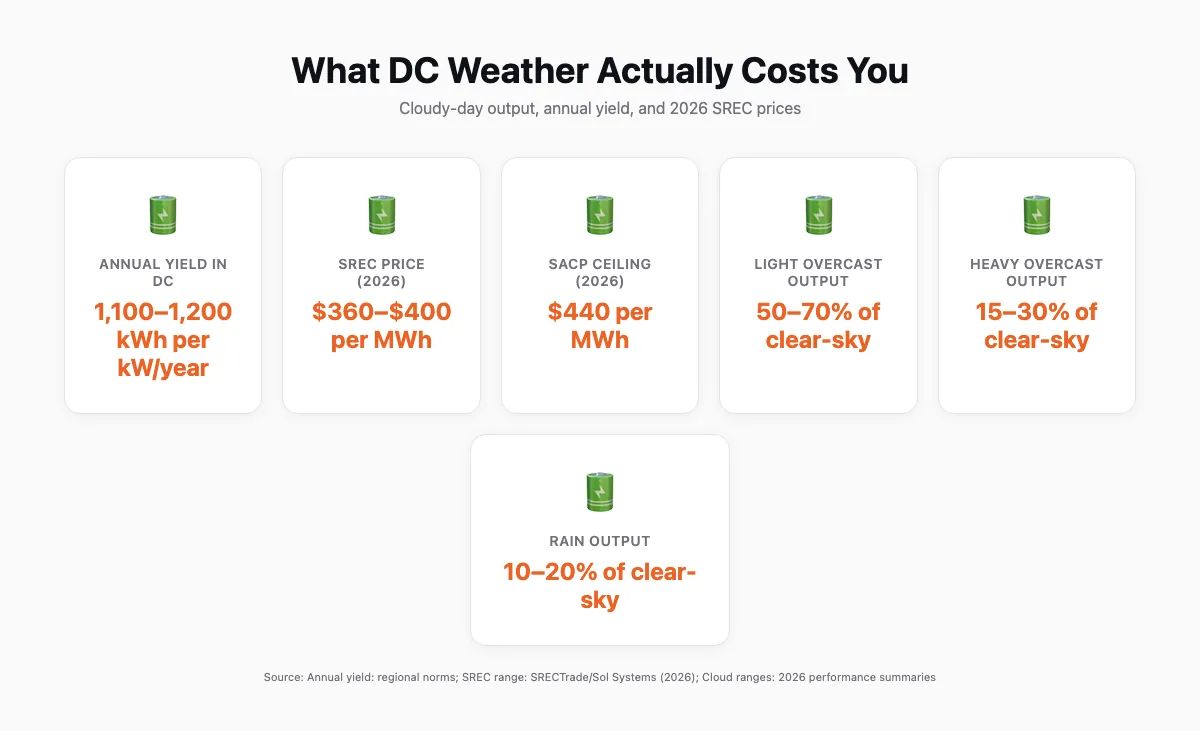
- Light overcast: about 50–70% of clear‑sky output.
- Heavy overcast: about 15–30%.
- Rain: about 10–20%.
These ranges match third‑party measurements of output by weather type published in 2026. The shape varies by cloud thickness and time of day.
What changes your result in DC:
- Roof orientation and tilt: South-facing 25–35° beats east/west or flat, but flat racking set at 5–10° can still hit DC’s 1,100–1,200 kWh/kW/year when shading is minimal.
- Shading: Chimneys, trees, and neighboring rowhouses hurt more than clouds. A single afternoon shadow band can shave 5–15% annually if unmodeled.
- Inverter/optimizer design: Module-level electronics help in partial shading and during passing clouds by keeping each panel at its own maximum power point.
- Soiling: DC pollen and soot streaks can cut 3–10% until a hard rain. That is seasonal and fixable.
Evidence and practical implications
Annual yield in DC: Plan on 1,100–1,200 kWh per kW of DC nameplate per year, assuming a shade-aware design. That is the local production density used by reputable calculators and is consistent with DC’s mid‑Atlantic irradiance. Use this band to sanity‑check any proposal.
SRECs: DC issues one SREC per 1,000 kWh generated and trades them on PJM‑GATS marketplaces. In 2026, DC SRECs are selling around $360–$400 per MWh. The Solar Alternative Compliance Payment cap for 2026 is $440. Those are ceilings and market prices, not guarantees. Tie your pro‑forma to a conservative sale price within that band.
Net metering: Pepco credits exported kWh at the retail rate, which lets cloudy‑day dips average out across the year. Credits roll under DC rules; check your Pepco tariff for details before assuming bill elimination.
Federal-credit treatment is date-sensitive. Confirm the current IRS guidance and District programs before including any credit or exemption in a cash-flow model.
Hypothetical DC example (Ward 5 rowhouse, no mature trees):
- System size: 8.0 kWDC.
- Modeled yield: 1,150 kWh/kW/year.
- Annual production: ~9,200 kWh.
- Cloud impact inside the model: Included. Expect some winter and storm dips; summer partly cloudy days can show brief boosts from edge‑of‑cloud effects.
- SRECs at $380 each: ~9.2 MWh × $380 ≈ $3,496/year.
- Bill offset: Depends on your Pepco rate and usage profile; net metering applies at retail.
If a proposal looks unusually optimistic for a shaded roof, ask for the weather file and shade study behind it. Use a written due-diligence checklist before signing: Decoding Your Solar Quote.
Community signal from DC homeowners
- On r/washingtondc, homeowners often worry that “we get too many gray days for solar to work.” The fix is to look at the annual kWh/kW number and the shade map, not daily swings. When neighbors share monitoring screenshots, the pattern is consistent: low winter output, higher late-spring/summer, and cloudy-day dips that wash out in the annual total.
What to ask your installer for DC weather realism
- Weather dataset: NSRDB for Washington‑Reagan or a documented TMY file for DC.
- Shade model: Site-specific, LIDAR‑based, with monthly solar access values.
- Production baseline: kWh by year with a clear variance trigger for investigation.
- SREC assumption: A conservative sale price within the $360–$400/MWh 2026 range, noted as an assumption, with no guarantee language.
Where the numbers come from
- Annual production estimates should identify the weather file, roof geometry, and shade assumptions used by the model.
- Cloudy‑day output ranges (10–70% of clear‑sky output depending on cloud thickness) are documented in 2026 summaries of measured performance. These are directional guidance ranges, not a guarantee for your roof.
- DC SREC pricing ranges and the 2026 SACP ceiling are published by DC program resources and SREC exchanges. See DOEE ↗, DCSEU ↗, and market trackers like SRECTrade ↗ or Sol Systems ↗ for current figures.
Links to go deeper
- Incentives snapshot after the federal ITC sunset: DC 2026 incentives.
- How SRECs work in DC and what drives their price: DC SREC guide.
- Run a rough production and bill‑offset check with assumptions you can edit: Solar calculator.
FAQs
Are solar panels worth it in DC?
Often, yes, if your roof has good solar access and you value SREC income and net metering credits. The economics in 2026 center on Pepco net metering and DC SRECs near $360–$400 per MWh, with DC’s production density around 1,100–1,200 kWh/kW/year. There is no federal 25D credit in 2026, so make sure your model excludes it and includes realistic shading. Check DOEE’s solar page ↗ and current marketplace information before relying on policy or market assumptions.
How much would solar panels cost for a 2000 sq ft home?
Square footage does not size a solar array. Your annual kWh usage and roof area do. For a sense of scale in DC, recent market pricing runs about $3.00–$3.40 per watt before local incentives. A typical 8 kW system would be roughly $24,000–$27,200 before incentives. Use your 12‑month Pepco kWh to size correctly, then price the system by watts, not by house size. For a tailored estimate, try our solar calculator.
What is the 33% rule for solar panels?
People sometimes use “33% rule” as shorthand for keeping a margin between modeled production and annual usage or for interconnection limits elsewhere. There is no DC‑specific 33% rule that governs residential solar sizing. In DC, you can size to your annual usage for net metering. Confirm your condo or HOA rules separately if applicable.
What is the 20% rule for solar panels?
In solar design, “20% rule” can refer to a variance trigger for investigating performance shortfalls or, in some jurisdictions, to plan review thresholds. In DC contracts, a 15–20% variance is a common threshold to prompt a production review, but it is not a citywide regulation. Make sure your contract defines the trigger and remedy in writing.
Relevant next step
To quantify cloudy-day risk for your roof, gather a Pepco bill, roof details, a DC weather file, and a shade study. Use the Green Zone assessment form to request a roof-specific review: /greenzone.
Citations
- DC solar program info and policy context: DOEE ↗, DCSEU ↗
- Cloudy‑day output ranges: 2026 summaries of measured performance (e.g., The Green Watt, May 2026)
- SREC market context: SRECTrade ↗, Sol Systems ↗
- Quote and verification guidance: Decoding Your Solar Quote
- Incentives after the ITC sunset: DC 2026 incentives


