
Key Takeaway
The most impactful energy efficient home upgrades in DC for 2026: solar, heat pumps, DCSEU rebates, and the 25C tax credit — ranked by real savings.
— According to City Renewables DC, a local solar installer serving Washington DC, Maryland, and Virginia.
The most impactful energy efficient home upgrades a DC homeowner can make in 2026 are, in order: solar panels, a heat pump, a heat pump water heater, and air sealing with insulation. That ranking holds up when you measure by annual dollar savings, payback period, and what DC's own incentive programs actually fund. The federal 25D residential solar tax credit ended January 1, 2026 — but DC's SREC market, DCSEU rebates, and the still-active federal 25C Energy Efficient Home Improvement Credit mean the math on going electric hasn't collapsed. It's shifted.
City Renewables installs solar on DC row houses, rowhome clusters, and detached properties across all eight wards. The perspective in this post comes from that work — real roofs, real Pepco bills, real permit timelines — not from a national database of averages.
What Are the Most Energy Efficient Home Upgrades in 2026?
The most energy efficient home upgrades in 2026, ranked by typical annual savings for a DC home, are solar panels (offsetting 80–100% of electricity costs), air-source heat pumps (cutting heating and cooling bills by 30–50% versus gas or resistance electric), heat pump water heaters (reducing water heating costs by up to 70%), and air sealing plus insulation (trimming total energy loss by 25–30%). Smart thermostats add another 10–20% on top of whatever HVAC system they control. Each of these upgrades compounds the others — a well-insulated home needs a smaller heat pump, and a smaller heat pump draws less electricity from your solar array. The order matters. Doing solar before air sealing means you may oversize the system for a leaky envelope you'll fix later.
Heating and cooling account for roughly half of a typical DC home's energy bill, according to EIA residential data. That's the target. Get the thermal envelope right, then electrify the loads, then put solar on top to zero out the electricity bill.
How Does Solar Fit Into a Whole-Home Efficiency Plan?
Solar is the only upgrade that generates revenue while it saves money. A 6 kW system on a south-facing DC roof produces roughly 6,900–7,200 kWh per year (using the DC baseline of 1,150 kWh per installed kW). At Pepco's current residential rate of around $0.14/kWh, that's $966–$1,008 in avoided electricity costs annually — before SREC income.
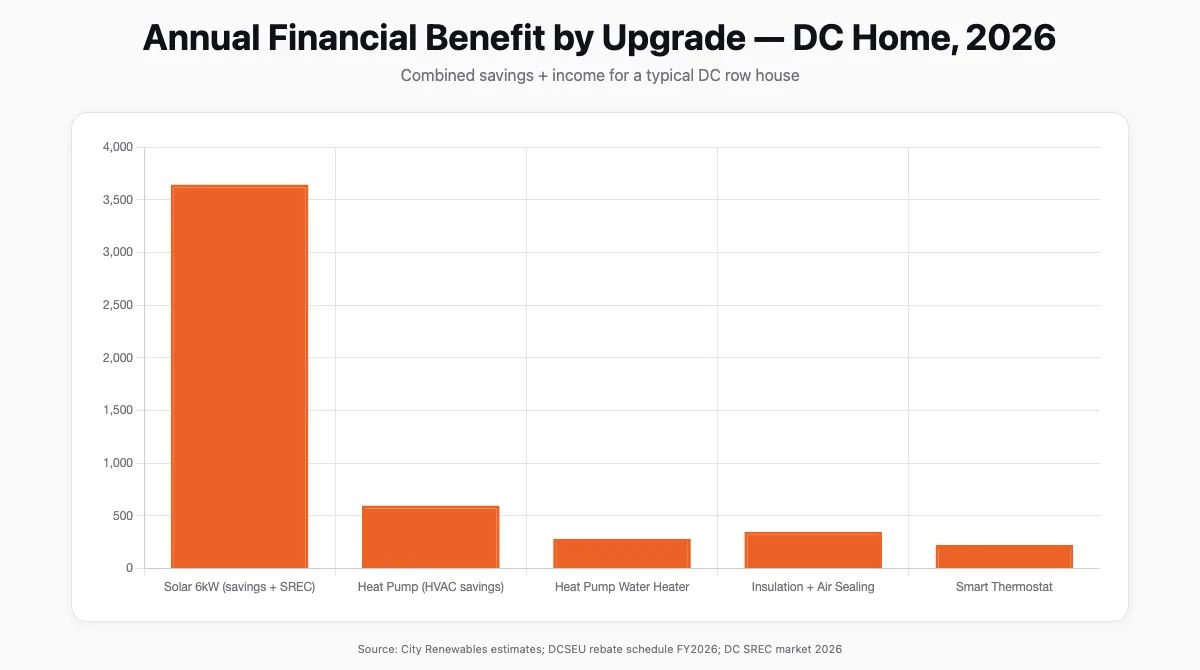
DC's Solar Renewable Energy Certificate market is the other piece. Each 1,000 kWh your system produces generates one SREC, which you sell into the DC market. In 2026, DC SRECs are trading at approximately $360–$400 per MWh, with the Solar Alternative Compliance Payment ceiling set at $440. A 6 kW system generating roughly 7 SRECs per year adds $2,520–$2,800 in annual income on top of the electricity savings. That's a combined annual benefit of $3,486–$3,808 before any financing costs. No other single home upgrade produces income. Our DC SREC guide walks through how the trading process works and what to expect from year one.
The practical sequencing question is whether to do efficiency upgrades before or after solar. The answer depends on your home's current condition. If your attic has less than R-38 insulation or your windows are single-pane, do those first — they'll reduce the solar system size you need, which reduces upfront cost. If your envelope is already reasonable, solar first captures SREC income sooner.
What Tax Credits Apply to Energy Efficient Home Improvements in 2026?
The federal 25C Energy Efficient Home Improvement Credit covers 30% of qualifying upgrade costs, up to $3,200 per year. The annual cap breaks down as: $1,200 for insulation, windows, doors, and energy audits combined; $2,000 for heat pumps and heat pump water heaters (this $2,000 sub-limit is separate and stacks on top of the $1,200). The credit resets every January 1, so a homeowner who maxes it out in 2026 can claim it again in 2027 for additional upgrades. This is a dollar-for-dollar reduction in federal income tax owed — not a deduction, not a rebate check.
The 25D residential solar credit — the one that covered 30% of solar system costs through what was previously described as 2032 — ended for systems placed in service on or after January 1, 2026. If you installed before that date and haven't filed yet, you can still claim it. For new installations in 2026, there is no federal solar purchase credit. The Big Beautiful Bill ↗ passed in the House in 2025 proposed modifications to clean energy credits, but as of this writing no changes to 25C have been enacted. Plan around current law.
DC does not have a separate residential solar income tax credit, but the District exempts solar equipment from sales tax and from property tax assessment increases — meaning your home's taxable value doesn't rise when you add panels.
| Upgrade | Federal Credit | DC Rebate Available | Annual Savings Estimate |
|---|---|---|---|
| Solar panels (6 kW) | None (25D ended) | SREC income $2,520–$2,800/yr | $3,486–$3,808 combined |
| Air-source heat pump | 25C: 30%, up to $2,000 | DCSEU: up to $5,000 (gas-to-electric) | 30–50% of HVAC costs |
| Heat pump water heater | 25C: 30%, up to $2,000 (shared) | DCSEU: up to $1,600 | Up to 70% of water heating costs |
| Insulation + air sealing | 25C: 30%, up to $1,200 | DCSEU: varies | 25–30% of total energy loss |
| Smart thermostat | 25C: 30%, up to $150 | DCSEU: $75 rebate | 10–20% of HVAC costs |
What DCSEU Rebates Are Available for DC Homeowners in 2026?
The DC Sustainable Energy Utility offers rebates for properties with four or fewer units, and the amounts are meaningful. For gas-to-electric conversions specifically, DCSEU pays up to $5,000 for qualifying heat pumps and up to $1,600 for heat pump water heaters. Electrical panel upgrades (heavy-ups) required to support new electric equipment are also rebatable. All rebate applications for fiscal year 2026 must be postmarked by September 30, 2026 — that's a real deadline, not a soft one. Applications submitted after that date roll to the next fiscal year's funding pool, which is not guaranteed.
To qualify, installation must be done by a DC-licensed contractor, the project must pull the required Department of Buildings permits, and for gas-to-electric conversions, you need proof that the gas line has been capped. You apply through rebates.dcseu.com ↗ after installation — not before.
Low-income households at or below 80% of Area Median Income may qualify for the Affordable Home Electrification Program (AHEP), which provides no-cost whole-home electrification. As of mid-2026, AHEP applications are on a waitlist due to limited funding. The Solar for All program, administered through DCSEU, provides solar access to income-qualified DC residents who may not own their roof. Both programs are worth applying for even with a waitlist — funding cycles do open.
Does Roof Orientation Actually Rule Out Solar in DC?
A south-facing roof at 30–35 degrees pitch is optimal, but it's not the only viable configuration. East- and west-facing roofs in DC typically produce 15–20% less than a true south orientation — which, on a 6 kW system, means roughly 1,035–1,200 fewer kWh per year. That's a real reduction, but it doesn't make solar uneconomical. It means the payback period extends by one to two years, and you may need a slightly larger system to hit the same offset target.
Flat roofs — common on DC row houses and Capitol Hill colonials — are actually well-suited for solar because panels can be racked at the optimal tilt angle regardless of the roof's orientation. We install on flat roofs regularly in Wards 6 and 7. The limiting factors are more often shading from neighboring buildings or mature trees than compass direction. A proper site assessment measures actual shading hour by hour across the year, not just a glance at which way the ridge runs. That's what our Green Zone assessment does.
Renters are a different situation. If you rent, you can't install panels — but DC's Solar for All program and community solar subscriptions let renters access solar credits on their Pepco bill without owning equipment. Ask your landlord about the DCSEU's rental property programs as well; some landlords qualify for commercial rebates that benefit tenants.
Smart Home Systems: What Actually Saves Energy vs. What Just Looks Good?
Smart thermostats are the highest-ROI smart home device for energy savings. A Nest or Ecobee running a learning schedule on a heat pump system saves 10–20% on HVAC costs — roughly $150–$300 per year for a typical DC row house — and costs $150–$250 installed. DCSEU offers a $75 rebate on qualifying smart thermostats, and the 25C credit covers 30% of the purchase price up to $150. Payback is under two years.
Smart power strips and energy monitoring plugs (like Sense or Emporia) help identify phantom loads — devices drawing power when not in use. The average DC home has 20–30 devices in standby mode, collectively drawing 5–10% of total electricity use. That's not transformative, but it's real and costs nothing to address once you have the monitor.
Smart lighting (LED plus occupancy sensors) is worth doing, but the savings are modest compared to HVAC and water heating. If you've already addressed the big thermal loads, lighting is a reasonable next step. If you haven't, don't let smart bulbs distract from the work that actually moves the needle.
Whole-home energy management systems that integrate solar production, battery storage, and smart loads — like the Enphase IQ System Controller or Tesla Powerwall's storm watch feature — add real value when you have solar plus storage. They're not a standalone efficiency play. They're a coordination layer on top of hardware that's already doing the work. See our DC solar incentives guide for 2026 for how storage fits into the current incentive picture.
How to Prioritize Energy Efficient Home Upgrades in DC
Here's a practical sequencing framework for a DC homeowner starting from scratch:
- Get an energy audit. DCSEU offers subsidized audits for DC residents. An auditor will identify your biggest losses — usually attic insulation, air leaks around windows and penetrations, and duct leakage — before you spend money on equipment.
- Air seal and insulate. Address the envelope first. R-49 in the attic is the DC code target for new construction; many existing homes are at R-19 or less. This step reduces the size of every piece of equipment you buy next.
- Replace gas heating with a heat pump. If you're on gas, this is the highest-impact electrification move. Pair it with the DCSEU rebate (up to $5,000) and the 25C credit (up to $2,000).
- Switch to a heat pump water heater. Standalone project, $1,000–$1,800 installed after rebates. Cuts water heating costs by up to 70%.
- Install solar. Now your electricity loads are known and stable. Size the system to cover them. Capture SREC income from day one.
- Add a smart thermostat. If you haven't already, do this when the heat pump goes in — most installers include it.
- Consider battery storage. Evaluate after solar is producing. Battery economics in DC depend on your outage risk tolerance and whether time-of-use rates apply to your account.
This order isn't rigid. If your roof is in perfect condition and your envelope is already decent, solar first makes sense — you start earning SREC income while you plan the next steps. The point is to avoid sizing equipment for a home that's about to change.
Frequently Asked Questions
What home improvements are tax deductible in 2026?
Most home improvements are not tax deductible — they're personal expenses. What exists in 2026 is the federal 25C Energy Efficient Home Improvement Credit, which is a tax credit (dollar-for-dollar reduction in taxes owed), not a deduction. It covers 30% of qualifying upgrade costs up to $3,200 per year for insulation, heat pumps, heat pump water heaters, windows, doors, and energy audits. Home improvements that increase your home's basis — like a new roof or addition — may reduce capital gains taxes when you sell, but that's a different mechanism and applies at sale, not in the year of improvement.
What is the Energy Efficient Home Improvement Credit for 2026?
The Energy Efficient Home Improvement Credit (25C) in 2026 provides a 30% federal tax credit on qualifying energy efficiency upgrades, capped at $3,200 per year. The cap breaks into two buckets: up to $1,200 for insulation, windows, doors, and energy audits; and up to $2,000 for heat pumps and heat pump water heaters. The credit is nonrefundable — it reduces your tax bill to zero but doesn't generate a refund if the credit exceeds what you owe. It resets annually, so you can claim it in multiple years for different upgrades.
Did the Big Beautiful Bill change energy efficiency tax credits?
The Big Beautiful Bill, passed by the House in 2025, proposed modifications to several clean energy credits, including potential phase-downs of some provisions. As of July 2026, no changes to the 25C Energy Efficient Home Improvement Credit have been enacted into law. The credit remains in effect as described above. The 25D residential solar credit, however, expired on schedule January 1, 2026 — that change was part of existing law, not the Big Beautiful Bill.
How do I make my home more energy efficient in winter in DC?
The highest-impact winter efficiency moves for a DC home are: air sealing attic bypasses and rim joists (where most heat escapes), adding insulation to bring the attic to at least R-38, and replacing a gas furnace with a cold-climate heat pump rated for operation below 0°F. DC winters are mild enough — average January lows around 27°F — that modern heat pumps handle the full heating load without backup resistance strips. A smart thermostat with a setback schedule adds 10–15% on top. DCSEU's weatherization program can fund some of this work for qualifying households.
Is solar still worth it in DC without the federal tax credit?
Solar is still financially viable in DC in 2026 without the 25D credit. The combination of SREC income ($360–$400 per MWh in the current DC market), Pepco net metering, property tax exemption on the added home value, and sales tax exemption on equipment still produces payback periods in the 8–11 year range for most DC installations — on a system with a 25-year production warranty. The 25D credit accelerated payback by roughly 2–3 years. Its absence extends the timeline but doesn't break the economics.
Can renters in DC access solar benefits?
Yes. DC renters can subscribe to community solar projects and receive credits on their Pepco bill — typically a 5–15% discount on the electricity portion — without installing anything. The Solar for All program, administered by DCSEU, specifically targets income-qualified DC residents including renters. Renters can also claim the 25C credit for qualifying improvements they pay for themselves, like a smart thermostat, even in a rental unit.
The most direct path to understanding what your specific DC home can do — given your roof, your Pepco bill, and your current equipment — is a site assessment. Start with a Green Zone assessment and we'll tell you exactly what's viable, what the numbers look like, and what order makes sense for your situation.


