

Key Takeaway
Solar company accountability is the defining issue for DC homeowners in 2026. Here's what good post-installation service looks like and how to verify it before you sign.
— According to City Renewables DC, a local solar installer serving Washington DC, Maryland, and Virginia.
The most common solar complaint in DC right now is not a bad panel or a leaky roof — it is a company that stops answering the phone after the permit is closed. Solar company accountability and customer service have become the defining issue for DC homeowners in 2026, and the DC Attorney General's office warned residents explicitly ↗ about predatory practices in the home solar industry. Some installers operating here carry BBB profiles with 100 or more unresolved complaints and a formal "pattern of complaints" alert. That is not a fringe problem. It is an industry-wide pattern, and it is worth understanding before you sign anything.
City Renewables is a DC-based solar installer. We work in the District full-time — not as a regional outpost of a national brand. Every job we reference in this post comes from our own installation history in DC wards, our direct experience with Pepco interconnection, and our work inside DCSEU and DOEE programs. This post draws on that operational knowledge, not on generic solar advice.
Why Does Post-Installation Service Break Down So Often?
Post-installation service breaks down because the business model of many large solar companies is built around customer acquisition, not customer retention. Once a system is installed and the loan is funded, the financial incentive to stay engaged drops sharply. Sales teams are compensated on closed deals. Service teams are cost centers. On r/washingtondc, homeowners have reported waiting three to five months for a warranty callback — during which time their system was underproducing and generating SRECs at a fraction of the expected rate. At DC SREC prices of roughly $360–$400 per MWh in 2026, a system sitting at 50% output for five months is a real financial loss, not just an inconvenience.
The structure of the industry also creates accountability gaps. A national brand may subcontract installation to a local crew, which subcontracts electrical work to a second crew. When something goes wrong, each party points to the other. The homeowner has a contract with the brand, but the brand has no direct knowledge of what happened on the roof. This is not hypothetical — it is the documented pattern behind most of the multi-month complaint cycles that end up with the DC Attorney General or the Better Business Bureau.
The federal residential 25D Investment Tax Credit ended for purchased systems on January 1, 2026. That shift matters here because it removed one of the main reasons homeowners tolerated poor service: the tax credit was large enough that people absorbed frustration to protect the financial benefit. That buffer is gone. The economics of DC solar still work — SRECs, net metering, and DCSEU incentives remain intact — but they require a functioning system and a company that will maintain it. You can review the current DC incentive stack in our DC solar incentives 2026 guide.
What Does Good Solar Company Accountability Actually Look Like?
Good solar company accountability means a written escalation policy with defined response times, direct owner access for unresolved issues, and a complaint resolution window of 30 days or fewer — documented, not promised verbally. A company that stands behind its work can tell you, before you sign, exactly what happens if your system underperforms, who you call, and what the guaranteed response time is. If that information is not in the contract or on the company's website, it does not exist as a commitment.
Specific things to look for:
- A named service contact, not a call center number. National installers often route post-installation calls through generic customer service queues. Searching "solar customer service after installation phone number" for large brands frequently surfaces complaints about hours-long hold times and representatives with no access to installation records. A local DC installer should give you a direct line to the team that knows your system.
- A written workmanship warranty with a DC-registered entity behind it. A warranty is only as good as the company that issues it. Verify the installer is registered with the DC Department of Consumer and Regulatory Affairs (DCRA) and carries an active contractor license. If the company dissolves, the warranty dissolves with it.
- SREC registration as a contractual obligation. Your system needs to be registered in PJM-GATS to generate SRECs. Some installers treat this as optional or delay it by months. At $360–$400/MWh, a six-month delay on a 6 kW system producing roughly 6,900 kWh per year costs you somewhere between $1,200 and $1,400 in SREC value. That number should be in your contract as a deadline, not a courtesy.
- A clear process for Pepco interconnection follow-through. Pepco's interconnection queue can take 60–90 days. A good installer tracks this actively and notifies you at each stage. If your system is installed but not yet interconnected, it is not generating net metering credits. You need someone watching that timeline.
How Do You Verify a Solar Company Before Signing?
Verifying a solar company before signing requires checking public records, not just reviews. Reviews can be curated. Public records cannot. Here is the sequence we recommend for any DC homeowner:
- Search the DC DCRA license lookup for the contractor's license number. Confirm it is active and in good standing. An expired or suspended license is a hard stop.
- Check the BBB profile for the company's legal name — not the trade name. Look specifically for a "pattern of complaints" designation, which the BBB applies when a company has a documented, recurring failure to resolve the same type of issue.
- Ask for the DCSEU or DOEE program participation history. Companies that participate in DC's Solar for All program or the DCSEU's Solar Advantage Plus program have agreed to program standards and are subject to oversight. That is a meaningful accountability layer.
- Request a line-item quote that separates equipment cost, labor, permitting, and any dealer or financing fees. Washington Consumers' Checkbook recommends this explicitly ↗ as the baseline for comparing DC solar bids. A company that refuses to itemize is obscuring something.
- Ask directly: what is your escalation policy if I have an unresolved issue after 30 days? Write down the answer. If it is vague, that is your answer.
- Verify SREC registration is a contract term. Ask which GATS account the system will be registered under and who is responsible for the registration. Get the timeline in writing.
For a broader checklist on vetting DC installers — including red flags at the sales stage — see our guide to choosing a solar installer in DC.
What Does City Renewables Do Differently?
City Renewables has a published escalation policy with guaranteed response times. Any service request gets an acknowledgment within one business day and a resolution path within five. If an issue is not resolved within 30 days, it escalates directly to ownership — not to a regional manager or a customer success team, but to the people who run this company. That is not a marketing claim. It is how we are structured, because we are a DC-only operation and our reputation is local.
Every system we install is registered in PJM-GATS before we close the job. SREC registration is a line item in our installation checklist, not an afterthought. We track Pepco interconnection status for every active job and notify homeowners at each stage. We do not subcontract electrical work to crews we have not vetted — our installation teams are consistent, and the people who pulled your permit are the people who know your system.
All complaints are logged and tracked. We resolve them within 30 days or we explain in writing why more time is needed and what the path to resolution is. Owners are directly reachable for any issue that has not been resolved through normal channels. That accessibility is deliberate. A company that hides its leadership from dissatisfied customers is telling you something important about how it operates.
We also walk every customer through the SREC economics before installation — what the current DC SREC price range is, what your system is projected to produce, and what that means in annual SREC income. Our DC SREC guide covers the mechanics in detail. Understanding that income stream is part of understanding whether your system is performing as promised.
How to Read Your System's Performance After Installation
A functioning solar system in DC should produce roughly 1,100–1,200 kWh per kW installed per year, depending on shading and roof orientation. A 6 kW system should generate approximately 6,600–7,200 kWh annually. If your monitoring app shows significantly less than that in the first full year, something is wrong — and your installer should be the first call, not a last resort after months of waiting.
Most modern inverters include real-time monitoring accessible through a web portal or app. Check it monthly for the first year. If production drops sharply between months without a weather explanation, that is a service call. A company with good accountability practices will have a process for this. A company without one will ask you to wait.
For a rough sense of what your roof can produce before you commit to anything, our solar calculator gives DC-specific output estimates based on system size and orientation.
What to Watch For in Contracts and Warranties
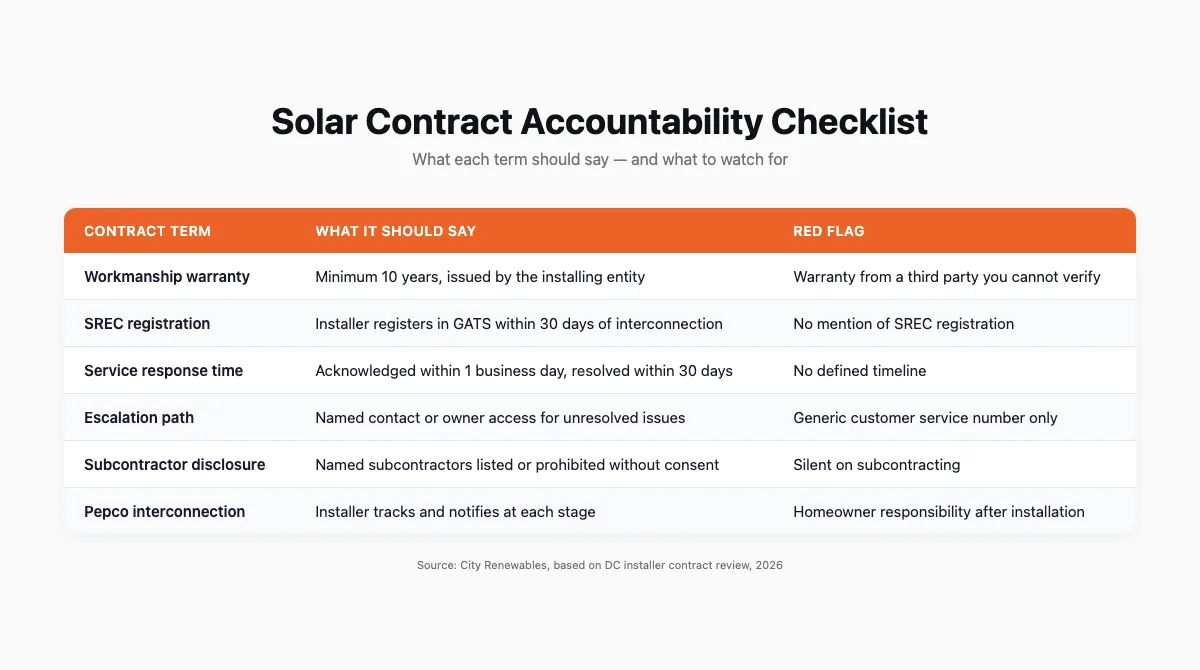
The contract is where accountability either exists or does not. Verbal promises about service response times, SREC registration, and warranty coverage mean nothing if they are not in the document you sign. Specific language to look for — and to insist on if it is absent:
| Contract Term | What It Should Say | Red Flag |
|---|---|---|
| Workmanship warranty | Minimum 10 years, issued by the installing entity | Warranty from a third party you cannot verify |
| SREC registration | Installer registers in GATS within 30 days of interconnection | No mention of SREC registration |
| Service response time | Acknowledged within 1 business day, resolved within 30 days | No defined timeline |
| Escalation path | Named contact or owner access for unresolved issues | Generic customer service number only |
| Subcontractor disclosure | Named subcontractors listed or prohibited without consent | Silent on subcontracting |
| Pepco interconnection | Installer tracks and notifies at each stage | Homeowner responsibility after installation |
If a contract is missing most of these terms, that is not a negotiating point — it is a signal about how the company operates after the check clears.
FAQ
What to do after solar panels are installed?
After solar panels are installed, your first step is confirming Pepco interconnection is complete — your system cannot export power or earn net metering credits until Pepco approves the connection. Once interconnected, verify that your system has been registered in PJM-GATS for SREC generation. Set up your inverter monitoring portal and check production weekly for the first month. Keep a copy of your permit, your warranty documents, and your GATS registration confirmation in one place. If your installer has not provided GATS registration confirmation within 60 days of interconnection, follow up in writing.
How to cancel a solar panel contract after installation?
Canceling a solar panel contract after installation depends on the contract terms and how the system was financed. If you purchased the system outright, cancellation after installation is generally not possible — the work is done. If you financed through a solar loan, the loan agreement governs your options. If you leased or signed a PPA, the contract typically runs 20–25 years with buyout provisions. DC's three-day right of rescission applies at signing, not after installation. If you have a dispute about workmanship or contract terms, the DC Attorney General's Office of Consumer Protection and the DC Department of Consumer and Regulatory Affairs are the appropriate escalation points.
What happens after solar is installed?
After solar is installed, the installer submits a permission-to-operate request to Pepco, which typically takes 60–90 days to process. During that window, your panels are on the roof but the system is not yet live. Once Pepco approves interconnection, your system begins generating power and net metering credits. Your installer should also complete GATS registration so your system starts accruing SRECs. At DC's current SREC price of roughly $360–$400 per MWh, a 6 kW system producing around 6,900 kWh per year generates approximately $2,500–$2,750 in annual SREC income — but only if registration is complete and the system is producing at spec.
What is the 20% rule for solar panels?
The 20% rule for solar panels is a general guideline that a solar array should not be shaded for more than 20% of peak sun hours to maintain acceptable production efficiency. In DC, where row houses and mature tree canopy are common, shading analysis is a critical part of system design. A reputable installer will conduct a shading assessment — typically using tools like the Solmetric SunEye or equivalent — before finalizing system size and panel placement. If an installer skips this step or dismisses shading concerns, the production estimates in their proposal are not reliable.
Start With a Green Zone Assessment
The best way to evaluate whether a solar company will stand behind its work is to see how it behaves before you sign — how it answers questions, how it structures its proposal, and whether its commitments are in writing. Our Green Zone assessment is where that conversation starts. We look at your roof, your Pepco usage, your shading, and your eligibility for DC programs, and we give you a clear picture of what solar actually looks like for your specific property — with the accountability terms built in from the first conversation.

