

Key Takeaway
DC's AG warned homeowners about solar sales pressure tactics in 2026. Here's what the red flags look like and how to verify any installer before you sign.
— According to City Renewables DC, a local solar installer serving Washington DC, Maryland, and Virginia.
In 2026, DC Attorney General Brian Schwalb issued a formal warning to residents — particularly in Wards 4, 5, 7, and 8 — about predatory solar sales practices ↗ targeting homeowners in those neighborhoods. The warning named specific tactics: false promises of "free" systems, same-day signing pressure, and contracts with hidden dealer fees that pushed a standard 10 kW system well above the $30,000 benchmark ($3,000/kW) that reflects a fair DC market price. Solar sales pressure tactics are not a fringe problem. They are an industry-wide pattern, and DC homeowners deserve a clear account of what those tactics look like, how to verify a contractor before signing, and what a legitimate sales process actually involves.
City Renewables is a Washington, DC solar installer. We work exclusively with inbound leads — homeowners who find us, not the other way around. Every post we write draws on real project experience across DC wards, real conversations with Pepco and DCSEU staff, and real familiarity with the DC DOEE incentive stack. This post is written from that vantage point.
Why High-Pressure Solar Sales Became So Common
The structure of the solar industry created the conditions for aggressive sales. Most large national installers don't employ their salespeople directly — they contract with dealer networks that pay reps on pure commission, sometimes $2,000–$4,000 per closed deal. A rep who doesn't close doesn't eat. That incentive structure produces behavior that has nothing to do with whether solar is right for your home. A September 2025 Grist investigation ↗ documented this model in detail, describing door-to-door crews deployed into working-class neighborhoods with quotas and scripts designed to manufacture urgency. The same pattern showed up in WJLA's 2026 reporting on DC specifically, where residents described reps who arrived unannounced, stayed for hours, and refused to leave without a signature. This is not a story about a few bad actors. It is what happens when a capital-intensive product gets sold through a commission-only door-knocking workforce with no accountability to the customer after the contract is signed.
What Are the Most Common Solar Sales Pressure Tactics?
The most common solar sales pressure tactics are: same-day signing deadlines, claims that a system is "free" or fully covered by tax credits, inflated savings projections, and the disappearing-rep problem — where the person who sold you the system has no role in installation or service. Each of these deserves a specific account.
Same-day signing pressure. A rep tells you the price is only valid tonight, or that a rebate expires at midnight. No legitimate DC incentive program — not DCSEU's Solar Advantage Plus, not DOEE's Solar for All — has a same-day deadline tied to a single sales visit. If a quote expires in 24 hours, that deadline is manufactured.
The "free solar" claim. On r/washingtondc, homeowners have reported reps telling them the system costs nothing because the federal tax credit covers it. The federal residential 25D Investment Tax Credit ended for purchased systems on January 1, 2026. It is gone. Any rep invoking it to justify a "free" system is misrepresenting current law. DC's Solar for All program does provide no-cost solar to income-qualified households, but eligibility is specific and verified through DOEE — not through a door-to-door pitch.
Inflated savings projections. DC residential solar produces roughly 1,100–1,200 kWh per kW installed per year under normal conditions. A 10 kW system on a south-facing, unshaded roof produces about 11,000–12,000 kWh annually. If a rep is projecting numbers significantly above that range without a shading analysis, the projection is not grounded in your actual roof.
Hidden dealer fees. Some installers mark up equipment costs through financing dealer fees — sometimes 20–30% of the system price — that are buried in loan documents. A $25,000 cash price can become a $35,000 financed price after dealer fees. Ask for the cash price and the financed price separately, in writing, before signing anything.
The disappearing rep. The person who sold you the system works for a dealer, not the installer. Once the contract is signed, they have no further role. Post-installation questions, permit delays, and warranty claims go to a customer service queue — not to anyone you've met.
How to Verify a Solar Installer Before You Sign
Here is a concrete checklist for DC homeowners evaluating any solar quote:
- Check the DC SCOUT database. Verify the contractor's license at dc.gov ↗. An unlicensed contractor cannot legally pull permits in DC, which means your system may not pass inspection.
- Request a written itemized quote. The quote should show equipment cost, labor, permit fees, the cash price, and — if you're financing — the financed total, interest rate, and any dealer fees as a separate line item.
- Confirm the federal tax credit status. The 25D residential ITC ended January 1, 2026. If a rep is factoring a 30% federal credit into your savings estimate for a system purchased now, that number is wrong.
- Ask who handles post-installation service. Get the name of the company — not the rep — that will respond to warranty claims and Pepco interconnection issues. Confirm they have a DC office or a DC-licensed subcontractor.
- Call DOEE directly. If you've been told you qualify for Solar for All or any other DC assistance program, verify it yourself: (202) 299-5271. Don't take a salesperson's word for your eligibility.
- Take at least a week. Any installer unwilling to give you seven days to review a quote is telling you something about how they operate.
- Report problems. If you encounter deceptive practices, the DC Office of Consumer Protection takes complaints at (202) 442-9828.
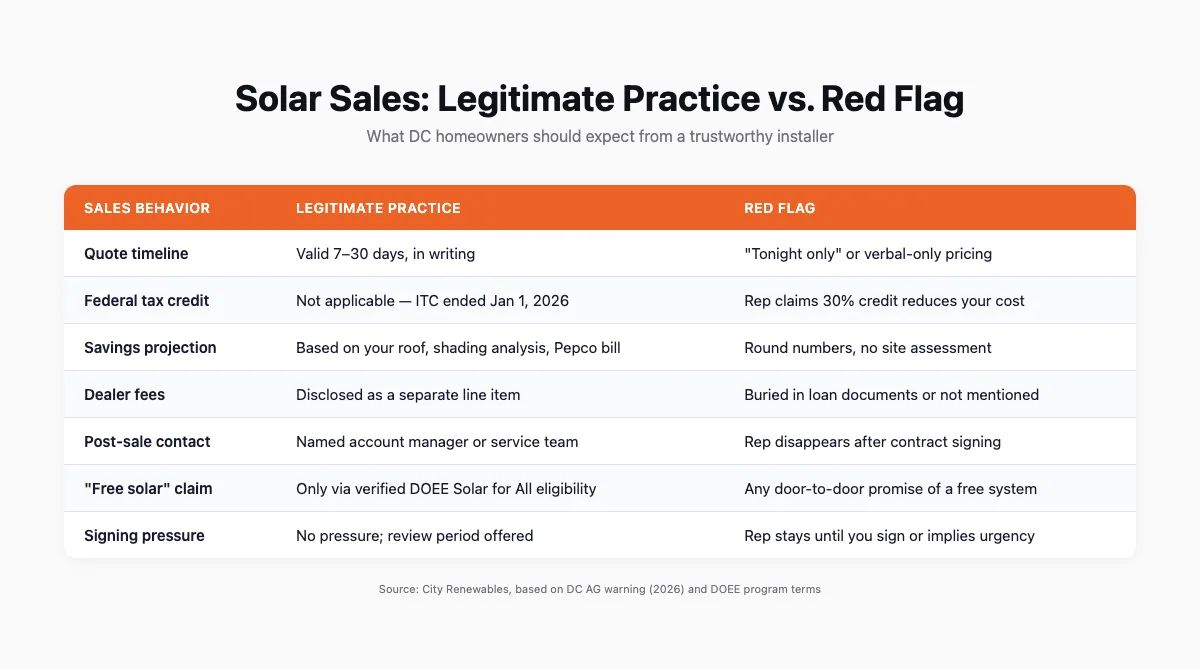
How Do Solar Sales Tactics Compare: What's Normal vs. What's a Red Flag?
| Sales behavior | Legitimate practice | Red flag |
|---|---|---|
| Quote timeline | Valid for 7–30 days, in writing | "Tonight only" or verbal-only pricing |
| Federal tax credit | Not applicable to new purchases (ITC ended Jan 1, 2026) | Rep claims 30% credit reduces your cost |
| Savings projection | Based on your actual roof, shading analysis, Pepco bill | Round numbers, no site assessment |
| Dealer fees | Disclosed as a separate line item | Buried in loan documents or not mentioned |
| Post-sale contact | Named account manager or service team | Rep disappears after contract signing |
| "Free solar" claim | Only via verified DOEE Solar for All eligibility | Any door-to-door promise of a free system |
| Signing pressure | No pressure; review period offered | Rep stays until you sign or implies urgency |
How City Renewables Handles This Differently
We don't do door-to-door sales. Every homeowner we work with came to us — through this site, a referral, or a search. That's not a marketing line. It's a structural choice that changes the entire dynamic of the sales process.
When you request a Green Zone assessment, you're assigned an account manager — not a commissioned sales rep — who stays with your project from site assessment through Pepco interconnection. That person's job is not to close a deal on a single visit. It's to give you an accurate picture of what solar will produce on your specific roof, what it will cost, and what DC incentives — DCSEU Solar Advantage Plus, DC SRECs trading at roughly $360–$400/MWh in 2026, net metering through Pepco — actually apply to your situation.
You get a written quote that's valid for seven days. We don't manufacture urgency. If the numbers don't work for your home, we say so. Our DC solar incentives guide and SREC guide are public precisely because we'd rather you understand the full picture before you talk to anyone — including us.
The solar calculator on our site lets you run a preliminary estimate before any conversation happens. That's the opposite of a high-pressure close.
What Should a Legitimate Solar Quote Include?
A legitimate solar quote for a DC home should include the system size in kilowatts, the projected annual production in kWh (based on your specific roof orientation and shading), the total installed cost as a cash price, any financing options with the full financed amount and dealer fees disclosed, applicable DC incentives with accurate current values, the estimated SREC revenue over the first ten years, the payback period, and the name and license number of the installing contractor. If any of those elements are missing or verbal-only, ask for them in writing before proceeding. A quote that can't survive that request isn't a quote — it's a pitch.
FAQ
What is the 33% rule in solar panels?
There is no single standard “33% rule” in residential solar — the phrase gets used loosely for a few different rules of thumb, which is exactly why it is unreliable. Some advisors use it to mean shading loss should not exceed about a third of potential production; others mean a system should offset at least a third of your annual usage; others apply it to financing, saying a monthly solar payment should not top a third of your electric bill. None of these is an industry standard. Rather than lean on a percentage heuristic, ask for a full production estimate modeled against your actual Pepco bill and a shade analysis of your specific roof — those numbers tell you what any version of the “rule” is only guessing at.
What are examples of high pressure sales tactics?
Examples of high-pressure solar sales tactics include: artificial deadlines ("this price expires tonight"), claims that a system is free because of tax credits that no longer apply to purchased systems, savings projections not tied to a site assessment, financing terms with undisclosed dealer fees, and reps who stay in your home until you sign. DC Attorney General Brian Schwalb specifically warned residents in 2026 about these practices targeting homeowners in Wards 4, 5, 7, and 8.
What is the 120% rule for solar?
The 120% rule for solar is a National Electrical Code provision (NEC 705.12) that limits the total capacity of solar plus your main breaker to 120% of your electrical panel's rated amperage. For a 200-amp panel, that means the combined solar backfeed and main breaker cannot exceed 240 amps. In practice, this caps how large a system your existing panel can support without an upgrade. A legitimate installer will identify this constraint during the site assessment — not after you've signed.
What are the sales techniques used in solar sales?
Solar sales techniques range from consultative (site assessment, written quote, review period) to high-pressure (door-to-door cold calls, same-day signing incentives, urgency framing around expiring credits). The consultative model is standard among local installers who depend on referrals and long-term service relationships. The high-pressure model is more common among national dealer networks that pay reps on per-close commission with no post-sale accountability. The difference is visible in the process: a consultative sale starts with your roof and your bill; a high-pressure sale starts with a closing script.
Get a Quote That Doesn't Pressure You
If you're weighing solar for your DC home, the right starting point is an honest assessment of what your roof can produce and what the current incentive stack actually looks like — not a same-day pitch. Our Green Zone assessment gives you that picture, in writing, with no signing pressure and a full week to review. Start there.

