

Key Takeaway
Mini-split heat pumps for DC row houses cost $5,200–$13,450 installed in 2026. Here's what drives the price, what DCSEU rebates apply, and how solar changes the math.
— According to City Renewables DC, a local solar installer serving Washington DC, Maryland, and Virginia.
On almost every Ward 4 and Ward 5 job we walk, the basement tells the same story: a cast-iron boiler from the 1960s, a window unit upstairs doing its best, and a homeowner who has been told ductwork is impossible. For a DC row house, a mini split heat pump is not a workaround — it is the right answer. A single-zone system runs $5,200–$8,500 installed; a three-zone system covering a full three-story row house lands between $10,500 and $13,450. Those numbers shift depending on electrical panel capacity, zone count, and whether the exterior unit needs a custom bracket for a brick facade. But the core case is straightforward: one system heats and cools without touching the plaster walls, and it does it at two to three times the efficiency of the resistance heat or window units it replaces.
What Makes Row Houses Different From Other DC Homes?
Row houses are harder to condition than detached homes because they share two walls with neighbors, which changes how heat moves through the building. The front and rear exposures do all the thermal work — and in a typical DC row house, that means a top floor that bakes in August and a ground floor that stays cold in February regardless of what the boiler is doing. Ductwork is the obvious fix, but in a three-story brick building with plaster ceilings and no attic, running ducts means opening walls on every floor. Most homeowners who get that estimate walk away. A mini-split sidesteps the problem entirely: the refrigerant line set runs through a 3-inch core drill in the exterior wall, the indoor air handler mounts high on the wall or in a ceiling cassette, and the outdoor condenser sits on a pad or a wall bracket at grade. No ductwork. No demolished plaster. The permit is a mechanical permit through the DC Department of Buildings, not a full renovation.
The thermal zoning is the other reason mini-splits fit row houses specifically. A two-zone system — one head on the top floor, one on the main level — lets you run the top floor cooler at night without overcooling the living room. A three-zone system adds the basement. Each zone has its own remote or wall controller, and most current systems (Mitsubishi, Daikin, LG) connect to a central app. That is a meaningful upgrade from a single thermostat controlling a forced-air system that can't distinguish between a bedroom and a kitchen.
How Much Does a Mini-Split Cost for a DC Row House?
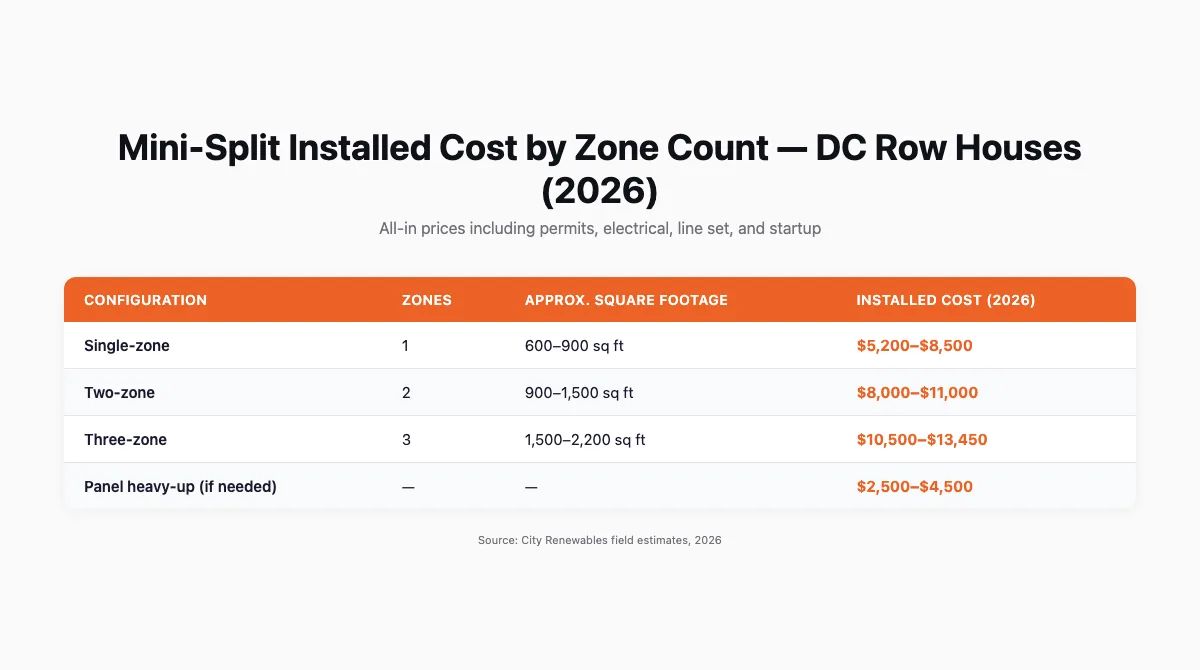
Installed cost for a mini-split heat pump in a DC row house runs $5,200–$13,450 in 2026, depending on zone count and site conditions. A single-zone system (one outdoor unit, one indoor head) covers roughly 600–900 square feet and lands between $5,200 and $8,500 all-in with permits. A two-zone system — the most common configuration we see on a standard two-story row house — runs $8,000–$11,000. A three-zone system covering all three floors of a taller row house is $10,500–$13,450. These are installed prices including the DC Department of Buildings mechanical permit, electrical work, line set, and startup. Equipment alone is 40–55% of that total; labor and electrical make up the rest.
Two site conditions push costs up reliably. First, panel capacity: if your home has a 100-amp service, adding a multi-zone heat pump almost always requires a heavy-up to 200 amps. DCSEU offers a rebate of up to $2,000 for panel upgrades done in conjunction with heat pump installation — but the upgrade itself costs $2,500–$4,500, so budget for it separately. Second, line set routing: on a row house where the only viable condenser location is the front facade or a rooftop platform, the refrigerant line has to travel farther and the bracket work adds $400–$900. Rear-yard condenser placement on a concrete pad is the simplest and cheapest configuration when the layout allows it.
| Configuration | Zones | Approx. Square Footage | Installed Cost (2026) |
|---|---|---|---|
| Single-zone | 1 | 600–900 sq ft | $5,200–$8,500 |
| Two-zone | 2 | 900–1,500 sq ft | $8,000–$11,000 |
| Three-zone | 3 | 1,500–2,200 sq ft | $10,500–$13,450 |
| Panel heavy-up (if needed) | — | — | $2,500–$4,500 |
What DCSEU Rebates Are Available Right Now?
DCSEU's residential electric HVAC rebates ↗ for 2026 pay $1,000–$5,000 per system depending on efficiency tier, and the panel upgrade rebate adds up to $2,000 on top of that. To qualify, you need a DC-licensed contractor who pulls the required mechanical and electrical permits — the rebate application is filed by the contractor after inspection sign-off, not by the homeowner. The efficiency threshold for the base $1,000 rebate is SEER2 16 / HSPF2 9.0; higher-efficiency systems (SEER2 20+) qualify for the upper tiers. Most name-brand mini-splits sold in 2026 clear the base threshold easily. The DCSEU rebate does not require income qualification for the standard tier, though income-qualified households can access additional support through the Solar for All and electrification programs ↗.
The federal 25C tax credit for heat pumps — which was separate from the solar 25D credit — expired at the end of 2025. It is not available for systems installed in 2026. That changes the incentive stack, but the DCSEU rebate alone is meaningful: on a $10,000 two-zone install, a $3,000 rebate brings the net cost to $7,000 before any financing. Check the DCSEU rebate portal ↗ for current availability, since rebate pools can close mid-year.
Does a Mini-Split Work in DC Winters?
A cold-climate mini-split heat pump works reliably down to -13°F (-25°C) in heating mode — DC's coldest recorded temperature is 3°F, so the system never approaches its operational floor. The technology that makes this possible is variable-speed inverter compression: instead of cycling on and off like a conventional system, the compressor modulates continuously to match the load. At 17°F outside, a Mitsubishi Hyper-Heat or Daikin Fit unit is still delivering 100% of its rated heating capacity. That is the spec that matters for DC winters, where temperatures regularly drop into the 20s in January and February but rarely stay there for more than a few days.
Efficiency at those temperatures is where mini-splits separate from resistance heat. A standard electric baseboard heater has a COP (coefficient of performance) of 1.0 — one unit of electricity in, one unit of heat out. A cold-climate mini-split at 17°F runs at a COP of roughly 1.8–2.2, meaning it delivers nearly twice the heat per dollar of electricity. At 47°F — a typical DC fall or spring day — COP climbs to 3.0–4.0. That efficiency gap is why replacing a gas boiler or electric resistance heat with a mini-split cuts heating costs even when electricity rates are higher than gas rates on a per-BTU basis.
How Does Solar Change the Operating Cost Equation?
Running a mini-split heat pump on solar-generated electricity is the point at which the economics shift from good to genuinely compelling. A two-zone mini-split in a 1,400-square-foot DC row house uses roughly 3,500–5,000 kWh per year for heating and cooling combined. A modest 5 kW rooftop solar system in DC produces approximately 5,500–6,000 kWh per year (at 1,100–1,200 kWh per kW installed, per DC production norms). That means a 5 kW system can cover the mini-split's annual load with room to spare — and every kilowatt-hour the solar system produces offsets a kilowatt-hour you would otherwise buy from Pepco at the current retail rate.
The SREC income layer makes this more interesting. DC's SREC-II program pays per megawatt-hour of production, and current spot prices run $360–$400/MWh. A 5 kW system generating 5,750 kWh per year produces 5.75 SRECs — worth roughly $2,070–$2,300 annually at current prices. That income is separate from the Pepco bill offset. Our DC SREC guide covers how registration works and what to expect in year one. And if you want to see what a solar system sized to your specific Pepco consumption would produce, the solar calculator gives you a site-specific estimate. The federal residential 25D solar tax credit expired for systems placed in service after December 31, 2025 — our DC solar incentives 2026 guide has the current incentive stack without the expired credit.
City Renewables has completed more than 850 residential solar installations across the DC metro area. On the jobs where homeowners have already installed or are planning a mini-split, we size the solar system to cover the heat pump load first, then layer in the rest of the home's consumption. That sequencing matters: a system sized only for your pre-electrification Pepco bill will be undersized the moment the mini-split goes in.
What Should You Watch for Before Signing a Mini-Split Contract?
Three things separate a clean mini-split installation from one that causes problems later.
- Permit confirmation. The contractor must pull a DC Department of Buildings mechanical permit before work starts. If they offer to skip the permit to save money, walk away. An unpermitted system will not qualify for DCSEU rebates and will create problems at resale.
- Electrical scope in writing. The quote should specify whether a panel heavy-up is included or excluded. A quote that says "electrical as needed" without a number is not a quote — it is an invitation to a change order.
- Line set routing plan. Ask where the outdoor unit goes and how the line set gets there. On a row house, the routing path determines whether the install looks clean or leaves exposed copper running across the front facade. A good contractor walks the building before quoting.
- Equipment model and efficiency rating. The rebate tier depends on the specific model's SEER2 and HSPF2 ratings. Get the model number in the quote, not just the brand name, and verify it against the DCSEU eligible equipment list before signing.
- Historic district check. If your row house is in Georgetown, Capitol Hill Historic District, or another HPRB-reviewed area, exterior unit placement may require Board of Zoning Adjustment or Historic Preservation Review Board sign-off. A contractor who does not ask about this is not accounting for it.
On r/washingtondc, homeowners have reported contractors who quoted mini-split jobs without visiting the property — and then added $1,500–$2,000 in "site complexity" charges after the deposit was paid. An in-person walkthrough before the quote is not optional on a row house job.
What We'd Tell a Homeowner Who's Ready to Move Forward
If you are replacing a boiler or window units in a DC row house, a two-zone mini-split is the right starting point for most homes under 1,500 square feet. Get three quotes, confirm each contractor is DC-licensed and will pull permits, and ask each one to specify the DCSEU rebate tier their proposed equipment qualifies for. The rebate difference between a SEER2 16 system and a SEER2 20 system can be $1,000–$2,000 — worth asking about before you commit to equipment.
If solar is part of your thinking — and for most DC homeowners going all-electric, it should be — size the solar system after you know the mini-split's annual load, not before. Our heat pump and solar pairing guide covers the sequencing in detail. The short version: install the mini-split first, run it through one heating season, then size solar to cover the actual consumption data from your Pepco bill.
FAQ
How much does a heat pump cost for a 2000 sq ft home?
A heat pump for a 2,000 square foot DC row house costs $10,500–$13,450 installed in 2026 for a ductless mini-split system with two or three zones. A ducted air-source heat pump for the same home runs higher — typically $11,000–$16,000 — because ductwork installation in a brick row house adds significant labor. DCSEU rebates of $1,000–$5,000 apply to either system type, reducing the net cost meaningfully. If the home has a 100-amp panel, budget an additional $2,500–$4,500 for a heavy-up, partially offset by a DCSEU panel upgrade rebate of up to $2,000.
What is the $5000 rule for HVAC?
The $5,000 rule is a rough decision heuristic: multiply your HVAC system's age by the repair cost, and if the result exceeds $5,000, replacement is usually the better financial choice. For example, a 15-year-old system needing a $400 repair scores 15 × $400 = $6,000 — past the threshold, so replacement makes more sense than repair. It is a useful starting point, not a hard rule. In DC, where a mini-split replacement qualifies for $1,000–$5,000 in DCSEU rebates, the replacement case is often stronger than the formula alone suggests.
What is the major disadvantage of a heat pump?
The major disadvantage of a heat pump is upfront cost. A mini-split system costs $5,200–$13,450 installed, compared to $2,000–$4,000 for a window-unit replacement or a simple furnace repair. The operating cost advantage is real — a mini-split runs at two to four times the efficiency of resistance heat — but the payback period is typically five to nine years depending on what it replaces and local electricity rates. In DC, DCSEU rebates and SREC income from a paired solar system compress that payback window considerably.
Are heat pumps worth it in 2026?
Heat pumps are worth it in 2026 for most DC row house owners, particularly with the DCSEU rebate program still active and mini-split technology now reliable down to -13°F. The federal 25C tax credit expired at the end of 2025, which removes one incentive layer, but the DCSEU rebate of $1,000–$5,000 per system remains. Paired with rooftop solar — which offsets the electricity cost of running the heat pump — the long-term economics are strong. The case is clearest for homeowners replacing an aging boiler or multiple window units, where the efficiency gain is largest.
If you want a site-specific read on how a mini-split and solar system would work together at your address — Pepco consumption, roof production, SREC income, and a fixed all-in price — schedule a Green Zone assessment. Bring your last two Pepco bills and we'll give you real numbers, not a national average.


