

Key Takeaway
Solar in Navy Yard DC works differently for condos vs. townhomes. Here's what the 2026 SREC market, HOA rules, and building types mean for your specific property.
— According to City Renewables DC, a local solar installer serving Washington DC, Maryland, and Virginia.
Solar in Navy Yard DC is a real option in 2026 — but the neighborhood's building stock creates constraints that most generic solar guides skip entirely. The majority of Navy Yard's residential units are in mid-rise condos or attached townhomes built after 2005, and those building types each carry a distinct set of rules around roof access, HOA authority, and interconnection that determine whether solar pencils out at all. The federal residential Investment Tax Credit (25D) expired January 1, 2026, so the financial case now rests almost entirely on DC's SREC-II market — currently trading at $360–$400 per MWh — and full retail net metering through Pepco.
City Renewables installs solar across Washington, DC, including Capitol Riverfront and the broader Navy Yard corridor. The work we draw on here includes rooftop assessments on M Street SE townhomes, conversations with condo association boards, and the interconnection paperwork that follows every job we complete in this zip code.
Does solar work on Navy Yard condos?
Solar on a Navy Yard condo is possible, but it almost always requires a community solar subscription rather than a rooftop system on your individual unit. In a mid-rise building, the roof is common-element property owned collectively by the association — no individual unit owner can install equipment on it without a formal board vote and, in most cases, a DC Department of Buildings permit filed by the association itself. That process can take months and rarely happens for a single owner's benefit. The practical path for most condo residents is the DC Solar for All ↗ program administered by DCSEU, which provides no-cost community solar subscriptions to income-qualified households and delivers bill credits without any rooftop work at all.
For residents who don't qualify for Solar for All, community solar subscriptions through a licensed provider on DOEE's renewable energy service providers list are the next option. You subscribe to a share of an off-site array — like the 6.1 MW rooftop project completed in early 2025 that now supports the Solar for All initiative — and receive a credit on your Pepco bill each month. You don't own the panels, so you don't earn SRECs directly, but you do reduce your electricity cost without touching the building's roof.
If you're a condo owner who wants to pursue rooftop solar for the whole building, the first step is getting the board to commission a structural and shading assessment. We've done these for buildings in the Capitol Riverfront area. The flat roofs on most Navy Yard mid-rises are actually well-suited for ballasted racking — no roof penetrations required — which makes the structural conversation easier. The harder conversation is usually about who owns the SRECs the system generates and how the savings get allocated across units.
What about Navy Yard townhomes — do they qualify for rooftop solar?
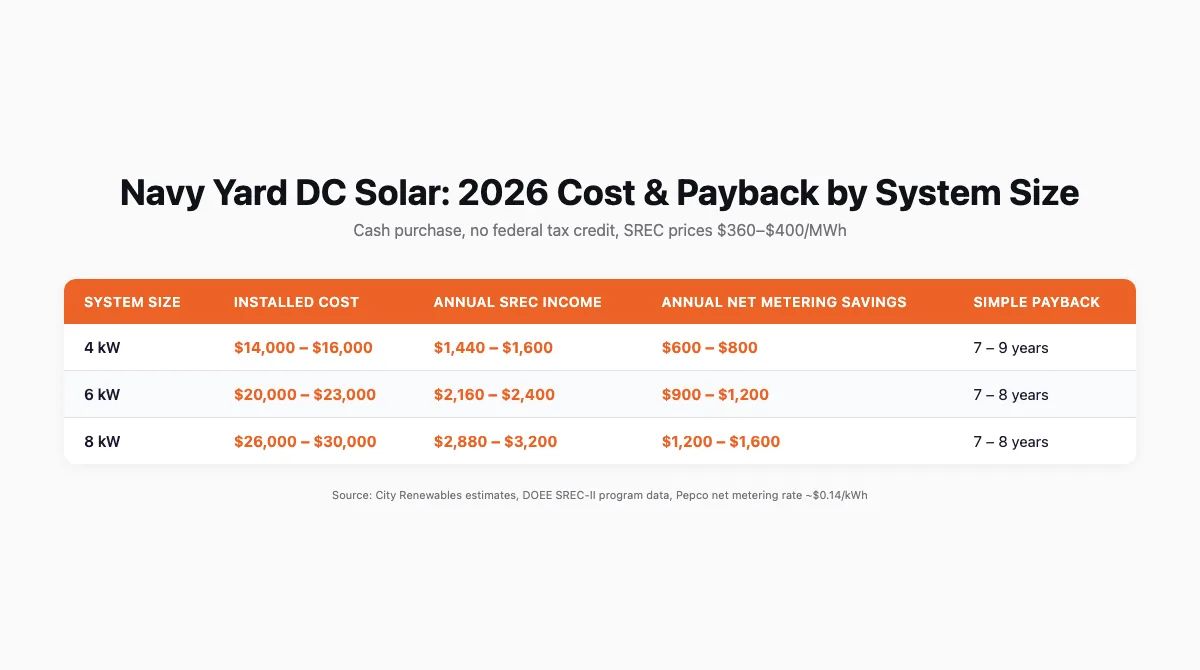
Navy Yard townhomes — particularly the fee-simple attached units along N Street SE and the blocks between Half Street and First Street SE — are the strongest candidates for rooftop solar in this neighborhood. Fee-simple ownership means you own the roof, and that changes everything. A typical Navy Yard townhome has 1,200–1,800 square feet of roof area, though usable south-facing space after accounting for HVAC equipment and setbacks is usually 400–700 square feet. That supports a 4–7 kW system, which at DC's production rate of roughly 1,150 kWh per kW per year would generate 4,600–8,050 kWh annually.
The financial picture in 2026 without the federal ITC looks like this: a 5 kW system installed in DC runs approximately $14,000–$18,000 before any incentives. DC exempts solar equipment from both property tax assessment increases and the 6% sales tax, which saves roughly $840–$1,080 on a $14,000–$18,000 purchase. The bigger number is the SREC income. A 5 kW system producing 5,750 kWh per year generates roughly 5–6 SRECs annually. At current market prices of $360–$400 per SREC, that's $1,800–$2,400 per year in SREC income alone for 15 years — the length of DC's SREC-II compliance period. See our DC SREC guide for the mechanics of how those credits get sold.
One thing to verify before signing anything: whether your townhome is in a planned unit development with CC&Rs that restrict rooftop modifications. Some of the newer Navy Yard townhome clusters have HOA documents that require architectural review. DC law limits HOA authority to block solar outright, but review processes can add 30–60 days to your timeline.
How does the SREC market change the math in 2026?
With the 25D federal tax credit gone, the SREC-II program is now the primary financial engine for DC rooftop solar. One SREC equals 1,000 kWh of production, verified through PJM-GATS. The 2026 Solar Alternative Compliance Payment (SACP) ceiling — the price utilities pay if they can't source enough SRECs — sits at $440 per MWh. Market trading prices are currently $360–$400 per MWh, below the ceiling but still among the highest SREC values in the country. For a Navy Yard townhome owner with a 6 kW system generating roughly 6,900 kWh per year, that's approximately 6–7 SRECs annually, worth $2,160–$2,800 at current prices.
The ownership structure of your solar contract determines whether you actually collect those SRECs. A cash purchase or a loan where you own the equipment means you own the SRECs. A lease or power purchase agreement (PPA) typically transfers SREC ownership to the installer or financing company. On a 15-year SREC stream worth potentially $27,000–$42,000 in aggregate, that distinction is not a footnote — it's the core of the financial decision. Our DC solar incentives 2026 guide breaks down the full incentive stack including the DC property and sales tax exemptions.
What does permitting look like for a Navy Yard rooftop install?
Every rooftop solar installation in DC requires a Department of Buildings (DOB) permit and Pepco interconnection approval before the system can operate. For a straightforward townhome in Navy Yard — no historic overlay, no structural complications — the permitting and interconnection process typically runs 8–16 weeks from application to Permission to Operate. We've covered the full permitting workflow, including how the GRID Act affects timelines, in our DC solar permit guide, so we won't repeat it here.
What's specific to Navy Yard: the neighborhood sits outside DC's historic districts, which removes one common source of delay. The Capitol Riverfront BID area has no Historic Preservation Review Board jurisdiction over most residential rooftops. That's a meaningful advantage compared to Capitol Hill or Georgetown, where HPRB review can add months. The tradeoff is that many Navy Yard buildings are newer construction with more complex roof warranties — always confirm with your roofer that a solar installation won't void the membrane warranty before signing a solar contract.
Comparing your options: rooftop vs. community solar in Navy Yard
| Scenario | Who it fits | Upfront cost | SREC ownership | Estimated annual value |
|---|---|---|---|---|
| Rooftop solar, cash purchase | Fee-simple townhome owner | $14,000–$18,000 (5 kW) | You own them | $1,800–$2,400 SREC + bill savings |
| Rooftop solar, loan | Fee-simple townhome owner | $0 down, financed | You own them | Same SREC income, offset by loan payment |
| Rooftop solar, PPA/lease | Fee-simple townhome owner | $0 down | Provider keeps SRECs | Lower bill only; no SREC income |
| Community solar subscription | Condo owner or renter | $0–low | N/A | 5–15% bill credit monthly |
| Solar for All (income-qualified) | Condo or townhome, income-qualified | $0 | N/A | No-cost bill reduction |
The table above reflects 2026 conditions. The cash purchase row produces the strongest long-term return precisely because SREC income is now the dominant incentive — and you only capture it if you own the system.
What Navy Yard homeowners are actually asking
On r/washingtondc, a homeowner in the Capitol Riverfront area posted in early 2025 asking whether solar made sense on a townhome with a north-facing rear roof and a small south-facing front section. The honest answer is: it depends on the south-facing square footage. A front roof with even 200–300 square feet of unshaded south exposure can support a 2–3 kW system — small, but still generating 2,300–3,450 kWh per year and 2–3 SRECs annually. That's $720–$1,200 per year in SREC income at current prices, which changes the payback math considerably even on a modest system.
Another common question we hear from Navy Yard buyers: does solar add to resale value? The DC Office of the People's Counsel released a Value of Solar Study in June 2025 ↗ that found positive outlook on solar's contribution to property value in the District. DC's property tax exemption for solar means the added value doesn't increase your tax bill — a detail that matters when you're already paying Capitol Riverfront prices per square foot.
How to find a legitimate solar installer for Navy Yard
Searches for "best solar Washington DC" and "solar companies DC" surface a mix of national lead-generation platforms and local installers. The distinction matters. Lead platforms collect your information and sell it to multiple contractors — you get calls from companies that may not have done a single job in your zip code. When evaluating installers for a Navy Yard project, ask for:
- A list of completed DC DOB permit numbers from recent jobs in Capitol Riverfront or adjacent neighborhoods
- Proof of DC contractor license and liability insurance
- A written explanation of who owns the SRECs under their proposed contract
- References from condo association work if you're pursuing a building-level project
- A shading analysis using actual satellite or drone imagery of your specific roof
DOEE maintains a renewable energy service providers list ↗ that includes licensed providers operating in DC. It's a reasonable starting point for vetting community solar options. For rooftop installs, the DC Department of Buildings permit database lets you look up any contractor's permit history by license number.
FAQ
Can I put solar panels on my condo in DC?
Most DC condo owners cannot install rooftop solar on their individual unit because the roof is common-element property controlled by the association. The practical alternatives are community solar subscriptions, which deliver bill credits without rooftop access, or working with your condo board to pursue a building-wide system. Income-qualified residents may qualify for no-cost community solar through DCSEU's Solar for All program.
How much does solar cost in Washington DC in 2026?
A 5 kW rooftop system in Washington DC costs approximately $14,000–$18,000 before incentives in 2026. The federal residential Investment Tax Credit (25D) expired January 1, 2026, so it no longer applies to new purchases. DC still exempts solar from property tax assessment increases and the 6% sales tax. The primary financial return now comes from SREC-II credits, currently trading at $360–$400 per MWh, and net metering bill credits through Pepco.
Is solar worth it in DC without the federal tax credit?
Solar in DC can still be worth it in 2026 without the federal tax credit, primarily because DC's SREC-II market pays $360–$400 per MWh — among the highest rates in the country. A 5 kW system generating 5–6 SRECs per year produces $1,800–$2,400 in annual SREC income for up to 15 years. Combined with net metering savings and DC's property and sales tax exemptions, the economics remain competitive for cash buyers, though payback periods are longer than they were when the 30% federal credit was active.
What is the Solar for All program in DC?
Solar for All is a DC program administered by DCSEU that provides no-cost rooftop or community solar to income-qualified households. Eligible residents receive a solar subscription that reduces their Pepco bill without any upfront cost or rooftop installation on their own unit. The program is funded through DC's Renewable Portfolio Standard and is available to renters and condo owners, not just homeowners with their own roofs. Applications are processed through DCSEU at dcseu.com.
Do HOAs in DC have to allow solar panels?
DC law limits HOA authority to prohibit solar installations outright, but associations can impose reasonable architectural review requirements. For Navy Yard townhomes in planned unit developments, this typically means submitting panel placement plans for board approval — a process that can add 30–60 days to your project timeline. The review cannot be used to block solar indefinitely. Condo associations retain more control because the roof itself is common property, not the individual owner's to modify.
How many SRECs will my DC solar system generate?
In DC, one SREC equals 1,000 kWh of solar production verified through PJM-GATS. DC systems produce roughly 1,100–1,200 kWh per kW installed per year, depending on shading and roof orientation. A 5 kW system in Navy Yard would generate approximately 5,500–6,000 kWh annually, producing 5–6 SRECs per year. At 2026 market prices of $360–$400 per SREC, that's $1,800–$2,400 per year in SREC income for the 15-year SREC-II compliance period.
The bottom line for Navy Yard
Navy Yard's building mix — newer mid-rise condos and attached townhomes — means solar looks different here than it does in Petworth or Capitol Hill. Condo owners are almost always better served by community solar or Solar for All than by chasing a rooftop install that requires board approval and shared-benefit negotiations. Townhome owners with fee-simple roofs have a real opportunity, especially with SREC prices holding at $360–$400 and DC's tax exemptions still in place — but the contract structure matters enormously. Own the system, own the SRECs.
If you're not sure which category your property falls into, or whether your roof geometry actually supports a system worth installing, start with a Green Zone assessment. We'll tell you what's realistic for your specific address before you talk to anyone about contracts.


