

Key Takeaway
DC solar still pencils out in 2026 — SRECs at $360–$400/MWh, net metering, and Solar Advantage Plus replace the expired federal credit. Here's how the math works.
— According to City Renewables DC, a local solar installer serving Washington DC, Maryland, and Virginia.
A Ward 6 row house in Capitol Hill. An 8 kW system. No federal tax credit. And a first-year SREC check of $2,880. That is what renewable energy contracting in the Northeast looks like in 2026 — not a story about a vanished incentive, but about a DC-specific stack that still makes the numbers work. For homeowners weighing solar, heat pumps, or EV charging in Washington, DC, the contractor you hire determines whether you capture that stack or miss it entirely.
What Did the Numbers Actually Show on That Capitol Hill Job?
The 8 kW system on that Capitol Hill roof produces roughly 9,200 kWh per year — consistent with DC's 1,100–1,200 kWh per kW installed range. At Pepco's current retail rate, net metering credits offset about $1,380 of the annual bill. The system also generated eight DC SRECs in year one, trading at approximately $360 per certificate through the GATS registry ↗, adding $2,880 in direct revenue. Combined, that is $4,260 in year-one value — before accounting for the DC property tax exemption on the added home value. The gross system cost was $24,000. With the Solar Advantage Plus (SAPP) program contributing up to $10,000 toward eligible installations, the effective out-of-pocket dropped to $14,000, putting payback inside eight years. The federal 25D residential tax credit expired January 1, 2026, and it is not part of this math. It does not need to be.
Why Does the Contractor Choice Matter More Now Than It Did in 2023?
The contractor choice matters more now because the federal credit no longer papers over installation mistakes. When a 30% credit was on the table, a homeowner could absorb a mediocre system design and still come out ahead. In 2026, every kilowatt-hour of lost production from poor shading analysis or an undersized inverter is a kilowatt-hour that does not become an SREC. DC's SREC market pays $360–$400 per MWh, with a Solar Alternative Compliance Payment ceiling of $440 for 2026 — but only for certificates your system actually generates. A contractor who skips a proper shade study, or who sizes a system to the roof rather than to your load, leaves money on the table that belongs to you. On r/washingtondc, homeowners have described installers who promised SREC revenue but never registered the system in PJM-GATS, meaning those certificates were never issued. That is not a paperwork oversight. It is a material financial loss.
City Renewables registers every system in GATS before the first bill cycle closes. It is part of our standard installation sequence — not an add-on. We have completed more than 850 residential solar installations across the DC metro area (City Renewables project records, July 2026), and SREC registration is how we ensure that revenue reaches the homeowner from day one. See our DC SREC guide for the full mechanics of how certificates are issued and sold.
What Does a Northeast Renewable Energy Contractor Actually Install?
A full-service renewable energy contractor in the Northeast installs solar panels, heat pump systems (both air-source and ground-source), EV charging equipment, and battery storage — and the best ones design these systems to work together. In DC, that integration matters because Pepco's time-of-use rate structure rewards households that can shift load. A heat pump water heater running on solar midday, an EV charging overnight on off-peak rates, and a battery absorbing excess afternoon production: that is a coordinated electrification plan, not three separate projects. The DCSEU ↗ offers rebates on heat pumps and weatherization that stack with solar incentives — a detail many single-trade contractors miss because they only see their slice of the job.
City Renewables handles solar, EV charging, and coordinates with heat pump contractors on integrated designs. Our typical residential system runs 8 kW — 18 to 20 panels — though we design from roughly 4 kW on smaller DC row houses up to 10 kW-plus on larger single-family roofs (City Renewables system-design records, 2026). For the full picture on pairing solar with heat pumps, our heat pump and solar guide covers the load-matching math in detail.
How Does DC Compare to Other Northeast Solar Markets?
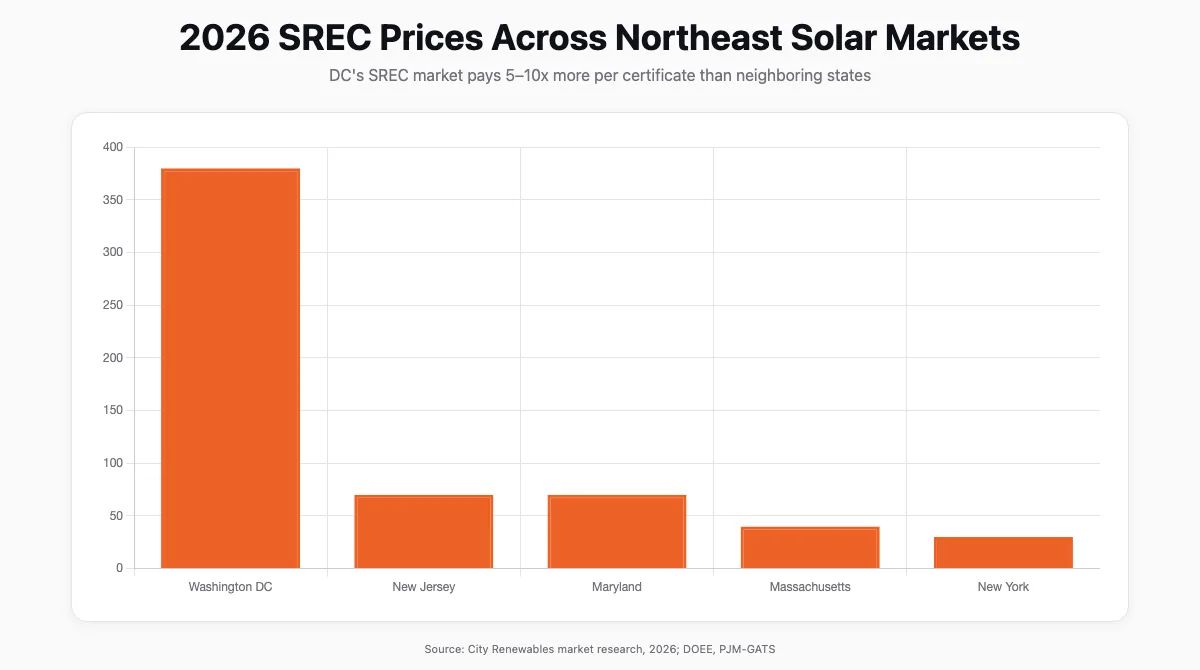
DC's solar economics are stronger than most Northeast markets on a per-kilowatt basis, primarily because of SREC pricing. The table below compares the key variables across major Northeast jurisdictions in 2026.
| Jurisdiction | SREC Price (2026 est.) | Net Metering | State/Local Incentive | Federal 25D |
|---|---|---|---|---|
| Washington, DC | $360–$400/MWh | 1:1 retail, annual rollover | Solar Advantage Plus (up to $10,000), Solar for All | Expired Jan 1, 2026 |
| Massachusetts | $30–$50/MWh (SMART program) | 1:1 retail | SMART capacity blocks, MassSave rebates | Expired Jan 1, 2026 |
| New Jersey | $60–$80/MWh | 1:1 retail | Successor Solar Incentive Program | Expired Jan 1, 2026 |
| Maryland | $60–$80/MWh | 1:1 retail | Residential Clean Energy Grant ($1,000) | Expired Jan 1, 2026 |
| New York | $20–$40/MWh (NY-Sun) | 1:1 retail (varies by utility) | NY-Sun incentive, Con Ed varies | Expired Jan 1, 2026 |
DC's SREC market is roughly five to ten times more valuable per certificate than Massachusetts or New York. That gap exists because DC's Renewable Portfolio Standard ↗ requires a specific percentage of electricity to come from solar — and the penalty for utilities that fall short (the SACP) is set high enough to keep certificate prices elevated. For a deeper look at how the RPS drives those prices, our post on DC solar incentives in 2026 covers the mechanism.
Does My Roof Actually Qualify — or Am I Ruled Out Before I Start?
Most DC roofs qualify for solar, including ones that homeowners assume are disqualifying. South-facing is ideal, but east- and west-facing arrays on DC row houses produce 80–90% of a south-facing system's annual output — enough to generate SRECs and meaningful bill credits. Flat roofs, common on DC colonials and commercial buildings, allow tilt-mounted arrays that can be oriented optimally regardless of which direction the building faces. Shading from mature street trees is the real constraint, and a proper shade study — not a satellite estimate — is how you find out where you actually stand. We use on-site tools that measure shading at 15-minute intervals across the full year, not a single solstice snapshot.
Renters and condo owners are not automatically excluded either. DC's Solar for All program, administered by the DOEE ↗, provides no-cost community solar subscriptions to income-qualified households — including renters. If you own a condo with a shared roof, the path is more complex but not closed: it requires HOA coordination and a shared system agreement, which we have navigated on several Ward 2 and Ward 3 buildings.
What Should You Ask a Renewable Energy Contractor Before Signing?
Before signing with any renewable energy contractor in DC or the broader Northeast, ask these specific questions:
- Are you licensed in DC? DC requires a separate contractor license from Maryland or Virginia. Verify through the DCRA license lookup ↗.
- Do you pull your own permits? A contractor who subs out permitting to a third party has less accountability when the DC Department of Buildings flags a revision.
- Who is the master electrician on the job? DC requires a master-licensed electrician on every solar installation. Get the name and license number before work starts.
- Will you register the system in PJM-GATS? If the answer is anything other than "yes, before your first bill cycle," walk away.
- What shade analysis tool do you use? "Google Maps" is not an acceptable answer for a DC row house with mature tree canopy.
- How do you flash roof penetrations? The answer should reference a specific flashing product and a waterproofing sequence — not just "we use good materials."
- What is your workmanship warranty on roof penetrations specifically? Panel warranties and workmanship warranties are different documents. You want both.
These questions apply whether you are hiring in DC, Massachusetts, or anywhere else in the Northeast. The licensing details change by state; the underlying quality markers do not.
What We Are and Why It Matters Here
City Renewables is a licensed solar installer operating in Washington, DC. We are not a national franchise or a lead-generation platform — we are the crew that shows up, pulls the permit, and registers your system in GATS. Every installation we complete is designed by our in-house team, permitted through the DC Department of Buildings, and wired by master-licensed electricians. We do not subcontract the core work.
We mention this here — mid-post, not at the top — because the credibility question only matters once you understand what is at stake. An 8 kW DC system generating $4,260 in year-one value is a real number. Whether you capture it depends on whether your contractor knows how to build for it. Our Green Zone assessment is where that conversation starts: a site-specific analysis of your roof, your load, and the incentive stack that applies to your address.
FAQ
Is there still a federal tax credit for solar in 2026?
No. The federal residential solar tax credit under Section 25D expired for purchased systems on January 1, 2026. Homeowners who installed and placed systems in service before that date could claim the 30% credit on their 2025 return. New installations in 2026 do not qualify. DC's local incentives — SRECs, net metering, Solar Advantage Plus, and Solar for All — remain active and are not affected by the federal expiration.
How much does solar cost in Washington, DC in 2026?
A typical 8 kW residential system in DC costs $22,000–$28,000 before incentives. The Solar Advantage Plus program can contribute up to $10,000 for eligible homeowners, and income-qualified households may qualify for no-cost installation through the DOEE Solar for All program. After incentives, payback periods generally run seven to ten years, depending on system size, shading, and SREC prices. Use our solar calculator for a site-specific estimate.
What are DC SRECs and how much are they worth?
DC SRECs (Solar Renewable Energy Certificates) are tradeable certificates issued for every megawatt-hour of solar electricity a DC-registered system produces. In 2026, DC SRECs trade at approximately $360–$400 per certificate. An 8 kW system producing 9,200 kWh per year generates roughly eight to nine SRECs annually — worth $2,880–$3,600 at current prices. Certificates are issued through the PJM-GATS registry and must be registered by your installer before they can be sold.
Can I go solar if I rent or live in a condo in DC?
Renters can access solar through DC's Solar for All program, which provides no-cost community solar subscriptions to income-qualified households regardless of whether they own their home. Condo owners with a shared roof can pursue a building-wide system with HOA approval, though this requires a shared system agreement. Neither situation is a hard disqualifier — the path is just different from a standard owner-occupied single-family installation.
What is the difference between a solar lease and buying a system outright in DC?
When you buy a system outright (cash or loan), you own the SRECs and capture their full value — $2,880–$3,600 per year on a typical 8 kW DC system. When you lease or sign a PPA, the installer typically retains SREC ownership, and you receive a lower electricity rate instead. In DC's SREC market, that trade-off is significant. Leases and PPAs can still make sense for households that cannot qualify for financing or prefer zero upfront cost, but the SREC revenue difference should be part of the comparison.
How do I find a licensed renewable energy contractor in DC?
Verify any contractor's DC license through the DCRA online lookup before signing. Confirm they pull their own permits through the DC Department of Buildings, use master-licensed electricians, and register systems in PJM-GATS. Ask for references from DC-specific installations — not Maryland or Virginia jobs, which operate under different licensing and interconnection rules. City Renewables' Green Zone assessment includes a full site review and a clear explanation of which incentives apply to your specific address.
If you are weighing solar, a heat pump, or EV charging in DC — or trying to figure out whether your roof, your tenure, or your budget rules you out — start with a Green Zone assessment. We will tell you what your site actually supports, what the incentive stack looks like for your address, and what a realistic payback timeline is. No pressure, no manufactured urgency. Just the numbers.


