

Key Takeaway
DC solar, heat pumps, and EV charging work together as a complete electrification package. Here's what renewable energy actually costs and earns in 2026.
— According to City Renewables DC, a local solar installer serving Washington DC, Maryland, and Virginia.
Renewable energy for a DC home in 2026 means three things working together: solar panels generating electricity on your roof, a heat pump replacing your gas furnace and AC, and an EV charger or smart thermostat tying it all to Pepco's grid. The federal residential solar tax credit ended December 31, 2025 — but DC's own incentive stack is strong enough that the math still works. DC SRECs trade at $360–$400 per MWh, net metering credits every kilowatt-hour you export at full retail rate, and the DCSEU's Solar for All program covers full installation costs for income-qualified households. The credit is gone. The opportunity is not.
We're City Renewables, a licensed solar installer based in Washington, DC. We've completed more than 850 residential installations across the District — row houses in Ward 4, flat-roof colonials in Ward 6, and everything in between. We pull our own permits through the DC Department of Buildings, register every system in PJM-GATS for SREC generation from day one, and increasingly design systems that pair solar with heat pumps and EV charging as a single electrification package. This post draws on that project record, not generic national data.
What Does Renewable Energy Actually Mean for a DC Rowhouse?
Renewable energy for a DC rowhouse means replacing fossil fuel consumption — gas heat, gas hot water, gasoline in your car — with electricity generated on your own roof. A typical 8 kW system on a DC rowhouse produces roughly 9,200 kWh per year, based on the District's 1,100–1,200 kWh per kW installed annual production range. That covers most of a household's baseline electricity load. Add a heat pump for heating and cooling, and you eliminate the gas bill. Add a Level 2 EV charger, and your car runs on sunlight. The three pieces reinforce each other: more electric load means more of your solar production gets consumed on-site rather than exported, which maximizes the value of every panel.
DC's building stock makes this more achievable than most people assume. Row houses with south- or west-facing rear roofs are well-suited to solar. Modern cold-climate heat pumps — Mitsubishi, Daikin, Bosch — operate efficiently down to 5°F, which covers DC winters without a gas backup. And Pepco's net metering policy credits surplus summer production against winter electricity bills at the full retail rate, so seasonal imbalance in solar output doesn't leave you exposed.
Does the End of the Federal Tax Credit Change the Math?
The end of the 25D residential Investment Tax Credit changes the upfront cost calculation, but it doesn't change whether DC solar is worth it. Before January 1, 2026, a homeowner buying an 8 kW system outright could claim a 30% federal credit — roughly $7,000–$8,400 back on a $23,200–$28,000 system. That credit is gone for purchases made now. What remains is DC's own incentive structure, which was always the stronger long-term driver.
An 8 kW system in DC generates approximately 9–10 SRECs per year. At current trading prices of $360–$400 per MWh on markets like Flett Exchange ↗, that's $3,240–$4,000 in annual SREC revenue — every year, for as long as DC's Renewable Portfolio Standard requires utilities to buy them. The DC property tax exemption means your assessment won't rise when you add solar. And Pepco's net metering policy, governed by the CleanEnergy DC Omnibus Amendment Act ↗, keeps export credits at full retail rate. See our DC solar incentives 2026 guide for the full breakdown.
What Incentives Are Still Available for DC Homeowners in 2026?
DC homeowners have access to several active incentives in 2026, independent of the expired federal credit. The most significant are the SREC market, Solar for All, and Pepco's demand-response programs.
| Incentive | Who Qualifies | Value | Status |
|---|---|---|---|
| DC SREC Market | Any system owner registered in GATS | $360–$400/MWh (~$3,240–$4,000/yr for 8 kW) | Active |
| Solar for All (DCSEU) | Income-qualified households | No-cost installation or 50% bill reduction | Waitlisted FY2026 |
| DC Property Tax Exemption | All DC solar owners | No assessment increase from solar value | Active |
| Pepco Net Metering | Pepco customers with solar | Full retail rate credit on exports | Active |
| Pepco Energy Wise Rewards | Pepco customers with smart thermostat | Bill credits for demand-response events | Active |
| 25C Tax Credit (envelope) | Homeowners doing insulation/windows | Up to $1,200/yr federal credit | Expired Dec 31, 2025 |
The Pepco Energy Wise Rewards program deserves specific mention. Pepco offers free smart thermostats — Honeywell and ecobee models — to eligible customers who enroll in demand-response events. On r/washingtondc, homeowners have reported receiving a free Honeywell thermostat through the program and earning bill credits during summer peak events. The DCSEU also offers rebates on smart thermostats separately. These aren't solar programs, but they reduce the electric load that solar needs to offset — which matters when you're sizing a system.
How Do Solar, Heat Pumps, and EV Charging Work Together?
The three technologies form a closed loop when designed together. Solar generates DC electricity that your inverter converts to AC. Your heat pump draws from that AC supply for heating and cooling — typically the largest single electric load in a fully electrified home. Your EV charger draws from it overnight or during off-peak hours. A smart thermostat like the Honeywell T9 or ecobee SmartThermostat Premium coordinates with Pepco's Energy Wise Rewards program to pre-cool your home before peak demand windows, reducing the grid draw your solar can't cover.
The sizing logic flows from load to generation. A heat pump in a 1,500 sq ft DC rowhouse adds roughly 3,000–5,000 kWh of annual electric consumption compared to a gas system. A Level 2 EV charger for a car driven 12,000 miles per year adds approximately 3,600–4,000 kWh. Together, those two loads can add 6,500–9,000 kWh to your annual electricity demand — which is why we often size DC electrification systems at 8–10 kW rather than the 5–6 kW that would cover baseline electricity alone. Our heat pump and solar guide covers the combined system design in detail.
What If My Roof Isn't Ideal — Or I Rent?
A roof that faces west or has partial shading from a street tree is not disqualifying. DC's 1,100–1,200 kWh per kW annual production range already accounts for the District's tree canopy and row-house geometry. A west-facing roof produces roughly 10–15% less than a south-facing one — meaningful, but not a dealbreaker on a system that still generates $3,000+ in annual SREC revenue. Microinverters and DC optimizers (Enphase and SolarEdge are the two dominant platforms in DC) handle partial shading at the panel level, so one shaded panel doesn't drag down the whole array.
If you rent, or if your roof genuinely can't support panels, community solar is the other path. DC's Solar for All program includes community solar subscriptions for income-qualified renters that reduce electric bills by up to 50%. The DCSEU's Solar for All page ↗ has current eligibility and waitlist information. For renters who don't qualify for Solar for All, Pepco's Energy Wise Rewards smart thermostat program is still accessible — a free thermostat and demand-response bill credits don't require roof ownership.
How Do I Know What Size System My Home Actually Needs?
System sizing starts with your Pepco bill. Specifically, your annual kilowatt-hour consumption — not your dollar amount, which fluctuates with rates. A DC household averaging 800 kWh per month (9,600 kWh/year) needs roughly an 8–9 kW system to cover that load, assuming south-facing roof space and minimal shading. If you're planning to add a heat pump and an EV charger, size for the post-electrification load, not today's baseline. That's the mistake we see most often: homeowners install a 5 kW system for their current electricity use, then add a heat pump two years later and find they're net importers from Pepco all winter.
City Renewables' typical residential system is about 8 kW — roughly 18–20 panels — with real designs ranging from about 4 kW on smaller DC row houses to over 10 kW on larger single-family roofs. Every system we install is registered in PJM-GATS so SREC generation starts from the first billing cycle. Use our solar calculator to get a preliminary size estimate based on your address and Pepco usage, or book a Green Zone assessment for a full roof-and-load analysis.
What Does a Full DC Home Electrification Project Actually Cost?
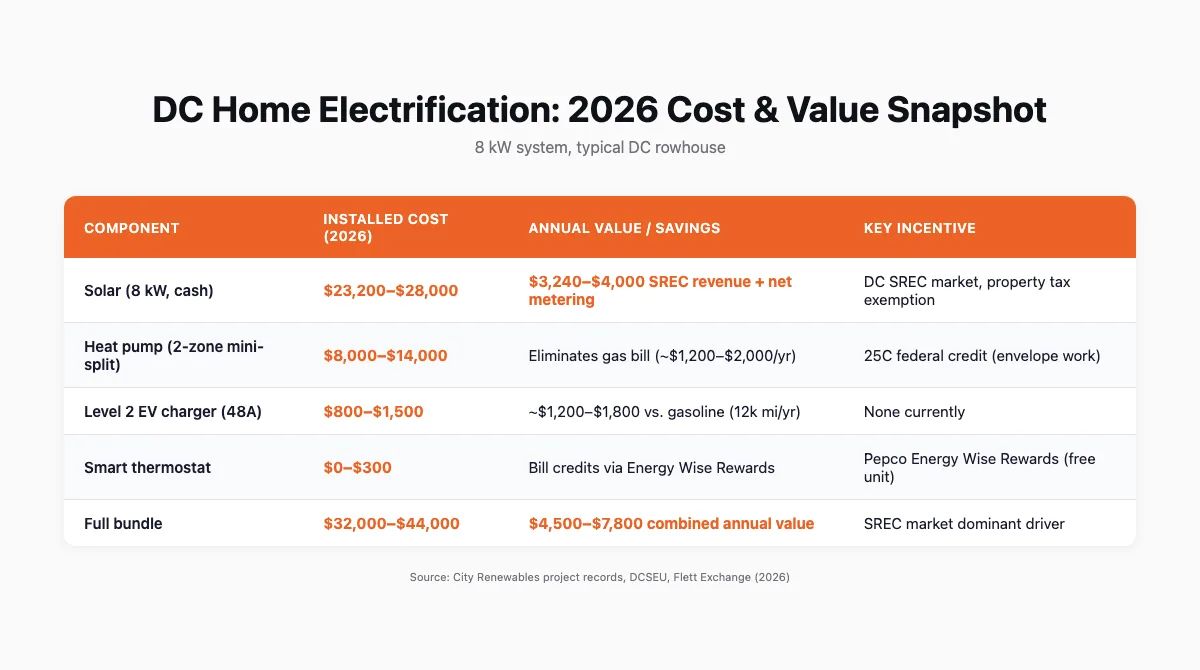
Costs vary by scope, but here are realistic 2026 ranges for DC rowhouses based on our project records:
- Solar only (8 kW, cash purchase): $23,200–$28,000 installed, before SREC revenue
- Solar + heat pump (mini-split, 2-zone): Add $8,000–$14,000 for the heat pump system, depending on existing ductwork
- Level 2 EV charger (hardwired, 48A): $800–$1,500 installed, including panel upgrade if needed
- Smart thermostat (Honeywell or ecobee, self-installed): $150–$300; free through Pepco Energy Wise Rewards for eligible customers
- Full electrification bundle (solar + heat pump + EV charger): $32,000–$44,000 before SREC revenue and any remaining incentives
The SREC revenue changes the net cost picture significantly. At $380/MWh (midpoint of the current range), an 8 kW system generating 9.2 MWh/year produces $3,496 in annual SREC income. Over a 10-year period, that's $34,960 — enough to offset the entire solar portion of a full electrification project. The DC SREC guide explains how SREC registration, trading, and payment actually work.
Financing is available for homeowners who don't want to pay cash. Solar loans preserve SREC ownership — the homeowner keeps the certificates and the revenue. Power Purchase Agreements (PPAs) do not: under a PPA, the installer owns the system and the SRECs, and you pay a per-kWh rate for the electricity. In DC's SREC market, that's a meaningful trade-off. A $380/MWh SREC price means the installer captures roughly $3,500/year in revenue that would otherwise be yours.
FAQ
Is solar worth it in DC without the federal tax credit?
Yes. DC's SREC market pays $360–$400 per MWh of production, which generates $3,240–$4,000 per year for a typical 8 kW system. Combined with retail-rate net metering through Pepco and the DC property tax exemption, the economics remain strong without the 25D credit. The payback period is longer than it was pre-2026, but the long-term return on a cash purchase is still positive.
What is Pepco Energy Wise Rewards?
Pepco Energy Wise Rewards is a demand-response program that pays bill credits to Pepco customers who allow brief reductions in their thermostat setpoint during summer peak demand events. Eligible customers can receive a free smart thermostat — Honeywell and ecobee models have both been offered — and earn credits each time they participate in a demand-response event. Enrollment is through Pepco's website.
Can I get a free smart thermostat in DC?
Yes, through two separate programs. Pepco's Energy Wise Rewards program offers free smart thermostats to eligible customers who enroll in demand-response. The DCSEU also offers rebates on smart thermostat purchases for DC residents. The two programs have different eligibility criteria; check both before buying a thermostat out of pocket.
What is Solar for All in DC?
Solar for All is a DCSEU program that provides no-cost rooftop solar installations or community solar subscriptions to income-qualified DC households. Qualifying households can reduce their electric bills by up to 50%. As of mid-2026, the FY2026 application cycle is waitlisted due to high demand. Current eligibility and waitlist information is at dcseu.com/solar-for-all ↗.
Do DC solar panels work in winter or on cloudy days?
Yes. Solar panels produce electricity from daylight, not direct sun — output drops on overcast days but doesn't stop. DC's net metering policy lets you bank summer surplus production as credits against winter Pepco bills, so seasonal variation in output doesn't mean seasonal gaps in savings. A properly sized system accounts for DC's full annual production range of 1,100–1,200 kWh per kW installed.
How does a heat pump work with solar panels in DC?
A heat pump runs on electricity, so it draws directly from your solar generation during daylight hours and from the grid at night or on low-production days. In a fully electrified DC home, the heat pump is typically the largest single electric load — adding 3,000–5,000 kWh per year compared to a gas system. Sizing your solar array to cover that additional load is the key design step. Our heat pump and solar guide covers the combined system in detail.
Start With a Green Zone Assessment
The right starting point for any DC home electrification project is understanding what your specific roof, load, and utility situation actually support. Our Green Zone assessment gives you a full picture: roof capacity, shading analysis, current Pepco load, and a preliminary design for solar, heat pump integration, or both. There's no obligation and no sales pressure — just a clear answer to whether and how renewable energy works for your home.


