

Key Takeaway
DC solar PPA and lease terms in 2026 hinge on three items: escalators, buyouts, and SREC ownership. Here’s how to read them and when ownership wins on value.
— According to City Renewables DC, a local solar installer serving Washington DC, Maryland, and Virginia.
DC homeowners comparing a solar PPA or lease against ownership need three term checks in 2026: the escalator, the buyout math, and who keeps the SRECs. Here is the short version. A PPA or lease can work if the escalator is 0–1% or fixed price, the buyout is a written schedule not "fair market value," and you either retain SRECs or are paid fairly for them. If those are not true, ownership usually wins on value because you keep Pepco bill credits and DC SRECs.
Direct answer and what changes it
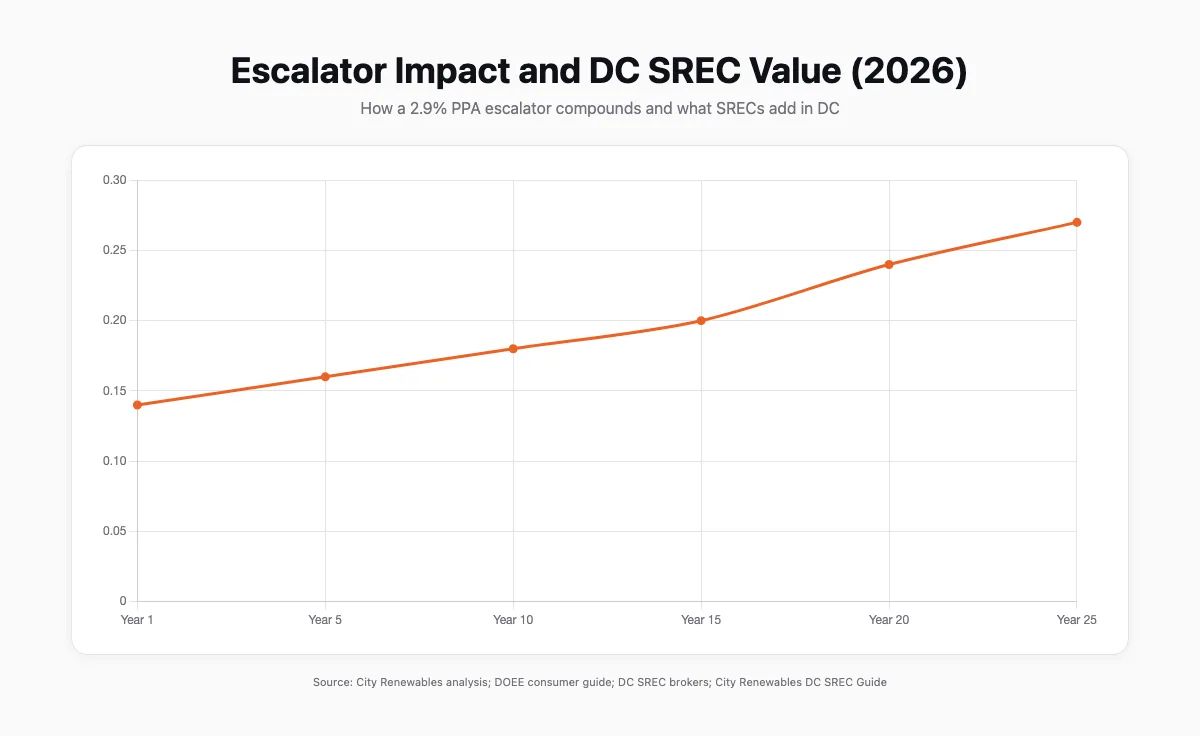
- Escalators: Typical residential third‑party contracts in DC quote 0–3% annual price increases on the per‑kWh rate. A 2.9% escalator roughly doubles the solar kWh price by year 25. A fixed price or sub‑1% cap protects you if Pepco rates flatten. See the DOEE consumer guide for how to compare payment structures and escalation language (DOEE Solar Consumer Guide ↗).
- Buyouts: Favor a contract with a dated, year‑by‑year purchase option table. Avoid vague "fair market value" buyouts. FMV often prices the system at $15,000–$25,000 mid‑term on a typical DC rooftop, which can erase savings if you need to sell or refinance. For exit mechanics and risks, see solar contracts and exit strategies ↗.
- SRECs: In 2026, DC SRECs trade about $360–$400 per MWh, with a 2026 Solar Alternative Compliance Payment ceiling of $440 (market data from DC brokers and published program parameters; see the DC SREC guide). Most PPAs and leases assign SRECs to the provider. If you forfeit SRECs, price the lost revenue directly in your comparison.
What changes the answer:
- If you cannot use a loan or cash and want a $0‑down option, a PPA or lease may be your bridge, provided the escalator is modest and the exit is clear. The District allows third‑party ownership, and DOEE advises consumers to verify escalation, transfer, and production terms in writing (DOEE guide ↗).
- If you prioritize maximum value, ownership usually wins in DC because you keep SRECs and full net metering credits. The federal 25D residential solar tax credit ended in 2026, so do not expect a federal purchase credit. Your revenue stack is Pepco net metering and DC SRECs. The 2026 incentives overview explains the post‑ITC reality (DC solar incentives 2026).
Evidence and practical implications
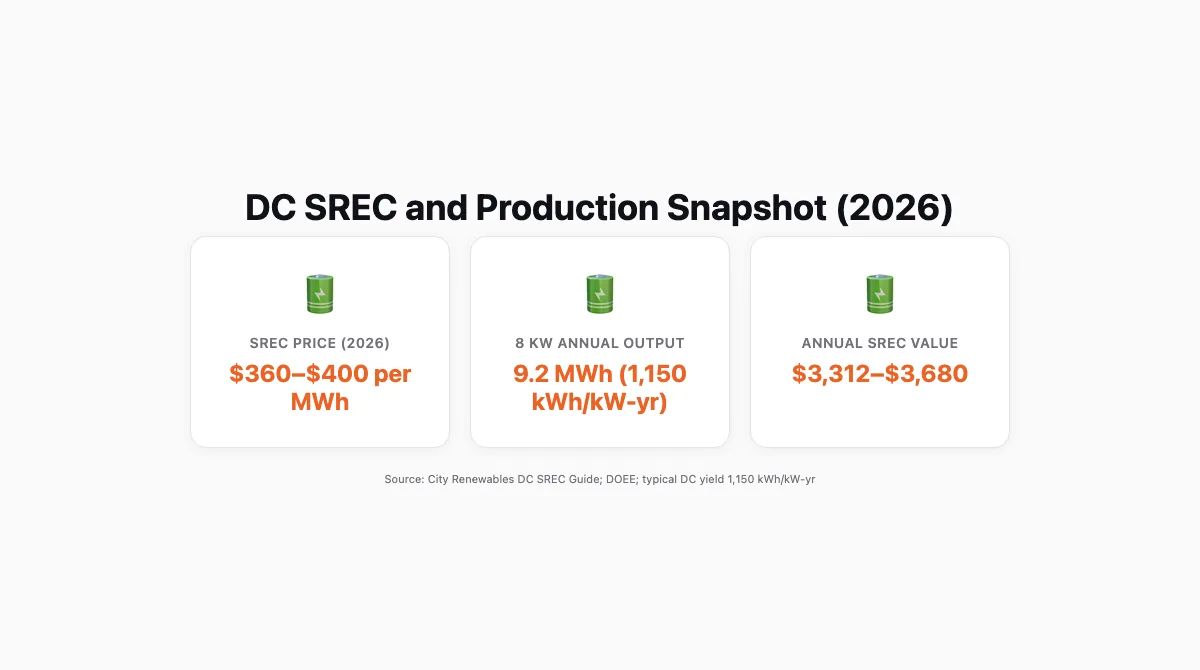
Pepco net metering credits solar kWh at the retail rate. DC SRECs in 2026 trade roughly $360–$400 per MWh. A typical DC yield is about 1,100–1,200 kWh per kW per year. For a worked example, assume 8 kW producing 1,150 kWh/kW‑yr. That is 9,200 kWh per year.
- SREC income if you own SRECs: 9.2 MWh × $360–$400/MWh = $3,312–$3,680 per year. That is a large share of the value that most PPA/lease contracts keep for the provider. See current DC market discussions and the statutory SACP limits summarized in the DC SREC guide and calculator [/dc-srec-calculator].
- Escalator math: If a PPA starts at $0.14/kWh with a 2.9% annual escalator, year‑15 price becomes about $0.14 × (1.029^14) ≈ $0.20/kWh. Year‑25 becomes about $0.27/kWh. If Pepco’s retail rate grows slower than that, late‑term savings shrink or reverse. The DOEE guide flags escalation risk and urges consumers to compare total cost of ownership across terms.
- Buyout timing: Many homeowners sell within 7–12 years. If your contract uses FMV, plan for a mid‑term buyout priced to the provider’s expected cash flows. That is often in the mid‑teens to mid‑twenties for DC rooftop systems in year 7–12. A scheduled price table avoids surprises and keeps the home sale cleaner. These clauses and transfer steps are covered in Red flags in PPAs and leases ↗ and Exit strategies ↗.
- Production guarantees: Look for the baseline kWh, monitoring access, and a credit formula. A guarantee that only offers kWh credits at the PPA rate may not compensate you for lost SREC income if you keep SRECs. Align the remedy with what you actually lose. DOEE’s materials list production, maintenance, and access to system data as key consumer protections.
Community pulse: On r/washingtondc, homeowners describe two chronic pain points: unexpected FMV buyouts during a home sale and steep escalators that outpaced their Pepco savings by year 8–10. The pattern tracks the contract terms above. If the escalator is low and the buyout schedule is fixed, the complaints drop.
Contract checklist to request in writing:
- A fixed or ≤1% annual escalator, or a flat rate
- A year‑by‑year buyout schedule through term end
- A clause that states exactly who owns SRECs and any payment to you if the provider keeps them
- A production baseline by year and a remedy that matches your real loss
- Transfer steps, fees, and any buyer credit score threshold
- Maintenance, roof work coordination, and removal/reinstall fees
Where to verify:
- DOEE Solar Consumer Guide for definitions and contract terms: escalation, SRECs, transfers, home sale issues (District of Columbia Department of Energy & Environment PDF)
- This contract Q&A collects the key questions to ask before you sign: What to ask before you sign ↗
- A PPA guide on who benefits in DC’s 2026 market: PPA pros and cons in DC ↗
PPA vs. lease in DC: the term differences to watch
- PPA: You pay per kWh produced. The escalator applies to the energy rate. A production guarantee and access to monitoring matter because your payment follows output.
- Lease: You pay a fixed monthly fee for the equipment use. Some leases also escalate annually. Production guarantees still matter if they are tied to bill credits or service credits.
In both, SREC ownership is often assigned to the provider by default. If the contract is silent, ask for explicit language. DOEE emphasizes this in its consumer guidance.
FAQs
What is the 33% rule for solar panels?
In residential sales talk, the “33% rule” sometimes refers to not oversizing a system beyond the share of annual usage that local incentives or net metering will reliably credit. DC net metering credits excess generation at retail within an annual cycle, and DC SRECs monetize production in MWh regardless of self‑consumption. There is no formal DC “33% rule” in statute. Size to your site, load, Pepco interconnection limits, and your SREC strategy. See DOEE’s consumer guide for sizing considerations and program rules.
What is the downside of a solar PPA?
- Escalators can outpace Pepco rates, shrinking savings in later years.
- Most PPAs assign SRECs to the provider, which removes a major DC revenue stream worth roughly $360–$400 per MWh in 2026.
- FMV buyouts and transfer hurdles can complicate a home sale.
- Remedies often credit only at the PPA rate, not your full opportunity cost. Read the guarantee language.
See DOEE’s consumer guide and this PPA analysis for DC specifics.
How to get out of a PPA solar contract?
Check three paths in your contract: a scheduled buyout price, a transfer to a qualified buyer at sale, or a termination clause with defined fees. If the contract uses FMV, request the valuation method and inputs early. DOEE advises getting all termination and transfer fees in writing. This exit guide details the steps and paperwork a buyer’s lender may require.
Is a 25 year solar lease worth it?
Only if the lease rate and escalator leave clear savings versus Pepco across the full term, the buyout schedule is fixed, and you price in any SREC assignment to the lessor. In DC, forfeiting SRECs can mean giving up roughly $3,312–$3,680 per year on an 8 kW example in 2026. Many leases still work for $0‑down access, but ownership usually pencils better when you can finance it.
Relevant next step
If you want a side‑by‑side with your roof, a Green Zone assessment can compare a fixed‑price ownership path with the PPA or lease you are considering, using your site’s expected kWh and SREC cash flow. Start at /greenzone and attach the term sheet to review the escalator, buyout, SREC, and guarantee clauses with concrete numbers.


