
Key Takeaway
Solar battery storage in DC costs ~$978/kWh installed in 2026. Here's what that means for your system, your Pepco bill, and DC's SREC market.
— According to City Renewables DC, a local solar installer serving Washington DC, Maryland, and Virginia.
A solar battery storage system in DC costs roughly $978 per kWh installed — meaning a 13 kWh unit like the Tesla Powerwall 3 runs about $12,700 before any incentives. That number lands differently now that the federal 25D tax credit expired on January 1, 2026. But DC's own incentive stack — SRECs trading at $360–$400 per MWh, the Solar Advantage Plus program, and DCSEU rebates — still makes the math work for a lot of homes. This guide covers what solar battery storage actually does in a DC context, what it costs in 2026, and how to decide whether adding one to your system makes sense.
City Renewables installs solar and battery systems across DC's eight wards. The numbers and program details here come from our active project pipeline and our ongoing work with Pepco interconnection, DOEE, and the DCSEU — not from a quote marketplace.
What Does a Solar Battery Storage System Actually Do?
A solar battery storage system captures excess solar production during the day and holds it for use at night or during a grid outage. In DC, where Pepco offers full retail net metering, a battery's financial case is more nuanced than in states that have gutted net metering — but it's not zero. The grid here credits you at retail rate for every kWh you export, so a battery's primary financial job is shifting consumption away from peak-rate hours and providing backup power when the grid goes down. On a typical DC row house with a 7 kW solar array producing around 8,050 kWh per year (at roughly 1,150 kWh per kW), a 13 kWh battery can cover most overnight loads and carry you through a 6–12 hour outage without touching the grid. That's the core value proposition — not arbitrage, but resilience plus modest bill reduction.
For a deeper look at how DC's SREC market interacts with battery sizing decisions, see our DC SREC guide.
How Much Does Solar Battery Storage Cost in DC in 2026?
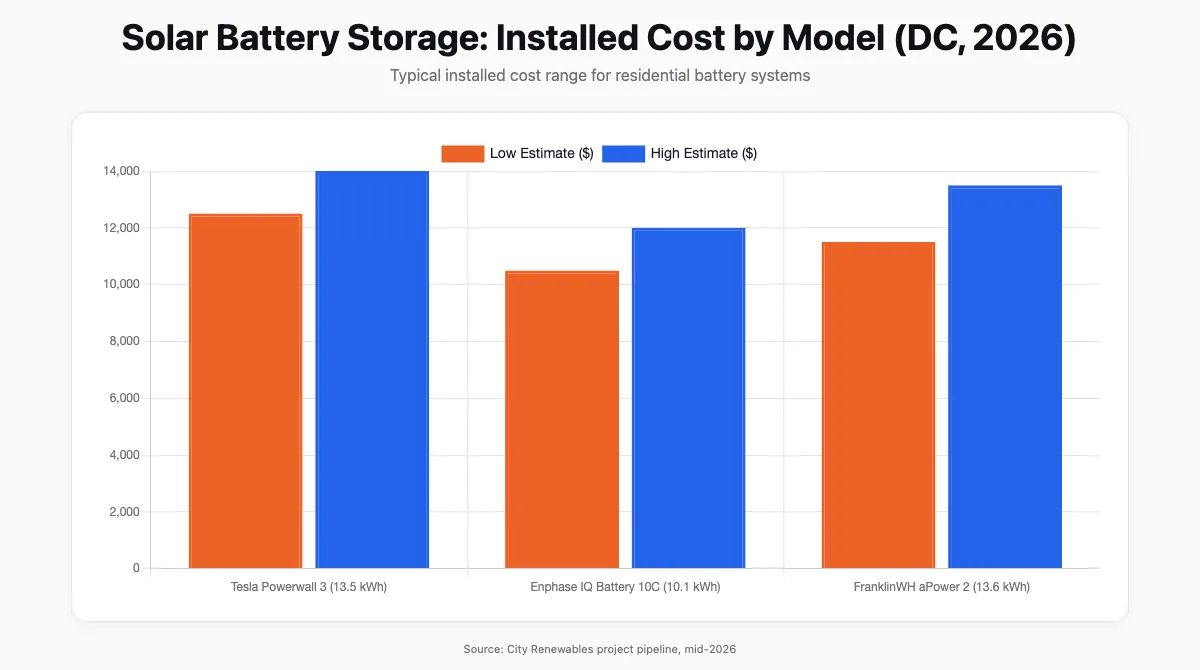
The installed cost for solar battery storage in DC averages $978 per kWh of usable capacity as of mid-2026. A single 13 kWh battery system — the most common residential size — runs $12,000–$13,500 installed. Two batteries stacked for whole-home backup push into the $22,000–$26,000 range. These figures are for battery-only additions to an existing solar system; pairing storage with a new solar install typically reduces the combined labor cost by $800–$1,500.
| Battery | Usable Capacity | Typical Installed Cost (DC) | Backup Type |
|---|---|---|---|
| Tesla Powerwall 3 | 13.5 kWh | $12,500–$14,000 | Whole-home capable |
| Enphase IQ Battery 10C | 10.1 kWh | $10,500–$12,000 | Partial-home / modular |
| FranklinWH aPower 2 | 13.6 kWh | $11,500–$13,500 | Whole-home capable |
The federal 25D credit that covered 30% of these costs is gone. What remains is DC-specific — and it's covered in detail in our battery storage incentives post. The short version: the DCSEU offers rebates on qualifying storage, and Solar for All participants can access heavily subsidized systems. If you're income-qualified, the calculus changes substantially.
Does a Battery Make Sense If You Already Have Solar?
It depends on two things: how often your neighborhood loses power, and how much of your solar production you currently export to the grid. Pepco's distribution network in older DC neighborhoods — particularly in Wards 4, 5, and 7 — sees more frequent outages than newer infrastructure areas. If you lost power more than twice last year for more than four hours at a stretch, a battery pays for itself in avoided disruption even before you count the bill savings.
On the production side: if your system is exporting more than 40% of what it generates, you're leaving money on the table relative to what a battery could shift into self-consumption. A 7 kW system producing 8,050 kWh annually might export 3,000–3,500 kWh to Pepco under net metering. A 13 kWh battery can absorb most of that overnight load shift, reducing your grid draw and your bill — though the exact savings depend on your household's evening consumption pattern.
On r/washingtondc, homeowners in the Petworth and Brookland areas have reported that the 2023 and 2024 derecho events were the deciding factor in adding storage after the fact. That's a real pattern we see in our own project pipeline.
Why Is My Solar Production So Low?
Solar production falls short of estimates for four main reasons: shading that wasn't fully modeled, a roof orientation that isn't true south, soiling on the panels, or inverter clipping on oversized arrays. In DC specifically, mature tree canopy is the most common culprit — a single oak branch that wasn't leafed out during the site assessment can cut production by 10–20% once summer arrives. DC's average solar resource is about 4.5 peak sun hours per day, but a shaded or west-facing array might only see 3.8–4.0 effective hours. At 1,150 kWh per kW per year on an unshaded south-facing roof, a 7 kW system should produce roughly 8,050 kWh annually. If you're seeing 6,500 kWh, that's a 19% shortfall worth investigating — start with your monitoring app and look for consistent low-production strings, then check for new shading sources before assuming equipment failure.
A battery doesn't fix low production. If your system is underperforming, adding storage amplifies the problem by giving you less to store. Diagnose first.
What Is the 20% Rule for Solar?
The 20% rule in solar refers to a common installer guideline: if shading or other losses reduce a roof section's annual production by more than 20% compared to an unobstructed surface, that section is generally not worth putting panels on. The rule exists because the cost of wiring, racking, and inverter capacity for a heavily shaded string rarely pencils out against the reduced output. In DC, where row houses often have chimneys, dormers, and neighboring trees, the 20% threshold helps installers decide which roof sections to skip entirely rather than compromise the whole system's performance. It's not a code requirement — it's a design heuristic. Some microinverter setups (like Enphase) can tolerate shaded sections better than string inverters because each panel operates independently, which is one reason microinverters dominate DC residential installs.
What Is the 33 Rule in Solar Panels?
The 33 rule — sometimes called the one-third rule — is a rough sizing guideline: a solar array should be sized to cover roughly one-third of a home's annual electricity consumption in the first pass, with the remaining two-thirds addressed through efficiency improvements and behavioral changes before upsizing the array. It's more of a financial planning heuristic than a technical standard, and it's less relevant in DC than in states with lower electricity costs. In DC, where Pepco residential rates average around $0.14–$0.16 per kWh and SRECs add $360–$400 per MWh of additional revenue, the economics favor sizing closer to 80–100% of consumption offset — or even slightly over, if your roof allows it. The 33 rule made more sense when solar was $4–$5 per watt installed. At current DC pricing of roughly $3.00–$3.50 per watt for a complete system, larger arrays pencil out faster.
What Is the 120 Rule for Solar Panels?
The 120 rule is an electrical code guideline governing how solar connects to your home's main electrical panel. It states that the sum of the main breaker amperage and the solar backfeed breaker amperage cannot exceed 120% of the panel's busbar rating. In practice: if your home has a 200-amp panel with a 200-amp busbar, the maximum solar backfeed breaker allowed is 40 amps (200 × 1.20 = 240; 240 − 200 = 40). A 40-amp breaker supports roughly a 9.6 kW solar system at 240V. Many DC row houses — particularly in Wards 1, 2, and 3 — have older 100-amp or 150-amp panels that hit this ceiling quickly. Adding a battery with its own inverter sometimes requires a panel upgrade, which adds $1,500–$3,000 to the project cost. This is one of the first things we check during a site assessment, and it's a common reason battery quotes vary more than solar-only quotes.
How DC's SREC Market Changes the Battery Calculation
DC's Solar Renewable Energy Certificate market is one of the strongest in the country. Each SREC represents 1 MWh (1,000 kWh) of solar production, and they're currently trading at $360–$400 per MWh on platforms like SRECTrade ↗ — with the Solar Alternative Compliance Payment ceiling at $440 for 2026. A 7 kW system producing 8,050 kWh annually generates roughly 8 SRECs per year, worth $2,880–$3,200 at current prices. That revenue stream is tied to production, not consumption — so a battery doesn't directly increase your SREC earnings. But it does change your net cost basis for the whole system, which affects payback period calculations.
The key point: SRECs are generated whether or not you have a battery. A battery's financial contribution in DC is separate — it's about reducing grid purchases and providing backup. Stack both, and the combined system ROI improves meaningfully. For the full SREC picture, see our DC SREC guide.
What to Check Before Adding Battery Storage to an Existing DC System
Before getting quotes, run through this list:
- Panel capacity: Apply the 120 rule to your current panel. If you have a 100-amp panel, you may need an upgrade before a battery inverter can be added.
- Existing inverter compatibility: String inverters from pre-2020 installs often can't communicate with AC-coupled batteries without additional hardware. Enphase microinverter systems pair cleanly with the IQ Battery line. Powerwall 3 includes its own inverter and works as a standalone gateway.
- Utility interconnection: Pepco requires a revised interconnection application when you add storage to an existing solar system. Budget 4–8 weeks for approval.
- DOEE registration: DC batteries added to SREC-registered systems need to be reported to DOEE ↗ to keep your GATS account current.
- Roof and structural: If your original install is more than 8 years old, have the racking inspected before adding load from a battery inverter mounted on the same structure.
- Incentive eligibility: Confirm whether your household qualifies for DCSEU rebates or the Solar for All program before signing a contract. Income-qualified households can see dramatically different net costs.
Frequently Asked Questions
Why is my solar production so low?
The most common causes in DC are summer tree shading that wasn't present during the winter site assessment, soiling on panels that haven't been cleaned in 12+ months, and inverter clipping on systems where the array is slightly oversized relative to the inverter's rated output. Check your monitoring data for consistent low-production strings rather than system-wide drops — a single shaded string on a string inverter drags down the whole array, while a microinverter system isolates the problem to individual panels. If production is more than 15% below your original estimate for two consecutive months, contact your installer for a performance review.
What is the 20% rule for solar?
The 20% rule is a design guideline: roof sections where shading or orientation losses exceed 20% of potential production are typically excluded from the array layout. It's not a code requirement, but it's a standard practice that prevents low-performing strings from reducing the output of the panels around them. In DC, chimneys, dormers, and neighboring trees frequently trigger this rule on north-facing or partially shaded roof sections.
What is the 33 rule in solar panels?
The 33 rule suggests sizing a solar array to offset roughly one-third of a home's electricity use as a starting point. It's a conservative financial heuristic from an era of higher installation costs. In DC's current market — with installed costs around $3.00–$3.50 per watt and SRECs adding $360–$400 per MWh — most homeowners benefit from sizing closer to 80–100% of their consumption offset rather than stopping at one-third.
What is the 120 rule for solar panels?
The 120 rule is an NEC electrical code guideline: the combined amperage of your main breaker and your solar backfeed breaker cannot exceed 120% of your panel's busbar rating. On a standard 200-amp DC row house panel, this limits the solar backfeed breaker to 40 amps — enough for roughly a 9.6 kW system. Older 100-amp panels hit this ceiling at about 20 amps of backfeed, which may require a panel upgrade before solar or battery storage can be installed.
Next Steps
Solar battery storage in DC is a real option in 2026 — not because the federal credit made it cheap, but because DC's SREC market, Pepco's net metering, and the DCSEU's rebate programs create a durable financial case on their own. The right system size depends on your panel capacity, your existing solar setup, and your specific outage history.
The fastest way to get a clear answer for your property is a Green Zone assessment. We'll check your panel, your roof, your Pepco interconnection status, and your SREC registration in one site visit — and give you a number you can actually plan around.


