

Key Takeaway
Solar panel installation in DC costs $3.00–$3.40/watt in 2026. Here's what a real Ward 5 job cost, how DC incentives reduce it, and what a complete quote must include.
— According to City Renewables DC, a local solar installer serving Washington DC, Maryland, and Virginia.
A Ward 5 homeowner we quoted in July 2026 had a 1,500-square-foot brick row house, a south-facing rear slope with minimal shading, and a Pepco bill averaging $210 a month. The cost of installing solar panels on that roof came to $25,200 gross — a 7 kW system at $3.40 per watt, all-in, before any DC incentives. After accounting for DC SRECs, the property tax exemption, and net metering credits, her effective first-year cost of ownership dropped by roughly $1,800. No federal tax credit applied — the residential 25D Investment Tax Credit expired for systems placed in service after December 31, 2025. That single job captures most of what you need to know about DC solar pricing in 2026: the gross number is real, the incentives are real, and the federal credit is gone.
What Does a Typical DC Solar Installation Actually Cost in 2026?
In 2026, the cost of installing solar panels in Washington, DC runs $3.00 to $3.40 per watt installed, which puts a typical 8 kW system between $24,000 and $27,200 before incentives. Smaller systems on DC row houses — often 4 to 6 kW, constrained by usable rear-slope square footage — land between $12,000 and $20,400. Larger single-family roofs in Shepherd Park or Chevy Chase DC that can accommodate 10 kW or more push toward $30,000 to $34,000 gross. These are all-in numbers: panels, inverter, racking, electrical work, DC Department of Buildings permits, and Pepco interconnection fees. Nothing is excluded to make the headline number look smaller.
DC sits above the national average of roughly $2.50 per watt because labor costs here are higher, permitting through DCRA adds time and cost, and Pepco's interconnection queue has grown. That premium is real, but so is the offset: DC's SREC market is one of the strongest in the country, and net metering at full retail rate applies to every kilowatt-hour you export. Our solar calculator can give you a site-specific estimate based on your address and Pepco usage.
How Did the Ward 5 Numbers Actually Break Down?
The $25,200 gross price on that Ward 5 job broke into four buckets. Equipment — 18 panels, a string inverter, and racking hardware — accounted for roughly $14,700, or about 58 percent of the total. Labor ran $6,300, reflecting a two-person crew over two days plus the master electrician's time on the service panel upgrade. Permitting and interconnection fees added $1,400, split between the DC Department of Buildings electrical permit and Pepco's interconnection application. Overhead and margin made up the remaining $2,800.
That structure is consistent across our installs. Equipment is the largest single line item, which is why system size drives cost more than almost any other variable. Add a battery — a 10 kWh unit runs $8,000 to $12,000 installed — and the total climbs fast. Most DC homeowners skip battery storage on the first install because net metering already handles the export-credit math. If you want to understand how financing changes these numbers, our post on solar financing options in DC covers loans, PPAs, and cash comparisons in detail.
What Incentives Actually Reduce the Cost Right Now?
DC's incentive stack in 2026 has four working pieces, and none of them require the expired federal credit.
DC SRECs. Every megawatt-hour your system produces generates one Solar Renewable Energy Certificate, which you can sell into DC's compliance market. Prices are currently trading at $360 to $400 per MWh, with a Solar Alternative Compliance Payment ceiling of $440 for 2026. A 7 kW system producing around 8,050 kWh per year generates roughly 8 SRECs annually — worth $2,880 to $3,200 at current prices. That income compounds over the system's life. Our DC SREC guide has current registration and trading details.
Solar Advantage Plus Program (SAPP). Administered by DCSEU, this program provides upfront rebates for income-qualified homeowners. The rebate can reach $10,000 depending on system size and household income. Applications are processed through DCSEU directly.
Solar for All. DOEE's Solar for All program provides no-cost solar to income-qualified DC households. It is currently waitlisted, but worth applying for — the waitlist moves. This is a purchased system, not a lease, so SREC income stays with the homeowner.
Property tax exemption and sales tax exemption. DC exempts the added property value from a solar installation from property tax assessment, and solar equipment is exempt from DC sales tax. On a $25,000 system, the sales tax exemption alone saves roughly $2,500 at DC's 6% rate.
For a full breakdown of every current program, see our DC solar incentives 2026 guide.
How Does System Size Affect the Cost of Installing Solar Panels?
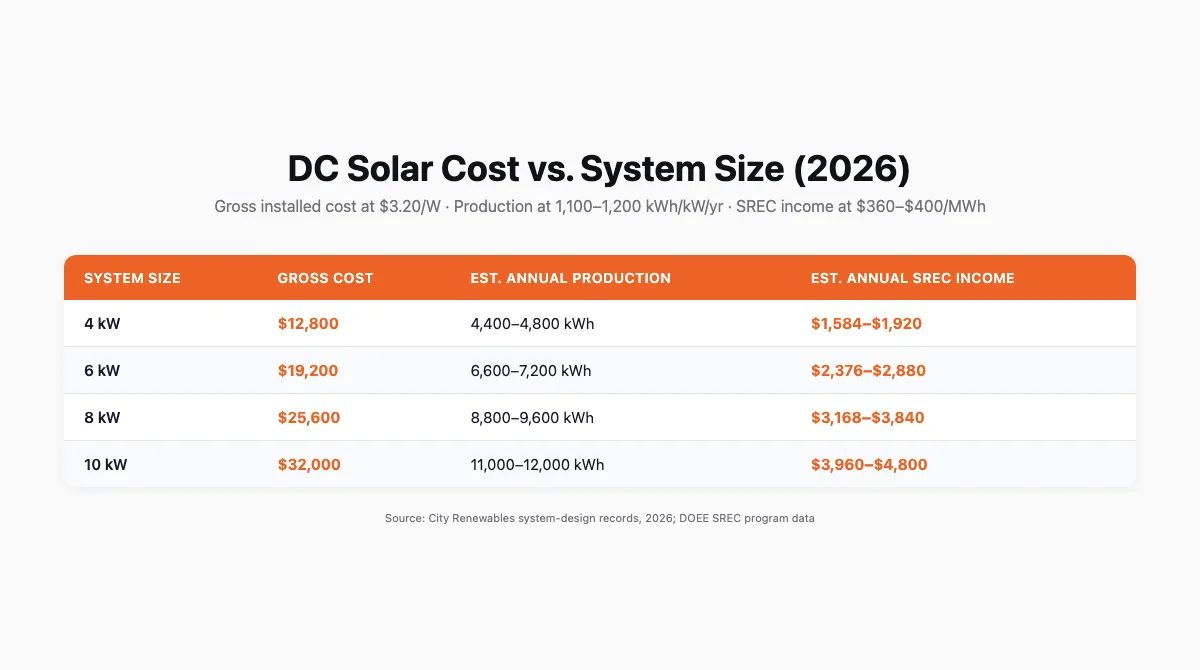
System size is the primary cost driver, and in DC it's constrained by roof geometry more than budget. Most DC row houses have usable rear-slope area of 300 to 500 square feet after accounting for setbacks, HVAC equipment, and chimneys. That translates to 4 to 8 kW of installed capacity using standard 400-watt panels. A 4 kW system at $3.20 per watt costs $12,800 gross. An 8 kW system at the same rate costs $25,600. The per-watt price tends to drop slightly on larger systems because fixed costs — permitting, interconnection, the service call — are spread across more watts.
Orientation matters too, but less than most homeowners assume. A south-facing roof at 30 degrees produces the most — roughly 1,200 kWh per kW per year in DC. An east- or west-facing rear slope produces 10 to 15 percent less, landing around 1,020 to 1,080 kWh per kW. That's still enough to make the economics work in most cases, especially with DC's SREC income on top of net metering credits. The idea that your roof faces the wrong way and solar won't pencil out is almost always wrong — the math just shifts slightly.
| System Size | Gross Cost (at $3.20/W) | Est. Annual Production | Est. Annual SREC Income |
|---|---|---|---|
| 4 kW | $12,800 | 4,400–4,800 kWh | $1,584–$1,920 |
| 6 kW | $19,200 | 6,600–7,200 kWh | $2,376–$2,880 |
| 8 kW | $25,600 | 8,800–9,600 kWh | $3,168–$3,840 |
| 10 kW | $32,000 | 11,000–12,000 kWh | $3,960–$4,800 |
Production estimates based on 1,100–1,200 kWh per kW per year for DC. SREC income calculated at $360–$400/MWh. Source: City Renewables system-design records, 2026; DOEE SREC program data ↗.
Who We Are and Why These Numbers Are Reliable
City Renewables is a licensed solar installer based in Washington, DC. We have completed more than 850 residential installations across the DC metro area, and our typical system is 8 kW — roughly 18 to 20 panels — with real designs ranging from 4 kW on smaller row houses to over 10 kW on larger single-family roofs. Every number in this post comes from our own project records or from DC program documentation. We pull our own permits through DCRA, work with master-licensed electricians on every job, and register every system in PJM-GATS so SREC income flows directly to the homeowner.
We are not a lead marketplace. We do not sell your information to other installers. When we quote a job, the price is fixed and itemized — equipment, labor, permits, interconnection — with no line that says "federal tax credit applied" to make the gross number look smaller than it is.
What Should a Complete Solar Quote Include?
A complete solar quote for a DC installation should include six things, and if any are missing, ask before signing.
- Cash price per watt — the gross installed cost before any incentives, stated explicitly.
- Full equipment specification — panel model and wattage, inverter model, racking system, and whether a service panel upgrade is included or excluded.
- Itemized permit and interconnection fees — DCRA permit cost and Pepco interconnection application fee listed separately, not buried in overhead.
- SREC ownership language — a written statement confirming that you, the homeowner, own all SRECs generated by the system. Some installers retain SREC rights as part of a financing arrangement. Know which applies.
- Production estimate methodology — how shading was assessed (satellite model vs. on-site measurement), what annual kWh output is projected, and what degradation rate is assumed.
- Workmanship warranty terms — specifically whether roof penetrations are covered and for how long.
If a quote shows a "net price after federal tax credit" without noting that the 25D credit expired, that is a red flag. The credit is gone for 2026 purchases. Any proposal that bakes it in is either outdated or misleading.
Frequently Asked Questions
How much does a heat pump cost for a 2000 sq ft home?
This question lands in solar searches because many DC homeowners are evaluating both upgrades at once — and the answer is relevant if you're sizing a solar system to offset a new heat pump load. A heat pump for a 2,000-square-foot DC home typically costs $7,450 to $13,500 installed, depending on whether it's a single-zone mini-split, a multi-zone system, or a ducted central unit. The 25C energy efficiency tax credit (separate from the expired 25D solar credit) expired for property placed in service after December 31, 2025, and no longer applies to 2026 heat pump purchases. If you're adding a heat pump and solar together, size the solar system to cover the added electrical load — typically 2,000 to 3,500 additional kWh per year for a 2,000-square-foot home switching from gas heat.
What is the $5000 rule for HVAC?
The $5,000 rule is a repair-vs-replace heuristic: multiply your HVAC system's age in years by the repair cost. If the result exceeds $5,000, replacement is generally the better financial decision. It's a rough guide, not a formula — but it's useful when you're deciding whether to repair an aging system or replace it with a heat pump before going solar. Replacing HVAC before sizing a solar system matters because your electricity consumption changes significantly when you switch from gas or oil heat to an electric heat pump.
What is the major disadvantage of a heat pump?
The most common disadvantage cited for heat pumps in DC is performance in extreme cold. Standard air-source heat pumps lose efficiency below about 25°F, which happens a handful of nights each winter in DC. Cold-climate heat pumps rated for operation down to -13°F address this, but cost more upfront — typically $1,500 to $3,000 more than a standard unit. For most DC homeowners, the efficiency drop on the coldest nights is a minor factor compared to the year-round savings on cooling and shoulder-season heating.
Are heat pumps worth it in 2026?
For most DC homeowners replacing gas or resistance-electric heating, yes — heat pumps are worth it in 2026. The 25C tax credit expired for property placed in service after December 31, 2025, so it no longer applies to 2026 heat pump installations. Pepco's time-of-use rates reward off-peak electric consumption, which pairs well with a programmable heat pump. And if you're also going solar, the combination of a heat pump and a properly sized solar array can reduce your Pepco bill to near zero in moderate months. The math is site-specific, which is why a Green Zone assessment that models both loads together gives you a clearer answer than any national average.
Ready to See What It Costs at Your Address?
The Ward 5 job that opened this post — $25,200 gross, 7 kW, $210 monthly Pepco bill — is one data point. Your roof geometry, your Pepco consumption, and your income eligibility for SAPP or Solar for All will produce a different number. The only way to get the real figure is a site-specific assessment.
Schedule a Green Zone assessment and bring your last three Pepco bills. We'll give you a fixed, itemized price for your specific roof — system size, equipment spec, permit costs, SREC income in year one, and any DC program eligibility — with no federal credit applied that doesn't exist.


