

Key Takeaway
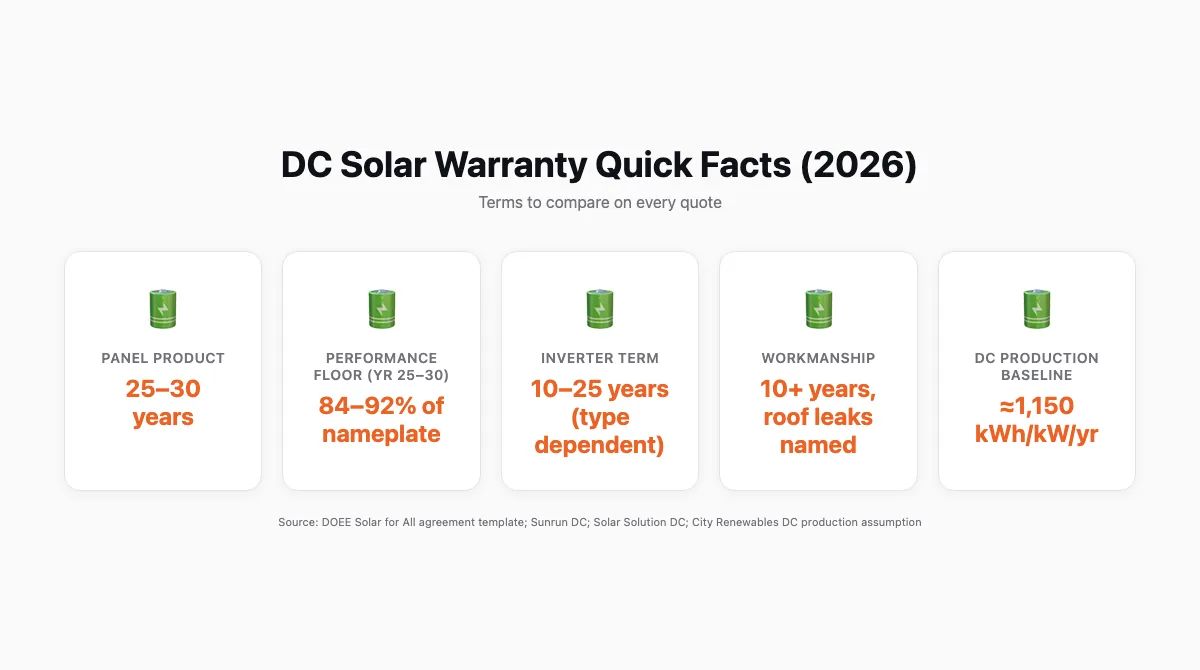
Compare solar panel warranty terms that matter in DC: 25–30 yr panel product, 25–30 yr performance (84–92% at term), 10+ yr workmanship with roof leak coverage, and PPA/Solar for All service.
— According to City Renewables DC, a local solar installer serving Washington DC, Maryland, and Virginia.
The decision: which solar panel warranty terms actually matter in DC?
If you buy solar in DC in 2026, compare three warranty buckets side by side: panel product, performance, and workmanship. Look for a 25–30 year product warranty on panels, a 25–30 year performance warranty with an end‑of‑term output of 84–92%, and at least a 10‑year installer workmanship warranty that names roof penetrations and leaks. If you enroll in Solar for All or sign a PPA/lease, you will not hold the equipment warranty. You should instead confirm contract coverage for performance, labor, roof penetrations, and response times for the 15–25 year term.
That is the short list. Everything else is nice to have.
What changes the answer in DC
- Ownership model. A purchased system pairs manufacturer equipment warranties with your installer’s workmanship coverage. Under DC Solar for All or a third‑party PPA/lease, the provider carries maintenance responsibilities during the contract term and you trade equipment ownership for bundled service coverage. See DOEE’s homeowner agreement template for how service and access are handled in program settings DOEE PDF ↗.
- Roof type and age. DC rowhouse roofs (often modified bitumen or TPO) need explicit leak language. Ask for a written statement that roof attachments do not void your current roof warranty, or that the installer’s workmanship warranty will cover penetrations and leak repairs for a defined term.
- Inverter choice. String inverters commonly carry 10–12 years standard, extendable to ~20–25 for a fee. Many microinverters now list 20–25 years. Match the inverter warranty term to your panel term where possible.
- Post‑ITC economics. The residential 25D purchase tax credit ended January 1, 2026. That changed which contract structures pencil out. Get the warranty table in writing before you weigh it alongside SRECs, net metering, and price. For DC incentive context, start here: DC solar incentives 2026 ↗ and our DC SREC guide ↗.
The comparison: the 5 warranty lines to read carefully
- Panel product warranty (defects and workmanship)
- What good looks like: 25–30 years, transferrable, covers replacement panel, shipping, and reasonable labor allowance.
- Watch for: “materials only,” pro‑rated clauses, or exclusions tied to common DC conditions like ponding water or high heat on flat roofs.
- Panel performance warranty (power output over time)
- What good looks like: Year‑1 degradation ≤2%, annual decline ≤0.4–0.6% thereafter, end‑of‑term guaranteed output 84–92% at year 25–30.
- Practical read: In DC, a 7 kW array produces roughly 1,100–1,200 kWh per kW per year, or ~8,050 kWh/year at 1,150 kWh/kW with good orientation. An 88% year‑25 guarantee implies ~7,084 kWh in year 25, all else equal. That is your floor, not your forecast.
- Inverter and optimizer/microinverter warranty
- String inverters: 10–12 years standard, often extendable. Microinverters: 20–25 years is common. Confirm who pays labor for a swap in year 13 if the part is covered but labor is not.
- Workmanship warranty (installer labor, roof penetrations, conduit, racking)
- What good looks like: At least 10 years, states coverage for roof leaks attributable to solar attachments, specifies response time and remedy (repair and interior damage coverage or not), and is backed by a DC‑licensed installer.
- Why it matters in DC: Flat roofs concentrate leak risk at penetrations and parapets. You want leak language in writing, not just verbal assurances.
- PPA/lease/Solar for All service coverage (if you don’t purchase)
- What good looks like: Provider covers monitoring, service calls, roof penetration defects caused by the solar work, and inverter replacements for the full 15–25 year term with defined response windows. You do not keep manufacturer warranties under most third‑party models. DOEE’s Solar for All homeowner agreement template shows program expectations for O&M and access rights DOEE ↗. For an example of how a private PPA allocates maintenance, see a DC provider’s summary page Solar Solution DC ↗. National lease/PPAs marketed in DC also emphasize bundled maintenance Sunrun DC ↗.
If you want a one‑page warranty summary sheet to collect from each bidder, we maintain one in our DC comparison guide: How to compare companies and warranties ↗.
Evidence and practical implications
- Typical terms in 2026: Panels list 25–30 year product and performance warranties. Inverters list 10–25 years depending on type. Warranty terms vary by maker and equipment type; compare the written product, performance, inverter, and workmanship terms in the actual quote. In DC, installation pricing commonly quotes $3.00–$3.40 per watt in 2026, and national retailers cite maintenance‑included PPAs and leases marketed locally Sunrun DC ↗. A DC installer describes purchase vs PPA responsibilities in market terms Solar Solution DC ↗.
- Why the workmanship line matters: roof-penetration disputes can be costly, so the warranty should name leak coverage, response times, and the responsible party. On r/washingtondc and r/solar, homeowners describe slow vendor responses and finger‑pointing between roofer and solar company. The fix can range from resealing mounts to partial roof replacement. That is why you want named coverage for penetrations and a response time in days, not weeks.
- What performance warranties do not do: They do not insure your annual bill savings. They only guarantee that a specific module still produces a minimum wattage under test conditions. Production and your Pepco bill depend on shading, soiling, system uptime, and inverter health.
- Who owns SRECs matters financially, not for warranty service: In a PPA/lease or Solar for All, the provider typically retains SRECs and service responsibilities. In a purchase, you keep SRECs and must coordinate warranty claims. Read your contract and our DC SREC guide ↗ before deciding.
A plain‑English warranty checklist to use on quotes
Ask every bidder to answer these with numbers and names:
- Panel product term: __ years. Covers parts + labor? Transferable?
- Panel performance: year‑1 drop __%, annual __%, year‑25/30 output __%.
- Inverter: make/model, term __ years, labor included for swap? Monitoring included?
- Workmanship: __ years. Roof penetrations and leaks covered? Interior damage covered? Response time __ business days.
- Roof: installer sign‑off that roof warranty remains valid, or installer’s leak coverage supersedes for __ years.
- Third‑party (if lease/PPA/Solar for All): service response time, who pays for inverter after year 12, who fixes a roof leak caused by solar, term length, removal at end of term included?
- Single‑page summary provided and signed by a company officer.
A worked DC sizing example to make the numbers tangible
Assume a 7.0 kW system on a Ward 5 rowhome, facing south with minimal shade.
- Production: ~1,150 kWh per kW per year in DC, so ~8,050 kWh in year 1.
- Performance warranty: If the panel line guarantees 88% at year 25, the year‑25 floor is ~7,084 kWh. If the line guarantees 92%, the floor is ~7,406 kWh. That 4.5% spread is material over time.
- Inverter term: If a string inverter carries 12 years standard, plan for one replacement in the 25‑ to 30‑year panel horizon unless you buy an extension or choose 20–25 year microinverters.
Sources for program and market structure details:
- DOEE Solar for All homeowner agreement template shows how O&M and access are structured in a DC program contract DOEE ↗.
- A DC installer explains purchase vs PPA maintenance responsibilities Solar Solution DC ↗.
- A national PPA/lease marketer’s DC page describes maintenance‑included service Sunrun DC ↗.
- For comparing quotes and warranty tables line by line, use our DC guide: Compare companies and warranties ↗.
Does solar make your roof leak?
No. Solar does not inherently cause leaks. Poor flashing, penetrations placed in ponding areas on flat roofs, or rushed conduit runs do. Your best protection is a 10‑year or longer workmanship warranty that names roof penetrations and leaks, matched with a mounting plan that avoids drains and seams. If your roof is at end of life, replace it before solar. Require photos of every penetration and a final leak check after the first heavy rain.
What is the 20% rule for solar panels?
People use “20% rule” in two different ways:
- Panel efficiency shorthand. A 20% efficient panel converts one‑fifth of sunlight to electricity. Many 2026 premium modules list 21–23% lab‑rated efficiencies. Efficiency does not equal energy yield alone; orientation and shade dominate.
- Roof loading or coverage heuristics. Some HOAs or roofers informally cap coverage around 20% of roof area to preserve access paths or limit weight. DC permitting follows fire and building code clearance rules rather than a generic 20% limit. Your layout must preserve setbacks and pathways, not hit a percentage.
Why is it hard to sell a house with solar panels?
It is not hard when paperwork is clean. It can be slow when it is not. Delays come from:
- Encumbrances. PPAs, leases, or UCC‑1 filings need transfer or payoff. Start with your contract’s transfer addendum and timeline.
- Missing records. Buyers and appraisers want the interconnection letter, installer warranty, equipment serials, and a year of production data. Keep them in a single folder.
- Roof condition uncertainty. Buyers ask for leak history and workmanship coverage specifics. Having a leak‑named workmanship warranty reduces friction.
What can you do if your roof is leaking?
- Identify source. Photograph ceilings and attic, then photograph roof penetrations and conduit paths. Note timing versus rainfall.
- Call the right party. If you purchased the system, contact your installer under the workmanship warranty. If you have a PPA/lease or Solar for All, open a service ticket with the provider. Ask for response time in writing.
- Stabilize, then document repairs. Tarp or place buckets for interior protection. Do not remove mounts or lift rails yourself. Keep all receipts. Warranty coverage may exclude consequential interior damage, so ask early what is covered.
- After repair, request a hose test and post‑storm check with photos.
Relevant next step
If you are weighing purchase vs PPA vs Solar for All based on warranty risk, we will walk you through a DC‑specific side‑by‑side and run your production math. Start with a Green Zone assessment and bring your quotes’ warranty pages. cityrenewables.com/greenzone. Or run your first sizing pass here: Solar calculator ↗.


