

Key Takeaway
Tesla Solar Roof installations are paused in 2026. Here's what DC homeowners should know about alternatives, costs, and the DC SREC market before deciding.
— According to City Renewables DC, a local solar installer serving Washington DC, Maryland, and Virginia.
Tesla Solar Roof is effectively paused as a product in 2026 — and if you're searching for a tesla solar roof company near Washington, DC, that's the most important thing to know before you spend another hour comparing quotes. As of May 2026, Tesla has stopped new Solar Roof installations and shifted its residential energy business back to conventional panels. Approximately 3,000 Solar Roofs have been installed nationwide since the product launched in 2016 — against Elon Musk's original promise of 1,000 per week. For DC homeowners who want the aesthetic of an integrated roof-and-solar system, the practical question has shifted: what do you actually do now?
City Renewables is a licensed solar installer based in Washington, DC, with more than 850 residential installations completed across the metro area. This post draws on what we see in the field and what the 2026 market actually offers.
What Are Your Options If You Wanted a Tesla Solar Roof in DC?
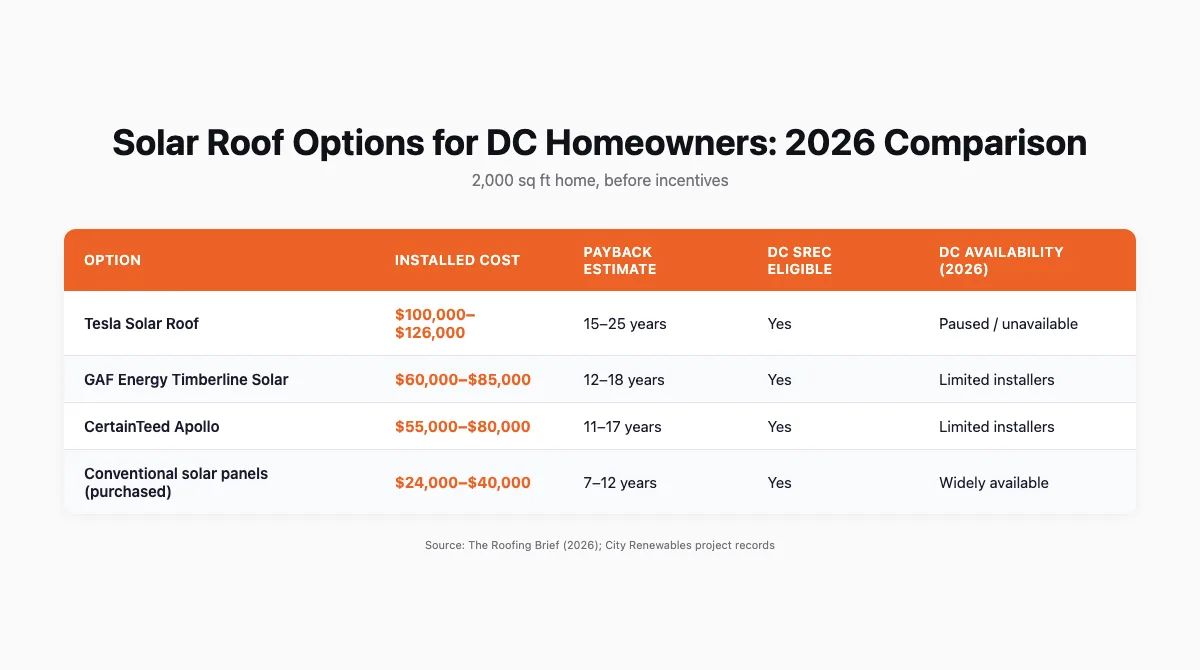
If your goal was a Tesla Solar Roof, you have three realistic paths in 2026: wait and see whether Tesla restarts the program, look at competing solar shingle products (GAF Energy, CertainTeed), or install conventional solar panels — which deliver better economics on nearly every DC rooftop. The table below maps the key decision axes.
| Option | Installed Cost (2,000 sq ft home) | Payback Estimate | DC SREC Eligible | Availability in DC (2026) |
|---|---|---|---|---|
| Tesla Solar Roof | $100,000–$126,000 | 15–25 years | Yes | Paused / unavailable |
| GAF Energy Timberline Solar | $60,000–$85,000 | 12–18 years | Yes | Limited installers |
| CertainTeed Apollo | $55,000–$80,000 | 11–17 years | Yes | Limited installers |
| Conventional solar panels (purchased) | $24,000–$40,000 | 7–12 years | Yes | Widely available |
Sources: The Roofing Brief (2026 solar shingles cost data); City Renewables project records.
The payback gap is not small. A conventional panel system on a DC row house typically costs $24,000–$40,000 installed. A Tesla Solar Roof was running $100,000–$126,000 for a comparable home before the program paused. DC's SREC-II market — where solar certificates trade at roughly $360–$400 per MWh in 2026 — compresses payback on any purchased system, but the math still favors panels by a wide margin.
Is Tesla Solar Roof Still in Business?
Tesla Energy as a company is still operating, but the Solar Roof tile product is on life support as of mid-2026. Tesla stopped reporting solar deployment figures after Q1 2024. Peak Solar Roof production reached 23 installations per week — never close to the 1,000-per-week target. In May 2026, reporting from Electrek confirmed Tesla had ceased new Solar Roof installations and was redirecting its residential solar focus to its TSP-420 conventional panel. Tesla's own website still lists the Solar Roof, but scheduling a consultation currently leads to a waitlist with no confirmed timeline. A patent filed in February 2026 for a new tile-mounting mechanism suggests some internal R&D continues — but that's engineering work, not a product relaunch.
For DC homeowners, the practical answer is: Tesla Solar Roof is not a product you can purchase and install today.
How Much Does a Tesla Solar Roof Cost for a 2,000 Sq Ft Home?
Before the program paused, a Tesla Solar Roof for a 2,000-square-foot home ran $100,000 to $126,000 fully installed, including at least one Powerwall 3 battery. Solar shingles from other manufacturers — GAF Energy's Timberline Solar and CertainTeed's Apollo line — cost $21–$25 per square foot installed in 2026, putting a full 2,000-square-foot roof in the $60,000–$85,000 range depending on roof complexity and the ratio of active solar tiles to inactive filler tiles. Those figures are before any incentives. The federal residential 25D Investment Tax Credit ended for purchased systems on January 1, 2026, so that 30% offset is no longer available — a significant change from the cost math you'll find in older reviews. DC's property tax exclusion on added solar value still applies, and SREC-II income still accrues on any grid-connected system registered in PJM-GATS.
For a conventional 8 kW panel system — the typical size City Renewables installs on DC row houses — the installed cost runs roughly $24,000–$32,000, and the SREC income alone can reach $3,300–$3,700 per year at current market prices.
Is a Tesla Solar Roof Any Good?
The Solar Roof's engineering is genuinely impressive: tempered glass tiles rated to 130 mph wind, a 25-year weatherization warranty, and an integrated Powerwall that handles both solar storage and backup power in a single system. The product scores well on aesthetics — it's the reason HOA-restricted neighborhoods and historic-adjacent DC blocks found it appealing. The problems are economic and logistical, not technical. At $100,000–$126,000 for a typical home, the payback period stretches 15–25 years. Conventional panels on the same roof, producing the same kilowatt-hours, cost less than a third of that. On r/washingtondc, homeowners who researched the Solar Roof consistently landed on the same conclusion: the tile looks better, but the numbers don't close unless you're replacing a failing roof anyway and the roofing cost is already sunk. That's a real use case — but it's narrow.
What Happened to Elon Musk's Solar Roof?
Elon Musk unveiled the Solar Roof in October 2016 on the set of Desperate Housewives, promising tiles indistinguishable from premium roofing materials that would generate solar power invisibly. The product shipped in limited quantities starting in 2018. By 2026, roughly 3,000 had been installed in the US — a fraction of the scale Musk projected. The gap between promise and production came down to manufacturing complexity: each tile is a small, precision-engineered glass-and-photovoltaic unit, and scaling that at roofing-industry volumes proved far harder than scaling conventional panel production. Tesla's solar division also went through multiple reorgs, a merger with SolarCity, and years of customer complaints about installation delays and warranty disputes. The Washington Post reported in December 2025 that homeowners were still weighing solar shingles versus panels — and that the honest answer for most was panels. By May 2026, Tesla had quietly exited new Solar Roof deployments.
Does DC's SREC Market Change the Calculus?
DC's SREC-II program is one of the strongest solar income streams in the country, and it applies to any grid-connected solar system — panels or tiles. Every megawatt-hour your system produces generates one SREC, which you can sell into the DC market. At 2026 trading prices of $360–$400 per MWh, a typical 8 kW system producing around 9,200 kWh per year generates roughly 9.2 SRECs — worth $3,300–$3,700 annually. That income stream runs for the life of the system, provided it stays registered in PJM-GATS. Our DC SREC guide covers what registration requires and why it's the step most homeowners don't know to ask about.
The SREC math doesn't make a $120,000 Solar Roof competitive with a $28,000 panel system. But it does make purchased solar — in any form — significantly more attractive in DC than in most other markets. If you're weighing DC solar incentives more broadly, including the sales tax exemption and Solar for All eligibility, our DC solar incentives guide has the full picture for 2026.
What Should You Actually Do If You Wanted a Solar Roof in DC?
If the aesthetic integration was the draw — you wanted solar that didn't look like panels — the honest answer is that your options in DC right now are limited and expensive. GAF Energy and CertainTeed have certified installers in the mid-Atlantic, but availability is thin and pricing is high. If you're replacing a failing roof anyway, a solar shingle product may still pencil out; get a roofing bid alongside a solar shingle bid and compare the net cost after subtracting what you'd spend on a new conventional roof.
If the driver was energy independence or bill reduction, conventional panels are the faster, cheaper, better-documented path. A south- or west-facing DC row house roof with minimal shading can support 6–10 kW of panels and produce 6,600–12,000 kWh per year. Our DC Roof Sun Score tool gives you a site-specific production estimate before you talk to any installer. And our roof assessment guide explains exactly what installers check before any design begins — relevant whether you're considering tiles or panels.
Every system City Renewables installs is registered in PJM-GATS from day one, which means SREC income starts accruing immediately after interconnection — not after a separate enrollment step you have to chase down.
Decision Checklist: Choose the Right Path for Your DC Roof
Use this to narrow your decision before you talk to any installer:
- Choose conventional solar panels if: your roof is in good condition, you want the shortest payback period, and aesthetics are secondary to economics. This is the right call for most DC homeowners in 2026.
- Choose a solar shingle product (GAF, CertainTeed) if: you're already replacing your roof, your HOA restricts visible panel hardware, and you're prepared for a 12–18 year payback horizon.
- Wait on Tesla Solar Roof if: the integrated Tesla ecosystem (Powerwall, app, warranty) is specifically what you want and you're not in a hurry. There's no confirmed relaunch timeline.
- Get a roof assessment first if: you're unsure whether your roof can support any solar product — age, shading, and structural load all matter before any design is drawn.
- Check Solar for All eligibility if: your household income qualifies — DOEE's Solar for All program provides no-cost solar to income-eligible DC residents and is worth confirming before you spend anything.
FAQ
Is Tesla Solar Roof still in business?
Tesla Energy is still operating as a company, but the Solar Roof tile product is effectively paused as of mid-2026. Tesla stopped new Solar Roof installations and shifted its residential focus to conventional panels. The product page remains live on tesla.com, but new installations are not being scheduled. There is no confirmed relaunch date.
How much does a Tesla Solar Roof cost 2000 sq ft?
Before Tesla paused the program, a Solar Roof for a 2,000-square-foot home ran $100,000 to $126,000 fully installed, including at least one Powerwall 3 battery. Competing solar shingle products from GAF Energy and CertainTeed run $60,000–$85,000 for a comparable installation in 2026. Conventional solar panels on the same home cost $24,000–$40,000 installed. The federal 25D residential solar tax credit ended January 1, 2026, so that offset no longer applies to any of these options.
Is a Tesla Solar Roof any good?
The Solar Roof is a well-engineered product — tempered glass tiles, 130 mph wind rating, 25-year weatherization warranty, integrated Powerwall storage. The issue is cost relative to output. At $100,000–$126,000 for a typical home, the payback period runs 15–25 years. A conventional panel system producing the same kilowatt-hours costs less than a third as much and pays back in 7–12 years in DC, where SREC income adds $3,300–$3,700 per year on a typical 8 kW system.
What happened to Elon Musk's Solar Roof?
Musk unveiled the Solar Roof in 2016 with a target of 1,000 installations per week by end of 2019. Peak production reached 23 per week. By 2026, approximately 3,000 had been installed nationwide. Manufacturing complexity, installation logistics, and customer service problems slowed the program. In May 2026, Tesla confirmed it had stopped new Solar Roof deployments and was prioritizing its conventional TSP-420 panel line.
If you want a site-specific read on what your roof can produce, what a purchased system would cost at your address in 2026, and what SREC income you'd generate in year one, schedule a Green Zone assessment. We'll map your roof, your shading, and your Pepco usage against what the DC market actually pays — before you commit to anything.


