
Key Takeaway
A solar roof assessment in DC checks six things before any design begins. Here's exactly what installers look at — and what can delay or block your project.
— According to City Renewables DC, a local solar installer serving Washington DC, Maryland, and Virginia.
A solar roof assessment in DC takes about 90 minutes on-site, and what we find in that window determines whether your project moves forward, gets delayed for repairs, or needs a redesigned layout. Most homeowners expect us to look at sun exposure. We do — but that's maybe 20 percent of the visit. The other 80 percent is structural: roof age, material condition, penetration points, and load capacity. Getting those wrong is how you end up with a leak three years after installation.
City Renewables installs residential and commercial solar in Washington, DC. Every project we take on starts with a physical site visit before any design work begins. This post draws on what our crew actually checks during that visit — the same checklist we use on rowhouses in Capitol Hill, flat-roofed colonials in Petworth, and slate-covered Victorians in Takoma.
Table of Contents
- What Does a Solar Roof Assessment Actually Cover?
- How Old Is Too Old? Roof Age and Solar Installation
- What Roof Materials Work Best for Solar in DC?
- Structural Load: Can Your Roof Handle the Weight?
- Shading Analysis: What We Actually Measure
- Does Installing Solar Damage the Roof?
- What Is the 120% Rule for Solar?
- What Happens If Your Roof Fails the Assessment?
- Frequently Asked Questions
- Ready to Find Out What Your Roof Can Do?
What Does a Solar Roof Assessment Actually Cover?
A solar roof assessment covers six distinct checks: roof age and remaining lifespan, material type and condition, structural load capacity, penetration and flashing quality, shading from trees and neighboring structures, and electrical panel capacity. Installers who skip any of these are designing a system without complete information. The assessment is not a sales call — it's an engineering intake.
Here's what we document on every DC visit:
- Roof age and condition — We check for curling shingles, soft spots, granule loss, and visible cracking. A roof with fewer than 5 years of life left needs replacement before panels go on.
- Material type — Asphalt shingle, TPO membrane, EPDM, slate, standing-seam metal, and modified bitumen each require different mounting hardware and flashing approaches.
- Structural framing — We measure rafter spacing, size, and span to calculate whether the existing structure can carry the added dead load of a solar array (typically 3 to 4 pounds per square foot).
- Existing penetrations — We look at how previous roof work was flashed. Poor flashing on old HVAC penetrations is a leading indicator of future leak risk around new mounts.
- Shading survey — We use a Solar Pathfinder or equivalent tool to map obstructions across the full solar window (roughly 9 a.m. to 3 p.m. year-round).
- Electrical panel — We check the main breaker size, available breaker slots, and bus bar rating. This feeds directly into the 120% rule calculation covered below.
The full written report from this visit becomes the basis for your system design and the structural letter that DCRA requires for permitting.
How Old Is Too Old? Roof Age and Solar Installation
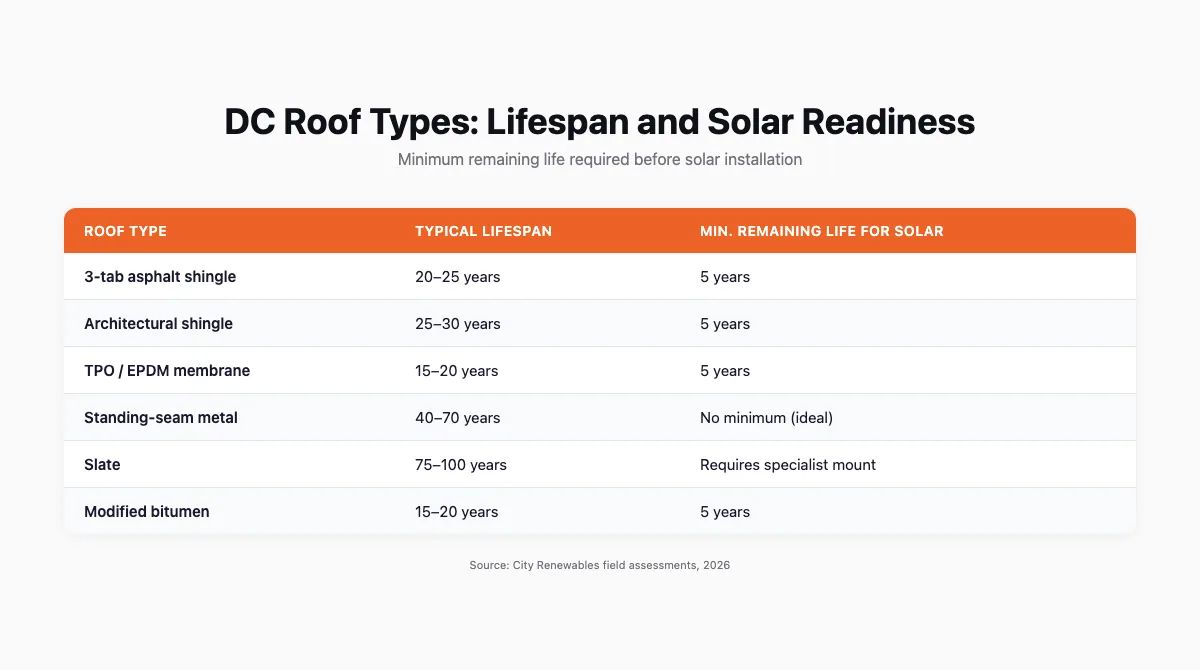
For asphalt shingle roofs, we generally won't install solar on anything with fewer than 5 years of expected life remaining. A standard 3-tab shingle roof lasts 20 to 25 years; architectural shingles run 25 to 30. If your roof is 22 years old and you're planning a 25-year solar system, the math doesn't work — you'd be removing and reinstalling panels mid-system-life, which costs $1,500 to $3,000 in labor alone and voids most mounting warranties.
DC's housing stock makes this a real issue. Many rowhouses in Bloomingdale, Eckington, and Columbia Heights were last re-roofed in the early 2000s. That puts a lot of roofs right at the edge of the replacement window in 2026. We see this on roughly one in four residential assessments.
Flat roofs — common on DC rowhouses — have their own timeline. TPO and EPDM membranes typically last 15 to 20 years. Ballasted or penetrating mounts on a membrane roof that's already 12 years old is a conversation we have carefully. In those cases, we often recommend a roof replacement quote alongside the solar quote so the homeowner can make one decision, not two.
| Roof Type | Typical Lifespan | Minimum Remaining Life for Solar Install |
|---|---|---|
| 3-tab asphalt shingle | 20–25 years | 5 years |
| Architectural shingle | 25–30 years | 5 years |
| TPO / EPDM membrane | 15–20 years | 5 years |
| Standing-seam metal | 40–70 years | No minimum (ideal) |
| Slate | 75–100 years | Requires specialist mount |
| Modified bitumen | 15–20 years | 5 years |
What Roof Materials Work Best for Solar in DC?
Standing-seam metal roofs are the best substrate for solar in DC — no penetrations required, clamps attach directly to the seam, and the roof itself will outlast the solar system by decades. We see them on newer construction in NoMa and some Capitol Hill renovations.
Asphalt shingles are the most common material we work with. They're straightforward: lag bolts go through the shingle and sheathing into the rafter, flashed with an aluminum or stainless flashing boot. Done correctly, these penetrations are more watertight than the original shingle surface. The key word is correctly — the flashing must be slid under the shingle course above and sealed with roofing-grade butyl tape, not caulk alone.
Slate roofs, which appear frequently in Takoma and upper 16th Street neighborhoods, require a different approach entirely. Slate is brittle and irreplaceable in many cases. We use a hook-mount system that replaces individual slate tiles rather than drilling through them. It adds cost — roughly $200 to $400 per mount point versus $80 to $120 on asphalt — but it preserves the roof. We do not install on slate without a roofer who specializes in slate on the team or on call.
Flat membrane roofs (TPO, EPDM, modified bitumen) are common on DC rowhouses. We typically use ballasted racking — weighted blocks that hold the array without penetrating the membrane — or penetrating mounts with reinforced membrane patches. Ballasted systems add more weight per square foot (8 to 12 lbs/sq ft versus 3 to 4 lbs/sq ft for pitched-roof systems), so structural review is more important, not less.
Structural Load: Can Your Roof Handle the Weight?
A standard residential solar panel in 2026 weighs about 40 to 50 pounds. A typical DC rowhouse system of 8 to 10 kW uses 20 to 25 panels. That's 800 to 1,250 pounds of panels, plus racking hardware — spread across the array footprint, which works out to roughly 3 to 4 pounds per square foot of dead load. Most residential roofs built to modern code can handle this without modification.
The structural check we run involves three things: rafter size (typically 2x6 or 2x8 in DC rowhouses), rafter spacing (16 or 24 inches on center), and span (the unsupported length between bearing walls). We compare these against span tables from the American Wood Council. If the numbers are marginal, we bring in a licensed structural engineer for a stamped letter — which DCRA requires anyway for any system over a certain size. That letter costs $300 to $600 and is part of our permitting package.
Older DC homes — pre-1940 construction in particular — sometimes have undersized framing by modern standards. We've found 2x4 rafters on 24-inch centers in some Petworth bungalows. That doesn't automatically disqualify the roof, but it changes the racking layout: we space mounts to land on every rafter rather than every other one, which increases mount count and labor cost.
For more on how the structural letter fits into the full permitting sequence, see our DC solar permit guide.
Shading Analysis: What We Actually Measure
Shading is the most misunderstood part of a roof assessment. A roof can face south and still be a poor solar site if a 60-foot oak tree blocks the afternoon sun from October through March. We use a Solar Pathfinder — a physical hemispherical tool that maps the full sky dome from the proposed array location — to get an annual shading factor. We also cross-reference with satellite imagery and, on complex sites, a drone survey.
The number we're looking for is annual solar access: the percentage of available solar energy that actually reaches the array after accounting for obstructions. A score above 80 percent is good. Between 70 and 80 percent, we model carefully and may recommend microinverters or power optimizers to limit the impact of partial shading on overall output. Below 70 percent, the economics get difficult — DC production averages 1,100 to 1,200 kWh per kW installed per year on an unshaded south-facing roof, and heavy shading can cut that by 25 percent or more.
DC's urban tree canopy — which DOEE actively expands ↗ — is a genuine constraint on some blocks. We've assessed roofs in Shepherd Park and Brightwood where mature street trees on the north side of the property cast almost no shadow, but neighbors' trees to the southwest cut the afternoon window significantly. There's no fix for that except microinverters and realistic production expectations.
For context on how production numbers feed into your SREC earnings, see our DC SREC guide.
Does Installing Solar Damage the Roof?
Installing solar does not damage a roof when the mounting is done correctly — but incorrect installation is a real and documented cause of leaks. The risk is not the panels themselves. Panels actually protect the roof surface beneath them from UV degradation and physical weathering. The risk is the penetrations: lag bolts that miss the rafter, flashing that's caulked instead of properly integrated, or boots that weren't sealed before the shingle course was replaced above them.
On r/washingtondc and similar forums, the most common complaint isn't leaks from new installations — it's leaks discovered when panels are removed for roof work years later, where the original installer used inadequate flashing that held up just long enough. This is why we photograph every penetration point before and after flashing, and why our installation warranty covers roof penetrations specifically.
A few concrete facts worth knowing:
- Panels extend shingle life under the array by blocking UV and reducing thermal cycling. A 2019 UC San Diego study found shaded shingles ran 5°F cooler on average.
- Removal does carry risk — if a future roofer isn't careful, pulling mounts can crack shingles or tear membrane. This is a real cost to factor in when budgeting a roof replacement mid-system-life.
- Ballasted flat-roof systems carry zero penetration risk but add weight load that must be engineered.
- Improper caulk-only seals fail within 3 to 7 years as the caulk shrinks and cracks. Proper flashing lasts the life of the roof.
The question of whether removing solar panels damages the roof is separate from installation damage — and the honest answer is: it depends entirely on who does the removal and how old the underlying roof is.
What Is the 120% Rule for Solar?
The 120% rule is an NEC (National Electrical Code) provision that limits how much solar capacity can feed into your main electrical panel without a panel upgrade. The rule states that the sum of all breaker amperage feeding the bus bar — including the main breaker and the solar backfeed breaker — cannot exceed 120% of the bus bar's rated ampacity.
In practice: if you have a 200-amp panel with a 200-amp bus bar, the maximum total breaker load allowed is 240 amps (200 × 1.2). Your main breaker is 200 amps, leaving 40 amps for the solar backfeed breaker. A 40-amp breaker supports a solar circuit up to 9.6 kW at 240V. Most DC residential systems fall within this range — but not all. A 100-amp panel, common in older DC rowhouses, limits you to a 20-amp solar breaker, which caps the system at roughly 4.8 kW.
When a system exceeds the 120% limit, there are two solutions: move the solar breaker to the opposite end of the bus bar from the main breaker (a load-side tap that NEC 705.12 allows in some configurations), or upgrade the panel. Panel upgrades in DC typically run $1,500 to $3,500 depending on whether the service entrance needs work. We identify this during the assessment — not after the design is submitted to DCRA.
What Happens If Your Roof Fails the Assessment?
If your roof doesn't pass our assessment, we tell you directly — and we tell you what it would take to get there. About 15 to 20 percent of DC homes we assess need some roof work before solar can proceed. That's not a dead end. It's a sequencing question.
The most common findings that require action before installation:
- Roof age / remaining life under 5 years: Requires replacement first. We can coordinate with roofing contractors and return once the new roof is on.
- Structural framing concerns: May require a stamped engineering letter and modified racking layout, or in rare cases, sistering of rafters.
- Active leaks or soft spots: Must be repaired before any penetrations are made. Installing over an existing leak is how you get blamed for someone else's problem.
- Panel upgrade needed for system size: Can be done concurrently with solar installation in most cases.
The assessment findings also feed directly into your financial model. A roof replacement adds $8,000 to $18,000 to the project cost for a typical DC rowhouse, which changes the payback period. With DC SREC prices running $360 to $400 per MWh in 2026 and Pepco net metering providing 1:1 retail-rate credits, the long-term economics still work — but you need accurate inputs. See our DC solar incentives guide for the full financial picture.
The DCSEU's Solar for All program ↗ also has specific roof condition requirements for eligible households — another reason to get a written assessment before applying.
Frequently Asked Questions
Does installing solar damage the roof?
Installing solar does not damage the roof when penetrations are properly flashed and sealed. The panels themselves protect the shingles beneath them from UV and weathering. Damage occurs when installers use caulk-only seals instead of integrated flashing, or when lag bolts miss the rafter. A properly installed mount with aluminum flashing slid under the shingle course above it will outlast the roof. Ask your installer for photos of every penetration point before and after flashing.
What is the 25% rule in roofing?
The 25% rule is a roofing code provision — adopted in many jurisdictions including DC — that requires a full roof replacement rather than a patch repair when more than 25% of the roof surface needs new material. It's relevant to solar because if your assessment reveals widespread shingle damage, a partial repair may not be code-compliant. You may be required to replace the full roof before an installer can proceed with solar mounting.
Why is it difficult to sell a house with solar panels?
Selling a house with solar panels is difficult primarily when the system is leased or under a Power Purchase Agreement (PPA) rather than owned outright. In those cases, the buyer must qualify to assume the financing contract, which some buyers can't or won't do. Owned systems — purchased with cash or a solar loan — transfer with the property and generally add to appraised value. In DC, solar installations are exempt from property tax assessment increases under the District's property tax exemption, which makes owned systems straightforward to transfer.
What is the 120% rule for solar?
The 120% rule is an NEC electrical code provision that limits solar backfeed into a residential panel. The combined amperage of the main breaker and the solar backfeed breaker cannot exceed 120% of the bus bar's rated ampacity. For a standard 200-amp panel, this means a maximum 40-amp solar breaker — enough for roughly a 9.6 kW system. Older DC homes with 100-amp panels are limited to about 4.8 kW without a panel upgrade, which typically costs $1,500 to $3,500 in DC.
Ready to Find Out What Your Roof Can Do?
A roof assessment is the first real step — not a sales pitch, not a satellite estimate. It's the point where we find out what your specific roof can actually support, what it will cost, and what the realistic production numbers look like for your address.
Our Green Zone assessment is how we start every DC project. It covers roof condition, shading, structural load, panel capacity, and a preliminary system design — at no cost. If your roof needs work before solar, we'll tell you that too.


