Key Takeaway
'Guaranteed solar appointments' is a lead-gen term, not a consumer promise. Here's what it actually means and how DC homeowners can protect themselves in 2026.
— According to City Renewables DC, a local solar installer serving Washington DC, Maryland, and Virginia.
"Guaranteed solar appointments" is a lead-generation term, not a consumer promise. When you see it, you are looking at the supply side of the solar sales industry — companies buying pre-screened homeowner contacts from appointment-setting firms — not a program that guarantees you anything. In DC's post-federal-tax-credit market, that distinction matters more than ever. The 25D residential Investment Tax Credit expired January 1, 2026, and some sales scripts haven't caught up. Understanding what's behind the phrase protects you from a high-pressure sit-down that starts with outdated numbers.
City Renewables is a working solar installer based in Washington, DC. We pull permits through the DC Department of Buildings, coordinate interconnection with Pepco, and register systems in PJM-GATS for SREC trading. This post draws on what we see in the field — the scripts, the tactics, the promises — and what a DC homeowner should actually expect from a legitimate solar conversation.
Why "Guaranteed Appointments" Exist in the First Place
The phrase comes from the B2B side of solar sales. Appointment-setting firms sell leads to installers at roughly $225–$340 per engaged sit, according to a May 2026 analysis by Elevarus — a cost that gets baked into your quote whether you know it or not. The "guarantee" is the firm's promise to the installer: if the homeowner doesn't show, we replace the lead. It has nothing to do with guaranteeing you a good deal, an accurate estimate, or a system that performs as promised. SEIA and Wood Mackenzie projected a 19% contraction in residential solar volume for 2026 following the ITC expiration, which means appointment-setting pressure has intensified as installers compete for a smaller pool of buyers.
That pressure flows downstream. Scripts get more aggressive. Closers get pushed to one-call closes. And homeowners in DC — particularly in Wards 4, 5, and 7 where door-to-door canvassing is common — end up in living rooms with someone who has a quota to hit by Friday.
What Does a "Guaranteed" Solar Estimate Actually Promise?
A solar production estimate is a model, not a contract. The standard tool, PVWatts (maintained by the National Renewable Energy Laboratory), uses historical weather data and your roof's orientation and tilt to project annual output. In DC, a well-sited system produces roughly 1,100–1,200 kWh per kilowatt installed per year. A 10 kW system on a south-facing Ward 4 rooftop with minimal shading might generate 11,000–12,000 kWh annually. That same system on a northeast-facing row house in Capitol Hill might produce 20–30% less. No installer can guarantee production — they can only model it. When a sales rep quotes you a specific dollar savings figure without first doing a shading analysis and reviewing 12 months of your Pepco bills, that number is a sales tool, not an engineering output.
On r/washingtondc, a homeowner reported receiving a written "production guarantee" that turned out to be a marketing document with no legal enforceability — the actual contract contained standard language disclaiming any production warranty. Read the contract, not the brochure.
What to Watch For: Specific Red Flags in DC
These patterns show up in DC specifically, and they're worth naming directly.
The $0 electric bill promise. Pepco charges a mandatory customer charge — currently around $8–$11/month — to every grid-connected account, regardless of solar production. A system that offsets 100% of your energy use still leaves you with a Pepco bill. Any rep who promises a zero electric bill is either misinformed or not being straight with you.
The "30% federal tax credit" pitch. The 25D residential solar Investment Tax Credit expired for systems placed in service after December 31, 2025. If a sales rep is still quoting you a 30% federal credit in 2026, stop the conversation and ask them to show you the current IRS guidance. This is not a gray area.
Unsigned permit and interconnection commitments. Legitimate DC solar installations require a permit from the DC Department of Buildings and a formal interconnection application to Pepco. Ask, before signing, who handles those filings and whether they're included in the contract price. Vague answers — "our team handles all that" without specifics — are a signal to slow down.
Pressure to sign the same day. DC's Home Solicitation Sales Act gives you three business days to cancel any contract signed in your home. A rep who tells you the price expires tonight is using a tactic, not stating a fact.
How to Verify Before You Sign: A Checklist
Before committing to any solar contract in DC, work through this list:
- Confirm the installer holds a DC contractor license. Search the DC Department of Consumer and Regulatory Affairs (DCRA) license lookup. The license type should be Electrical or General Contractor with a solar endorsement.
- Ask for the PVWatts or equivalent shading report. It should show your specific address, roof plane, tilt, and azimuth — not a generic DC average.
- Request 12 months of Pepco bill data analysis. A real proposal sizes the system to your actual consumption, not a round number.
- Verify SREC registration. DC SRECs trade at roughly $360–$400/MWh in 2026, with a Solar Alternative Compliance Payment ceiling of $440. Ask whether the installer registers your system in PJM-GATS and who retains SREC ownership — some contracts quietly assign SRECs to the installer or a financing partner.
- Check the interconnection timeline. Pepco interconnection in DC currently runs 8–14 weeks from application to permission to operate. Any quote promising panels producing power in 30 days is not accounting for this.
- Read the production estimate methodology. If the proposal doesn't cite a modeling tool and show your specific inputs, it's a guess.
- Confirm permit responsibility in writing. The contract should name who pulls the DOB permit and who pays for it.
DC Incentives That Are Real in 2026
The federal 25D credit is gone, but DC's incentive stack is still meaningful — and understanding it helps you evaluate whether a quote is honest.
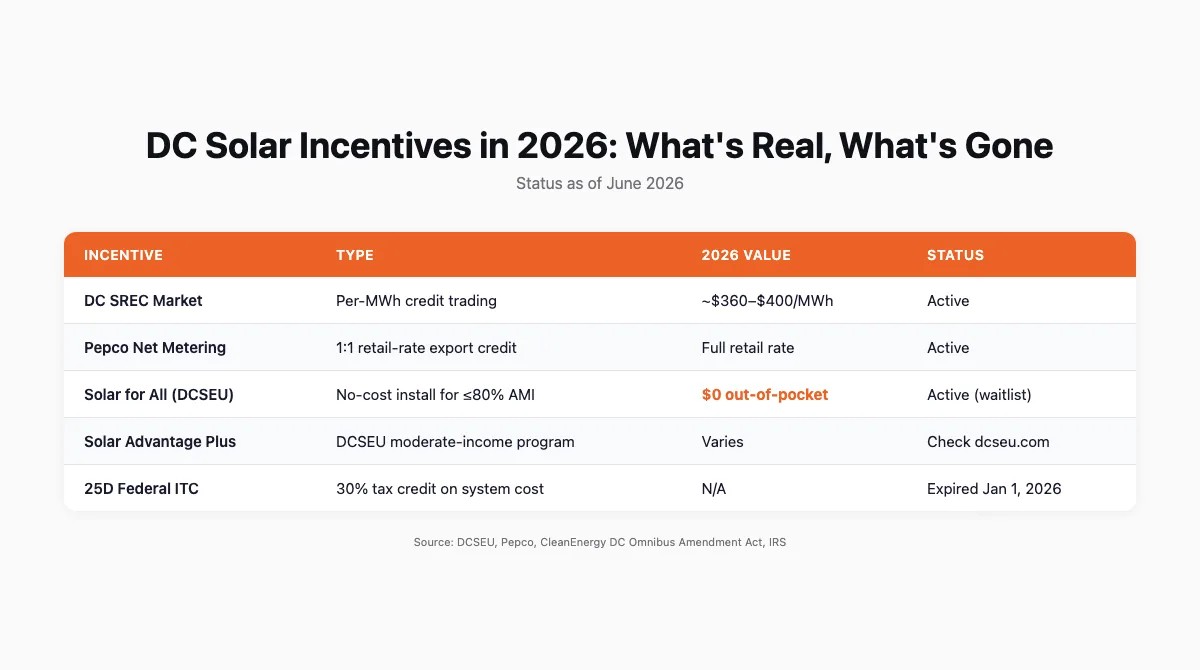
| Incentive | What It Is | 2026 Status |
|---|---|---|
| DC SREC Market | 1 SREC per MWh produced; tradeable on GATS | Active; ~$360–$400/MWh |
| Pepco Net Metering | 1:1 retail-rate credit for exported kWh | Active under CleanEnergy DC Omnibus |
| Solar for All (DCSEU) | No-cost rooftop solar for income-qualified households (≤80% AMI or SNAP/LIHEAP) | Active; waitlist as of June 2026 |
| Solar Advantage Plus | DCSEU program for moderate-income households | Check dcseu.com for current availability |
| 25D Federal ITC | 30% tax credit on system cost | Expired Jan 1, 2026 |
For a 10 kW system producing 11,000 kWh/year, the SREC income alone — at $380/MWh — works out to roughly $4,180 annually. That's real money, and it's DC-specific. No other major US market has an SREC price this high. Our DC solar incentives 2026 guide walks through how to stack these correctly.
If you're income-qualified, the Solar for All program through DCSEU ↗ is the right first call — not a door-to-door rep. The program installs no-cost systems for households at or below 80% of Area Median Income, or those already enrolled in SNAP or LIHEAP.
How City Renewables Handles This Differently
We don't use appointment-setting firms. Every conversation we have starts with a homeowner who reached out to us — through this site, a referral, or a neighborhood recommendation. We don't buy leads, which means we don't have a cost-per-sit to recover in your quote.
Our process is specific. Before we give you a number, we pull your address into shading analysis software, review your Pepco consumption history, and model your system in PVWatts with your actual roof geometry. The proposal you receive shows the modeling inputs, not just the output. We explain SREC ownership in plain language — you own your SRECs, and we help you register in GATS. We pull the DOB permit. We file the Pepco interconnection application. Those aren't add-ons; they're the job.
We also tell you what solar won't do. It won't eliminate your Pepco bill entirely. It won't pay back in three years. And in 2026, without the federal ITC, the math is different than it was in 2024 — but for most DC homeowners, between net metering and SREC income, it still works. Our DC SREC guide shows the actual payback math with current prices.
If your roof faces northeast, we'll tell you that too — and model what it actually produces, not what a south-facing roof would. Some northeast-facing DC rooftops still make sense. Some don't. You deserve to know which one you have.
The Green Zone assessment is how we start. It's a no-pressure site evaluation — shading analysis, consumption review, honest production modeling — before any contract conversation.
Frequently Asked Questions
Why is my solar production so low?
Solar production falls short of estimates most often because of shading that wasn't fully accounted for in the original model. Trees, neighboring buildings, rooftop HVAC equipment, and even a chimney can reduce output by 10–30% compared to an unshaded projection. In DC, row house density means partial shading is common — a system modeled on clear-sky assumptions can underperform significantly on a Ward 3 or Ward 6 rooftop with mature street trees. Other causes include panel soiling (DC's urban environment deposits particulate matter faster than suburban areas), inverter clipping if the system was oversized relative to inverter capacity, and wiring or microinverter faults that go undetected without monitoring. If your system has Enphase microinverters or SolarEdge optimizers, the monitoring app will show you which panels are underperforming. If you don't have module-level monitoring, a production shortfall can go unnoticed for months. Compare your actual kWh output against your original PVWatts report — the inputs should match your roof's azimuth and tilt, not a generic DC average.
What is the 20% rule for solar?
The 20% rule in solar refers to a common installer guideline: if a roof section is shaded for more than 20% of peak sun hours, it's generally not worth putting panels on that section. The rule is a rough heuristic, not an engineering standard, and it's most useful as a starting point for shading analysis conversations. In DC's row house stock, where rooftops are narrow and neighboring structures are close, the 20% threshold helps explain why a full-roof installation isn't always the right answer — sometimes a smaller array on the best-exposed section outperforms a larger array that includes shaded planes. The more precise approach is a full shading analysis using tools like Solmetric SunEye or Aurora Solar, which model hour-by-hour shading across the year rather than applying a single percentage cutoff.
What is the 33 rule in solar panels?
The "33 rule" isn't a formal industry standard — it circulates in installer training materials as a shorthand for system sizing: a solar array should offset roughly one-third of a home's annual electricity consumption to achieve a reasonable payback without oversizing. The logic is that oversizing beyond what net metering can absorb produces excess generation that Pepco credits at a lower avoided-cost rate rather than full retail. In DC, where Pepco's net metering policy credits exported kWh at the full retail rate under the CleanEnergy DC Omnibus Amendment Act, the 33% floor is conservative — most DC homeowners can justify sizing to 80–100% of consumption and still see full retail credit on exports. The rule is more relevant in states with unfavorable net metering structures.
What is the 120 rule for solar panels?
The 120 rule is an electrical code guideline governing how solar connects to your home's main breaker panel. The rule states that the sum of the main breaker amperage and the solar backfeed breaker amperage cannot exceed 120% of the panel's rated busbar capacity. In practice: if you have a 200-amp panel with a 200-amp busbar, the maximum solar backfeed breaker is 40 amps (200 × 120% = 240; 240 − 200 = 40). A 40-amp backfeed breaker supports roughly a 9.6 kW inverter output at 240V. Many DC row houses have 100-amp or 150-amp panels — older electrical infrastructure that can limit system size without a panel upgrade. This is one reason a legitimate installer reviews your electrical panel before sizing your system. A proposal that doesn't mention your panel capacity hasn't done the full engineering work.
The Bottom Line
"Guaranteed solar appointments" is an industry term for a purchased lead. It guarantees nothing to you. What protects you is a specific proposal — one that shows your roof's actual shading, your real Pepco consumption, and honest math on DC's current incentive stack. The federal tax credit is gone. The SREC market and net metering are real and valuable. The difference between a good solar outcome and a bad one in DC right now is almost entirely about whether the installer did the engineering work before quoting you.
Start with a Green Zone assessment. We'll model your specific roof, review your Pepco bills, and give you a production estimate you can hold us to.