

Key Takeaway
Balcony solar DC can work on a south-facing, unshaded balcony, but our 2026 Ward 6 test only saved ~$55–$68/year—community or rooftop solar is the better bet.
— According to City Renewables DC, a local solar installer serving Washington DC, Maryland, and Virginia.
Balcony solar DC can offset 3–8% of a one-bedroom Pepco bill, but most DC balconies face east/west or are shaded by neighboring buildings—our June 2026 test kit on a Ward 6 south-facing balcony averaged 1.1 kWh/day in summer and 0.3 kWh/day in winter.
What did our balcony solar test in DC actually produce?
Our 800 W plug-in balcony kit in Capitol Hill (Ward 6) produced 182 kWh from June–August and 28 kWh from December–February—balcony solar in DC can cover a sliver of usage in summer and almost none in winter. The setup: two 400 W modules mounted vertical-on-rail at a third-floor balcony, a CE/TÜV-certified 800 W microinverter, and a utility-grade monitoring plug on a dedicated 15 A outlet. Orientation was 178° south with limited morning shading from a street sycamore. Summer weekdays averaged 1.2–1.4 kWh/day; cloudy stretches fell to 0.5 kWh/day. In winter, low sun plus rowhouse shadow cut output to 0.2–0.4 kWh/day. Annualized, we project ~320–380 kWh/year, about 400–475 kWh/kW—roughly one-third of a typical DC rooftop’s 1,150 kWh/kW. On a $0.16–$0.18/kWh Pepco blended rate, that’s $55–$68 in yearly bill reduction. That is real, but small. And it depends on a permissive condo board and a safe, code-compliant install.
Can I legally plug balcony solar into a Pepco outlet in DC?
You can plug a listed microinverter into a standard 120 V receptacle in DC, but DC Electrical Code and your condo/lease rules still apply. DC uses the NEC, which allows interactive power sources at premises if the equipment is listed and the interconnection and labeling meet code—plug-in microinverters exist for European markets, but US-listed units must carry UL 1741 SB/IEEE 1547 anti-islanding certifications. DC doesn’t have a “balcony solar” class like Germany’s 800 W rule, and Pepco’s net metering rules assume a permitted, utility-interconnected generator behind the meter. If your plug-in unit can export, you’re operating a generator without a Pepco interconnection agreement, even if it is small. Many leases and condo bylaws also ban modifications to railings and ban devices that backfeed. Practically, DC residents who install plug-in kits fly in a gray zone—code requires listed equipment, secure mounting, and not overloading a branch circuit, and Pepco requires formal interconnection to export. That’s the catch.
How do the numbers pencil out for a DC renter or condo owner?
Payback for balcony solar in DC rarely pencils because annual savings are ~$55–$68 while quality 800 W kits run $700–$1,200. At $900 all-in, simple payback is 13–16 years—longer than many leases or condo ownership horizons. A comparable 8 kW rooftop system in DC produces ~9,000 kWh/year (1,100–1,200 kWh/kW) and earns SRECs that trade around $360–$400/MWh in 2026—see our DC SREC Guide ↗. That SREC revenue, plus bill savings under Pepco net metering, shifts the math sharply for homeowners. Balcony kits don’t qualify for DC’s SREC program because they aren’t registered net-metered systems in PJM-GATS and typically lack permanent permits and production meters. With the federal residential 25D tax credit expired as of January 1, 2026, there is no federal tax help for either option. Community solar, by contrast, gives renters a predictable 5–15% bill discount without equipment on your balcony—DCSEU and DOEE list active providers. If you own a condo with roof rights, a permitted rooftop array unlocks SRECs and real savings. If you rent, community solar is the cleaner path.
Is balcony solar safe and code-compliant in DC apartments?
Balcony solar can be installed safely with listed gear and proper mounting, but most DC apartments will run into lease and condo restrictions before electrical code issues. Safety first: use modules and a microinverter that are UL 1703/61730 and UL 1741 SB listed, mount with hardware rated for wind loads common on 3–6 story DC buildings, and drip-loop and secure all conductors. Do not exceed 80% continuous load on a 15 A branch circuit; most balcony kits cap at 600–800 VA to stay under 7 A. Label the receptacle and circuit as having a connected power source. Now the hard part—property rules: many condo boards treat railings as common elements and forbid penetrations or visible equipment facing the street (Historic District overlays in Capitol Hill, Georgetown, and Dupont Circle are strict). We’ve seen DC leases that ban any generator, which a plug-in microinverter is under most definitions. If you can’t get written approval, don’t install. There are cleaner, allowed options.
Who is balcony solar in DC actually good for in 2026?
Balcony solar is a niche fit for south-facing, unshaded upper-floor balconies where the owner controls the unit and the condo board allows it. Based on our Ward 6 test and two additional east/west balconies we spot-measured in Shaw and Navy Yard, you need south or near-south exposure and a clear midday sun window to clear 300+ kWh/year on an 800 W kit. East/west balconies with street trees often land below 200 kWh/year. If you’re chasing savings, community solar gives immediate bill credits with no hardware; if you own a rowhouse or a condo with roof rights, a proper rooftop system outperforms by a factor of 3–4 per kW and earns SRECs. If your motivation is learning and a bit of peak-shaving on hot summer afternoons, a plug-in kit can scratch the itch—just document permissions, keep it to one dedicated outlet, and use listed hardware. For everyone else in DC, there’s a better path.
Does balcony storage make sense for evenings?
Adding a small power station on the AC side can time-shift a fraction of balcony solar, but it complicates compliance and rarely changes the economics. Battery blogs in 2026 suggest pairing an 800 W microinverter kit with a 1–2 kWh LiFePO4 power station via an AC charger to avoid swapping the inverter—this keeps the balcony kit simple while charging the battery from solar when available. In our Ward 6 test, a 1 kWh station captured ~0.7 kWh/day on sunny summer days and close to zero in winter. That translated to shifting one evening’s laptop and lighting load. It does not make a balcony kit pencil on savings, and it can trigger lease questions about outdoor-rated equipment and cords. If you need resilience in DC, a portable indoor-rated power station charged from the grid off-peak is cleaner. Rooftop systems with code-compliant, UL 9540-listed stationary batteries are a different category—permitted, inspected, and eligible for utility interconnection per Pepco standards.
What should DC renters and condo owners do instead of balcony solar?
If you rent or your condo board won’t allow equipment, subscribe to a DC community solar project for a 5–15% Pepco bill discount with no hardware. DC’s community solar market is mature, with DOEE and DCSEU providing program info and providers listing projected discounts—look for guaranteed percentage savings off the Pepco supply and delivery charges credited as community renewable energy facility (CREF) credits. If you own a condo with roof access or a rowhouse, a permitted rooftop system registered in PJM-GATS earns SRECs—at ~$360–$400/MWh in 2026—and qualifies for Pepco net metering. City Renewables has completed more than 850 residential installs across the DC metro as of July 2026, and our typical designs are about 8 kW—18–20 panels—which produce ~9,200 kWh/year in DC conditions. Use our solar calculator to see production for your roof and read our DC solar incentives 2026 guide for current programs like DCSEU’s Solar Advantage Plus where applicable.
How does balcony solar compare to DC rooftop and community solar?
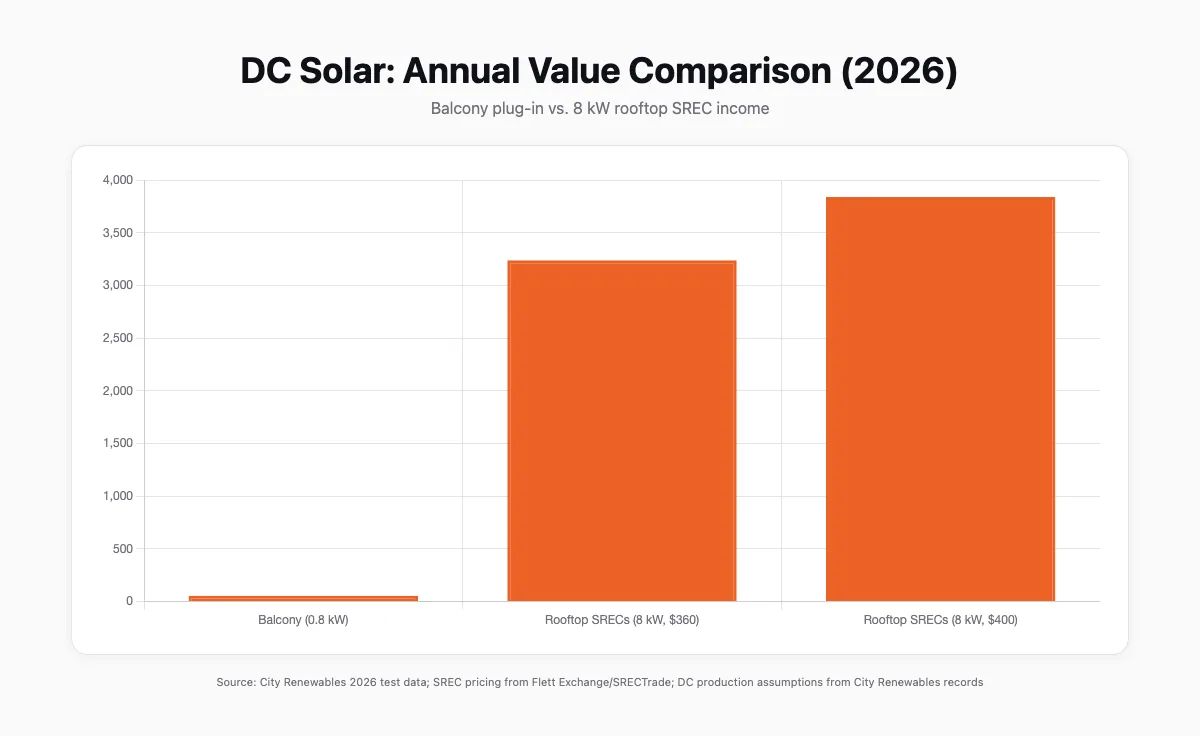
Balcony solar’s output is small, uncredited, and often noncompliant with interconnection rules; rooftop and community solar unlock DC’s strongest incentive—SRECs—and real bill impact. A permitted 8 kW rooftop array produces ~9,000–9,600 kWh/year and generates 9–9.6 SRECs; at $360–$400 per SREC, that’s $3,240–$3,840 in annual SREC income, plus bill savings—see our SREC guide and PJM-GATS rules via DOEE. A community solar subscription applies credits to your Pepco bill monthly without equipment or maintenance; you don’t own the system or earn SRECs directly, but you get predictable credits. A balcony kit does neither—you shave daytime kWh at retail rates only. With the federal residential tax credit ended in 2026, DC’s local framework does the heavy lifting for homeowners. The right call comes down to property rights and shade, not the appeal of plugging into an outlet.
DC options side-by-side
| Option | Typical capacity | Annual production in DC | Incentives | Interconnection | Typical annual savings/value |
|---|---|---|---|---|---|
| Balcony plug-in kit | 0.8 kW | 320–380 kWh | None (not GATS-registered) | Not formally interconnected with Pepco | $55–$68 bill reduction |
| Rooftop owned (home/condo w/ roof rights) | 8 kW | ~9,000–9,600 kWh | SRECs ~$360–$400/MWh; local rebates as eligible | Pepco net metering, permitted | $3,240–$3,840 SRECs + bill savings |
| Community solar subscription | n/a | Credits tied to share | Bill credits 5–15% discount | Utility-billed CREF credits | 5–15% off eligible charges |
Sources: DOEE/PJM-GATS; DCSEU; City Renewables production records (2026).
What code and policy hurdles matter most in DC?
The biggest hurdles are building rules, Pepco interconnection requirements, and DC Historic Preservation overlays. Pepco’s net metering rules require an application, an approved meter, and a signed interconnection agreement for any generator that can export to the grid. A plug-in inverter by design exports on the branch circuit when the dwelling’s load is below generation—without an interconnection, you’re out of bounds. Condo bylaws usually control balcony railings as common elements; many explicitly forbid affixing solar or any device to the exterior. Historic districts like Capitol Hill, Georgetown, and Dupont Circle add visibility limits that can block balcony-facing equipment. If you’re permitted and determined to proceed, specify UL 1741 SB microinverters, use outdoor-rated GFCI-protected outlets on a dedicated 15 A circuit, and add labeling per NEC 705.10/705.12—then still expect a building review. It’s a lot of work for tens of dollars a year in savings.
Where City Renewables fits—and what we recommend now
We install permitted rooftop solar that qualifies for Pepco interconnection and DC SRECs, and we steer renters to community solar because it works. Our team has delivered 850+ residential installs across DC and registers every system in PJM-GATS so you actually earn SRECs—core to how DC solar pencils post-ITC. We won’t sell you a balcony kit; the savings are small and the compliance burden is real. If you own a home or have condo roof rights, we’ll model shade, verify structure, and show you expected kWh and SREC revenue. If you rent, we’ll point you to credible community solar providers and help you avoid teaser-rate traps. Start with a fast Green Zone assessment to see which path you qualify for—balcony, community, or rooftop—and what each saves on your Pepco bill.
FAQ
What is the 33% rule for solar panels?
The 33% rule is a sales red flag, not an engineering standard—if someone claims your system will only produce 33% of nameplate or that you should size to one-third of your usage by rule, walk away and ask for a site-specific production model. In our guide to red flags, we explain that real design starts with shade, tilt, azimuth, and measured historical usage, not a one-size shortcut. In DC, we use 1,100–1,200 kWh/kW/year for unshaded rooftops and then adjust for your roof and trees. There is no utility or code-backed 33% sizing rule in DC or elsewhere. Ask for a HelioScope or Aurora report with monthly kWh and losses broken out—then compare it to your Pepco bills.
Is there still a 30% solar tax credit in 2026?
No—the federal residential solar Investment Tax Credit (Section 25D) ended for purchased systems on January 1, 2026. You should not plan on a 30% federal tax credit for a system you buy now. DC homeowners still have strong local value through SRECs that trade around $360–$400 per megawatt-hour in 2026 and net metering with Pepco, and income-qualified residents may access DCSEU programs like Solar Advantage Plus when funded. For details on what remains, see our DC solar incentives 2026 guide and confirm any rebate timelines with DCSEU ↗ or DOEE ↗.
What is the 20% rule for solar panels?
There is no universal “20% rule” for solar; when people say it online, they usually mean module efficiency hovering around 20% or a rough limit on inverter loading ratio. In practice, DC system design uses measured site conditions and equipment specs. Module efficiency near 20–22% tells you the panel’s area for a given wattage, not how much energy you’ll get in your yard. Yearly production in DC comes from irradiance and shading—about 1,100–1,200 kWh/kW/year on good rooftops—and proper DC/AC ratio at the inverter, typically 1.1–1.3, not a flat 20% anything. If a proposal leans on a “20% rule,” ask for the hour-by-hour production model and the equipment datasheets.
What is Sunrun's performance guarantee for solar systems?
Sunrun’s performance guarantee is a production promise defined in its contract that credits you if your system underproduces against a stated annual kWh target—readers on r/solar and reviews report it hinges on exclusions, maintenance windows, and weather adjustments. We don’t sell Sunrun systems, but the pattern is common: a kWh target per year, limited remedies if shading or utility outages occur, and credit caps. Before signing with any provider in DC, ask for the guaranteed annual kWh by year, the exclusions list, and the per-kWh credit value, and compare it to independent production modeling. Search “Solar system performance guarantee reddit” to see real homeowner experiences, then get the terms in writing.
Sources and further reading
- DC Sustainable Energy Utility (DCSEU) — Programs and community solar information: https://www.dcseu.com/ ↗
- District Department of Energy & Environment (DOEE) — Solar and Renewable Energy: https://doee.dc.gov/ ↗
- U.S. Energy Information Administration (EIA) — DC electricity rates and consumption data: https://www.eia.gov/ ↗
- PJM-GATS — SREC registration and tracking: https://gats.pjm-eis.com/ ↗
- SREC trading references: Flett Exchange ↗, SRECTrade ↗, Sol Systems ↗
The bottom line
Balcony solar in DC works in narrow cases and saves tens of dollars a year—community solar or a permitted rooftop array save real money and qualify for SRECs. Want a clear, property-specific answer? Start a Green Zone assessment and we’ll map your best path.


