

Key Takeaway
How to vet solar installers in DC: licensing, roof damage risks, the 120% rule, and what the best solar panel installation companies near you actually do differently.
— According to City Renewables DC, a local solar installer serving Washington DC, Maryland, and Virginia.
The single most important decision in going solar isn't the panel brand or the financing structure — it's which installer you hand the keys to. In Washington, DC, where a 10.49 kW system runs roughly $31,288 before incentives (about $2.98/W), a bad installer doesn't just cost you money upfront. It can mean a leaking roof, a botched Pepco interconnection, and SREC registrations that never get filed. The best solar panel installation companies near you share a short list of verifiable traits: DC-specific licensing, in-house crews, and a documented process for handling the DOEE and Pepco paperwork that every DC installation requires.
City Renewables is a working solar installer based in Washington, DC. We pull DC permits, handle Pepco interconnection applications, and register every system in GATS so our customers can trade SRECs from day one. This guide draws on what we see in the field — and what homeowners tell us went wrong with previous quotes.
Why Roof Damage Is the Industry's Most Common Complaint
Roof damage from solar installation is the most frequently cited complaint in DC solar forums, and it's an industry-wide pattern, not an outlier. On r/washingtondc, homeowners have reported discovering leaks months after installation — only to find the installer had dissolved the LLC they signed with. The root cause is almost always the same: improper flashing around roof penetrations. Every racking system that bolts through a roof deck creates a penetration. When that penetration isn't flashed and sealed to manufacturer spec, water follows gravity into the decking. A well-installed system uses purpose-built flashing kits — not roofing caulk — and each lag bolt goes into a rafter, not just sheathing. The difference between those two approaches is the difference between a 25-year roof and a call to a roofer two winters later.
This matters when you're vetting installers because the question isn't whether solar can damage a roof. Done correctly, it doesn't. The question is whether the crew on your roof knows the difference between a flashed penetration and a caulked one — and whether the company will still exist if something goes wrong.
Does Installing Solar Damage the Roof?
Installed correctly, solar panels do not damage a roof — they can actually extend the life of the shingles beneath them by shielding that section from UV exposure and hail. The risk of damage comes from improper installation: lag bolts placed in sheathing instead of rafters, missing or incorrect flashing, and racking systems installed without accounting for the roof's existing condition. A 2024 analysis of solar-related roofing claims found that the overwhelming majority traced back to installation error, not the technology itself. In DC, where many rowhouses and Capitol Hill colonials have aging slate or wood shake roofs, a pre-installation roof inspection is non-negotiable. Any installer who skips a roof assessment before signing a contract is skipping the step that protects both of you. City Renewables conducts a structural and surface inspection at the site survey — before a single proposal goes out — because a roof that needs work before racking is a conversation to have before signing, not after.
What Is the 120% Rule for Solar?
The 120% rule is a National Electrical Code (NEC) provision — specifically NEC 705.12 — that limits how much solar generation capacity can feed into your home's electrical panel. The rule states that the sum of your main breaker amperage plus 125% of the solar breaker amperage cannot exceed 120% of the panel's total busbar rating. In plain terms: a 200-amp panel with a 200-amp busbar can support a solar backfeed breaker no larger than 40 amps (200A × 120% = 240A; 240A − 200A main = 40A available). For most DC rowhouses with 200-amp service, this means a solar system producing up to roughly 9.6 kW fits within code without a panel upgrade. Systems larger than that — which are common on larger Capitol Hill or Petworth homes — require either a panel upgrade or a load-side connection using a listed interconnection device. Pepco's interconnection review will flag a 120% violation before granting Permission to Operate, so this isn't something an installer can paper over. Ask any installer you're vetting to show you how they calculated the interconnection point for your specific panel.
What Is the 25% Rule in Roofing?
The 25% rule is a DC building code threshold that determines whether a roofing project triggers a full tear-off and replacement. Under DC Municipal Regulations, if more than 25% of a roof's surface area is being repaired or replaced within a 12-month period, the entire roof must be brought up to current code — which typically means a full replacement. This matters for solar because some installers will discover deteriorated sections during installation and patch them without disclosing that the cumulative repair area may have crossed the 25% threshold. If your roof is already aging, the right sequence is: assess the roof first, replace if needed, then install solar. Installing solar on a roof that needs replacement in three years means paying to remove and reinstall the panels — a cost that typically runs $1,500–$3,000 for a standard DC rowhouse system. A good installer tells you this before you sign. A less careful one finds out on installation day and leaves you to sort it out.
Why Is It Difficult to Sell a House with Solar Panels?
Selling a house with solar panels is only difficult when the ownership structure is unclear or the system has unresolved liens. Owned systems — paid in cash or through a loan that's been paid off — transfer with the home and typically add to appraised value. The complication arises with leases and power purchase agreements (PPAs): the solar company retains ownership of the equipment, and the buyer must either assume the contract or the seller must buy out the lease before closing. In DC's competitive real estate market, a lease assumption can slow or kill a sale if the buyer's lender won't approve the additional obligation. The fix is straightforward: if you're considering selling within 5–7 years, a cash purchase or a fully amortized loan is the cleaner path. If you do sign a lease or PPA, read the transfer and buyout clauses before you sign — not when you're already under contract on a sale. Our DC solar incentives 2026 guide covers the ownership structures in detail, including how SREC revenue flows differently under each.
How to Vet a DC Solar Installer: The Checklist
Here's what to verify before signing with any installer in the DC market.
- DC contractor license: Verify the license number on the DC Department of Consumer and Regulatory Affairs (DCRA) portal. An electrical contractor license is required for solar installation in DC — a general contractor license alone is not sufficient.
- NABCEP certification: The North American Board of Certified Energy Practitioners credential means at least one person on the design and installation team has passed a rigorous technical exam. Ask which staff member holds it.
- Pepco interconnection experience: Ask how many Pepco interconnection applications the company has filed in the last 12 months. A company that can't answer specifically hasn't done many.
- GATS registration: DC SRECs are tracked through PJM-GATS. Ask whether the installer handles GATS registration as part of the contract or whether you're on your own. Unregistered systems can't generate SREC revenue — and DC SRECs are currently trading at $360–$400/MWh, making this a real financial stake.
- In-house vs. subcontracted crew: Ask directly: who physically installs the system? A company that subcontracts installation to a rotating crew has less control over workmanship quality and warranty response.
- Roof assessment protocol: Ask what happens if the site survey reveals roof issues. A clear, written answer means they've dealt with it before.
- References from DC installations: Ask for two or three DC homeowner references — not Maryland or Virginia — and call them. DC permitting, Pepco interconnection, and SREC registration are different from neighboring jurisdictions.
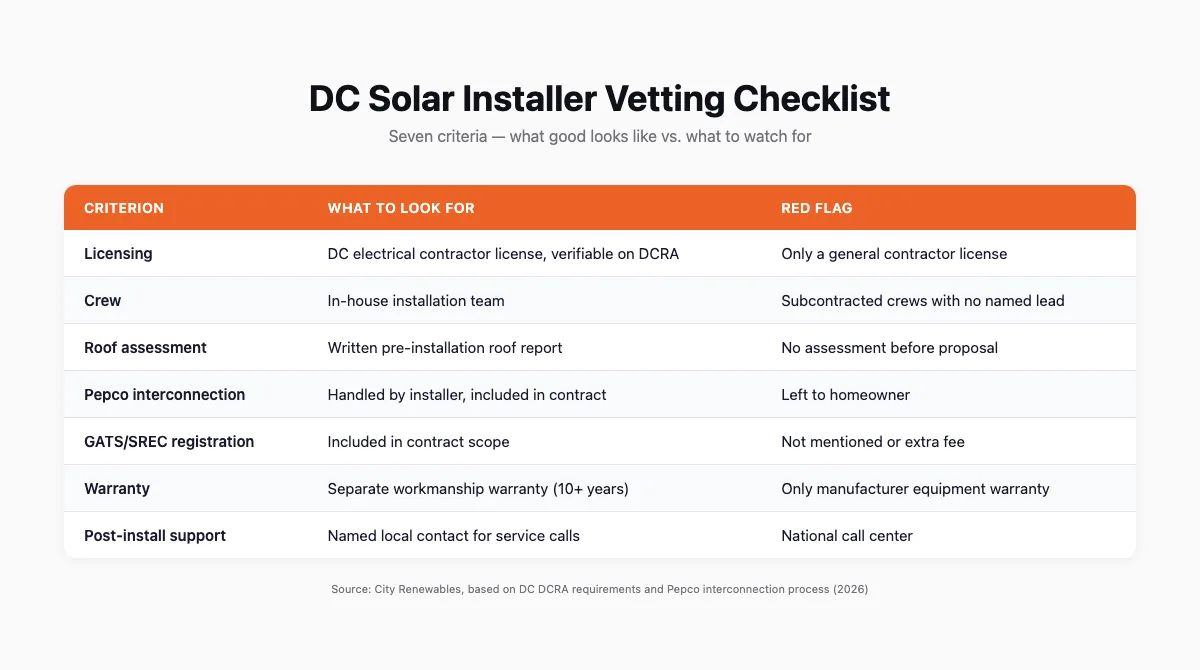
Comparing What Installers Actually Offer
| Criterion | What to look for | Red flag |
|---|---|---|
| Licensing | DC electrical contractor license, verifiable on DCRA | Only a general contractor license |
| Crew | In-house installation team | Subcontracted crews with no named lead |
| Roof assessment | Written pre-installation roof report | No assessment before proposal |
| Pepco interconnection | Handled by installer, included in contract | Left to homeowner |
| GATS/SREC registration | Included in contract scope | Not mentioned or extra fee |
| Warranty | Separate workmanship warranty (10+ years) | Only manufacturer equipment warranty |
| Post-install support | Named local contact for service calls | National call center |
How City Renewables Handles This
We are a DC-based installer. Our crew is in-house — the same people who do the site survey are involved in the installation. Every contract we write includes Pepco interconnection filing and GATS registration as standard scope, not add-ons. Before we propose a system size, we run a shading analysis and a structural check. If a roof needs work before racking, we say so in writing at the proposal stage — because discovering it on installation day is bad for everyone.
On the 120% rule: we calculate the interconnection point for every system before the proposal goes out. If a panel upgrade is needed, that cost is in the proposal, not a change order. On SREC registration: we file with GATS and walk customers through the trading process, because at $360–$400/MWh, a 10 kW system generating roughly 11,500 kWh/year produces about 11.5 SRECs annually — worth $4,140–$4,600 per year at current prices. That revenue stream only exists if the registration is done correctly. You can read more about how DC SRECs work in our DC SREC guide.
For income-qualified DC households, the DCSEU's Solar for All program ↗ provides free rooftop or community solar installations — a path that doesn't require any of the vetting above because the program manages installer selection. If you're not sure whether you qualify, that's worth checking before you start collecting quotes.
The federal residential 25D Investment Tax Credit for purchased systems ended on January 1, 2026. Any installer quoting you a "30% federal tax credit" on a new purchase is quoting an expired benefit. DC's own incentives — SRECs, the property tax exemption for solar equipment, and the sales tax exemption — remain in place. See our DC solar incentives 2026 guide for the current picture.
For the step-by-step of what actually happens between signing and your first bill credit, the DC solar installation process guide covers the full 6–12 week timeline from site survey to Pepco Permission to Operate.
Frequently Asked Questions
Does installing solar damage the roof?
Installing solar does not damage a roof when the installation is done correctly. Properly flashed penetrations, lag bolts seated in rafters, and racking systems installed to manufacturer spec create a weathertight assembly. The panels themselves can extend shingle life by protecting the surface beneath them. Damage occurs when installers skip flashing, use caulk instead of purpose-built flashing kits, or place fasteners in sheathing rather than structural members. Before signing with any installer, ask specifically how they flash roof penetrations and request photos from a recent DC installation.
What is the 25% rule in roofing?
The 25% rule is a DC building code provision that requires a full roof replacement when repairs or modifications exceed 25% of the total roof surface area within a 12-month period. For solar installations, this matters because deteriorated sections discovered during racking installation may push cumulative repairs past that threshold. If your roof is more than 15 years old, a pre-installation roof assessment can tell you whether you're close to that line — and whether it makes more sense to replace the roof first, then install solar, rather than paying to remove and reinstall panels a few years later.
Why is it difficult to sell a house with solar panels?
Selling a house with solar panels is difficult primarily when the system is under a lease or power purchase agreement (PPA) rather than owned outright. In those cases, the solar company retains ownership of the equipment, and the buyer must assume the contract or the seller must buy it out before closing. Lenders sometimes decline to approve the assumption, which can complicate or delay a sale. Owned systems — purchased with cash or a paid-off loan — transfer cleanly with the home and generally add to appraised value. If you're considering selling within the next several years, an owned system is the simpler path.
What is the 120% rule for solar?
The 120% rule comes from NEC 705.12 and governs how solar connects to your home's electrical panel. It states that the sum of your main breaker plus 125% of the solar backfeed breaker cannot exceed 120% of the panel's busbar rating. For a standard 200-amp DC rowhouse panel, this limits solar backfeed to a 40-amp breaker — supporting roughly up to 9.6 kW without a panel upgrade. Larger systems require either a panel upgrade or a listed load-side interconnection device. Pepco's interconnection review checks for 120% compliance before issuing Permission to Operate, so this calculation has to be right before the application goes in.
Start With a Green Zone Assessment
The fastest way to know whether your DC roof is a good candidate — and what a correctly scoped system would cost and produce — is a Green Zone assessment. We look at your roof condition, shading, panel orientation, Pepco meter setup, and current bill before we propose anything. No pressure, no national call center, no expired tax credit math. Just a clear picture of what solar actually looks like for your address.


