Key Takeaway
DC solar panels still pencil out in 2026 — SREC revenue, net metering, and Solar for All replace the expired federal credit. Here's what to know.
— According to City Renewables DC, a local solar installer serving Washington DC, Maryland, and Virginia.
The federal residential solar tax credit expired on January 1, 2026 — but DC solar panels still pencil out better than almost anywhere in the country. DC's SREC market pays $360–$400 per megawatt-hour of production, retail-rate net metering credits every kilowatt-hour you export to Pepco, and the DCSEU Solar for All program covers full installation costs for income-qualified households. The math changed. The opportunity didn't.
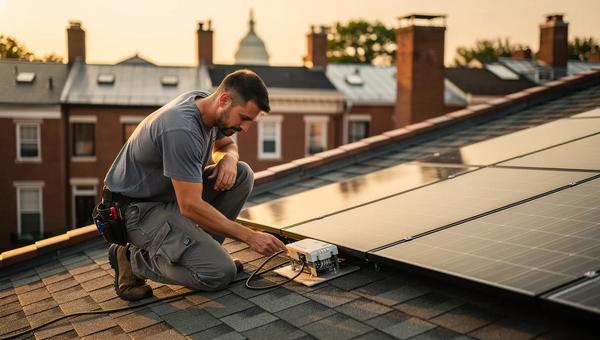
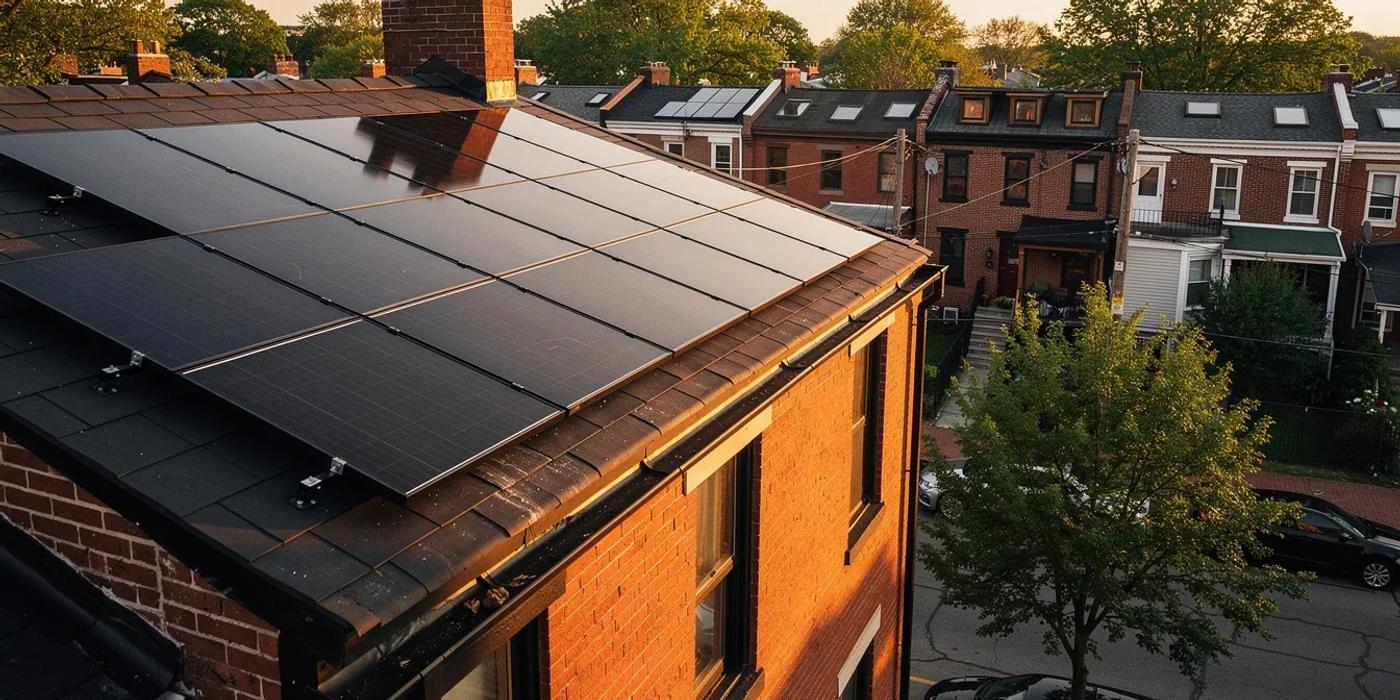
We're City Renewables, a solar installer based in Washington, DC. Every recommendation in this guide comes from systems we've designed and installed across the District — row houses in Ward 4, flat-roof colonials in Ward 6, and everything in between. We work with Pepco's interconnection process daily and register every system in GATS so our customers capture SREC revenue from day one.
What Makes a Solar Panel Right for a DC Home?
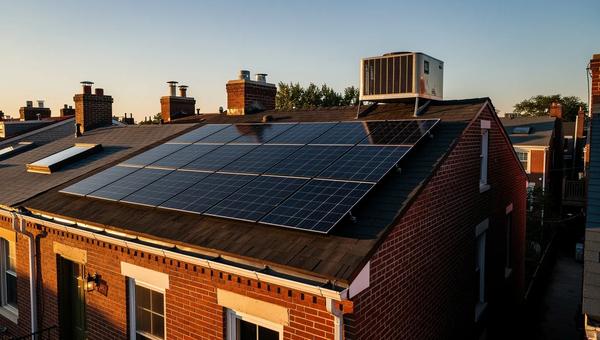
The best solar panel for a DC home is one that produces reliably in the District's specific conditions: partial shading from mature street trees, steep-pitched rear roofs on row houses, and summer heat that can suppress output on lower-efficiency modules. DC rooftops average 1,100–1,200 kWh of production per kilowatt installed per year — a narrower range than sunnier markets, which means panel efficiency and shading tolerance matter more here than in Phoenix. Monocrystalline PERC and TOPCon panels dominate the DC market in 2026 because they hold efficiency above 21% and degrade more slowly over a 25-year warranty period. For most DC homes, a 7–10 kW system using 400–430W panels covers 80–100% of annual consumption. The panel brand matters less than the combination of efficiency rating, temperature coefficient, and whether your installer sizes the system against your actual Pepco usage data — not a national average.
Which Panel Technologies Are Installed in DC in 2026?
Three cell technologies appear on DC rooftops right now, and each has a distinct profile.
| Technology | Typical Efficiency | Temperature Coefficient | Best For |
|---|---|---|---|
| Monocrystalline PERC | 20–22% | -0.35% / °C | Most DC row houses; cost-efficient |
| TOPCon (n-type) | 22–23% | -0.29% / °C | Small roofs needing max output |
| HJT (heterojunction) | 22–24% | -0.24% / °C | Flat roofs with high heat exposure |
PERC panels are the workhorse — widely available, well-priced, and proven over a decade of DC installations. TOPCon is the current sweet spot for homes with limited roof space, like the narrow rear sections of Capitol Hill rowhouses, where squeezing out an extra 5–8% efficiency per panel meaningfully changes system size. HJT panels carry the best temperature coefficient, which matters on dark-membrane flat roofs in Wards 7 and 8 that can hit 150°F in July — but they cost roughly 10–15% more per watt than PERC.
How Much Do Solar Panels Cost in DC in 2026?
With the 25D federal tax credit gone, the gross cost of a DC solar installation now lands entirely on the homeowner or their financing. Expect to pay $2.85–$3.50 per watt installed, which puts a typical 8 kW system at $22,800–$28,000 before any DC-specific incentives. A 10 kW system runs $28,500–$35,000. Those numbers are real — not the pre-incentive sticker prices some installers still advertise with the old 30% credit baked in.
What offsets that cost in 2026:
- DC SREC revenue — Each 1,000 kWh your system produces generates one SREC. At current DC market prices of $360–$400 per SREC, an 8 kW system producing roughly 9,200 kWh/year generates 9 SRECs annually — worth $3,240–$3,600/year. Over a 15-year SREC obligation period, that's $48,600–$54,000 in cumulative revenue at today's prices. See our DC SREC guide for how registration and trading work.
- Net metering — Pepco credits excess generation at the full retail rate, currently around $0.23–$0.24/kWh. A well-sized system can reduce your annual Pepco bill to near zero.
- DCSEU Solar for All — Income-qualified DC residents (at or below 80% of Area Median Income) can receive a no-cost solar installation through the DCSEU Solar for All program ↗. No loan, no PPA, no out-of-pocket cost.
- Property tax exemption — DC exempts the added home value from a solar installation from property tax assessment under the CleanEnergy DC Omnibus Amendment Act.
For a full breakdown of every current DC incentive, see our DC solar incentives 2026 guide.
Does Roof Orientation Actually Matter That Much?
South-facing is ideal, but it's not the only viable orientation in DC — and this is the belief that stops more homeowners than any other. A south-facing roof at a 30–35° pitch in DC produces at roughly 100% of theoretical maximum. A west-facing roof at the same pitch produces about 85–90% of that. East-facing comes in around 80–85%. Even a north-facing rear roof on a row house, if it's unshaded and steep, can produce 65–70% of a south-facing equivalent — enough to cover a meaningful share of consumption when combined with a south-facing section.
The real constraint in DC isn't compass direction. It's shading. A single large oak tree casting shadow across 30% of your roof surface from 10am–2pm will cut production more than switching from south to west orientation. We use shade analysis tools on every site assessment to model hour-by-hour production across the full year. If you're wondering whether your specific roof works, that's exactly what a Green Zone assessment is designed to answer.
What About Homes That Don't Own Their Roof?
Condo owners and renters can't install rooftop solar directly, but DC has two paths worth knowing. First, community solar subscriptions let you subscribe to a share of an off-site solar array and receive bill credits from Pepco — no roof required. Second, if you own a condo unit in a building where the HOA controls the roof, DC law allows individual unit owners to petition for solar access. It's not fast, but it's a real option. The DOEE maintains a community solar registry for DC projects accepting subscriptions.
Solar Loans vs. PPAs in DC: What Changed in 2026
Before January 2026, a Power Purchase Agreement (PPA) made sense for many DC homeowners because the installer captured the 30% federal tax credit and passed some of the savings back as a lower per-kWh rate. That credit is gone for residential purchases. The calculus shifted.
With a solar loan, you own the system, you own the SRECs, and you capture all the net metering credits. With a PPA, the installer owns the system and typically retains the SRECs — which in DC's market are worth $360–$400/MWh. That's a significant transfer of value. A homeowner with an 8 kW system on a loan gives up nothing. A homeowner on a PPA gives up roughly $3,200–$3,600/year in SREC revenue to the installer.
The right answer depends on your credit, your tax situation, and whether you want the simplicity of a fixed monthly payment with no maintenance responsibility. But in DC specifically, the SREC market makes ownership substantially more valuable than it is in states without a premium SREC program.
How Do You Know If Your System Is Producing Correctly?
This is the question DC homeowners ask most often after installation — and it's a legitimate one. Production that looks low isn't always a problem. It's often a calibration issue between what was estimated and what the roof actually delivers.
DC systems produce 1,100–1,200 kWh per kW installed per year under normal conditions. An 8 kW system should generate 8,800–9,600 kWh annually. If your monitoring app shows significantly less, work through this checklist before assuming equipment failure:
- Check the monitoring period. First-year production is often lower because installations happen mid-year. Annualizing a partial year overstates the shortfall.
- Check for shading changes. Trees leaf out in April and lose leaves in October. Summer production on a shaded roof can be 20–30% lower than winter production on the same roof.
- Check inverter alerts. Enphase and SolarEdge monitoring apps flag individual panel or string faults. A single failed microinverter on a 20-panel system reduces output by 5% — visible in the data.
- Check GATS registration. If your system isn't registered in PJM-GATS, you're producing SRECs that aren't being captured. This doesn't affect kWh production but it affects revenue.
- Compare against your original proposal. Installers use PVWatts or similar tools to generate production estimates. Ask for the assumption file — specifically the shading derate factor used. If the estimate assumed 5% shading losses and your roof has 20%, the gap is in the model, not the equipment.
On r/washingtondc, homeowners regularly report production 10–15% below installer estimates in the first year. In most cases the gap traces to shading assumptions that were too optimistic, not to defective panels.
FAQ
Why is my solar production so low?
Low solar production in DC most commonly traces to one of four causes: shading from trees or neighboring structures that wasn't fully accounted for in the original estimate, a partial-year monitoring window being annualized incorrectly, one or more failed microinverters that haven't triggered an alert, or a system that was undersized relative to actual consumption. DC systems should produce 1,100–1,200 kWh per kW installed per year. If your system is producing below 900 kWh/kW/year after a full 12-month period, request a site inspection and ask your installer to pull the inverter-level production logs.
What is the 20% rule for solar?
The 20% rule in solar refers to a common installer guideline that a solar system should not be sized to produce more than 120% of a home's annual electricity consumption — and some utilities apply a 20% overage cap on interconnection approvals. Pepco's interconnection rules for DC residential systems follow similar logic: systems significantly oversized relative to historical usage may face additional review. In practice, sizing to 100–110% of consumption is the standard recommendation for DC homes, leaving a small buffer for electrification additions like an EV charger or heat pump without triggering an oversizing flag.
What is the 33 rule in solar panels?
The "33 rule" isn't a formal industry standard, but it appears in installer conversations as a rough heuristic: a solar system should cover roughly one-third of a home's energy use from direct consumption, one-third through net metering credits, and one-third through SREC revenue or other incentives. In DC's market, the SREC component of that third is unusually strong — $360–$400/MWh versus $10–$50/MWh in most other states — which is why DC homeowners who own their systems outright often see faster payback periods than the national average.
What is the 120 rule for solar panels?
The 120 rule refers to the National Electrical Code guideline that the combined amperage of a solar backfeed breaker and the main service panel breaker cannot exceed 120% of the panel's busbar rating. For a standard 200-amp DC home service panel, that means the solar backfeed breaker cannot exceed 40 amps (200A × 120% = 240A total; 240A − 200A main = 40A max backfeed). This is a hard electrical code limit, not an installer preference. Homes with 100-amp service panels — common in older DC rowhouses in Wards 1 and 5 — may need a panel upgrade before solar can be installed, which adds $1,500–$3,000 to project cost.
Conclusion
DC solar panels in 2026 work without the federal tax credit. The SREC market, net metering, and Solar for All for income-qualified households form an incentive stack that still produces strong economics — particularly for homeowners who own their systems and capture SREC revenue directly. The panel technology choice matters less than getting the shading analysis right, sizing against real Pepco usage data, and ensuring GATS registration happens at commissioning.
If you want to know exactly what your roof produces, what it earns in SRECs, and what a system costs net of DC incentives, start with a Green Zone assessment. It's free, it's specific to your address, and it gives you real numbers — not national averages.