

Key Takeaway
How solar panels work, what they cost in DC in 2026, and which incentives replace the expired federal tax credit — from a working DC installer.
— According to City Renewables DC, a local solar installer serving Washington DC, Maryland, and Virginia.
A solar panel converts sunlight into direct current electricity through photovoltaic (PV) cells — typically made of silicon — and that DC electricity runs through an inverter to become the AC power your home uses. In Washington, DC, a properly sized rooftop system produces roughly 1,150 kWh per kilowatt installed per year (range: 1,100–1,200 kWh/kW depending on shading and roof orientation). A typical DC row house installs 6–10 kW, generating 6,900–11,500 kWh annually. At current Pepco residential rates near $0.23–$0.24/kWh, that's roughly $1,587–$2,760 in avoided electricity costs every year — before you count DC's SREC income.
City Renewables is a working solar installer based in Washington, DC. We design and install rooftop PV systems across all eight wards, handle Pepco interconnection, and register every system in GATS (the PJM Generation Attribute Tracking System) so homeowners start earning SRECs from day one. This post draws on that field experience, not marketing copy.
Table of Contents
- How Does a Solar Panel Actually Work?
- What Does a Complete Rooftop Solar System Include?
- How Much Do Solar Panels Cost in DC in 2026?
- What Incentives Replace the Federal Tax Credit?
- Why Is My Solar Production So Low?
- What Is the 20% Rule for Solar?
- What Is the 33 Rule in Solar Panels?
- What Is the 120 Rule for Solar Panels?
- Does Your Roof, Orientation, or Rental Status Rule You Out?
- FAQ
How Does a Solar Panel Actually Work?
A solar panel works by exposing silicon PV cells to photons from sunlight, which knock electrons loose and create an electric current — the photovoltaic effect, first documented by Edmond Becquerel in 1839. Each cell produces a small voltage; a standard residential panel strings 60–72 cells together to produce 350–430 watts at peak output. That output is direct current (DC). Your home runs on alternating current (AC), so a string inverter or microinverter on each panel converts the power before it reaches your breaker panel. The whole chain — sunlight to usable electricity — happens in real time, with no moving parts and no combustion. Modern monocrystalline panels convert 20–23% of the sunlight that hits them into electricity; the rest becomes heat. That efficiency number matters when your roof space is limited, which it often is on DC row houses.
Panel degradation is slow but real. Most manufacturers warrant 80% of rated output at year 25. In practice, panels degrade roughly 0.5% per year, meaning a 400W panel installed today produces about 350W in 2051. That's still a functioning system — just a slightly smaller one.
What Does a Complete Rooftop Solar System Include?
The panels themselves are only part of what gets installed. A complete grid-tied rooftop system has five main components:
- Solar panels — the PV modules mounted on your roof, typically 10–28 panels for a DC home.
- Inverter(s) — converts DC to AC. String inverters handle the whole array from one box; microinverters (Enphase is the dominant brand) sit behind each panel and optimize individually, which matters on partially shaded roofs.
- Racking and mounting hardware — the aluminum rail system that attaches panels to your roof structure. Installers flash every penetration to maintain your roof warranty.
- Production meter — a separate meter (required by Pepco) that measures gross generation for SREC reporting.
- Interconnection equipment — the disconnect switch and any upgrades Pepco requires to connect your system to the grid.
Battery storage is optional and separate. If you add a battery (Tesla Powerwall 3 or Enphase IQ Battery 5P are the common choices in DC), you also need a transfer switch or a hybrid inverter. We cover the solar-plus-storage combination in our DC solar incentives 2026 guide.
How Much Do Solar Panels Cost in DC in 2026?
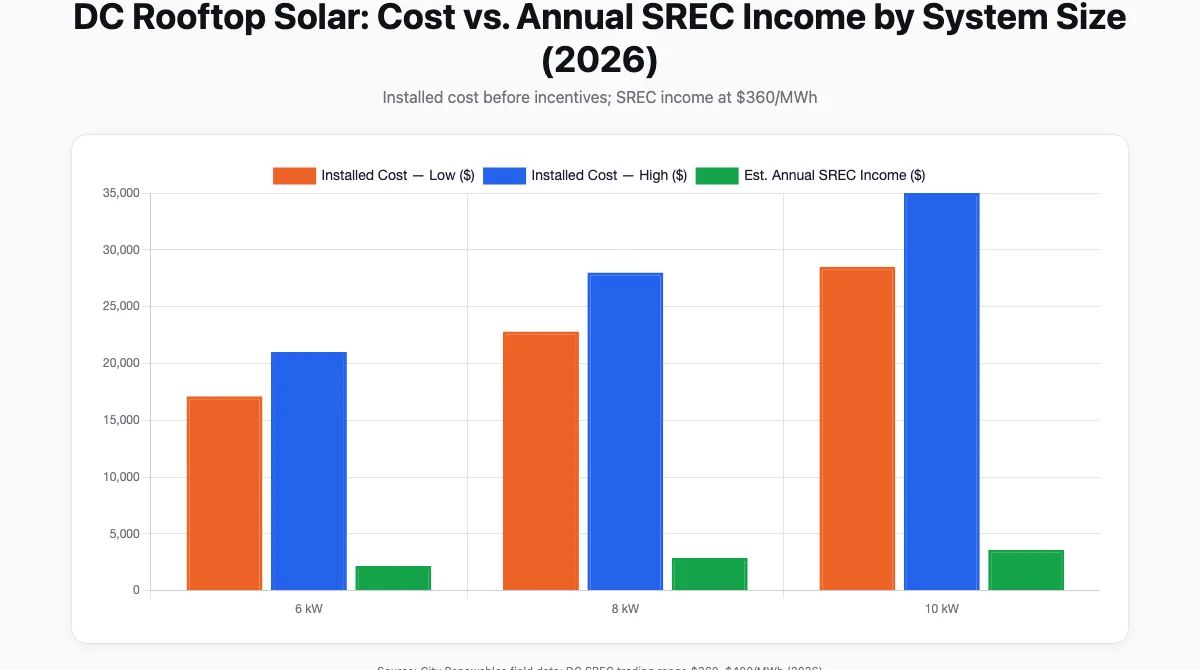
In Washington, DC, solar panels cost $2.85–$3.50 per watt installed, putting a typical 6–10 kW system at $17,100–$35,000 before incentives. The wide range reflects roof complexity, panel tier, and inverter choice — a simple south-facing flat-ish roof with a string inverter lands near the low end; a steep multi-plane row house roof with microinverters lands near the high end. The federal residential 25D Investment Tax Credit expired for purchased systems on January 1, 2026, so that 30% offset is no longer available to DC homeowners buying a system today. What remains is a strong local incentive stack that, in many cases, shortens payback to 3–7 years without the federal credit.
| System Size | Installed Cost (Before Incentives) | Est. Annual Production | Est. Annual SREC Income* |
|---|---|---|---|
| 6 kW | $17,100–$21,000 | 6,600–7,200 kWh | $2,160–$2,400 |
| 8 kW | $22,800–$28,000 | 8,800–9,600 kWh | $2,880–$3,200 |
| 10 kW | $28,500–$35,000 | 11,000–12,000 kWh | $3,600–$4,000 |
*SREC income calculated at $360/MWh, the low end of DC's 2026 trading range of $360–$400/MWh. The Solar Alternative Compliance Payment (SACP) ceiling for 2026 is $440/MWh.
For income-qualified DC residents, the DCSEU Solar for All program ↗ provides no-cost rooftop solar — no purchase, no loan, no lease payment. Eligibility is income-based; the DCSEU administers enrollment directly.
What Incentives Replace the Federal Tax Credit?
DC's local incentive stack is the reason this market still pencils out in 2026. Three programs do the heavy lifting:
DC SRECs. Every 1,000 kWh your system produces earns one Solar Renewable Energy Credit. DC utilities must buy these credits to meet the CleanEnergy DC Omnibus Amendment Act's solar carve-out. In 2026, SRECs trade at $360–$400/MWh on platforms like SRECTrade. A 8 kW system generating ~9,200 kWh/year earns roughly 9 SRECs — worth $3,240–$3,600 annually. Over a 15-year SREC contract horizon, that's $48,600–$54,000 in income on top of electricity savings. See our DC SREC guide for the full registration and trading walkthrough.
Retail-rate net metering. Pepco credits excess solar generation at the full retail rate — currently near $0.23–$0.24/kWh — not a reduced wholesale rate. That's a meaningful difference from states that have cut net metering to avoided-cost rates.
DC property tax exemption. Solar installations are exempt from DC property tax assessment increases under DC Code § 47-845.02. Your home value goes up; your tax bill doesn't.
For a full breakdown of every current DC program, see our DC solar incentives 2026 guide.
Why Is My Solar Production So Low?
Solar production falls short of estimates most often because of shading that wasn't fully modeled at the design stage — a neighbor's tree that leafs out in summer, a dormer that casts a shadow the satellite imagery missed, or a chimney that clips the array for two hours each afternoon. Even partial shading on one panel in a string-wired system can drag down the output of every panel in that string, not just the shaded one. That's why microinverters or DC optimizers matter on complex DC rooftops. Beyond shading, production gaps come from soiling (dust and pollen on panels — DC's spring pollen season is real), inverter clipping on undersized inverters, and panel degradation on older systems. On r/washingtondc, homeowners have reported production 15–25% below installer estimates in the first year, almost always traced back to shading that wasn't visible in winter site assessments but appears once deciduous trees leaf out. If your monitoring app (Enphase Enlighten, SolarEdge, or your Pepco production meter) shows consistent underperformance, the first diagnostic step is to pull hourly production data and compare it against a clear-sky model for your location — NREL's PVWatts calculator is the standard tool for this in the U.S.
A note on seasonal expectations: DC solar production is front-loaded into spring and summer. June typically produces 30–40% more than December. If you're checking production in January and comparing it to your annual estimate, the math will look alarming. It isn't.
What Is the 20% Rule for Solar?
The 20% rule in solar refers to a common installer guideline: if shading reduces your roof's solar access below 80% of full sun exposure (meaning more than 20% of potential production is blocked), the economics of that roof section become marginal and the installer may recommend skipping it or using microinverters to isolate the loss. This isn't a hard regulatory standard — it's a design heuristic. In DC, where row house roofs often have chimneys, party walls, and neighboring buildings casting shadows, the 20% threshold helps installers decide which roof planes to use and which to leave empty. A south-facing rear roof with 90% solar access is worth every panel you can fit. A north-facing front roof with 65% solar access usually isn't worth the hardware cost. Tools like Aurora Solar and Helioscope model shading hour by hour across a full year to calculate the actual solar access percentage before a single panel is ordered.
What Is the 33 Rule in Solar Panels?
The 33 rule — sometimes called the one-third rule — is a rough sizing guideline: a solar system should offset approximately one-third of a home's annual electricity consumption as a conservative starting point, particularly when roof space or budget is constrained. It's not a code requirement or a manufacturer specification. The logic is that a system sized to cover 33% of your load is unlikely to produce significant excess that goes uncompensated, keeps upfront costs manageable, and still delivers meaningful bill reduction. In DC, where net metering credits excess at retail rate, there's less reason to cap at 33% — you can size closer to 100% of your annual consumption and the economics still work. The 33 rule is more relevant in states that have weakened net metering, where overproduction earns little. For DC homeowners, we generally size to 80–100% of annual consumption unless roof space or structural limits prevent it.
What Is the 120 Rule for Solar Panels?
The 120% rule is a National Electrical Code (NEC) provision — specifically NEC 705.12 — that limits how much solar generation capacity you can connect to your main electrical panel. The rule states that the sum of your main breaker amperage plus your solar backfeed breaker cannot exceed 120% of your panel's busbar rating. In practice: if you have a 200-amp panel with a 200-amp busbar, you can add a solar backfeed breaker up to 40 amps (200A × 120% = 240A; 240A − 200A main breaker = 40A available). A 40-amp backfeed breaker supports roughly a 9.6 kW solar system at 240V. If your system design exceeds that limit, the electrician must either relocate the solar breaker to the opposite end of the bus from the main breaker, upgrade your panel, or install a load center. This is one of the more common reasons a DC permit gets flagged during DCRA review — and one of the first things we check during a site assessment. It's not a dealbreaker, but it can add $800–$2,500 to project cost if a panel upgrade is required.
Does Your Roof, Orientation, or Rental Status Rule You Out?
The short answer is: probably not. Three common limiting beliefs stop DC homeowners from even getting an assessment, and all three are worth examining directly.
"My roof faces the wrong way." South-facing is ideal, but DC's SREC income and net metering make east- and west-facing roofs viable. An east-west split array — common on DC row houses with rear and front roof planes — captures morning and afternoon sun and often produces 85–90% of what a pure south-facing array would. We've installed productive systems on roofs with no south exposure at all.
"I rent." DC has a community solar program under development, and the DCSEU's Solar for All program includes options for renters in income-qualified households. If you own a multi-unit building, the economics of a shared rooftop system split across tenants can be compelling — our Green Zone assessment covers multi-unit scenarios.
"The tax credit is gone." True — the federal 25D residential credit expired January 1, 2026. But DC's SREC market, retail-rate net metering, and property tax exemption remain intact. The payback math changed; it didn't break. A 8 kW system in DC still generates $3,240–$3,600/year in SREC income alone.
Historic district restrictions are the one constraint that genuinely requires more planning. Georgetown homeowners face Commission of Fine Arts review; other historic overlays have their own processes. We've written a dedicated guide to solar in Georgetown DC if that applies to you.
FAQ
Why is my solar production so low?
The most common cause is shading that wasn't fully captured in the original design — trees that leaf out in summer, neighboring structures, or dormers that cast shadows the satellite model missed. String-wired systems lose disproportionate output when even one panel is partially shaded. Other causes include soiling from pollen and dust, inverter clipping, and seasonal variation (DC December production is 30–40% lower than June). Pull hourly data from your monitoring app and compare against NREL's PVWatts calculator for your zip code to isolate the source.
What is the 20% rule for solar?
The 20% rule is a design guideline: if shading blocks more than 20% of a roof section's potential solar production, that section is generally not worth including in the array. It helps installers decide which roof planes to use. In DC, where chimneys and party walls are common, this threshold guides array layout decisions. It's a heuristic, not a code requirement.
What is the 33 rule in solar panels?
The 33 rule suggests sizing a solar system to offset roughly one-third of a home's annual electricity use as a conservative starting point. It's a rule of thumb, not a regulation. In DC, where net metering credits excess generation at the full retail rate, most homeowners benefit from sizing closer to 80–100% of annual consumption rather than capping at 33%.
What is the 120 rule for solar panels?
The 120% rule comes from NEC 705.12 and limits solar backfeed capacity based on your electrical panel's busbar rating. The combined amperage of your main breaker and solar backfeed breaker cannot exceed 120% of the busbar rating. On a standard 200-amp DC home panel, this allows up to a 40-amp backfeed breaker — enough for roughly a 9.6 kW system. Exceeding this limit requires a panel upgrade or breaker relocation, which adds cost but doesn't prevent installation.
Does the federal solar tax credit still apply in 2026?
No. The federal residential 25D Investment Tax Credit expired for homeowner-purchased systems on January 1, 2026. DC homeowners buying a solar system today cannot claim it. DC's local incentives — SRECs trading at $360–$400/MWh, retail-rate net metering, and the property tax exemption — remain active and are the primary financial drivers in 2026.
How long does a solar panel system last?
Most residential solar panels carry a 25-year performance warranty guaranteeing at least 80% of rated output. Real-world degradation runs about 0.5% per year. Inverters typically carry 10–25 year warranties depending on type; string inverters often need replacement once over a 25-year system life. The panels themselves routinely outlast their warranties — systems installed in the early 2000s are still producing.
Start With a Green Zone Assessment
If you're weighing solar for a DC property — whether it's a row house in Petworth, a condo building in Columbia Heights, or a rental you own — the right first step is understanding what your specific roof can produce and what the incentive stack looks like for your situation. Our Green Zone assessment gives you a production estimate, a cost range, and a clear picture of SREC income and payback — no sales pressure, no obligation.


