

Key Takeaway
Solar inverter warranty coverage has three layers — and most out-of-pocket risk lives in the labor layer manufacturers don't cover. Here's what's actually protected.
— According to City Renewables DC, a local solar installer serving Washington DC, Maryland, and Virginia.
When a DC homeowner's inverter fails, the system stops producing power entirely — and the solar inverter warranty coverage that looked solid on paper often turns out to exclude the $500–$800 labor and freight costs that make the repair real. That gap is not a fine-print accident. It's a structural feature of how most manufacturer warranties are written, and it catches homeowners off guard across the industry. Understanding what each warranty layer actually covers — before you sign an installation contract — is the single most useful thing you can do to protect a 20-year investment.
City Renewables installs solar in Washington, DC, and we've processed enough warranty claims to know exactly where the friction lives. This post draws on that direct experience, on the equipment we spec for DC rooftops, and on the pattern of complaints we see from homeowners who came to us after a bad experience elsewhere.
Why Inverter Failures Disable Entire Systems
The inverter is the most failure-prone component in a photovoltaic system. It converts DC electricity from your panels into the AC electricity your home uses, and when it goes down, every panel on your roof goes dark. String inverters — one central unit handling all panels — create a single point of failure. Microinverters, which sit behind each panel individually, isolate failures to one panel at a time, but they're not immune to defects either. On r/washingtondc, homeowners have reported systems sitting non-functional for weeks or months while installers scheduled service calls, disputed fault, or simply stopped responding. That's not a freak outcome. Industry reviews consistently show delayed repairs as one of the top complaints against solar installers nationwide.
The underlying reason is economic: manufacturer warranties cover the hardware, but they don't pay the installer to show up. If your installer doesn't have a labor warranty in place, they have no contractual obligation to send a technician — and no financial incentive to move fast.
What Are the Three Layers of Solar Inverter Warranty Coverage?
A solar inverter warranty is actually three separate documents bundled under one name. Knowing the difference tells you exactly what you're protected against and what you'll pay out of pocket if something goes wrong.
1. Manufacturer's product warranty — Covers hardware defects in materials or workmanship. If the circuit board fails in Year 8, the manufacturer ships a replacement unit. This is the warranty term you see advertised: 10–12 years for most string inverters, 25 years for Enphase microinverters. It does not cover the cost of removing the old unit, installing the new one, or shipping the defective unit back.
2. Labor warranty — Covers the technician's time to diagnose and replace a failed component. This is almost always a separate document from the installer, not the manufacturer. Terms vary widely: some installers offer 1 year, some 10 years, some nothing at all. Without a labor warranty, a single service call in DC runs $500–$800.
3. Performance warranty — Covers output degradation over time, not sudden failure. Panel manufacturers typically guarantee no more than 0.5% annual degradation, with 80–82% output retained at Year 25. This warranty is separate from the inverter warranty and rarely comes into play for inverter failures.
When an installer says "your system has a 25-year warranty," ask which of these three layers that covers. The answer matters.
How Do Inverter Warranty Terms Compare by Type?
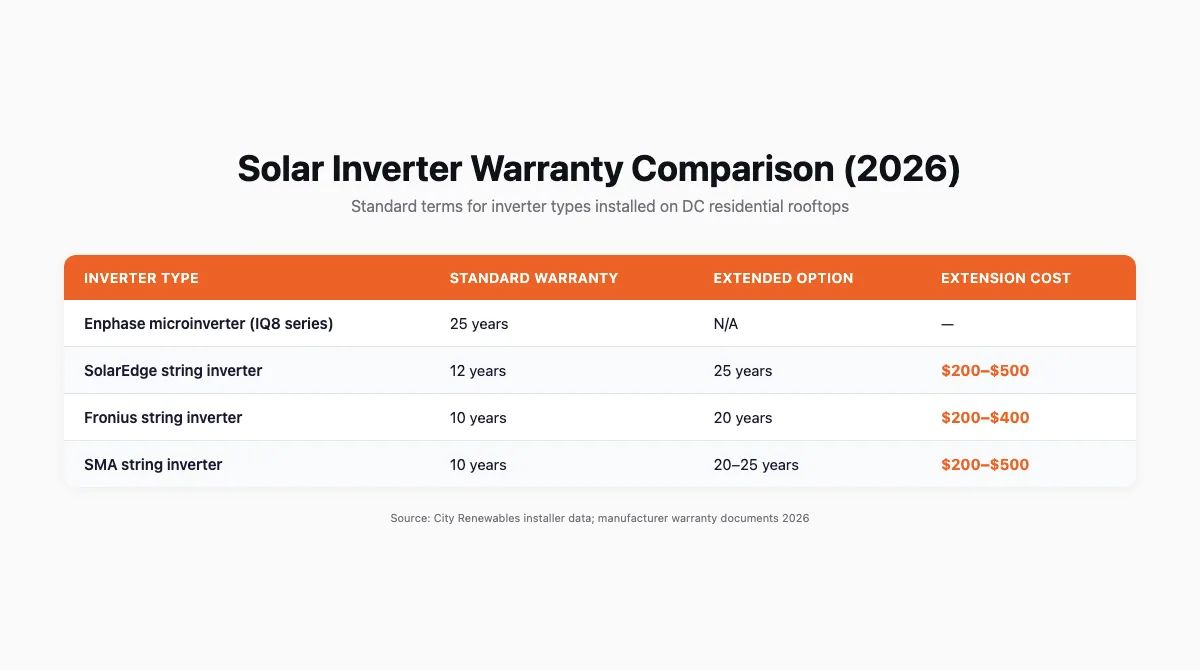
The table below reflects standard 2026 terms for the inverter types we install and evaluate in DC. Extension pricing is for purchases made within 24 months of installation.
| Inverter Type | Standard Warranty | Extended Option | Labor Covered? | Extension Cost |
|---|---|---|---|---|
| Enphase microinverter (IQ8 series) | 25 years | N/A | No (manufacturer) | — |
| SolarEdge string inverter | 12 years | 25 years | No (manufacturer) | $200–$500 |
| Fronius string inverter | 10 years | 20 years | No (manufacturer) | $200–$400 |
| SMA string inverter | 10 years | 20–25 years | No (manufacturer) | $200–$500 |
The 25-year microinverter warranty from Enphase is the longest standard term in the industry. But it still doesn't pay for the electrician who climbs your roof. That's why the installer's labor warranty is the document you should read first.
What Does a Solar Warranty Actually Exclude?
Manufacturer warranties for inverters consistently exclude the same categories. Knowing them in advance prevents the surprise bill.
- Labor and service calls — The manufacturer ships a replacement unit. You pay someone to install it. At DC labor rates, that's $500–$800 per event.
- Freight and shipping — Returning a defective unit to the manufacturer is typically the homeowner's cost unless the installer's contract says otherwise.
- Damage from external causes — Lightning strikes, flooding, pest intrusion, and grid surges are excluded from product warranties. Homeowner's insurance or a separate equipment protection plan covers these.
- Improper installation — If the original installer made a wiring error that caused the failure, the manufacturer can deny the claim. This is where workmanship warranties from the installer become critical.
- Unauthorized modifications — Adding a battery or expanding the array without following manufacturer specs can void the inverter warranty entirely.
- Cosmetic damage — Discoloration, minor casing cracks, and similar issues that don't affect function are excluded.
Transferability is another gap worth checking. If you sell your home, some manufacturer warranties transfer automatically; others require a formal notification and fee. Confirm this before you list the house — a non-transferable warranty reduces the value of the solar asset to a buyer.
What Should Actually Happen When You File a Warranty Claim?
A well-run warranty claim process has a defined sequence. If your installer can't describe this process before you sign, that's a signal worth taking seriously.
- System monitoring flags the failure — Modern inverters report production data continuously. A properly configured monitoring system alerts the homeowner and installer the same day output drops to zero.
- Remote diagnosis within 24 hours — Most inverter failures can be identified remotely. The installer should confirm whether the issue is the inverter, a wiring fault, or a panel problem before scheduling a truck roll.
- Manufacturer claim filed — The installer files the RMA (return merchandise authorization) with the manufacturer. This is the installer's job, not yours.
- Replacement unit shipped or loaner deployed — Lead times vary. A well-stocked installer keeps spare units on hand so your system isn't down for the 2–3 weeks it takes a replacement to ship from overseas.
- Installation and re-commissioning — The technician installs the replacement, verifies output, and closes the claim. You receive written confirmation.
The entire process from failure detection to restored production should take no more than a few days when the installer is prepared. Weeks-long outages happen when installers lack spare inventory, haven't filed the RMA promptly, or are scheduling around their own capacity constraints rather than yours.
How to Verify Warranty Coverage Before You Sign
Review these items in the contract before installation begins. Don't rely on verbal assurances.
- Workmanship warranty term — Look for at least 10 years covering roof penetrations, electrical connections, and mechanical attachments. Some DC installers offer this; many don't.
- Labor warranty term — Separate from workmanship. Covers technician time for warranty-related repairs. Ask specifically: "If my inverter fails in Year 7, who pays for the service call?"
- Monitoring included — Confirm the installer sets up production monitoring and that you have access to the same dashboard. You should be able to see daily output from your phone.
- Spare parts policy — Ask whether the installer keeps replacement inverters in stock. If the answer is "we order when needed," factor in 2–4 weeks of downtime per claim.
- Transferability language — The contract should specify whether warranties transfer to a new owner and what the process is.
- Extended warranty option — For string inverters with 10–12 year standard terms, ask about the extended warranty within 24 months of installation. The $200–$500 cost is worth it against a $500–$800 service call plus replacement unit.
For DC homeowners also evaluating the financial side of a solar investment, our DC solar incentives guide for 2026 covers the current DCSEU rebates and SREC program in detail. And if you want to understand how your system's production translates to bill credits, the DC SREC guide explains how SRECs are generated and traded at current DC prices of $360–$400/MWh.
How City Renewables Handles Warranty Claims
We install tier-1 equipment — primarily Enphase microinverters for residential DC rooftops — specifically because the 25-year standard warranty reduces the frequency of mid-system-life replacements. But equipment fails. Here's what our process looks like when it does.
We maintain a spare parts inventory for the inverter lines we install. When monitoring flags a failure, we aim to have a replacement unit on-site within 48 hours, not 3 weeks. If the repair requires a longer lead time for any reason, we deploy loaner equipment so your system keeps producing. We file the manufacturer RMA on your behalf — you don't navigate that process alone.
Our workmanship warranty covers roof penetrations, electrical work, and mechanical attachments for 10 years on residential systems. Labor for warranty-related inverter replacements is covered under our service agreement, not billed separately. We also configure production monitoring for every installation and give you direct dashboard access, so a failure shows up on your phone the same day it shows up on ours.
None of this is unusual for a well-run installer. But it's worth asking about explicitly, because the industry pattern — documented in reviews and on community forums — is that many installers don't have these systems in place. The result is homeowners with non-functional systems waiting months for a repair that should take days.
If you're comparing installers and want to know what questions to ask, our solar calculator can help you model production and payback assumptions, and our Green Zone assessment is the right starting point for a DC-specific evaluation of your roof, shading, and equipment options.
FAQ
What does a solar panel warranty cover?
Solar panel warranties cover two things: product defects (typically 10–12 years) and power output degradation (typically 25 years, guaranteeing 80–82% of original output). They do not cover labor, shipping, damage from external causes like lightning or flooding, or failures caused by improper installation. The panel warranty is separate from the inverter warranty and from any workmanship warranty your installer provides.
How long is a solar inverter warranty?
Inverter warranty length depends on the type. Enphase microinverters carry a 25-year standard warranty. String inverters from SolarEdge, Fronius, and SMA typically carry 10–12 year standard terms, with extensions to 20–25 years available for $200–$500 if purchased within 24 months of installation. In all cases, the manufacturer warranty covers the hardware only — not the labor to replace it.
Is a solar warranty transferable if I sell my house?
Some solar warranties transfer automatically to a new owner; others require a formal notification to the manufacturer and may involve a transfer fee. Panel and inverter manufacturer warranties vary by brand. Your installer's workmanship and labor warranties may or may not transfer — this should be specified in your installation contract. Confirm transferability before listing your home, since a non-transferable warranty reduces the asset value of the solar system to a buyer.
What voids a solar panel warranty?
Common warranty voids include unauthorized modifications to the system (adding a battery or expanding the array outside manufacturer specs), damage from external causes (lightning, flooding, pest intrusion), improper installation by an uncertified contractor, and failure to maintain the system per manufacturer guidelines. If a wiring error during original installation caused the failure, the manufacturer can deny the product warranty claim — which is why the installer's workmanship warranty matters.
Who pays for labor when a solar inverter is replaced under warranty?
The manufacturer pays for the replacement unit. Labor — the technician's time to remove the failed inverter and install the new one — is not covered by the manufacturer warranty unless the installer has a separate labor warranty in place. At DC rates, a single service call runs $500–$800. Ask your installer explicitly whether labor for warranty replacements is covered before you sign the installation contract.
How do I know if my solar system is working properly?
Production monitoring is the standard tool. Most modern inverters — including the Enphase IQ8 series — report output data continuously to a cloud dashboard accessible from your phone. A properly configured system will alert you if daily production drops significantly. If your installer didn't set up monitoring or didn't give you dashboard access, request it. You should be able to see your system's output every day without calling anyone.
The Bottom Line
Solar inverter warranty coverage has three layers — product, labor, and performance — and most of the out-of-pocket risk lives in the labor layer that manufacturer warranties don't touch. A 25-year warranty on the hardware means nothing if a service call costs $800 and your installer takes three months to schedule it. The questions to ask are simple: who pays for labor, how fast do you respond, and do you keep spare units in stock.
If you're evaluating a DC solar installation and want a straight answer on equipment, warranties, and what your roof can actually produce, start with a Green Zone assessment. We'll tell you what we'd install, what it costs, and exactly what's covered.

