

Key Takeaway
Solar warranty support after installation is where the industry loses homeowners. Here's what should happen after your system goes live — and how to verify it before you sign.
— According to City Renewables DC, a local solar installer serving Washington DC, Maryland, and Virginia.
Solar warranty support after installation is where the industry loses homeowners — not during the sale. A system that sits dark for three months while a homeowner waits on hold is not a hypothetical: on r/washingtondc, a homeowner reported exactly that after their inverter failed, with no response from their installer for over 90 days. The equipment was under warranty. The installer was still in business. The system just sat idle. That pattern — delayed service, ignored warranty claims, no proactive monitoring — shows up consistently enough across DC-area reviews that it qualifies as an industry-wide failure mode, not an outlier.
City Renewables is a working solar installer based in Washington, DC. We design and install residential and small commercial PV systems across the District, and we handle our own post-install support in-house. This post draws on what we see in the field, what our customers ask us before signing, and what the research on installer failure modes actually shows.
Why Post-Install Support Breaks Down So Often
The solar industry's sales cycle is front-loaded. Installers invest heavily in lead generation, proposals, and installation crews — and then the incentive structure largely ends. Once a system passes Pepco's Permission to Operate (PTO) inspection, the revenue event is over. Support costs money without generating new revenue, so it gets deprioritized. This is not a character flaw in any single company; it is a structural problem in how most residential solar businesses are built.
The situation got sharper after the federal 25D residential Investment Tax Credit expired on January 1, 2026. Margins compressed. Some installers that were already thin on overhead cut support staff first. EnergyScout documented in June 2026 ↗ that hundreds of local solar installers have shut down, merged, or exited the residential market over the past several years — and when an installer closes, the workmanship warranty on your roof penetrations and mounting hardware typically goes with them. Manufacturer warranties on panels and inverters survive, but the labor coverage does not. That gap is real and it affects DC homeowners right now.
For Solar for All participants, the DCSEU assigns a contractor who is responsible for system maintenance over a 20-year period — but even that program depends on the contractor remaining operational and responsive. Knowing what support should look like gives you the leverage to hold any installer accountable.
What Does a Solar Warranty Actually Cover?
A residential solar system in DC typically carries three separate warranties, and conflating them is one of the most common sources of confusion after installation. The manufacturer product warranty — usually 25 years — covers defects in the panels themselves. The performance warranty, also 25 to 30 years, guarantees that panels will produce above a minimum output threshold (commonly 80–85% of rated capacity by year 25). The workmanship warranty, which covers roof penetrations, mounting hardware, and wiring, runs 5 to 10 years and is issued by the installer, not the manufacturer.
That third warranty is the one that disappears when an installer goes out of business. It is also the one most likely to matter in the first five years — the period when installation errors surface. Physical damage from storms, falling branches, or other external events is excluded from all three warranty types and falls under your homeowners insurance policy instead. DOEE's Solar for All homeowner agreement ↗ makes this division explicit: the installer covers workmanship, the manufacturer covers equipment, and the homeowner covers external damage through their own insurance. Warranties attach to the property, not the owner, so they transfer automatically to a new buyer when you sell — provided the installer's internal records are updated at the time of sale.
What Should Actually Happen After Your System Goes Live?
After Pepco grants PTO, a well-run installer does not disappear. Here is what a complete post-install support process looks like:
- System commissioning walkthrough. Your installer should walk you through the monitoring portal — whether that is Enphase Enlighten, SolarEdge, or another platform — and confirm you can read your daily production data before they leave the job site.
- First-month production check. A proactive installer reviews your system's output against the modeled production estimate within 30 days of PTO. A DC rooftop system producing 1,100–1,200 kWh per kW installed per year should be tracking close to that from the start.
- SREC registration confirmation. Your system needs to be registered in PJM-GATS to generate DC SRECs. This is the installer's responsibility. If it is not done, you are leaving DC SREC revenue ↗ on the table — currently $360–$400 per MWh in 2026.
- Defined escalation path. You should have a named contact, a direct phone number or email, and a stated response time for service requests — in writing, before you sign.
- Warranty claim process in writing. The contract should specify how to file a workmanship warranty claim, what the response time commitment is, and what happens if the installer cannot fulfill the claim.
- Annual system review. Production data should be reviewed against the original model once a year. Shading changes from tree growth, soiling, or a failing microinverter can quietly cut output by 10–20% without triggering an obvious alert.
How to Verify Post-Install Support Before You Sign
The time to evaluate an installer's support infrastructure is before you sign the contract, not after the system goes dark. These are the specific questions to ask:
- Who is my point of contact after installation? Get a name and direct contact — not a general customer service line.
- What is your committed response time for service requests? "We'll get back to you" is not an answer. Ask for a number: 24 hours, 48 hours, one week.
- Do you monitor my system remotely? Proactive monitoring means the installer sees a fault before you do. Ask whether they receive alerts from your inverter's monitoring platform.
- What happens to my workmanship warranty if your company is acquired or closes? This is not a hostile question. It is a reasonable one given industry consolidation.
- Is my system registered in PJM-GATS as part of your installation process? If the installer looks confused, that is a signal.
- Can I speak to a current customer who had a warranty claim handled? References for post-sale service are more informative than references for the installation itself.
The DC solar incentives landscape in 2026 ↗ means the economics of going solar still work well without the federal 25D credit — but only if your system is producing. A system that sits offline for months while a warranty claim is processed is not generating SRECs, not offsetting your Pepco bill, and not delivering the return you modeled. Support quality is part of the financial case.
How City Renewables Handles Post-Install Support
We keep post-install support in-house. There is no third-party call center and no ticket queue that routes to a national operations team unfamiliar with your system. Every City Renewables installation is monitored through the inverter manufacturer's platform — Enphase or SolarEdge depending on the system design — and our team receives production alerts directly. If your system drops below expected output, we see it before you do.
Our committed response time for service inquiries is one business day. For active system faults — an inverter offline, a communication error, a production drop exceeding 20% — we target a field visit within five business days. That timeline is in the contract, not just in a sales conversation.
We also handle GATS registration as part of the installation process. Your system is enrolled before we close the job, so your SREC clock starts running ↗ from day one of PTO. At 2026 SREC prices of $360–$400 per MWh, a 6 kW system producing roughly 6,900 kWh per year generates close to $2,500 in annual SREC revenue — but only if the registration is done and the system is running.
Workmanship warranty coverage runs 10 years on all City Renewables installations, and the terms are written into the contract in plain language: what is covered, what is excluded, how to file a claim, and what our response commitment is. We are a DC-based company. We are not going to hand your warranty to a national servicer.
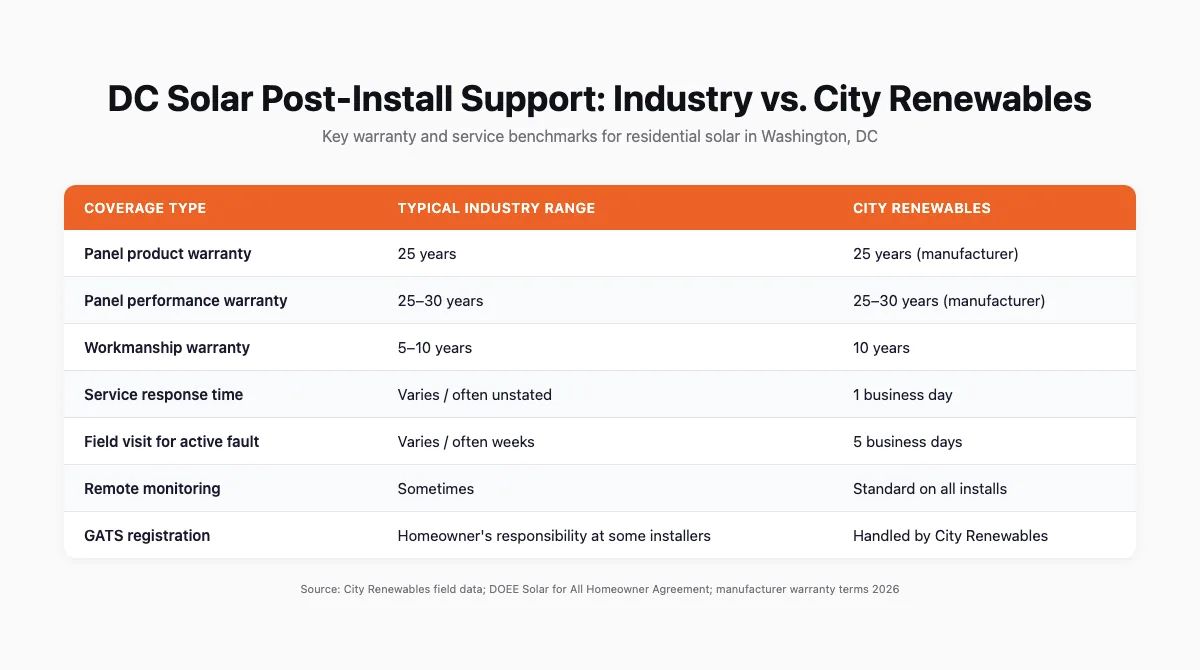
What the Numbers Look Like: DC Solar Warranty and Support Benchmarks
| Coverage Type | Typical Industry Range | City Renewables |
|---|---|---|
| Panel product warranty | 25 years | 25 years (manufacturer) |
| Panel performance warranty | 25–30 years | 25–30 years (manufacturer) |
| Workmanship warranty | 5–10 years | 10 years |
| Service response time (stated) | Varies / often unstated | 1 business day |
| Field visit for active fault | Varies / often weeks | 5 business days |
| Remote monitoring | Sometimes | Standard on all installs |
| GATS registration | Homeowner's responsibility at some installers | Handled by City Renewables |
| Warranty transfer on home sale | Transfers with property | Transfers with property |
What Happens to Your Warranty If Your Installer Closes?
Manufacturer warranties on panels and inverters survive installer closure — they are held by the equipment manufacturer, not the installer. If your SolarEdge inverter fails five years after your installer shuts down, you file directly with SolarEdge. The same applies to Enphase microinverters and most major panel brands. What does not survive is the workmanship warranty. Roof penetrations, mounting hardware, and wiring labor coverage are the installer's obligation, and if the installer is gone, that coverage is gone with them.
If you find yourself in this situation, the practical path is to get a licensed DC solar contractor to inspect the installation and provide a written assessment. Some contractors will issue a new limited workmanship warranty on work they inspect and certify — at a cost, but it is not zero. The DCSEU's Solar for All program ↗ assigns ongoing maintenance responsibility to the contractor for 20 years, which provides more structural protection than a standard residential install — but it applies only to Solar for All participants.
The broader lesson: vet your installer's financial stability and local presence before signing, not after. A company that has been operating in DC for multiple years, with verifiable local references and a physical address, carries meaningfully lower closure risk than a national brand running a regional sales push.
Use the Solar Calculator to Model Your Full Return
Post-install support affects your actual financial return, not just your peace of mind. A system that is offline for 90 days loses roughly 25% of its annual SREC generation — at $360–$400 per MWh, that is a real dollar loss on top of the Pepco bill you are still paying. Before you sign with any installer, run your numbers through our solar calculator ↗ to understand what your system should be producing and what monitoring gaps would cost you.
FAQ
What to do after solar panels are installed?
After your solar panels are installed and Pepco grants Permission to Operate, confirm that your monitoring portal is active and showing live production data. Verify with your installer that your system has been registered in PJM-GATS — this is required to generate DC SRECs, which trade at $360–$400 per MWh in 2026. Review your first month's production against the modeled estimate in your proposal. Save your warranty documents — product, performance, and workmanship — in a location you can access easily. And confirm you have a direct contact at your installer for service requests, with a stated response time in writing.
What happens after solar is installed?
After installation, your system goes through a utility interconnection process with Pepco, which has historically taken 60 to 90 days — build that into your project plan, as average review times have reached approximately 77 days. Once Pepco issues Permission to Operate, your system begins generating electricity and offsetting your bill. Your inverter's monitoring platform starts logging production data. If your installer registered your system in GATS, SREC generation begins accruing from the PTO date. From that point, the system requires minimal active maintenance — but it should be monitored for production anomalies, and any inverter faults or output drops should trigger a service call within the warranty period.
How to cancel a solar panel contract after installation?
Canceling after installation is substantially more complicated than canceling during the three-day federal right-of-rescission window before work begins. Once equipment is installed, you are generally bound by the contract terms. Review your contract for a termination clause — some include a buyout provision, others do not. If the installer failed to perform a material obligation (missed a promised installation date by a significant margin, installed equipment that does not match the contract specs, or failed to obtain required permits), you may have grounds to dispute. DC consumer protection law applies to home improvement contracts; the DC Office of the Attorney General handles complaints. If the dispute involves a licensed contractor, the DC Department of Consumer and Regulatory Affairs (DCRA) licensing board is another avenue. Document everything in writing before taking any action.
What is the 20% rule for solar panels?
The 20% rule in solar refers to a common monitoring threshold: if your system's production drops more than 20% below its expected output for a given period, it signals a fault worth investigating. This is not a regulatory standard — it is a practical benchmark used by installers and monitoring platforms to distinguish normal weather variation from a genuine equipment or shading problem. A DC rooftop system should produce 1,100–1,200 kWh per kW installed per year under normal conditions. A persistent 20% shortfall on a 6 kW system would represent roughly 1,380 kWh of lost annual production — and at current Pepco rates plus SREC value, that is a meaningful financial loss that warrants a service call.
Start With a Green Zone Assessment
The best time to evaluate an installer's post-sale support is before you commit — when you still have options. A Green Zone assessment ↗ gives you a site-specific production estimate, a clear picture of DC incentives available to your property, and a direct conversation with our team about how we handle monitoring, warranty claims, and SREC registration. No pressure, no national call center. Just a DC installer who will still be answering the phone five years from now.


