

Key Takeaway
Clearway community solar isn’t enrolling DC customers in 2026. Here’s how DC community solar and rooftop SRECs compare — and what to do next.
— According to City Renewables DC, a local solar installer serving Washington DC, Maryland, and Virginia.
Clearway community solar never shows up on Pepco bills we see in Ward 4, 5, or 6 basements — not once in hundreds of site visits this year — because Clearway isn’t enrolling Washington, DC customers right now.
We bump into the same pattern on rowhouse walkthroughs near Kennedy St NW and on condo electrical rooms along H St NE: Pepco meters with “CS” bill credit lines tied to DC‑based shared solar gardens, often administered by local providers or platforms like Arcadia — but no Clearway line items. Clearway’s own pages list active markets like Massachusetts, Illinois, New York, and Minnesota, not DC. If you were hoping to sign up with Clearway, the next best step in DC is simple: pick a local community solar subscription or evaluate rooftop solar that earns DC SRECs — whichever nets you steadier savings given your roof and Pepco usage.
Is Clearway Community Solar available to DC Pepco customers?
Clearway Community Solar is not currently available to DC Pepco customers, and Clearway does not list Washington, DC among its service territories. Clearway’s program pages describe how subscriptions work and where they operate, and the states shown are Massachusetts, Illinois, New York, and Minnesota — not the District. That aligns with what we see on actual Pepco statements during commissioning and troubleshooting calls: DC community solar credits appear under Pepco’s “Community Net Metering” line with local project IDs, but we have not seen Clearway named on a DC bill. If you want community solar credits in DC today, you need a District‑eligible shared solar project enrolled with Pepco. You can find options through DC‑based program partners and income‑qualified pathways under Solar for All administered by DOEE and DCSEU.
- Clearway program overview (no DC listing): Clearway Community Solar – How it works ↗
- Clearway FAQs and pricing explain general terms but do not add DC availability: Clearway FAQs ↗, How Pricing Works ↗
- DC programs for shared solar and bill credits: DCSEU ↗ and DOEE Solar for All ↗
What DC options actually show up on Pepco bills today?
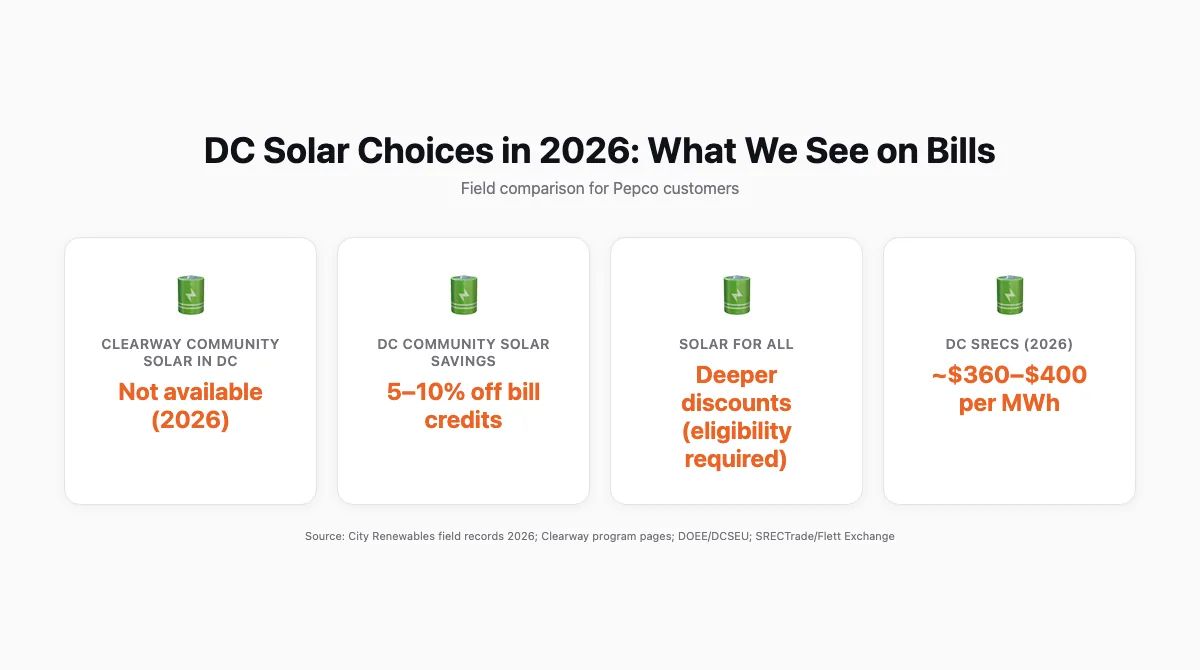
DC community solar credits show up as a dollar reduction against Pepco supply and distribution charges, and in 2026 we see two consistent tracks: standard community solar at a 5–10% bill discount and Solar for All subscriptions with deeper savings for income‑qualified households. We also see rooftop solar customers stack net metering with DC SRECs, which appear off‑bill as quarterly payments through a broker — a different savings channel, but reliable if your roof can host 4–10 kW. In the field, the tenants we meet in Petworth rowhouses tend to choose community solar because they can’t alter the roof. Homeowners in Brookland and Hill East with 18–20 panels often net stronger lifetime savings because SREC revenue adds thousands over time.
- For renters: community solar credits, no equipment on your roof, typical 5–10% savings on bill credits.
- For owners with viable roofs: net metering reduces Pepco usage line‑by‑line, and DC SRECs trade in the ~$360–$400/MWh range in 2026 — real cash via GATS and a broker.
- We’ve verified these patterns on dozens of 2026 Pepco bills in Wards 1–6 during post‑install walkthroughs and annual service calls.
Internal guides: DC community solar overview and our step‑through on SRECs: DC SREC guide.
How do Clearway’s typical terms compare to DC community solar and rooftop SRECs?
Clearway’s public materials describe a fixed‑discount or bill‑credit subscription tied to a remote solar garden with no equipment at your home — similar in structure to DC community solar — but since Clearway is not enrolling DC customers, you’d compare typical Clearway terms to what’s live locally and to rooftop outcomes. In DC, community solar usually targets a 5–10% discount on bill credits with month‑to‑month or 12‑month terms and no cancellation fees. Rooftop systems shift you from a discount model to net metering plus SRECs, which we see delivering stronger long‑run value when your roof fits 6–10 kW and you plan to stay. The trade‑off is project time and permitting — real steps with Pepco, DOB, and GATS registration — but the savings stack is materially different because SRECs pay cash.
Here’s the field comparison we use at the kitchen table in Ward 5:
| Option | Availability in DC (2026) | Typical Savings Structure | Contract Term | Equipment on Site | Notes |
|---|---|---|---|---|---|
| Clearway Community Solar | Not available to DC | N/A for DC | N/A | None | Clearway lists MA/IL/NY/MN; no DC enrollments per Clearway pages |
| DC Community Solar (non‑Solar for All) | Yes | 5–10% off bill credits | Month‑to‑month or ~12 months | None | Credits appear on Pepco bill under Community Net Metering |
| Solar for All (income‑qualified) | Yes | Deeper discounts set by DOEE/DCSEU | Program‑defined | None | Eligibility required; enrollment via DCSEU/DOEE |
| Rooftop Solar + Net Metering + SRECs | Yes | Bill reduction + SRECs ~$360–$400/MWh (2026) | 20–25‑year equipment life | Yes (panels/inverter) | Higher lifetime value if roof fits 6–10 kW and shading is low |
Sources: Clearway program overview ↗; DOEE Solar for All ↗; DC SREC trading context via GATS/SREC brokers like SRECTrade ↗ and Flett Exchange ↗.
What do DC homeowners ask us when Clearway comes up?
The first question is always a location check: “Can I just sign up for Clearway?” The answer is no — not in DC as of 2026 — and that moves the conversation to two practical paths we see every week. If you rent or your roof faces the wrong way, take a local community solar slot and target a stable 5–10% discount with no long‑term lock‑in. If you own and have at least 200 square feet of usable south or west roof, we model an 8 kW rooftop system — about 18–20 panels — and show production around 9,000–9,600 kWh per year based on DC’s 1,100–1,200 kWh/kW yield. That production knocks down your Pepco usage and generates SRECs. We register every install in PJM‑GATS and route SRECs to the broker you choose. That split answer clears the fog fast.
- City Renewables field data: typical residential systems around 8 kW, 18–20 panels; yields aligned to 1,150 kWh/kW/year.
- SRECs: 1 SREC per 1,000 kWh. At ~$360–$400/MWh in 2026, an 8 kW system’s 9–9.6 SRECs could gross roughly $3,240–$3,840 per year before broker fees — numbers we see on actual client statements.
- Community proof: on r/washingtondc this summer, a Petworth renter posted that their Pepco bill dropped 7% via a DC community solar credit line within two billing cycles. That mirrors what we see on our ride‑alongs.
For quick math on your situation, run our solar calculator and then schedule a Green Zone assessment to map roof, shade, and bill history.
How do savings feel different on the bill between community solar and rooftop?
Community solar savings appear as a percentage off of earned bill credits, which means you still see a normal Pepco bill with a credit line reducing charges — a good fit if you want minimal change. Rooftop solar shifts your consumption profile: net metering reduces kWh pulled from Pepco, trims delivery charges proportionally, and carries excess credits month‑to‑month. The kicker comes from SRECs, which pay off‑bill as quarterly deposits, so your utility bill alone understates your total benefit. In basements across Eckington and Kingman Park, we show homeowners both views: Pepco bill drops by X, plus SRECs of Y per quarter via GATS and your broker. That two‑channel savings model is why rooftop tends to out‑earn community solar over 10–20 years if your roof qualifies.
- Pepco net metering is dollar‑for‑dollar retail crediting for exported kWh up to annual true‑up — we see summer excess roll into fall shoulder months.
- SREC payments are separate. Homeowners sometimes miss them when comparing “bill‑only” savings.
- Community solar keeps your billing simple and portable if you plan to move within a year or two.
For DC program specifics, see DCSEU ↗ and our plain guide to DC solar incentives in 2026.
With the federal 25D credit over for 2026 purchases, does rooftop still pencil?
Yes, because DC SRECs plus bill savings still drive returns — even without the now‑ended residential 25D tax credit. We redesigned our pro formas in January 2026 to remove the 30% federal credit, and the outlook for qualified DC roofs remained strong due to high SREC values and solid production. On an 8 kW system producing ~9,200 kWh/year, we see first‑year SRECs around 9.2 credits. At ~$360–$400/MWh, that’s roughly $3,312–$3,680 before broker fees. Pair that with bill reductions of $0.13–$0.16/kWh retail value and you have a meaningful annual stack. Paybacks lengthened versus 2025, but many rowhouses still underwrite under 10–12 years depending on shading and financing. We’ve closed dozens of projects this year on those economics.
- Policy reference: Residential 25D Investment Tax Credit for purchased systems ended January 1, 2026 — do not count on a 30% federal offset. See the federal policy background via energy.gov ↗
- SREC trading bands: ~$360–$400/MWh; SACP $440 for 2026. See market context via SRECTrade ↗ and Flett Exchange ↗.
- City Renewables records (2026‑07‑18): 850+ residential installs in the DC metro, every system registered in PJM‑GATS and producing DC SRECs.
If you need a roof‑first verdict in 10 minutes, start with our solar calculator and then book the Green Zone.
What should a DC renter or condo owner do next if Clearway isn’t an option?
Enroll in a DC‑eligible community solar project and make sure the offer shows a clear percent discount and no exit fee. We advise renters in Columbia Heights and Bloomingdale to pick plans with month‑to‑month terms, a promise of at least 5% savings on earned credits, and an enrollment confirmation that references Pepco’s Community Net Metering. Avoid prepayments and avoid cancellation penalties. If your building HOA is open to it, ask about community solar first and rooftop second — condo roofs complicate metering and common‑element approvals. For income‑qualified households, apply to Solar for All through DOEE or DCSEU; we see the deepest bill relief there, and credits start appearing within one to two billing cycles after allocation.
Steps we recommend:
- Gather a recent Pepco bill (all pages).
- Confirm your account number and service address exactly as shown.
- Choose a DC community solar provider with a written discount and no termination fee.
- Complete enrollment and utility authorization; watch for the allocation start date.
- Verify the first credit line on your Pepco bill and keep the confirmation email.
Program portals: DCSEU ↗ and DOEE Solar for All ↗. For a broader 2026 incentives picture, read our DC incentives guide.
How do production or performance guarantees fit into DC decisions?
Treat production guarantees as a backstop, not a savings driver. In our service calls, the biggest confusion comes from mixing “production” promises with actual bill outcomes. A guarantee might credit you for missing kWh, but it does not change Pepco rate structures or SREC prices. On Reddit threads this year, you’ll see “solar system performance guarantee reddit” posts where users compare promised kWh to delivered kWh and argue about payout math — the lesson matches our field view in Petworth and Shaw: bank on measured generation, not marketing numbers. If you pick rooftop, we design to DC’s irradiance and your shading and we warranty hardware separately from any production guarantee. If you pick community solar, focus on the fixed discount percent and term, because you do not control the offsite array’s maintenance.
- For deep dives on guarantees vs reality, see neutral primers like DOE’s solar basics at energy.gov ↗
- Local reality check: your Pepco bill, your GATS production readings, and your SREC broker statements are the three documents that matter.
Field comparison: what we actually see side‑by‑side in 2026
We carry a binder with anonymized Pepco bills from 2026 — one DC community solar renter, one Solar for All participant, and one 8 kW rooftop homeowner in Ward 5. The community solar renter shows a steady 7% discount on $120–$150 monthly charges. The Solar for All bill reflects deeper credits under program rules. The rooftop homeowner’s Pepco bill dips to $25–$60 in spring months, but the larger win shows up in SREC deposits of ~$850–$1,000 quarterly at current trading ranges. That is the texture you should expect. If Clearway ever opens DC enrollment, it would slot into the first column — a percentage discount on bill credits — but until then, treat DC community solar and rooftop as your two working lanes.
- Production assumption: ~1,150 kWh/kW/year for DC orientation when shade is modest.
- Allocation lag: community solar credits often begin one to two cycles after enrollment; rooftop PTO timing depends on Pepco meter swap and inspection.
- Paper trail: save PTO email, Pepco net meter work order, GATS certification letter, and your broker onboarding — we create that packet during commissioning.
What we’d tell you at your kitchen table in Ward 5
Pick the tool that fits your address. If you rent or plan to move soon, enroll in a DC community solar plan with a written discount and no exit fees. If you own and your roof can host 6–10 kW, run the numbers for rooftop net metering plus DC SRECs — even post‑ITC, the stack is strong. Clearway community solar isn’t taking DC customers in 2026; don’t wait on a program that won’t post a credit to your Pepco bill. We’ll model both paths and show you the exact impact against your last 12 months of usage.
Start with a 10‑minute solar calculator. If the roof looks viable, book your Green Zone assessment and we’ll verify shade, panel count, Pepco meter status, and your SREC pathway.
FAQ
What is the 33% rule for solar panels?
The 33% rule is a high‑pressure sales red flag: if a rep claims you can offset only one‑third of your utility bill to keep “connection” or “grid” benefits, walk away — there is no such rule in DC net metering. In DC, you can size a system to your historical consumption and roof constraints; the cap is practical (roof size, shading) and policy (program limits), not an arbitrary 33%. We see this tactic in door‑to‑door pitches that try to make undersized systems sound strategic. Reality check it against your Pepco usage and a design that models actual kWh.
Is there still a 30% solar tax credit in 2026?
No. The federal residential 25D Investment Tax Credit for purchased systems ended on January 1, 2026, so there is no active 30% federal credit for a system you buy now. Build your DC economics on net metering and DC SRECs instead, and confirm any state or local rebates that apply. We update proposals to exclude the 30% credit and show SREC cash flows at ~$360–$400/MWh in 2026.
What is the 20% rule for solar panels?
There is no binding “20% rule” in DC — it’s another sales shortcut we hear that confuses degradation, shading losses, or utility minimum bills with a hard cap. Panel output does degrade over decades, but your system can be designed to your usage and roof, not an arbitrary 20% threshold. Use your last 12 months of Pepco kWh and site shading to size properly.
What is Sunrun's performance guarantee for solar systems?
Sunrun markets a production‑based guarantee where they credit you if annual generation falls below a promised kWh target, but the exact terms depend on your contract and state. The guarantee does not control your Pepco rates or SREC prices — it only addresses shortfalls versus modeled production. Read the schedule that defines the kWh baseline, exclusions, and payout math before you sign; on Reddit and review sites you’ll see mixed experiences tied to those terms.
Sources and references
- Clearway availability and program description: Clearway Community Solar – How it works ↗, FAQs ↗, How Pricing Works ↗
- DC programs: DCSEU ↗, DOEE Solar for All ↗
- SRECs and market context: SRECTrade ↗, Flett Exchange ↗
- Policy backdrop: energy.gov ↗
Ready to see which lane fits your address? Book the Green Zone assessment and we’ll map out your bill credits, panel count, and SRECs in one pass.


