

Key Takeaway
The federal 25C heat pump tax credit expired Dec 31, 2025. Here's what DC homeowners can still claim in 2026 — DCSEU rebates up to $5,000, panel upgrades, and more.
— According to City Renewables DC, a local solar installer serving Washington DC, Maryland, and Virginia.
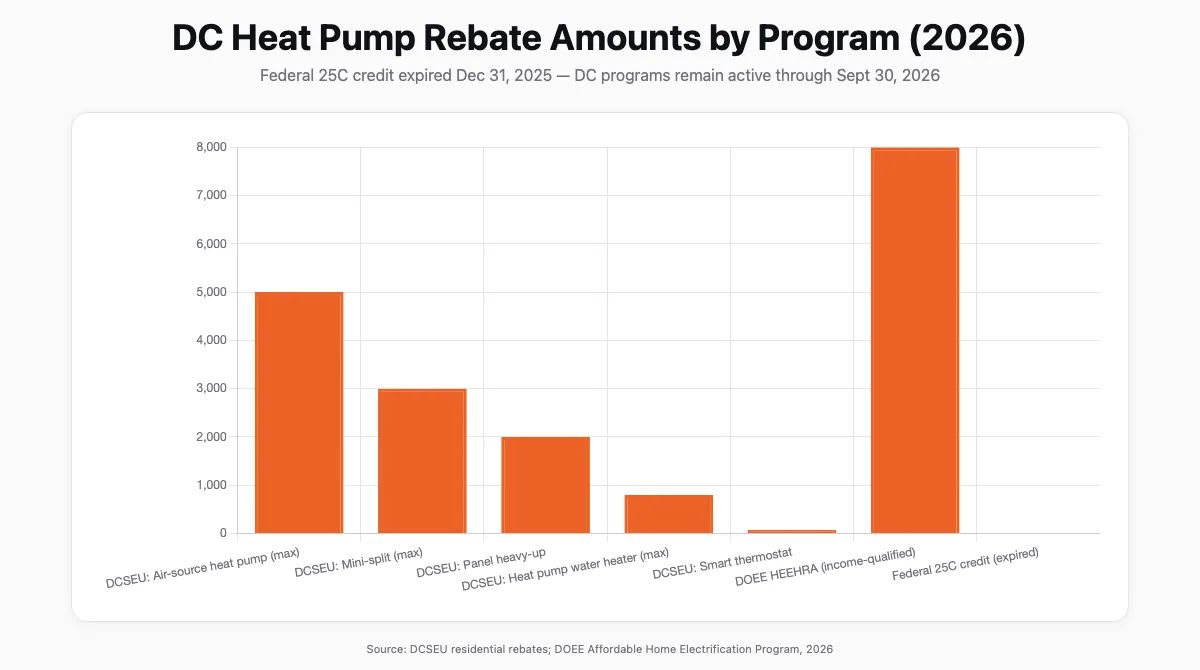
DC homeowners can still collect $1,000 to $8,000 in heat pump rebates in 2026 — but the federal 25C tax credit that once covered up to $2,000 per year expired on December 31, 2025. What remains are two distinct DC-specific programs: universal DCSEU rebates open to any income level, and income-qualified federal HEEHRA rebates administered by DOEE. Both have deadlines. The DCSEU window closes September 30, 2026.
We're City Renewables, a solar installer based in Washington, DC. We work with homeowners who are pairing heat pumps with rooftop solar — and that means we track the full incentive picture, not just the solar side. This post draws on current DCSEU program documentation, DOEE guidance, and what we hear from DC homeowners navigating the post-ITC reality.
What DC Heat Pump Rebates Are Available in 2026?
The DCSEU offers rebates of $1,000 to $5,000 for ENERGY STAR certified heat pumps, available to all DC residents regardless of income. These are the most accessible rebates in the District right now. Separately, low- and moderate-income households — those earning up to 150% of Area Median Income — may qualify for up to $8,000 through the federal HEEHRA program, which DOEE administers locally as the Affordable Home Electrification Program (AHEP). As of mid-2026, AHEP is waitlisted for Fiscal Year 2026, so new applicants should get on the list now rather than waiting. The two programs can stack if you qualify for both, but you cannot double-count the same equipment cost. Applications for DCSEU rebates must be submitted within 30 days of installation and postmarked by September 30, 2026. See the DCSEU residential HVAC rebate page ↗ for current amounts and eligible models.
DCSEU Rebate Amounts by Equipment Type
| Equipment | DCSEU Rebate | Notes |
|---|---|---|
| Air-source heat pump (ENERGY STAR) | $1,000–$5,000 | Amount varies by efficiency tier |
| Heat pump water heater | $400–$800 | Must be ENERGY STAR certified |
| Electric panel heavy-up (to 200A) | $2,000 | Must support eligible electric appliance |
| Wiring upgrade (per circuit) | $400 | Must support heat pump or eligible appliance |
| Mini-split heat pump | $1,000–$3,000 | Ductless systems qualify |
What Happened to the Federal 25C Tax Credit?
The Section 25C Energy Efficient Home Improvement Credit — which covered up to $2,000 per year for air-source heat pumps — expired December 31, 2025. It is not available for systems installed in 2026. This is a real loss: a homeowner who installed in late 2025 could claim $2,000 back on their federal return; someone installing the same system in January 2026 gets nothing from 25C. The 25D credit for geothermal heat pumps is a separate provision and has its own status — check DSIRE ↗ for current geothermal credit availability. For air-source systems, which cover the vast majority of DC residential installs, the federal credit is gone. The DCSEU rebate is now the primary incentive for most homeowners.
Does the DCSEU Rebate Require a Licensed Contractor?
Yes — and this is where applications most often get rejected. The DCSEU requires that your installer hold a Master Refrigeration and Air Conditioning Mechanic license issued by DC. You also need a Department of Buildings (DOB) mechanical permit pulled before work begins. If your contractor skips the permit or doesn't hold the right DC license, your rebate application will be denied — even if the equipment itself qualifies. We've heard from homeowners on r/washingtondc who lost their rebate because a contractor pulled a residential permit instead of a mechanical permit. Verify your contractor's license at the DC Department of Buildings before signing anything. The DCSEU application page ↗ lists the exact documentation required.
What Are the Income-Qualified Options?
Households earning up to 150% of Area Median Income can access the HEEHRA rebate of up to $8,000 for a heat pump through DOEE's Affordable Home Electrification Program. For a family of four in DC, 150% AMI is roughly $175,000 in 2026 — so this isn't limited to very low incomes. The catch is that AHEP is currently waitlisted for FY2026. Getting on the waitlist now matters because funding can open mid-year. DOEE also runs the Solar for All program for low-income households, which we cover separately in our DC solar incentives 2026 guide. If you're income-qualified, it's worth applying to both AHEP and DCSEU simultaneously — they can stack on the same project as long as the combined rebate doesn't exceed the equipment cost.
Can You Stack Heat Pump Rebates with Solar Incentives?
Yes, and this is where the math gets interesting. A heat pump running on grid electricity in DC costs roughly $600–$1,000 per year to operate. The same heat pump running on solar-generated electricity can cut that operating cost close to zero — while your solar system earns DC SRECs worth approximately $360–$400 per MWh traded. The DCSEU rebate applies to the heat pump regardless of whether you have solar. The solar incentives — SAPP rebate, SREC income — apply to the solar system independently. There's no rule against claiming both. We walk through the full solar incentive picture in our DC solar incentives 2026 guide, and the SREC mechanics specifically in our DC SREC guide. The short version: pairing a heat pump with solar is the highest-value electrification path available to DC homeowners right now.
What About Pepco Rebates and Other Utility Programs?
Pepco does not currently offer a standalone residential heat pump rebate separate from the DCSEU program. The DCSEU is DC's ratepayer-funded utility program — it's funded through a surcharge on Pepco and Washington Gas bills — so when people search for "Pepco rebates DC," the DCSEU is effectively what they're looking for. Pepco does participate in demand-response programs that can provide bill credits, but those are separate from equipment rebates. The DCSEU also offers a DC smart thermostat rebate — currently $75 for qualifying smart thermostats — which pairs well with a new heat pump installation. A DC fridge rebate ($50–$100 for ENERGY STAR refrigerators) and a DC electric stove rebate are also available through the DCSEU electrification rebate page. See the full list at the DCSEU electrification rebates page ↗.
How to Apply: Step-by-Step
- Confirm equipment eligibility. Check the DCSEU's approved equipment list before purchasing. Not every ENERGY STAR heat pump qualifies — efficiency thresholds apply.
- Hire a licensed DC contractor. Verify they hold a Master Refrigeration and Air Conditioning Mechanic license and will pull a DOB mechanical permit.
- Get the DOB mechanical permit. This must be in place before installation begins.
- Complete installation. Keep all invoices, equipment model numbers, and permit documentation.
- Submit your DCSEU application within 30 days of installation. Applications must be postmarked by September 30, 2026.
- If income-qualified, apply to AHEP separately. Contact DOEE directly to get on the waitlist for HEEHRA funding.
- If adding solar, start that process now. The Pepco interconnection queue adds 12–24 weeks. Starting both projects together saves time.
What If Your Panel Can't Support a Heat Pump?
This is a real barrier in DC's older housing stock. Many rowhouses in Capitol Hill, Petworth, and Brookland still have 100-amp panels — and a heat pump plus an electric water heater can push that to its limit. The DCSEU offers $2,000 for a panel heavy-up to 200 amps and $400 per circuit for wiring upgrades, provided the work supports a heat pump or other eligible electric appliance. These rebates apply on top of the heat pump rebate itself. A panel upgrade typically costs $3,000–$5,000 in DC, so the $2,000 rebate covers a meaningful share. If you're also adding solar, the panel upgrade is often necessary anyway — and the cost can be rolled into the solar project financing. The HeatPumpLocator panel check tool ↗ can give you a quick read on whether your current panel can handle the load before you call a contractor.
FAQ
What rebates are available for heat pumps in DC in 2026?
The DCSEU offers $1,000 to $5,000 for ENERGY STAR certified heat pumps, open to all DC residents regardless of income. Income-qualified households (up to 150% AMI) may also access up to $8,000 through DOEE's Affordable Home Electrification Program, though that program is currently waitlisted for FY2026. The federal 25C tax credit expired December 31, 2025 and is not available for 2026 installations.
How do I apply for DCSEU rebates?
You apply through the DCSEU website after installation is complete. You must submit within 30 days of installation and postmark your application by September 30, 2026. Required documentation includes proof of purchase, equipment model number, contractor license information, and the DOB mechanical permit number.
Can I combine heat pump rebates with solar incentives in DC?
Yes. The DCSEU heat pump rebate and DC solar incentives — including the SAPP rebate and SREC income — are separate programs and can be claimed on the same property. There is no rule preventing you from collecting both. Pairing a heat pump with solar is the most cost-effective electrification path in DC right now.
Is the federal heat pump tax credit still available in 2026?
No. The Section 25C Energy Efficient Home Improvement Credit, which covered up to $2,000 per year for air-source heat pumps, expired on December 31, 2025. It is not available for systems installed in 2026. The 25D geothermal credit is a separate provision — check DSIRE for its current status.
What is the DC heat pump water heater rebate?
The DCSEU offers $400 to $800 for ENERGY STAR certified heat pump water heaters. The same contractor licensing and permit requirements apply. This rebate can be combined with the space heating heat pump rebate on the same project.
Do Pepco rebates cover heat pumps in DC?
Pepco does not offer a separate residential heat pump rebate. The DCSEU — funded through a surcharge on Pepco and Washington Gas bills — is the primary rebate program for DC residents. When searching for Pepco rebates DC, the DCSEU is the program you're looking for.
The Bottom Line
The federal 25C credit is gone, but DC's own incentive stack — DCSEU rebates up to $5,000, panel upgrade support up to $2,000, and income-qualified HEEHRA funding up to $8,000 — still makes 2026 a reasonable year to upgrade. The hard deadline is September 30, 2026 for DCSEU applications. If you're also considering solar, the two projects pair well and the incentives don't conflict.
If you want to understand how a heat pump and solar system would work together on your specific DC property — roof, panel, shading, and all — start with a Green Zone assessment. We'll map out the full picture before you commit to anything.


