

Key Takeaway
DC homeowners can stack up to $8,600 in DCSEU electrification rebates plus $29K+ in SREC income in 2026. Here's every active program and how to combine them.
— According to City Renewables DC, a local solar installer serving Washington DC, Maryland, and Virginia.
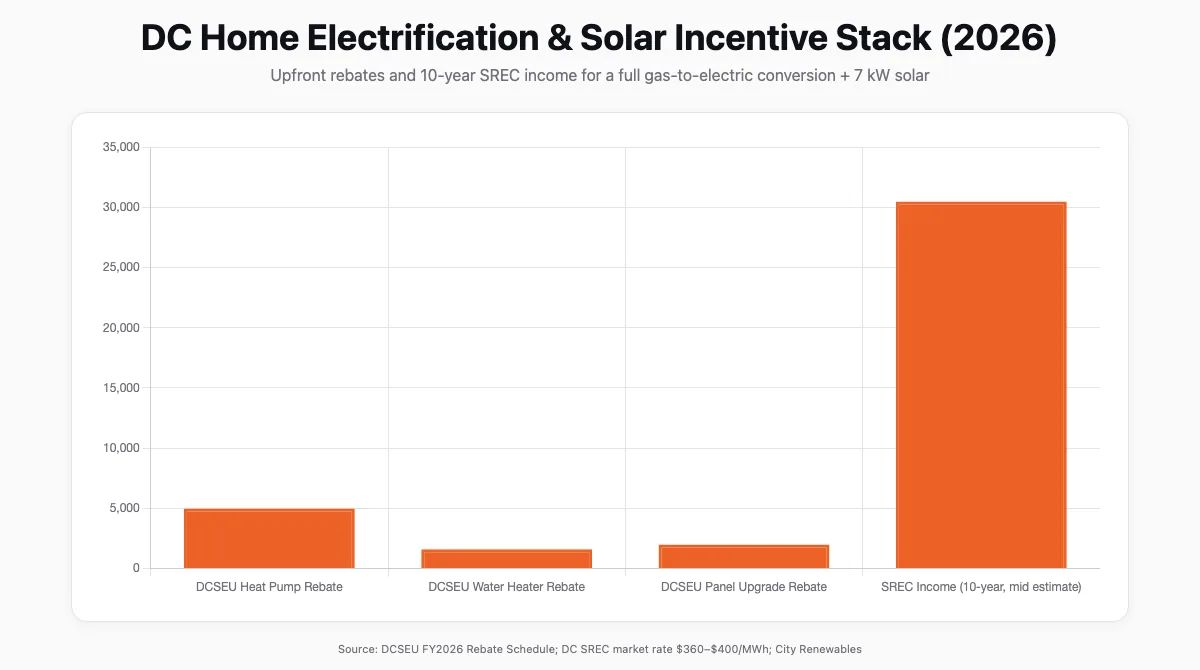
DC homeowners switching from gas to electric in 2026 can stack up to $8,600 in upfront rebates through the DC Sustainable Energy Utility (DCSEU) — before counting annual SREC income or net metering savings. The federal 25D solar tax credit ended January 1, 2026, and the 25C credit for envelope improvements expired December 31, 2025. But the local rebate stack in DC is deeper than most homeowners realize, and it covers heat pumps, water heaters, panel upgrades, and solar all at once.
City Renewables installs solar and coordinates electrification projects across DC's eight wards. We work with Pepco interconnection, DCSEU rebate applications, and the DC Department of Energy and Environment (DOEE) on a regular basis. This guide reflects what we're actually seeing on the ground in 2026 — which programs are funded, which are waitlisted, and how to sequence the work so you capture every dollar available.
What Home Electrification Rebates Are Available in DC Right Now?
The DCSEU's Residential Electrification Rebates program is the primary source of upfront cash for DC homeowners converting from gas or oil to electric systems in 2026. The program covers equipment and services, requires installation by a DC-licensed contractor, and requires Department of Buildings permits for most measures. Applications must be submitted within 30 days of installation and postmarked by September 30, 2026. The rebates are available to residential properties with four or fewer units — so rowhouses, condos, and small multifamily buildings all qualify. You do not need to own solar panels to access these rebates. You do not need to be low-income. These are standard, income-neutral incentives funded through DC ratepayer dollars.
Here's the current rebate schedule for FY 2026:
| Measure | DCSEU Rebate |
|---|---|
| Qualifying heat pump (gas-to-electric conversion) | Up to $5,000 |
| Heat pump water heater | Up to $1,600 |
| 200-amp electrical panel upgrade (heavy-up) | Up to $2,000 |
| Circuit addition (per circuit, up to 3) | $400/circuit |
| Maximum combined | ~$8,600 |
Sources: DCSEU Residential Electrification Rebates ↗, DCSEU FY2026 Application Form ↗
The heat pump rebate requires proof of gas-to-electric conversion — typically a photo of capped gas lines. That's the documentation step most homeowners miss. Your contractor should handle it, but confirm before they leave the job site.
Does DC Have a HEAR or HEEHRA Rebate Program?
Yes — but with an important distinction. The federal Home Electrification and Appliance Rebates (HEAR) program and the Home Efficiency Rebates (HOMES) program were funded through the Inflation Reduction Act and allocated to states and territories to administer. DC received its allocation, and DOEE is the administering agency. As of mid-2026, DC's federal HEAR rebate portal is active through DOEE — you can find current status and application guidance at doee.dc.gov ↗. The HEAR program (sometimes called HEEHRA in earlier federal documents) targets low-to-moderate income households and covers appliances including heat pump water heaters, heat pumps, electric stoves, and heat pump clothes dryers. Income-qualified DC households can receive up to $14,000 in combined HEAR rebates — stacked on top of DCSEU's own electrification rebates. If you've been searching for the "Home Energy Rebates portal" or wondering "when will HEEHRA rebates be available" — in DC, the answer is: check DOEE's page directly, because availability and funding levels shift as the program draws down.
The DCSEU's own Affordable Home Electrification Program (AHEP) is a separate, no-cost pathway for income-qualified residents. AHEP covers comprehensive upgrades — heat pumps, insulation, water heaters — at no charge to qualifying households. As of June 2026, AHEP is waitlisted. If you meet the income criteria or participate in LIHEAP, SSI, or similar programs, get on the waitlist now. The queue moves.
How Do You Stack DCSEU Rebates With Solar?
Stacking works because the programs target different measures. DCSEU's electrification rebates cover the conversion from gas to electric. Solar incentives — SRECs, net metering, and any remaining DOEE solar programs — cover the generation side. You can pursue both in the same year, and in many cases the same project triggers both.
A typical all-electric conversion in DC might look like this:
- Install a heat pump to replace a gas furnace — DCSEU rebate up to $5,000
- Install a heat pump water heater — DCSEU rebate up to $1,600
- Upgrade the electrical panel to 200 amps — DCSEU rebate up to $2,000
- Add solar panels to offset the increased electricity load — DC SRECs generate $360–$400 per MWh in 2026
- Enroll in Pepco net metering — excess generation credited at retail rate
The solar piece is where ongoing income compounds. A 7 kW system in DC produces roughly 8,050 kWh per year (at 1,150 kWh/kW). At current SREC prices, that's $2,900–$3,200 in annual SREC income alone — on top of the electricity bill savings. Our DC solar incentives 2026 guide covers the full solar incentive picture, including what changed when the federal ITC ended.
For the heat pump and solar combination specifically, we've written a dedicated post: Heat Pumps + Solar in DC covers the system sizing and load math in detail. This post focuses on the rebate coordination layer.
What Are the Eligibility Requirements for DCSEU Electrification Rebates?
The DCSEU electrification rebates have four hard requirements that disqualify applications when missed:
- DC-licensed contractor: The installer must hold a current DC contractor license. Out-of-state contractors working without DC licensure make the rebate ineligible.
- Department of Buildings permit: Most measures require a permit pulled before work begins. The permit number goes on the application.
- Gas-to-electric conversion documentation: For heat pump rebates, you must show you're replacing a gas or oil system — not just adding a heat pump to an existing electric system. Capped gas line photos are the standard proof.
- 30-day submission window: Applications must be submitted within 30 days of installation completion. Miss the window, lose the rebate. Set a calendar reminder the day the contractor finishes.
Properties must be residential with four or fewer units. Renters can apply if they are the account holder responsible for the utility bill — so if you pay your own Pepco bill, you may qualify even without owning the property. Confirm with DCSEU before purchasing equipment.
What Solar Incentives Still Exist in DC After the Federal Tax Credit Ended?
The federal 25D residential Investment Tax Credit ended January 1, 2026. For DC homeowners buying solar with cash or a loan in 2026, there is no federal tax credit. That's a real change — on a $28,000 system, that's $8,400 that no longer exists as a credit.
But DC's local solar incentives were strong before the ITC, and they remain strong now. The three that matter most:
DC SRECs: Every megawatt-hour your system produces generates one Solar Renewable Energy Credit. DC utilities must buy them to meet the Renewable Portfolio Standard. In 2026, SRECs are trading at $360–$400/MWh, with a Solar Alternative Compliance Payment (SACP) ceiling of $440. On a 7 kW system producing 8,050 kWh/year, that's 8 SRECs annually — roughly $2,900–$3,200/year in income. Over a 10-year SREC contract, that's $29,000–$32,000. Our DC SREC guide covers how to register, aggregate, and sell.
Net metering with Pepco: Excess solar generation is credited at the retail rate against your bill. DC's net metering rules are among the most favorable in the region.
Solar Advantage Plus (SAPP): DOEE's income-qualified solar program provides upfront rebates for eligible households. Check current availability at doee.dc.gov — funding levels change.
Can Renters Access Any of These Rebates?
Renters have more options than most people assume. The DCSEU electrification rebates are available to renters who are the Pepco account holder — meaning you pay the electric bill directly. If your landlord pays utilities and bundles them into rent, you're not the account holder and the rebate path is different.
For renters who do pay their own Pepco bill: the heat pump water heater rebate (up to $1,600) is the most accessible measure, since water heaters are often tenant-controlled. Panel upgrades and HVAC systems typically require landlord coordination.
The HEAR program through DOEE has specific provisions for renters in multifamily buildings, particularly for income-qualified households. On r/washingtondc, renters in Ward 4 and Ward 7 have reported successfully accessing DCSEU rebates for heat pump water heaters in rental units — the key was being the named Pepco account holder and getting written landlord consent for the installation.
Solar is harder for renters in single-family rentals, but community solar subscriptions through DCSEU's Solar for All program don't require roof access at all.
How to Apply: Step-by-Step for DCSEU Electrification Rebates
- Confirm eligibility before purchasing equipment. Check the current program terms at dcseu.com/residential-rebates/electrify ↗. Rebate amounts and requirements can change mid-fiscal year.
- Hire a DC-licensed contractor. Ask for their DC license number before signing a contract. Verify it with the Department of Buildings.
- Ensure permits are pulled. Confirm the contractor is pulling the required Department of Buildings permits before work begins.
- Document the gas-to-electric conversion. Photograph capped gas lines, removed gas equipment, and the new electric equipment with model numbers visible.
- Collect required paperwork. You'll need: contractor invoice, permit documentation, equipment spec sheets, and proof of DC residency.
- Submit within 30 days. Apply online at rebates.dcseu.com or submit the paper form. The FY2026 deadline for postmarked applications is September 30, 2026.
- Track your application. DCSEU processes rebates in batches. Follow up if you haven't received confirmation within 6 weeks.
Stacking the Full DC Incentive Picture: Real Numbers
A DC homeowner doing a full gas-to-electric conversion plus solar in 2026 — a 3-bedroom rowhouse in Petworth, say — might see this incentive stack:
| Incentive | Amount | Type |
|---|---|---|
| DCSEU heat pump rebate | Up to $5,000 | Upfront cash |
| DCSEU heat pump water heater rebate | Up to $1,600 | Upfront cash |
| DCSEU panel upgrade rebate | Up to $2,000 | Upfront cash |
| DC SREC income (7 kW system, Year 1) | ~$3,000 | Annual income |
| DC SREC income (10-year total) | ~$29,000–$32,000 | Cumulative income |
| Pepco net metering savings (est.) | ~$800–$1,200/year | Bill reduction |
| Federal 25D ITC | $0 | Expired Jan 1, 2026 |
The upfront rebates alone cover $8,600 of the conversion cost. The SREC income over a decade exceeds the cost of a typical solar installation. These numbers aren't projections — they're based on current program rates and DC's actual solar production profile of 1,100–1,200 kWh per kW installed per year.
Frequently Asked Questions
What is the HEAR rebate program?
HEAR stands for Home Electrification and Appliance Rebates — a federal program funded through the Inflation Reduction Act and administered by states and DC. In Washington DC, DOEE administers the HEAR program. It provides rebates for income-qualified households switching to electric appliances including heat pumps, heat pump water heaters, electric stoves, and heat pump clothes dryers. Income-qualified DC households can receive up to $14,000 in combined HEAR rebates. Check current availability and application status at doee.dc.gov ↗.
When will HEEHRA rebates be available in DC?
HEEHRA (High-Efficiency Electric Home Rebate Act) is the legislative name for what became the HEAR program. In DC, DOEE launched the program and it is active as of mid-2026. Availability depends on remaining funding — the program draws down as applications are approved. Check doee.dc.gov for current status rather than relying on third-party trackers, which often lag by weeks.
How do I apply for the ENERGY STAR appliance rebate application online in DC?
For DCSEU rebates, apply online at rebates.dcseu.com. For DOEE's HEAR program rebates, the application portal is linked from doee.dc.gov. Both require proof of purchase, equipment spec sheets showing ENERGY STAR certification, contractor documentation, and DC residency. DCSEU's online portal is the faster path for most standard electrification measures.
Can I stack DCSEU rebates with the HEAR program?
Yes. DCSEU rebates and DOEE's HEAR program rebates are separate funding sources and can be combined for the same project. A qualifying heat pump installation could receive up to $5,000 from DCSEU and additional HEAR rebates through DOEE if you meet the income requirements. Document each application separately — they have different forms, different deadlines, and different administering agencies.
Do DC electrification rebates apply to condos?
Yes, for units in buildings with four or fewer residential units. Larger multifamily buildings have different pathways — DCSEU has commercial and multifamily programs separate from the residential rebate track. If you own a condo in a larger building, contact DCSEU directly to determine which program applies to your situation.
What happened to the federal solar tax credit for DC homeowners?
The federal 25D residential Investment Tax Credit for purchased solar systems ended January 1, 2026. DC homeowners who buy solar with cash or a loan in 2026 receive no federal tax credit. The 25C credit for certain envelope improvements also expired December 31, 2025. DC's local incentives — SRECs, net metering, SAPP, and DCSEU programs — remain active and are the primary financial case for solar in 2026. See our DC solar incentives 2026 guide for the full breakdown.
Start With a Green Zone Assessment
The rebate stack is real, but capturing all of it requires sequencing the work correctly — permits before installation, applications within 30 days, the right contractor license on file. We coordinate this for every project we take on.
If you're weighing a heat pump, water heater, panel upgrade, or solar installation — or all four — a Green Zone assessment is the right first step. We'll map your property's solar potential, identify which DCSEU and DOEE programs you qualify for, and give you a clear picture of the actual numbers before you commit to anything.


