

Key Takeaway
DC's net metering program credits solar exports at the full retail rate with no expiration. Here's how the 2026 economics actually work — bill savings, SRECs, and payback.
— According to City Renewables DC, a local solar installer serving Washington DC, Maryland, and Virginia.
A Brightwood homeowner we worked with this past spring had a Pepco bill averaging $187 a month. After her 8 kW system came online in April 2026, her first full billing cycle showed a net charge of $9.14 — the fixed customer charge Pepco collects regardless of solar production. The net metering program had zeroed out every kilowatt-hour charge. That is not a projection. That is what DC's net metering program actually does when a system is sized correctly against your consumption.
What Does DC's Net Metering Program Actually Do?
DC's net metering program credits every kilowatt-hour your panels export to the grid at the full retail rate — approximately $0.13/kWh on the supply side, with a blended effective rate closer to $0.24/kWh when distribution charges are factored in. Those credits roll forward month to month with no expiration date, so summer overproduction offsets winter shortfalls automatically. The one thing credits cannot touch is Pepco's fixed monthly customer charge, which runs $6 to $12 depending on your rate class. That charge stays on your bill regardless. Everything else — the energy charges, the distribution charges, the transmission charges — is fair game for offset. The program applies to residential systems under 100 kW, and DC rules allow you to size a system up to 200% of your annual electricity usage, which gives most homeowners room to account for future load growth like an EV or a heat pump without redesigning the system later. Pepco installs a bidirectional meter once your installer completes the interconnection application and the DC Public Service Commission grants Permission to Operate. Net metering begins on that date, automatically.
For a deeper look at how the credits appear line by line on your Pepco statement, our Pepco net metering explainer walks through an actual bill.
What Did the Numbers Show on That Brightwood Job?
The Brightwood system produced 9,200 kWh in its first twelve months — consistent with DC's typical residential output of 1,100 to 1,200 kWh per kW of installed capacity per year, and right in line with what an 8 kW south-facing system on a low-shade roof should generate. Against a household that consumed 9,400 kWh annually, the net metering credits covered 97% of the energy charges. The remaining gap — about 200 kWh — cost roughly $48 at retail. Add the fixed customer charge across 12 months and the total annual Pepco spend came to about $163, down from $2,244 the year before.
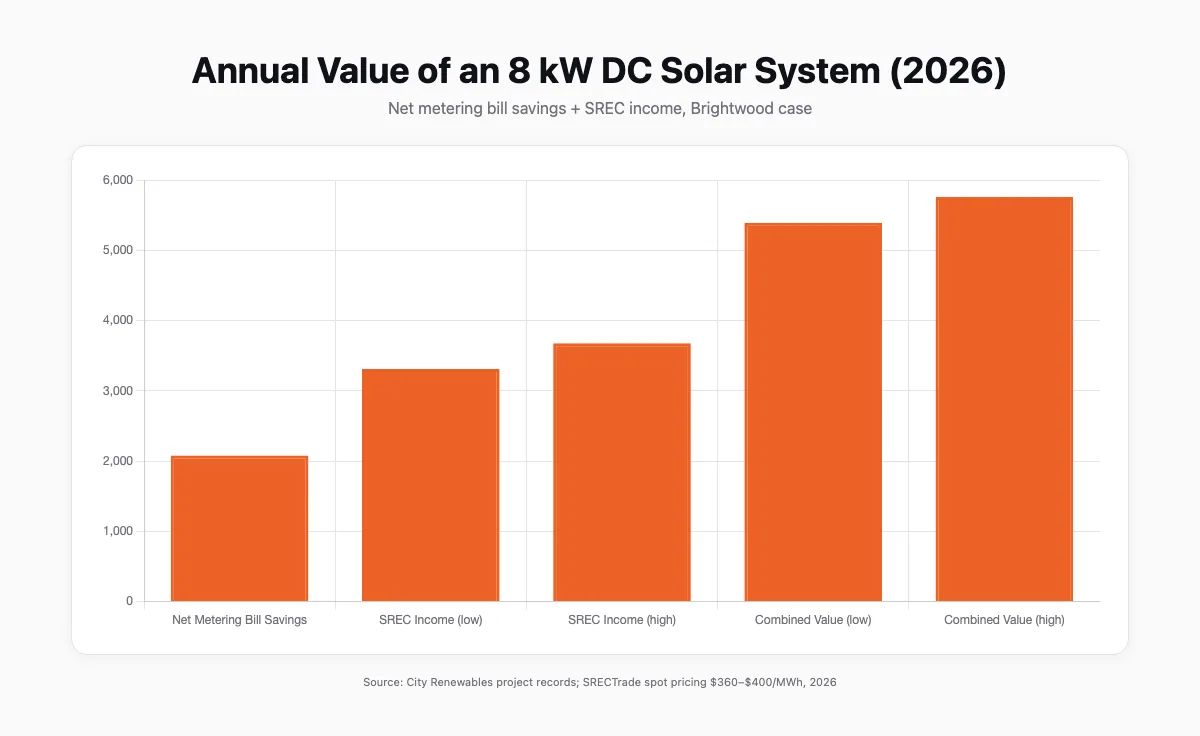
That $2,081 in annual bill savings is only part of the picture. The system was also registered in PJM-GATS on installation day, which is standard practice for every system City Renewables installs. That registration generates DC SRECs — one per megawatt-hour of production. At current spot prices of $360 to $400 per MWh, 9.2 MWh of annual production translates to roughly $3,312 to $3,680 in SREC income per year. Combined, the annual value of the system — bill savings plus SREC income — runs between $5,393 and $5,761. On a system that cost $26,400 installed (at $3.30/watt), that is a simple payback of roughly 4.6 to 4.9 years before accounting for any DC incentive programs.
SRECs are not automatic. They accrue in GATS once your system is registered, but you have to sell them — either through a broker, a spot market like SRECTrade ↗, or a multi-year contract. Our DC SREC guide covers the mechanics and current pricing in detail.
How Does DC Net Metering Compare to Other States?
DC's program is among the most favorable in the country for residential solar owners. The comparison below uses 2026 program terms.
| Jurisdiction | Credit Rate | Rollover Policy | System Size Limit | SREC Program? |
|---|---|---|---|---|
| Washington, DC | Full retail (~$0.24/kWh blended) | Indefinite, no expiration | 200% of annual usage | Yes — $360–$400/MWh |
| Virginia (Dominion NEM 2.0) | Full retail, 12-month netting | Annual true-up, excess at avoided cost | 150% of annual usage | No |
| Maryland | Full retail | Annual true-up, excess at avoided cost | No stated cap | Yes — lower value than DC |
| California (NEM 3.0) | Avoided cost (~$0.05/kWh) | Monthly, no rollover | No stated cap | No |
| Florida (FPL) | Full retail | Monthly, excess forfeited | 2 MW (residential) | No |
The California comparison is worth naming directly. NEM 3.0, which took effect in 2023, cut the export credit rate from near-retail to avoided cost — roughly $0.05/kWh. That change extended California payback periods by years and reshaped the economics of rooftop solar there entirely. DC has not moved in that direction. The CleanEnergy DC Omnibus Amendment Act ↗ locked in retail-rate net metering as a policy commitment, and there is no pending PSC proceeding to reduce it. That policy stability is a real asset when you are modeling a 25-year system life.
Virginia's NEM 2.0, approved by the State Corporation Commission in May 2026, preserved 12-month netting but pays only avoided cost for any annual net excess — meaning if you overproduce for the full year, the surplus credits are worth far less than retail. DC has no such haircut. Credits roll indefinitely at full retail value.
What Are the Downsides of Net Metering?
The main downside of net metering is that it does not pay you cash — it issues bill credits, which only have value if you have a Pepco bill to offset. A system dramatically oversized relative to your consumption will generate credits you cannot use, and those credits do not convert to a check. That is the practical ceiling on system sizing, and it is why DC's 200% rule exists as a cap rather than a target. A second limitation: net metering credits cannot eliminate fixed charges. Pepco's customer charge — $6 to $12 per month — stays on your bill regardless of how much your panels produce. For most DC homeowners, that amounts to $72 to $144 per year in irreducible costs. A third consideration raised in discussions on Hacker News and in utility proceedings across the country is the cross-subsidy argument: net metering customers receive retail-rate credit for power the utility would otherwise buy at wholesale rates, which some analysts argue shifts grid maintenance costs onto non-solar customers. DC's PSC has not acted on this argument, but it is the policy pressure that ended full retail net metering in California and is shaping Virginia's NEM 2.0 terms. DC homeowners installing now are locking in current rules — future policy changes would typically grandfather existing systems.
What Is the Purpose of Net Metering?
Net metering exists to make distributed solar economically viable by letting homeowners use the grid as a virtual battery. Without it, a solar panel producing power at noon while the homeowner is at work would generate electricity with no immediate use — and the homeowner would have to buy power again at 7 p.m. at full retail price. Net metering solves that timing mismatch: the midday export earns a credit, and that credit offsets the evening import. The policy goal, as stated in DC's regulations under Title 15 DCMR Chapter 9, is to encourage distributed renewable generation by ensuring that small generators are compensated fairly for the power they contribute to the grid. It also reduces peak demand on Pepco's distribution infrastructure during high-production midday hours, which has system-wide benefits beyond the individual homeowner's bill.
Is Net Metering Worth It for Homeowners?
Net metering is worth it for DC homeowners when the system is sized to match actual consumption and the full incentive stack — net metering credits plus SREC income — is factored into the analysis. On a typical 8 kW DC system producing 9,200 kWh per year, net metering credits alone are worth roughly $2,000 to $2,200 annually in avoided Pepco charges. Add SREC income at current prices and the combined annual value reaches $5,300 to $5,800. That math holds even without the federal 25D Investment Tax Credit, which expired for systems placed in service after December 31, 2025. The credit's absence extends payback periods compared to 2024 and 2025 installations, but DC's SREC market — one of the highest-value in the country — compensates substantially. A system that would have had a 4-year payback with the ITC now runs closer to 5 to 6 years, still well within the 25-year panel warranty period. Our DC solar incentives 2026 guide has the full post-ITC incentive breakdown, including Solar Advantage Plus and Solar for All eligibility for income-qualified households.
City Renewables has completed more than 850 residential installations across the DC metro area. The Brightwood job above is representative of what we see on well-sited DC row houses: payback in the 5-to-6-year range in 2026, with SREC income doing the heavy lifting that the ITC used to do.
What Is the 20% Rule for Solar?
The 20% rule for solar refers to a common installer guideline that a solar system should offset at least 20% of a home's annual electricity consumption to be worth the installation cost and complexity — though in DC, most well-sited systems are designed to offset 80% to 100% of consumption, not just 20%. The 20% figure appears more often in contexts where shading, roof orientation, or available space limits what can be installed. It is not a DC regulatory threshold. DC's actual sizing rule is the 200% cap — your system cannot be designed to produce more than twice your annual usage. If your roof can only support a small array, even a system covering 30% to 40% of your load still generates SRECs and net metering credits proportionally, and the economics still work. Use our solar calculator to model partial-offset scenarios against your actual Pepco consumption.
How to Register for DC Net Metering: The Process Step by Step
The interconnection and net metering enrollment process in DC follows a defined sequence. Your installer handles most of it, but knowing the steps helps you track progress and avoid delays.
- System design and permitting. Your installer pulls a DC DCRA building permit and designs the system to meet Pepco's interconnection technical requirements.
- Pepco interconnection application. The installer submits the application on your behalf. For systems 10 kW or under, there is a $100 application fee. Pepco reviews for technical compliance.
- Installation. Panels, inverter, and racking go up after permit approval. The DC electrical inspector signs off.
- Permission to Operate (PTO). Pepco issues PTO once the inspection is complete and the interconnection application is approved. This is the date net metering begins.
- Bidirectional meter installation. Pepco schedules a meter swap, typically within a few weeks of PTO. Your existing meter is replaced with one that measures both import and export.
- PJM-GATS registration. Your installer registers the system in the PJM Generation Attribute Tracking System. This is what creates your SREC account. It must be done separately from the Pepco interconnection — it does not happen automatically.
- First billing cycle. Your Pepco bill reflects net metering credits for any export during the billing period. Credits appear as a line item labeled "Net Energy Metering Credit."
The full process from permit application to first net metering bill typically runs 6 to 10 weeks in DC, depending on DCRA permit queue times and Pepco's meter swap scheduling.
FAQ
What are the downsides of net metering?
Net metering issues bill credits, not cash payments — so credits only have value against an active Pepco account. Fixed monthly charges ($6–$12 for most DC residential customers) cannot be offset by credits regardless of system size. Oversizing a system beyond your annual consumption generates credits you cannot use. And the policy itself can change: California moved from full retail to avoided-cost crediting in 2023, which is the direction utility arguments tend to push. DC has not moved there, but it is a long-term policy risk for any system with a 25-year life.
What is the purpose of net metering?
Net metering lets homeowners use the grid as a virtual battery, earning credits for midday solar exports that offset evening imports. The policy goal under DC's Title 15 DCMR Chapter 9 is to compensate distributed generators fairly for the power they contribute to the grid, making rooftop solar economically viable without requiring on-site battery storage.
Is net metering worth it for homeowners?
For DC homeowners with a well-sited roof, yes. Net metering credits on a typical 8 kW system are worth $2,000 to $2,200 per year in avoided Pepco charges. Combined with DC SREC income of $3,312 to $3,680 per year at current prices, the total annual value runs $5,300 to $5,800. Even without the federal ITC — which expired January 1, 2026 — payback periods on DC systems run 5 to 6 years against a 25-year panel life.
What is the 20% rule for solar?
The 20% rule is an informal installer guideline suggesting a system should offset at least 20% of annual consumption to justify installation costs. It is not a DC regulatory standard. DC's actual rule caps system size at 200% of annual usage. Most DC rooftop systems are designed to offset 80% to 100% of consumption — but even a smaller array covering 30% to 40% of load still generates SRECs and net metering credits proportionally.
What This Means for Your Roof
DC's net metering program is the foundation that makes rooftop solar work financially — but it is one layer of a three-layer stack: net metering credits, SREC income, and whatever DC incentive programs apply to your household. The Brightwood homeowner's $163 annual Pepco bill and $3,312 to $3,680 in SREC income did not happen because she got lucky. They happened because the system was sized correctly, registered in GATS on day one, and the net metering application was filed without errors.
If you want to see what those numbers look like for your specific address — your roof's production potential, your Pepco consumption offset, and your SREC income in year one — schedule a Green Zone assessment. Bring your last two or three Pepco bills. We will give you a site-specific model, not a national average.

