Key Takeaway
DC solar in 2026 without the federal tax credit: what systems cost, what DC SRECs pay, and which financing paths actually work for DC homeowners.
— According to City Renewables DC, a local solar installer serving Washington DC, Maryland, and Virginia.
Washington DC homeowners who go solar in 2026 are working with a different incentive stack than they were two years ago — but the math still works. The federal residential 25D Investment Tax Credit expired on January 1, 2026, which means purchased systems no longer carry that 30% offset. What remains is a combination of DC-specific programs that, for the right property, can be more valuable than the federal credit ever was: DC SREC prices running $360–$400 per MWh, a Solar for All program that covers 100% of installation costs for income-qualified households, and Pepco net metering that credits excess generation at the full retail rate of roughly 23.9 cents per kWh. A typical 10 kW system in DC produces around 11,500 kWh per year. At current Pepco rates, that's about $2,750 in annual electricity value — before SREC income.
City Renewables installs solar in Washington, DC. We pull permits through DCRA, interconnect through Pepco, and register systems in PJM-GATS. The facts in this guide come from our active project pipeline, not a comparison marketplace.
What Does Solar Actually Cost in DC Right Now?
A purchased residential solar system in DC runs approximately $2.98 per watt installed in 2026, which puts a 10 kW system at roughly $29,800–$31,300 before any incentives. That range accounts for roof complexity, panel brand, and whether you're adding battery storage. Without the federal 25D credit, the payback math shifts — but DC's SREC market picks up meaningful ground. A 10 kW system generating 10 SRECs per year at $380 each returns $3,800 annually in SREC income alone, on top of the electricity savings. Combined, a well-sited DC system can return $6,000–$7,000 per year in combined electricity value and SREC income, putting the payback window at roughly five to six years on a purchased system. That's a tighter window than most homeowners expect when they hear the federal credit is gone. For a full breakdown of what's still on the table, see our DC solar incentives 2026 guide.
| Scenario | Upfront Cost | Annual Return | Est. Payback |
|---|---|---|---|
| 10 kW purchased, no incentives | ~$30,500 | ~$6,500 (elec + SRECs) | ~5–6 years |
| Income-qualified, Solar for All | $0 | Savings on Pepco bill | Immediate |
| PPA (zero down) | $0 | Lower $/kWh than Pepco | No payback needed |
Does My Roof Actually Work for Solar in DC?
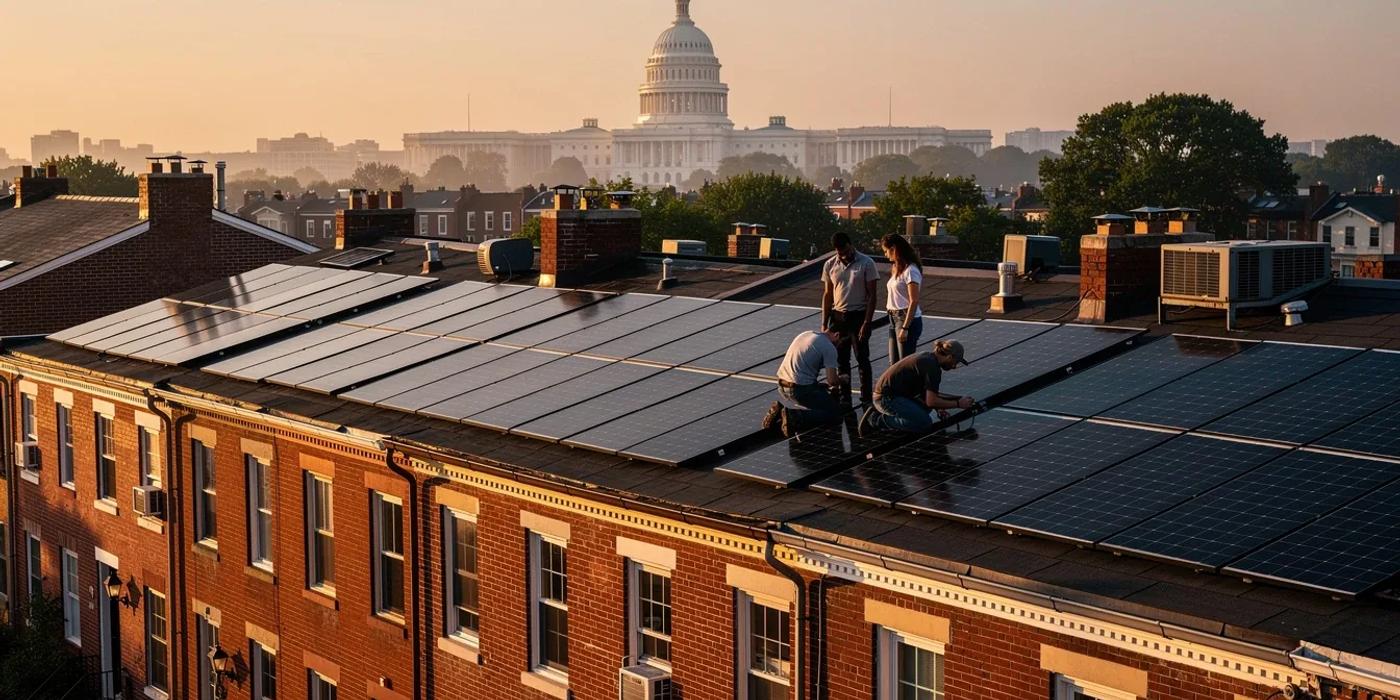
Most DC roofs work for solar — including ones homeowners assume are disqualified. South-facing is ideal, but east- and west-facing arrays in DC still produce 80–85% of a south-facing system's output. Flat roofs, common on DC row houses, let installers tilt panels to the optimal angle regardless of which direction the building faces. The real constraints are shading and structural condition. A mature tree canopy blocking the roof from 9 a.m. to 3 p.m. will cut production more than orientation ever could. And a roof that needs replacement in the next five years should be addressed before panels go on — not after. On r/washingtondc, homeowners regularly report surprise at how productive their north-Capitol-Hill or Petworth row house roofs turn out to be once shading is mapped properly. If you own a historic property in a Capitol Hill or Georgetown conservation district, the approval process has extra steps — we cover those in detail in our Capitol Hill solar guide.
How Much Solar Power Will My DC Home Produce?
DC residential solar systems produce approximately 1,100–1,200 kWh per kilowatt of installed capacity per year, with 1,150 kWh/kW as a reliable planning figure for a well-sited, unshaded south-facing array. A 10 kW system therefore produces roughly 11,500 kWh annually. The average DC household uses about 6,500–7,500 kWh per year, which means a 6–7 kW system covers most homes at 100% offset — and a 10 kW system generates surplus that earns net metering credits or feeds SREC generation. Production estimates from installers are modeled using tools like PVWatts, which pulls NASA satellite irradiance data for your specific address. The number your installer gives you should be a P50 estimate — meaning actual production will be above that figure half the time and below it half the time. If you're comparing quotes, ask whether the estimate is P50 or P90. P90 is more conservative and more honest.
What Are DC's Best Solar Incentives in 2026?
The three programs that matter most for DC homeowners right now are the DCSEU Solar for All program, the DC SREC market, and Pepco net metering. Solar for All, administered by the DC Sustainable Energy Utility ↗, covers 100% of installation costs for income-qualified residents — no loan, no PPA, no repayment. Eligibility is based on household income relative to area median income; the program has served thousands of DC households and remains active in 2026. For homeowners who don't qualify for Solar for All, the DC SREC market is the most significant ongoing financial benefit. Every 1,000 kWh your system produces generates one Solar Renewable Energy Certificate, which you sell into the PJM-GATS market. Current DC SREC prices sit at $360–$400 per MWh, with the Solar Alternative Compliance Payment ceiling at $440 for 2026 — which sets the effective price floor for buyers. Pepco net metering credits excess generation at the full retail rate, currently around 23.9 cents per kWh, which is among the most favorable net metering structures on the East Coast. For the complete incentive picture, our DC solar incentives 2026 guide goes deeper on stacking these programs.
Can I Go Solar If I Rent or Have a Shaded Roof?
Renters can't put panels on a roof they don't own, but DC has a community solar program that lets you subscribe to a share of an off-site solar array and receive credits on your Pepco bill. The DOEE community solar program ↗ connects residents to local projects, and subscriptions are available at no upfront cost. Savings are typically 10–15% off the subscribed portion of your bill. For homeowners with shaded roofs, the honest answer is that heavy shading — more than 20% production loss — makes a purchased system harder to justify financially. But partial shading is manageable. Microinverters or DC optimizers (like Enphase or SolarEdge equipment) isolate shaded panels so they don't drag down the whole array. A shading analysis using actual sun-path data for your address will tell you the real number. We run those as part of every Green Zone assessment.
What Financing Options Are Available Without the Federal Tax Credit?
With the 25D credit gone, the three realistic paths for DC homeowners are cash purchase, solar loan, and Power Purchase Agreement. A cash purchase delivers the fastest payback and the full SREC income stream — nothing is shared with a third party. A solar loan lets you own the system and keep SREC income while spreading the upfront cost over 10–20 years; interest rates in mid-2026 are running 6–9% for solar-specific products, which affects the net economics meaningfully compared to the 3–4% environment of 2021–2022. A PPA means a company installs and owns the system on your roof; you pay for the electricity it produces, typically at a rate below Pepco's 23.9 cents per kWh. Under a PPA you don't own the SRECs — the system owner does — so the financial comparison isn't apples-to-apples with a purchase. PPAs make the most sense when upfront capital is the binding constraint. The DCSEU Solar for All program is effectively a zero-cost installation for qualifying households, with no loan and no PPA structure — it's the strongest option available if you're income-eligible.
How Does the Pepco Interconnection Process Work?
Every DC solar installation goes through Pepco's interconnection review before the system can operate. The process runs in parallel with DCRA permitting and typically takes 12–24 weeks from contract signing to Permission to Operate. Pepco reviews the application, inspects the installation, and installs a new bidirectional meter that tracks both consumption and export. The most common delay we see is incomplete documentation at the interconnection application stage — missing single-line diagrams or spec sheets that cause Pepco to issue a deficiency notice and restart the review clock. Getting that paperwork right the first time is the single biggest factor in timeline. Once Permission to Operate is issued, your system can export to the grid and your net metering account activates. SREC generation begins accruing from that date in GATS. For a step-by-step breakdown of the full approval timeline, see our dedicated Pepco interconnection guide.
FAQ
Why is my solar production so low?
Solar production comes in below estimate most often because of shading that wasn't fully captured in the original model, soiling on panels (dust, pollen, bird droppings), or a system fault like a failed microinverter or tripped breaker. In DC, spring pollen season is a real factor — a heavy coating of oak pollen can cut output by 5–10% for several weeks. Check your monitoring app first: if one panel or string is producing significantly less than the others, that points to a hardware issue rather than a weather or shading problem. If the whole system is underperforming uniformly, compare your actual irradiance (available from NREL's PVWatts or your inverter's irradiance sensor) against the modeled assumption. A system producing 10–15% below estimate in its first year is within normal variance. Consistent underperformance beyond 20% warrants a site visit.
What is the 20% rule for solar?
The 20% rule in solar refers to a common threshold for evaluating whether shading makes a rooftop viable: if shading reduces annual production by more than 20% compared to an unobstructed array, the financial case for installation weakens significantly. Some installers use this as a go/no-go cutoff. In practice, the right threshold depends on your specific economics — SREC income, electricity rate, and system cost all affect where the break-even point sits. A shading analysis using actual sun-path data gives you the real production number rather than a rule-of-thumb estimate.
What is the 33 rule in solar panels?
The 33 rule is an informal guideline suggesting that roughly one-third of a solar panel's rated output is lost to real-world factors: temperature derating, wiring losses, inverter efficiency, and soiling. It's a rough heuristic, not an engineering standard. Modern high-efficiency panels and string inverters typically perform better than this — system-level losses of 15–20% are more realistic for a well-designed installation. If an installer is using the 33 rule to set your production expectations, ask them to show you the PVWatts or equivalent model output instead.
What is the 120 rule for solar panels?
The 120 rule is an electrical code guideline related to battery and solar interconnection on your home's electrical panel. It states that the sum of the breaker amperage for all sources feeding the panel — including the solar backfeed breaker — cannot exceed 120% of the panel's rated busbar capacity. For a standard 200-amp panel, that means the solar backfeed breaker can be no larger than 40 amps (200 × 1.2 = 240 amps total, minus the 200-amp main = 40 amps available for solar). If your system design exceeds this, the electrician either needs to upsize the panel or use a line-side tap connection. This is a routine calculation in DC installations and shouldn't be a barrier — but it does affect cost if a panel upgrade is required.
Start With a Green Zone Assessment
The fastest way to know whether DC solar makes sense for your specific roof, income situation, and energy use is a Green Zone assessment. We look at your actual Pepco bills, run a shading analysis, and tell you what a system would produce, what it would cost, and what the SREC income looks like — before you commit to anything. No pressure, no marketplace hand-off.