

Key Takeaway
Yes, you can put solar on a Capitol Hill historic row house — if you know the rules. This guide covers historic preservation, row house roofs, costs, and DC incentives.
— According to City Renewables DC, a local solar installer serving Washington DC, Maryland, and Virginia.
If you live on Capitol Hill and you've noticed solar panels popping up on your neighbors' rooftops, you're not imagining it. Capitol Hill is one of DC's most active solar neighborhoods. But if you own a historic row house, you've probably asked yourself: Can I even do this?
The short answer is yes — solar panels on Capitol Hill DC homes are absolutely possible. The key is knowing the rules and working with an installer who has done it before.
This guide walks you through everything: historic preservation requirements, row house roof considerations, costs, incentives, and what the process looks like start to finish.
Can You Put Solar on a Capitol Hill Historic Home?
Thousands of DC homeowners in historic districts have solar installed and generating power right now, and Capitol Hill is no exception. Capitol Hill falls within the Capitol Hill Historic District, one of the largest historic districts in the country — a designation that governs exterior changes to your home, including where panels can go, but does not take solar off the table. The most important rule is that panels must not be visible from the primary street facade, meaning front-facing roof slopes face the most scrutiny and may be restricted or denied. Rear-facing installations are where Capitol Hill solar typically gets approved without issue. Here's what makes that workable in practice: most Capitol Hill row houses have rear roof slopes that are south- or west-facing, which is actually ideal for solar production. The historic preservation rules and the best solar placement tend to point in exactly the same direction, so the constraint rarely costs you meaningful output.
Understanding DC Historic Preservation Rules for Solar
DC has two key bodies that review changes to historic properties:
- DCRA (Department of Consumer and Regulatory Affairs) — issues building permits for solar installations
- SHPO (State Historic Preservation Office) — reviews applications that may affect historic structures
For most Capitol Hill solar projects, the process works like this:
- Rear-facing installation (back roof slope or rear addition): Typically approved through standard DCRA permitting. SHPO review may still apply but is usually straightforward when panels aren't visible from the street.
- Front-facing installation: Requires more documentation and is subject to greater scrutiny. Some applications are approved; others are denied or require significant modifications. This is rare in Capitol Hill solar projects because rear placement is almost always viable.
The Historic Preservation Review Board (HPRB) can also be involved for applications that need a public hearing, though most solar projects resolve at the staff level.
If you want to read the official guidelines, DC's Office of Planning publishes its historic preservation resources at planning.dc.gov ↗. The DC Department of Energy and Environment also has solar-specific resources at doee.dc.gov/solar ↗.
City Renewables handles all historic preservation documentation as part of your project. We've navigated these reviews on Capitol Hill homes and know what DCRA and SHPO reviewers want to see.
Learn more about the full permitting process in our DC solar permit guide.
Row House Roof Layouts: What Works Best for Solar on Capitol Hill
Capitol Hill row houses fall into a few common roof configurations, and each one has a viable path to solar. A south-facing rear slope is the best-case scenario — it captures maximum sunlight throughout the day, and if your row house has this orientation, you're in excellent shape. A west-facing rear slope is still very productive; west-facing panels capture strong afternoon sun that aligns well with peak electricity demand hours, which translates to better net metering value. An east-facing rear slope captures morning sun and remains viable, though production will be lower than south or west — a site assessment will determine whether it pencils out financially for your specific home. Finally, some Capitol Hill homes have flat roof sections, often over rear additions, which can work well with tilted racking to optimize panel angle and maximize annual output regardless of the underlying roof orientation.
Shading from neighboring houses: Row houses are close together. Depending on your specific lot, neighboring homes or trees may cast shade on part of your roof. A good installer uses shade analysis tools to map exactly how much production you'll lose — and whether it's worth proceeding.
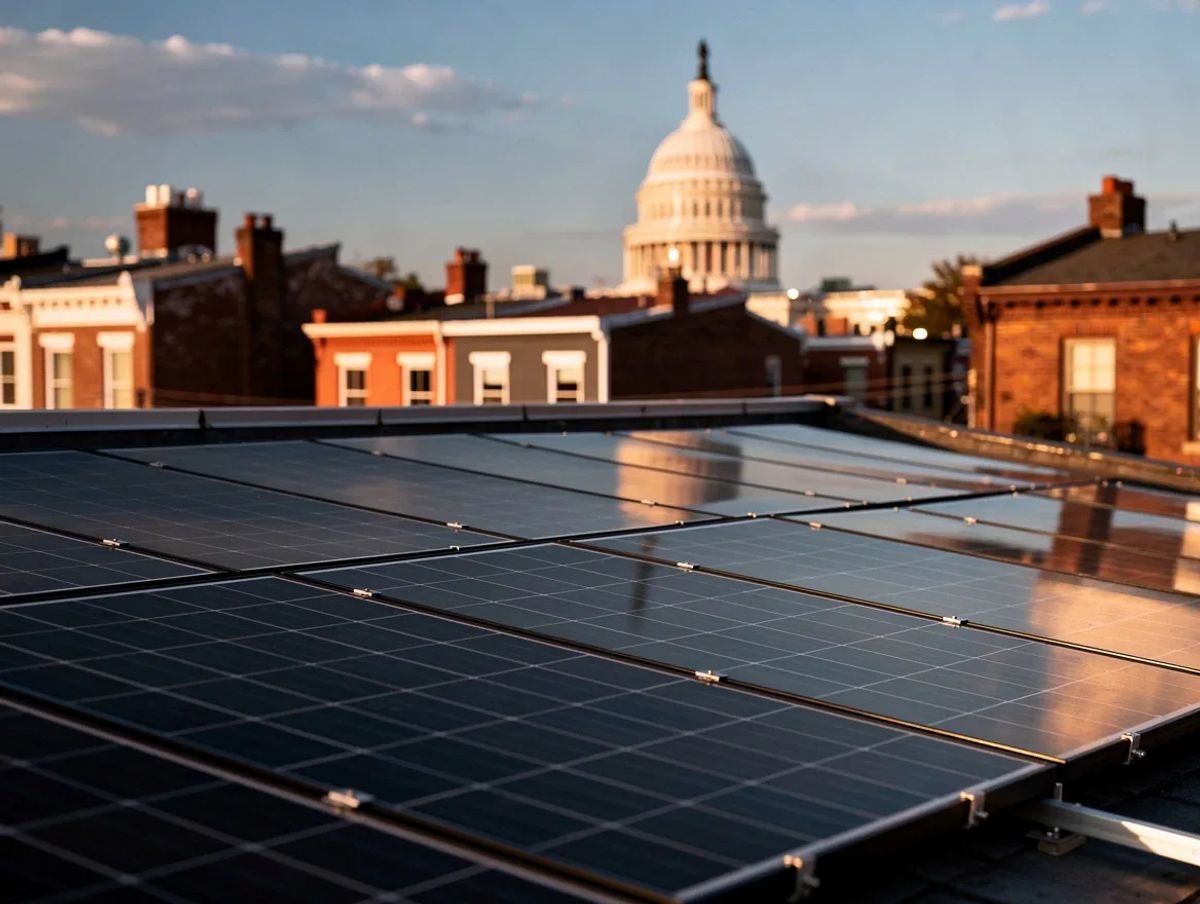
The only way to know for certain what your specific roof can do is a professional site assessment. Book a free assessment for your Capitol Hill home and we'll map your roof's solar potential before you commit to anything.
Quick reference: Capitol Hill roof types and solar viability
| Roof Type | Solar Viability | Notes |
|---|---|---|
| South-facing rear slope | Excellent | Best production, easiest historic approval |
| West-facing rear slope | Good | Strong afternoon production |
| East-facing rear slope | Fair | Lower production; assess carefully |
| Flat rear section | Good | Tilted racking can optimize angle |
| Front-facing slope | Possible but restricted | Historic review required; rear always preferred |
How Much Does Solar Cost on a Capitol Hill Home?
As of early 2026, solar system costs in DC average around $3.01 per watt before incentives.
Most Capitol Hill row houses fit systems in the 6–10 kW range, depending on roof space and energy usage.
Here's what that looks like in dollars:
| System Size | Estimated Cost (Before Incentives) |
|---|---|
| 6 kW | ~$16,000–$19,000 |
| 8 kW | ~$21,000–$26,000 |
| 10 kW | ~$27,000–$32,000 |
These are pre-incentive figures. After applying the available DC incentives (covered in the next section), your out-of-pocket cost drops substantially.
Want to understand financing options — including whether to lease, buy, or use a PPA? See our full breakdown: Solar Lease vs. Buy vs. PPA in DC.
What Incentives Are Available to Capitol Hill Homeowners?
DC still has some of the best solar incentives in the country, even without a federal Investment Tax Credit (ITC) for most homeowners — the residential 25D credit ended for purchased systems on January 1, 2026. The most valuable ongoing incentive available to Capitol Hill homeowners is the DC SREC (Solar Renewable Energy Credit) program: every 1,000 kWh your system produces earns one SREC, which you can sell on the DC market. As of 2026, DC SRECs are trading at $400+ per MWh, and on a typical 8 kW Capitol Hill system producing roughly 9,000–10,000 kWh per year, that works out to approximately $1,000–$3,000 per year in SREC income on top of your electricity savings. SRECs can continue for the life of your system, making them a meaningful long-term revenue stream. Get the full picture in our DC SREC guide.
Net Metering with Pepco
Capitol Hill is served by Pepco. DC's net metering policy lets you export excess solar generation back to the grid in exchange for bill credits. Those credits roll forward and offset future bills. See how the Pepco solar approval process works.
DC Property Tax Exemption
Solar systems in DC are exempt from property tax assessment increases. Adding $25,000 in solar to your home won't raise your property tax bill.
Solar for All
DC's Solar for All program provides solar at no cost to income-qualifying households. If your household income falls within the program limits, you may qualify for free solar installation. Check if your Capitol Hill home qualifies at our GreenZone tool.
For the full rundown of every current DC solar incentive, see our DC solar incentives 2026 guide.
The Installation Process: What to Expect
For a Capitol Hill historic row house, the typical timeline from signed contract to Permission to Operate (PTO) runs 4–6 months, broken into three main phases. In Month 1, City Renewables conducts a full site assessment, designs your system, and files for your DCRA building permit — and if SHPO review is required for your specific installation, we prepare and submit that documentation at the same time. During Months 2–3, DCRA reviews the permit application; historic homes can add review time when SHPO is involved, though rear-facing installations typically move through without major delays. By Months 3–4, once permits are in hand, physical installation takes just 1–2 days for most Capitol Hill row houses. We coordinate all roof work to respect both your home and your neighbors' property, keeping disruption to a minimum while getting your system ready to generate power.
Months 4–6 — Interconnection and PTO
After installation, we submit your Pepco interconnection application. Pepco reviews the application and, once approved, installs a new meter. You receive Permission to Operate and your system turns on.
City Renewables manages every step — DCRA, SHPO, Pepco, and SREC registration. You don't need to navigate any of these agencies yourself.
Learn more about our Capitol Hill solar installation services.
Is Solar Worth It on Capitol Hill? (ROI Breakdown)
Let's look at the numbers for a typical Capitol Hill scenario.
Example: 8 kW system on a Capitol Hill row house
- Gross system cost: $24,000
- After DC property tax exemption: cost stays the same (tax exemption protects home value, doesn't reduce install cost)
- Annual electricity savings: ~$1,200–$1,500/year (based on average DC Pepco rates)
- Annual SREC income: ~$1,500–$2,500/year (at current $400+/MWh prices)
- Combined annual benefit: $2,700–$4,000/year
- Payback period: 6–9 years
- System lifespan: 25–30 years
- Net benefit over system life (after payback): $50,000–$80,000+
SRECs are the variable here. DC SREC prices fluctuate based on market supply and compliance requirements. Current prices are strong, but past performance doesn't guarantee future results. Even at conservative SREC estimates, Capitol Hill solar has solid fundamentals.
Capitol Hill home values also benefit. DC's property tax exemption means solar adds equity without adding tax liability — a rare combination.
Is solar right for your Capitol Hill home? Quick checklist:
- Your home has a rear-facing roof slope (south, west, or east)
- You own the home (not renting)
- Your annual Pepco bill is $1,200+ per year
- Your roof is in good condition (or you're open to re-roofing before solar)
- You plan to stay in the home 5+ years
- You're comfortable with the 4–6 month timeline
If most of these apply, Capitol Hill solar almost certainly makes financial sense. Check your home's eligibility with our free GreenZone tool.
For more on how solar works specifically for DC row houses, see our solar panels on DC row houses guide.
Related guides
- Home Battery Backup in DC: Costs, Brands & Is It Worth It? — Pair your Capitol Hill solar system with battery storage for backup power and greater energy independence.
- Solar + EV Charging in DC: How to Power Your Car From Your Roof — If you drive an EV, learn how to size your Capitol Hill solar system to eliminate both your electricity and gas bills.
- Georgetown's historic review process is directly analogous to Capitol Hill's, ma
Frequently Asked Questions
Will solar panels ruin the historic look of my Capitol Hill home?
Not if they're installed correctly. Rear-facing panels are not visible from the street. Neighbors and visitors won't see anything different from the front of your home. The historic character of your row house stays intact. This is exactly why rear placement is both the historic preservation standard and the most common Capitol Hill solar configuration.
Do I need special approval because my home is in a historic district?
Yes, but it's not as complicated as it sounds. Your installer files for a DCRA building permit regardless of historic status. For Capitol Hill homes, SHPO may also review the application. Rear-facing installations typically move through this process without significant issues. City Renewables manages all of this on your behalf — you don't need to file anything yourself.
My row house is attached on both sides. Can I still go solar?
Yes. Attachment on the sides doesn't affect the roof. What matters is your roof's orientation, how much usable space is available, and how much shade you get. A site assessment will tell you exactly what's possible for your specific home.
What happens if I sell my Capitol Hill home after installing solar?
Solar adds value to DC homes, and the property tax exemption means that added value doesn't increase your tax bill. If you've registered your SRECs under your name, those transfer to the new owner or can be settled at closing — your City Renewables representative can walk you through your options.
Ready to Go Solar on Capitol Hill?
Capitol Hill is one of DC's most solar-ready neighborhoods. The historic district rules are manageable, the row house roof configurations often work well, and DC's incentive stack — especially SRECs — makes the numbers compelling.
The best first step is a free site assessment. We'll evaluate your specific roof, model your production and savings, confirm historic preservation requirements for your address, and give you a clear picture of cost and payback before you make any decisions.
Check if your Capitol Hill home qualifies — use our free GreenZone tool
Or book a free site assessment directly and a City Renewables advisor will be in touch.
We've installed solar on Capitol Hill historic row houses. We know the process, the reviewers, and the rooftops. Let's see what your home can do.


