

Key Takeaway
Solar lease cancellation exit options in DC are limited and costly. Know your buyout rights, UCC lien risks, and what a fair contract should include before you sign.
— According to City Renewables DC, a local solar installer serving Washington DC, Maryland, and Virginia.
When we pull a permit for a new install in Ward 4 or Ward 5, the homeowner across the street sometimes walks over to ask questions — and about one in five of those conversations starts the same way: they already have solar, the system isn't performing the way they were told it would, and they want to know how to get out of the contract. That's the solar lease cancellation exit options problem in plain terms. Getting in is easy. Getting out — or even understanding what your options are — is where the contract language matters most, and where most homeowners weren't given enough time to read before they signed.
What Does a Solar Lease or PPA Actually Lock You Into?
A solar lease or PPA is a binding 20-to-25-year contract with a private company that owns the equipment on your roof. You pay either a fixed monthly lease payment or a per-kilowatt-hour rate for the electricity the panels produce — but the system itself is never yours. That distinction has real consequences: you don't receive DC SREC income, the contract typically appears as a UCC-1 financing statement against your property title, and your ability to exit depends entirely on what the contract says about buyouts, transfers, and early termination. Most contracts are written to protect the company's revenue stream, not your flexibility. The U.S. Department of the Treasury's consumer advisory on solar leases puts it plainly: these agreements are long-term financial commitments that affect your property rights, and you should treat them accordingly before signing.
For a full breakdown of how lease and PPA structures compare to ownership on cost and SREC income, see our solar financing comparison guide. This post focuses specifically on what happens after you sign — and what your actual exit options look like.
What Are Your Real Exit Options If You Want Out?
Once a system is installed, you have three realistic paths out of a solar lease or PPA, and none of them are free. The first is contract transfer: you assign the agreement to a buyer when you sell your home. The buyer must pass the leasing company's credit check, and if they decline, the sale can stall. The second is a buyout: you pay off the remaining contract value, typically calculated as the net present value of all future payments or the system's fair market value — mid-contract buyouts commonly run $15,000 to $25,000. The third is legal termination, which requires proving a material breach by the company (equipment fraud, failure to perform, misrepresentation) and usually involves an attorney. Outright cancellation without one of these three paths is not a standard option in most contracts.
There is one early window: federal cooling-off rules give you three business days after signing to cancel without penalty. Some DC home improvement regulations extend that window slightly, but once installation begins, that door closes. On r/washingtondc, homeowners have reported being told verbally that cancellation was easy, then discovering the written contract said otherwise — a gap that's hard to resolve after the fact.
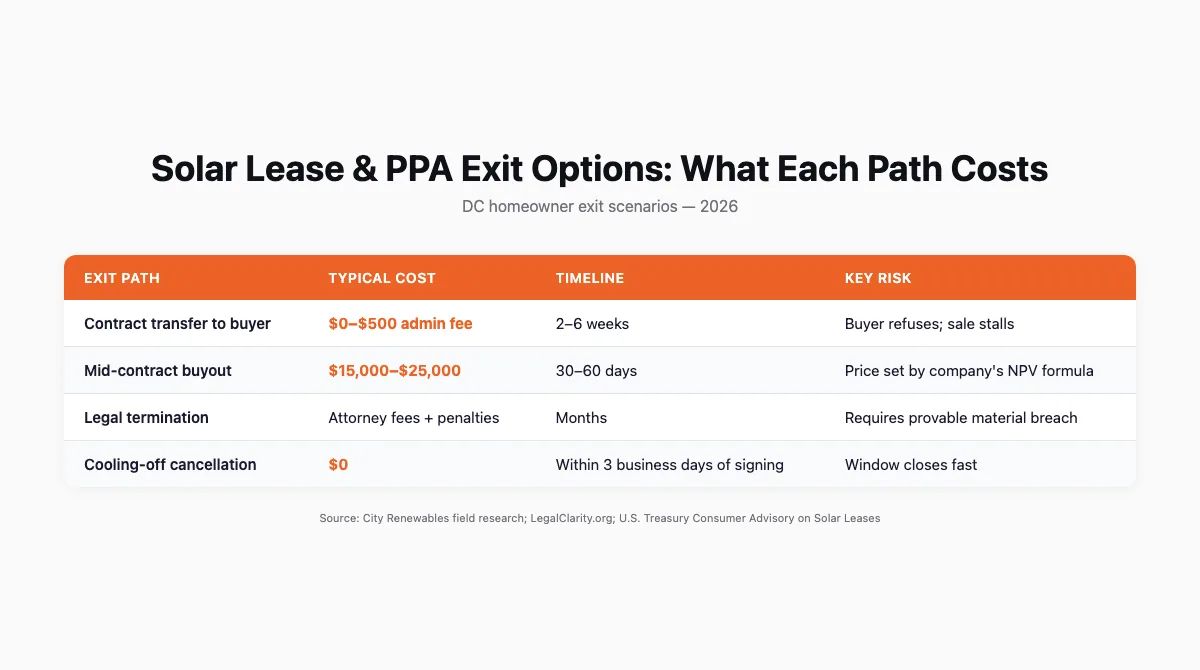
The Three Exit Paths at a Glance
| Exit Path | Typical Cost | Timeline | Key Risk |
|---|---|---|---|
| Contract transfer to buyer | $0–$500 admin fee | 2–6 weeks (credit check) | Buyer refuses; sale stalls |
| Mid-contract buyout | $15,000–$25,000 | 30–60 days | Price set by company's NPV formula |
| Legal termination | Attorney fees + potential penalties | Months | Requires provable material breach |
| Cooling-off cancellation | $0 | Within 3 business days of signing | Window closes fast |
Why Does a Solar Lease Show Up on Your Title?
Leasing companies file a UCC-1 financing statement — sometimes called a fixture filing — against your property to protect their interest in the equipment. This is standard practice across the industry, and it's not inherently predatory, but it does mean the lien must be cleared before you can sell or refinance. Title companies flag it. Buyers' attorneys flag it. If the leasing company is slow to respond or has gone out of business, clearing the lien can delay a closing by weeks. The U.S. Treasury's consumer advisory on solar leases ↗ specifically warns consumers to ask whether a UCC filing will be made and how it gets removed at contract end. That's a question worth asking before you sign, not after your buyer's attorney finds it in the title search.
For DC homeowners who own their systems outright — through cash or a solar loan — no UCC-1 is filed. The system is an improvement to your property, not collateral for a third party's asset.
How Does a Lease or PPA Affect a Home Sale in DC?
Selling a DC home with an active solar lease or PPA requires one of two things: a buyer willing to assume the contract, or a buyout funded from sale proceeds. Neither is automatic. In a competitive DC market, a buyer who has to qualify for a solar lease credit check — on top of a mortgage — has one more variable in an already complicated transaction. Some buyers simply walk away. Others negotiate a price reduction to offset the buyout cost, which effectively comes out of the seller's equity. Washington Consumers' Checkbook has documented this pattern specifically in the DC metro area, noting that lease encumbrances have complicated or delayed home sales for local homeowners.
A purchased system — owned outright — transfers with the home as a property improvement and typically adds to appraised value rather than complicating the title. That's a meaningful difference when you're trying to close on a timeline.
What Should a Fair Solar Contract Actually Include?
A contract that protects the homeowner — not just the installer — will be specific on five points. Before you sign anything, confirm each of these is addressed in writing:
- SREC ownership: The contract must state explicitly who receives DC SREC income. If it's silent, the company keeps it. At current DC trading prices of $360–$400 per MWh, that's real money — roughly $2,900–$3,300 per year for a typical 8 kW system.
- Escalator cap: Annual payment escalators of 2–3% compound over 25 years. The contract should state the exact escalator rate and whether it's capped.
- Buyout formula: How is the buyout price calculated, and at what intervals can you exercise it? Vague language here means the company sets the price.
- Transfer process: What's the timeline and credit threshold for transferring the contract to a buyer? Is there a fee?
- Removal obligation: If the contract ends and you don't renew, who removes the equipment and who pays for it? Some contracts leave removal costs to the homeowner.
For a deeper look at what to read in any solar contract before signing, our solar contract review guide covers the clause-by-clause questions worth asking.
How Does City Renewables Handle This Differently?
We don't offer leases or PPAs. Every system City Renewables installs is a purchased system — cash or solar loan — which means the homeowner owns the equipment from day one, no UCC-1 filing, no third-party escalator, and no buyout required to sell. Across more than 850 residential installations in the DC metro area (City Renewables project records, 2026), we've seen what happens when homeowners come to us after signing elsewhere: the most common regret isn't the panels, it's the contract structure they didn't fully understand at the time.
Because we register every system in PJM-GATS ↗, DC SRECs flow directly to the homeowner — not to us. At current trading prices, that income stream is a core part of why purchased solar pencils out in DC even without the federal 25D credit, which expired for systems placed in service after December 31, 2025. Our contracts include a plain-language removal clause: if a system needs to come down for a roof replacement or any other reason, the scope and cost are defined upfront. No ambiguity about who pays.
If you want to understand the full DC incentive picture — SREC income, DCSEU programs, Solar for All eligibility — our DC solar incentives guide for 2026 has the current numbers.
What to Do If You're Already in a Lease You Want to Exit
If you're already under a lease or PPA and want out, work through these steps before calling the company:
- Pull your contract and find the buyout clause. Look for language about "early termination," "purchase option," or "fair market value." Note the formula and any exercise windows.
- Request a payoff quote in writing. Companies are required to provide this. Get it in writing — verbal quotes aren't binding.
- Check for a UCC-1 filing. Search DC's UCC filing database through the DC Department of Consumer and Regulatory Affairs ↗ to confirm whether a lien is recorded and under whose name.
- Document any performance shortfalls. If the system has consistently underproduced relative to the guaranteed output in your contract, that gap may constitute a material breach. Keep Pepco bills and any monitoring app data.
- Consult a consumer attorney before signing anything. Early termination agreements often include broad liability waivers. Don't sign a settlement without legal review.
- Ask about Solar for All. If your household income qualifies for the DCSEU Solar for All program, that program provides solar at no cost without a third-party ownership encumbrance — it won't undo an existing contract, but it's worth knowing about for future decisions.
FAQ
What is the downside of a solar PPA?
The primary downside of a solar PPA is that you don't own the system, which means you don't receive DC SREC income, you carry a UCC-1 lien on your property for the full contract term, and your ability to sell or refinance your home depends on the leasing company's cooperation. Annual payment escalators — typically 2–3% per year — can also erode the savings margin over a 20-to-25-year term, particularly if utility rates don't rise as projected. The SEIA model PPA framework ↗ outlines the standard terms, but individual contracts vary significantly in how they handle buyouts, transfers, and end-of-term removal.
What is the 33% rule in solar panels?
The 33% rule is a high-pressure sales tactic, not an industry standard or engineering guideline. It refers to a claim — sometimes made by door-to-door solar salespeople — that a system will offset 33% of your bill, or that you need to act within a 33-day window to lock in a price or incentive. Neither framing reflects how solar is actually sized or priced. System size is determined by your actual Pepco consumption, your roof's usable area, and your shading profile — not a percentage rule. If a salesperson invokes a "33% rule" as a reason to sign quickly, treat it as a signal to slow down, not speed up. Our post on high-pressure solar sales tactics covers this and similar tactics in detail.
Is it hard to sell a home with a solar PPA?
Selling a home with an active solar PPA is harder than selling one with an owned system, and the difficulty scales with the buyer pool. The buyer must either assume the PPA — passing the leasing company's credit check — or you must buy out the contract from sale proceeds, which typically costs $15,000–$25,000 mid-contract. In a competitive DC market, buyers who face an additional credit qualification step sometimes walk away, and others negotiate a price reduction to offset the buyout. Washington Consumers' Checkbook has documented this pattern in the DC metro area. A purchased system transfers as a property improvement with no credit check and no lien to clear.
Is a PPA better than a lease?
A PPA and a lease are structurally similar — both are third-party ownership arrangements where you pay for the use of equipment you don't own — but they differ in how you're billed. Under a lease, you pay a fixed monthly amount regardless of how much electricity the system produces. Under a PPA, you pay per kilowatt-hour generated, so your bill varies with production. Neither gives you SREC income, and both carry a UCC-1 lien on your property. For most DC homeowners, the more important question isn't PPA vs. lease — it's whether third-party ownership makes sense at all compared to a purchased system, given that DC's SREC market makes ownership significantly more valuable here than in most other states.
What We'd Tell a Homeowner Before They Sign
Read the buyout clause, the escalator rate, and the SREC ownership language before you sign anything. If any of those three sections are missing or vague, ask for a revised draft — not a verbal explanation. A company that won't put clear exit terms in writing is telling you something about how they expect the relationship to go.
If you want a site-specific read on what a purchased system would cost at your DC address, what SREC income you'd generate in year one, and whether your household qualifies for Solar for All, schedule a Green Zone assessment. You can also run a rough production estimate first with our solar calculator — bring that number to the assessment and we'll build on it with your actual Pepco consumption data.


