

Key Takeaway
A real solar system performance guarantee in DC names the kWh baseline, weather file, shade model, and payout per missing kWh—if it’s not in writing, it’s not a guarantee.
— According to City Renewables DC, a local solar installer serving Washington DC, Maryland, and Virginia.
Deciding whether a solar system performance guarantee is real comes down to what’s in writing: the modeled kWh baseline, the weather dataset, the shade study, the monitoring remedy, and how shortfalls get paid. If your quote doesn’t specify those five items in clear numbers, you don’t have a guarantee—you have marketing.
We’re City Renewables, a DC installer. We design, build, and monitor rooftop solar across all eight wards.
What are you actually deciding—and what’s the bottom line?
A strong solar system performance guarantee is a written promise to deliver a stated annual kWh with a defined remedy—cash, bill credits, or corrective work—if the system underperforms after weather normalization. The bottom line in DC: insist on a contract that cites a site-specific shading model (LIDAR-based), NSRDB weather data for Washington-Reagan or a documented Typical Meteorological Year (TMY) file, a production baseline in kWh-by-year, a trigger threshold for investigation at 15–20% variance, and a payout formula tied to Pepco retail rates or your average SREC sale price. Since the federal 25D solar tax credit ended on January 1, 2026, accountability on production is now central to return. Pepco net metering and DC SRECs still carry the economics, but only if the kWh shows up. Read the modeling inputs on page one of the quote—not the brochure.
Common options compared early
| Option | What’s guaranteed | Typical trigger | Typical remedy | Who keeps SRECs | Notes in DC |
|---|---|---|---|---|---|
| Cash purchase + installer production guarantee | Annual kWh (weather-normalized) | 15–20% shortfall | Cash per missing kWh or corrective work | Homeowner | Strong if modeling inputs are disclosed and GATS registration is handled |
| Loan (ownership) + guarantee | Same as above | 15–20% | Cash/credit; service visit | Homeowner | Same as purchase; lender may require monitoring |
| PPA (power purchase agreement) | Price per kWh; sometimes a minimum production | Often portfolio-based | Bill credit or rate adjustment | PPA owner | Read the PPA variance language; remedies can be limited |
| Lease | System uptime; sometimes production | Uptime or % shortfall | Service response; limited credits | Lessor | Check who sets baselines and how they measure kWh |
We install ownership solutions with written annual kWh baselines and monitoring-backed remedies; we register every system in PJM-GATS so SREC income starts on time.
Does the price-and-performance math pencil out in DC in 2026?
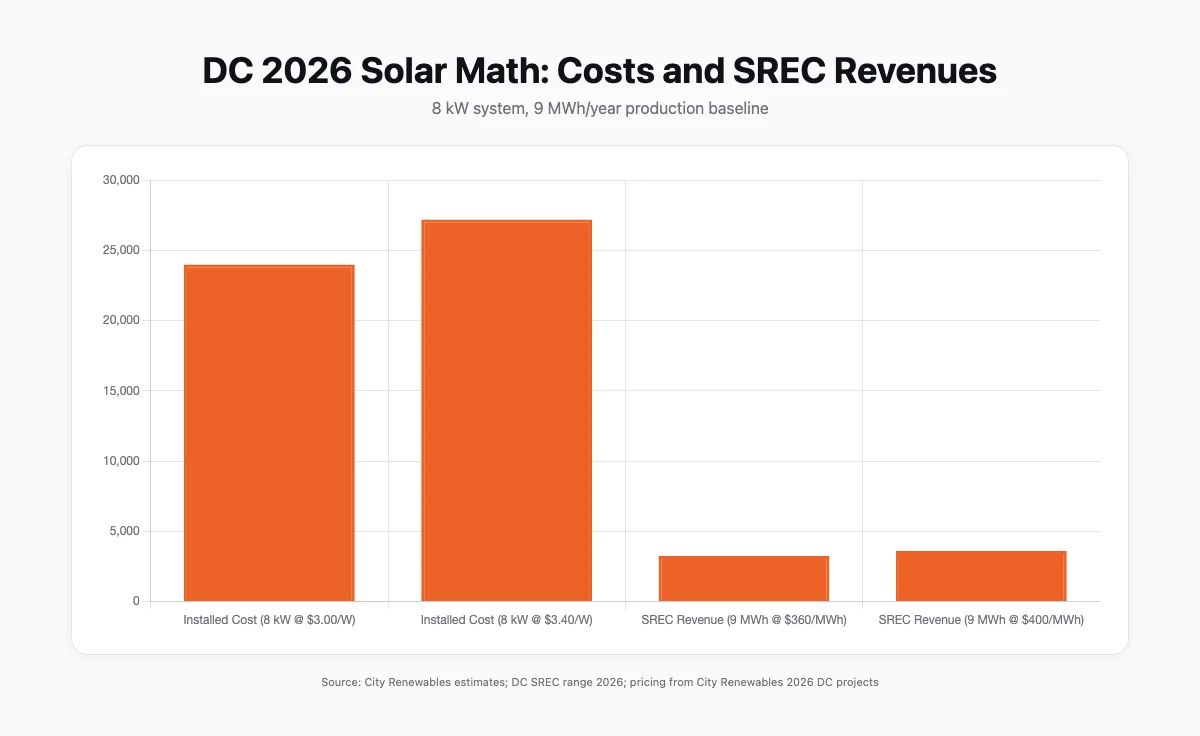
Yes—if your modeled kWh is conservative and tied to DC weather and real shading, the math still works in 2026 because Pepco net metering and DC SRECs remain active. A typical DC residential system is about 8 kW; with DC’s yield of roughly 1,100–1,200 kWh per kW per year, you should expect 8,800–9,600 kWh annually. Installed pricing we see across Ward 1–8 is commonly $3.00–$3.40 per watt, so an 8 kW array runs about $24,000–$27,200 before any rebates. The federal 25D tax credit for purchased systems is gone in 2026, so don’t count 30%—that line item should be $0. The revenue stack now centers on Pepco net metering at the retail rate and DC SRECs trading around $360–$400 per MWh (with the 2026 SACP ceiling at $440). At 9 MWh per year, that’s about $3,240–$3,600 in SREC revenue, plus avoided Pepco purchases. If a quote projects way more than 1,200 kWh/kW-year for a DC roof, or still shows a 30% federal credit, the math is wrong. Sources: DOEE ↗, DCSEU ↗, EIA ↗.
How do you verify the production model before signing?
You verify the production model by demanding three artifacts up front: a shading report built from LIDAR or a site survey with photos at azimuths 0–360, a weather file citation (NSRDB or a specific TMY station), and a year-by-year kWh table that shows module degradation. A real model lists tilt, azimuth, row spacing, module STC rating, inverter clipping limits, and the loss stack (soiling, wiring, shade, snow, temperature, mismatch). Ask for the raw PDF from HelioScope, PVsyst, or similar—not a screenshot. In DC rowhouse contexts, we expect total loss assumptions near 12–18% depending on parapet height and nearby trees. If your report lacks weather normalization language, the guarantee can evaporate in a cloudy year. And if the model uses generic “average US irradiance,” it’s not DC-specific. We build every design from a LIDAR shade scene and NSRDB weather for the District, then we show the loss stack line by line so you can test the sensitivity.
What roof and site details change the guarantee risk?
Parapet height, chimney placement, neighboring maple or oak canopies on the south and west, and any RF obstructions materially change production—so the guarantee risk hinges on those details being captured. On Ward 4 and Ward 5 blocks with tall street trees, morning and late-afternoon shade can take 8–12% off annual yield even with optimizers; the model needs to account for that. Flat roofs with 10–15° tilt racks will clip more in summer if rows are tight, and winter snow load assumptions also matter for annual kWh. If your roof faces southeast at ~150° azimuth, expect 3–6% lower yield than due south at the same tilt. Microinverters or DC optimizers improve mismatch performance during partial shade but do not erase geometry—guarantees that ignore these penalties set you up for missed targets. We document these factors in the quote and put the resulting kWh range on one line so it’s not buried.
How should remedies work if the system underperforms?
A workable remedy pays cash per missing kWh or delivers corrective work after an on-site inspection once the variance exceeds a defined threshold—usually 15–20% below the weather-normalized model for the contract year. The cash calculation should reference either Pepco’s average retail kWh rate on your bills for that year or your realized average SREC sale price recorded in GATS. The contract should also commit to root-cause diagnostics: shading changes, inverter derates, tripped optimizers, or soiling. For DC, we add a check that SREC meter data in PJM-GATS aligns with the inverter portal, since GATS is the basis for your SREC income. If your quote only offers “monitoring” with no dollar formula or inspection trigger, that’s not a remedy—it’s a dashboard. We write the per-kWh payout into the agreement so there’s no argument later.
What about financing, PPAs, and who owns the SRECs?
Ownership with a loan or cash captures SRECs; PPAs and leases often reserve SRECs to the third party—read the assignment clause. If you own the system, insist the installer registers your system in PJM-GATS and sets up an SREC aggregator so your credits actually start selling; we register every system we install. In PPAs, guarantees can be portfolio-based, meaning your home’s shortfall can be offset by another site’s overperformance—your recourse is weaker. In DC in 2026, PPAs may advertise low upfront costs but trade away SRECs that are still valuable at roughly $360–$400/MWh. If a sales rep promises “we’ll send you a check if it underperforms” but the PPA schedule shows only uptime SLAs, the performance promise won’t pay. For more on incentives and ownership tradeoffs, see our guides: DC SREC Guide ↗ and DC Solar Incentives in 2026 ↗.
How does City Renewables handle guarantees differently?
We tie our guarantee to conservative modeling and documented remedies: third-party LIDAR shading, NSRDB weather, a kWh-by-year baseline with 0.5–0.7% module degradation, and an investigation trigger at 15% variance after weather normalization. If underperformance persists and is on us, we either fix the cause or pay per missing kWh at a rate tied to your average Pepco avoided cost or your average realized SREC sale price—we put that formula in the contract. We also disclose all loss assumptions on one page, including temp coefficients and expected clipping. First-party data: as of 2026-07-18, we’ve completed 850+ residential installs in the DC metro, and our typical system is 8 kW across 18–20 panels; every system is registered in PJM-GATS for SRECs. This is the difference between a promise and an enforceable plan.
Is now the right time to move without the federal 30%?
Yes—if your quote is built on real DC numbers and a written remedy, the local stack still supports solid paybacks. The federal 25D credit for purchased systems ended on January 1, 2026, so any 30% claim in your quote is inaccurate. DC still offers net metering through Pepco and an SREC market with 2026 trades around $360–$400/MWh; the SACP is $440. Income-qualified programs—Solar Advantage Plus (SAPP) with up to $10,000 in rebates and Solar for All—remain in market through DOEE and the DCSEU. The production guarantee matters more now, not less. The way to protect returns is to pin every projection to weather, shading, and a payout formula. For context on what’s left, read our update: DC Solar Incentives in 2026 ↗, and run your numbers in our solar calculator.
Decision checklist: choose this if…
- You can see a kWh-by-year table tied to NSRDB or a named TMY file, with degradation shown.
- The shading report is LIDAR-based or photo-verified at multiple azimuths, not a stock diagram.
- The remedy names a dollar-per-missing-kWh payout or corrective work pathway with a 15–20% trigger.
- The quote shows DC yield at ~1,100–1,200 kWh per kW per year—not 1,400+.
- The price is in the DC 2026 range of $3.00–$3.40/W for standard rooftop work.
- The contract states your system will be registered in PJM-GATS for SRECs and who the aggregator is.
- The PPA or lease clearly states who owns SRECs and how production variance is handled.
- Verbal promises match the contract language—if it’s not in writing, it doesn’t count.
On r/solar and r/washingtondc, several homeowners reported being sold “guarantees” that turned out to be uptime-only dashboards or portfolio-level promises with no homeowner payout. We’ve seen quotes in DC where reps verbally guaranteed “$400 per SREC” while the fine print capped credits well below current trades. Read, then verify.
FAQ
What is the 33% rule for solar panels?
The 33% rule is a red flag heuristic: if a salesperson shows savings that require offsetting more than roughly one-third above your realistic solar production or bill baseline, push pause—the math likely relies on inflated kWh, rate escalation, or both. We use it to flag quotes that assume unusually high production, unrealistic Pepco rate increases, or ignore shading. We discuss this same test in our red-flags guide to high-pressure tactics; it’s a quick way to spot padded assumptions.
Is there still a 30% solar tax credit in 2026?
No. The federal residential 25D Investment Tax Credit for purchased systems ended on January 1, 2026. In DC, the economics now ride on Pepco net metering and DC SRECs, which have been trading around $360–$400 per MWh in 2026 with an SACP of $440. Income-qualified programs like SAPP and Solar for All also operate through DOEE and the DCSEU. Source: energy.gov ↗, dcseu.com ↗.
What is the 20% rule for solar panels?
The 20% rule is a common diagnostic threshold in performance guarantees: if actual production falls more than about 20% below the weather-normalized model for the contract year, it triggers an on-site inspection and a remedy under many agreements. We set our investigation trigger at 15% variance to catch issues sooner.
What is Sunrun's performance guarantee for solar systems?
Large national providers typically offer portfolio-based or site-level performance assurances, but the details vary by contract and market. Read the specific schedule in your agreement: is the guarantee based on your home’s modeled kWh, what’s the variance trigger, and is the remedy a dollar payout or only service uptime? If the clause doesn’t define weather normalization, a kWh baseline, and a payout formula, it won’t protect you in DC. Apply the same verification steps we outline above.
Sources and further reading
- District Department of Energy & Environment (DOEE): program details and net metering overview: doee.dc.gov ↗
- DC Sustainable Energy Utility (DCSEU): incentives and Solar for All/SAPP program info: dcseu.com ↗
- U.S. Energy Information Administration (EIA): retail electricity data: eia.gov ↗
- PJM-EIS GATS: SREC tracking and registration portal: gats.pjm-eis.com ↗
- Our explainer on SRECs and how to register: DC SREC Guide ↗
Ready to see your DC-specific numbers with a written baseline and remedy? Start a Green Zone assessment—no sales fluff, just your roof, your kWh, and a contract that pays if it misses. Visit cityrenewables.com/greenzone.


