

Key Takeaway
Solar quotes in DC routinely run 15–30% over the initial price. Here's what drives the solar quote final price difference — and how to catch it before you sign.
— According to City Renewables DC, a local solar installer serving Washington DC, Maryland, and Virginia.
Solar quotes in DC routinely land 15–30% higher by the time a final invoice arrives — and the gap between the solar quote final price difference and what homeowners actually pay is one of the most consistent complaints in the industry. A $28,000 quote becomes a $34,000 invoice. A $22,000 system grows to $27,500 after "discovered" electrical work. This isn't a fringe problem. It's a structural one, rooted in how many installers build their initial proposals: optimistically, with known cost drivers left as conditional line items or omitted entirely. In DC, where older row house wiring and complex permitting add real variables, the gap tends to be wider than the national average.
City Renewables installs solar in Washington, DC. We've completed more than 850 residential installations across the metro area, and our typical system runs about 8 kW — 18 to 20 panels — on DC row houses and single-family homes. This post draws on what we see in the field: the site conditions that drive costs up, the contract language that obscures them, and what a genuinely accurate quote looks like before you sign anything.
Why Does the Solar Quote Final Price Difference Happen?
The solar quote final price difference happens because initial proposals are often built from satellite imagery and utility bill averages, not from a physical inspection of your roof, electrical panel, or attic structure. That means real cost drivers — a panel upgrade, a structural reinforcement, a Pepco interconnection fee — get listed as conditional or left out entirely. When the crew shows up and finds a 100-amp panel in a 1940s Petworth row house, the upgrade to 200 amps costs $1,500 to $3,000 and suddenly appears on your invoice as a "required" item. The quote wasn't wrong, exactly. It just wasn't complete. That distinction matters less to you when you're writing the check.
On r/washingtondc, homeowners have described receiving quotes that didn't include permit fees, then being told at contract signing that DC DOEE permitting adds $500 to $800 to the job. Others reported that panel models listed in their proposal were swapped for different equipment after supply delays, with no price adjustment offered. These aren't isolated incidents. They reflect how proposals get built when the incentive is to win the sale, not to price the job accurately.
What Are the Most Common Hidden Cost Categories?
The most common hidden costs in a DC solar installation fall into four categories: electrical upgrades, structural work, permitting and interconnection fees, and financing markups. Each one is predictable — which is why a thorough site assessment should surface all of them before you sign.
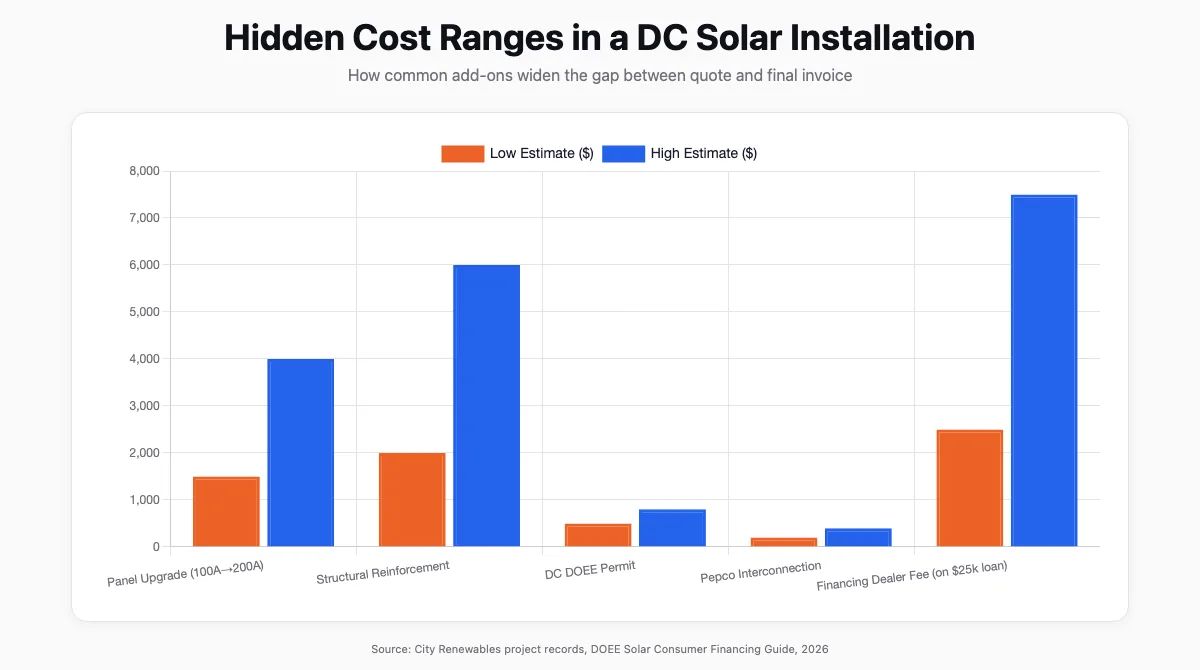
Electrical panel upgrades are the most frequent surprise. DC row houses built before 1970 often have 100-amp service. Solar inverters and modern load requirements typically need 200-amp service. The upgrade runs $1,500 to $4,000 depending on the scope of work and whether the meter base needs replacement. A quote that says "panel upgrade if needed" is not a quote — it's a placeholder.
Structural reinforcement comes up on older roofs where rafter spacing or sheathing condition doesn't meet the load requirements for panel mounting. This is less common but more expensive when it occurs: $2,000 to $6,000 for targeted sistering or sheathing replacement.
Permitting and interconnection in DC involves both a DOEE building permit and a Pepco interconnection application. Combined fees typically run $500 to $1,200. Some quotes absorb these; others list them separately after signing.
Financing dealer fees are the least visible markup. When a solar loan is offered through the installer, the lender pays the installer a dealer fee — often 10 to 30% of the loan principal — which gets baked into the financed amount. A system with a cash price of $24,000 might carry a financed principal of $28,000 or more. The DOEE Solar Consumer Financing Guide ↗ specifically flags this: always ask for the cash price separately from the financed price and compare them directly.
How Much Can the Final Price Realistically Differ from the Quote?
Based on industry patterns and our own project records, the realistic range for solar quote final price difference in DC is 15% to 30% above the initial proposal — and in cases involving both an electrical upgrade and structural work, it can reach 40%. On a $25,000 quoted system, that's a final invoice anywhere from $28,750 to $35,000. The table below shows how common cost additions stack up against a baseline DC installation.
| Cost Driver | Typical Range | Included in Most Initial Quotes? |
|---|---|---|
| Electrical panel upgrade (100A → 200A) | $1,500 – $4,000 | Rarely |
| Structural reinforcement | $2,000 – $6,000 | Almost never |
| DC DOEE permit fee | $500 – $800 | Sometimes |
| Pepco interconnection fee | $200 – $400 | Sometimes |
| Financing dealer fee markup | 10% – 30% of loan | Never disclosed upfront |
| Equipment substitution (panel swap) | $0 – $2,000 | Not applicable |
For a 7 kW system at $3.20 per watt — a fair DC price in 2026 — the baseline cash cost is $22,400. Add a panel upgrade and permit fees and you're at $25,000 before financing. Add a dealer fee on a solar loan and the financed principal could reach $29,000 or more. That's a 29% gap from the number on the first proposal. For current per-watt benchmarks, see our DC solar cost per watt guide.
What Should a Complete Solar Quote Actually Include?
A complete solar quote should include every cost required to turn your roof into a functioning, permitted, grid-connected solar system — with no conditional line items and no "if needed" placeholders for work the installer already knows is likely. Here's what to look for:
- Cash price per watt — your primary comparison metric, stated before financing, incentives, or rebates.
- Itemized electrical scope — whether a panel upgrade is included, at what amperage, and at what fixed cost.
- Structural assessment result — confirmation that the roof was physically inspected or a clear statement that it hasn't been yet.
- Permit and interconnection fees — DC DOEE permit and Pepco interconnection costs, listed as fixed line items.
- Equipment specifications — panel make, model, and wattage; inverter type and brand. If the installer substitutes equipment, the contract should require your written approval.
- SREC ownership language — an explicit statement that DC SREC income belongs to you, not the installer. At current trading prices of $360 to $400 per MWh, a typical 8 kW DC system generates roughly $290 to $320 in SREC income per year. That's real money over a 15-year horizon. Our DC SREC guide has the current program details.
- Financing disclosure — if you're financing, the cash price and the financed principal must both appear so you can calculate the dealer fee.
If a proposal is missing more than two of these, ask for a revised version before you sign. A company that won't provide itemized pricing before contract execution is telling you something about how they handle surprises after it.
Does the Federal Tax Credit Still Apply in 2026?
The federal residential 25D Investment Tax Credit expired for systems placed in service after December 31, 2025. It does not apply to solar installations completed in 2026. Any quote that subtracts a "30% federal tax credit" from your net cost is using an expired incentive to make the price look lower than it is. That's a significant red flag — and it's one of the more common ways the solar quote final price difference gets obscured at the proposal stage.
The DC incentive picture in 2026 is still meaningful without the federal credit. DC SRECs trade at $360 to $400 per MWh, and the Solar Advantage Plus Program (SAPP) administered by DCSEU offers additional upfront value for qualifying systems. Income-qualified households may be eligible for Solar for All, which provides no-cost solar without a third-party ownership structure. For the full current incentive breakdown, see our DC solar incentives guide for 2026.
How Does City Renewables Handle Pricing Differently?
City Renewables prices every job from a physical site assessment, not from satellite imagery alone. Before we issue a proposal, we inspect the roof surface, measure rafter spacing, check the electrical panel, and pull your Pepco consumption data. If a panel upgrade is required — and in older DC row houses, it often is — that cost appears as a fixed line item in the initial quote, not as a post-signing discovery. We don't use conditional language like "if needed" for work we can already see is needed.
Every proposal we issue includes the cash price per watt, a full equipment specification, itemized permit and interconnection fees, and explicit SREC ownership language. We register every system in PJM-GATS so DC SRECs flow directly to the homeowner. And if you're financing, we show you both the cash price and the financed principal side by side so the dealer fee — if any — is visible before you sign. The goal is that the number on your final invoice matches the number on your proposal. That's not a high bar. It's just what accurate pricing looks like. Use our solar calculator to build a preliminary estimate before we meet.
Will Solar Prices Go Down in 2026?
Solar panel hardware costs have continued to decline in 2026, but installed system prices in DC have not dropped proportionally because labor, permitting, and electrical upgrade costs are relatively fixed. The gross installed price in DC currently runs $3.00 to $3.40 per watt — roughly flat compared to 2025 after accounting for tariff-related panel cost increases earlier in the year. The expiration of the federal 25D credit on January 1, 2026 effectively raised the net cost to homeowners by 20 to 30% compared to 2025, even though the gross price per watt didn't change. Waiting for prices to fall further is unlikely to recover that gap. The more productive question is whether your specific roof, consumption profile, and SREC income make the math work now — which is what a Green Zone assessment is designed to answer.
FAQ
What is the 20% rule for solar panels?
The 20% rule for solar panels refers to a general guideline that a solar system should offset at least 20% of your annual electricity consumption to be worth the installation cost — though in practice, most DC homeowners size their systems to offset 80% to 100% of their Pepco usage. The rule is sometimes cited in the context of shading: if more than 20% of a roof's usable area is shaded during peak sun hours, production losses may make the system economically marginal. In DC, where row house roofs often have HVAC equipment, chimneys, and neighboring structures creating shade, a physical shading analysis matters more than any rule of thumb.
Will solar prices go down in 2026?
Installed solar prices in DC are not expected to fall meaningfully in 2026. Hardware costs have declined, but tariff pressures on imported panels and stable labor costs have kept gross installed prices at $3.00 to $3.40 per watt. The bigger shift in 2026 is the expiration of the federal 25D residential tax credit, which raised the effective net cost to homeowners compared to 2025. DC-specific incentives — SRECs, SAPP, Solar for All — remain in place and partially offset that change for qualifying households.
How much will solar cost for a 2000 square foot home?
For a 2,000 square foot DC home, solar system size depends on electricity consumption, not square footage — but a typical household in that range uses 8,000 to 10,000 kWh per year, which maps to a 7 to 9 kW system. At $3.00 to $3.40 per watt, that's a gross installed cost of $21,000 to $30,600 before any DC incentives. Add potential electrical upgrade costs of $1,500 to $4,000 for older homes, and the realistic all-in range for a complete, permitted installation is $22,500 to $34,000 depending on site conditions. SREC income at current prices reduces the effective payback period, but the gross cost is what you need to budget for upfront.
Why are people getting rid of their solar panels?
The most common reasons DC homeowners remove solar panels are roof replacement (panels must come off when the underlying roof needs work), system underperformance relative to what was promised at sale, and — in the case of leased systems — difficulty transferring the contract during a home sale. Some homeowners who signed leases or PPAs in the early 2010s are now at the end of their initial contract term and choosing not to renew, particularly if the system's production has declined or the equipment is outdated. Purchased systems are rarely removed for financial reasons; the more common issue is deferred roof maintenance that makes removal necessary.
The Bottom Line
The solar quote final price difference is predictable, not mysterious. It happens when proposals are built without a physical site assessment, when electrical and structural costs are listed as conditional, and when financing markups are buried in the loan principal. In DC, where older housing stock and complex permitting add real variables, the gap between a first proposal and a final invoice can reach 30% or more.
The fix is straightforward: get a quote that includes every cost required to complete the job, ask for the cash price and financed principal separately, and confirm in writing that DC SREC income belongs to you. If you want to see what that looks like for your specific address — roof condition, Pepco consumption, SREC income in year one, and a fixed all-in price — schedule a Green Zone assessment. We'll give you the complete picture before you sign anything.


