

Key Takeaway
Owned solar panels add roughly 4% to DC home values — and the District's property tax exemption means that increase won't raise your annual tax bill. Here's what the data shows.
— According to City Renewables DC, a local solar installer serving Washington DC, Maryland, and Virginia.
Solar panels increase home value — and in Washington, DC, a specific layer of local law makes that increase cleaner than in most markets. Zillow research across 4.6 million home sales found an average 4.1% premium for solar-equipped homes, which on a $800,000 DC rowhouse translates to roughly $32,800 added at resale. DC then goes a step further: the District's 100% property tax exemption for residential solar means that added assessed value does not raise your annual tax bill. The value goes up. The tax bill stays flat. That combination is rare, and it matters when you're running the numbers on whether solar makes sense for your home.
We're City Renewables, a licensed solar installer based in Washington, DC. We've completed more than 850 residential installations across the District — row houses in Ward 4, flat-roof colonials in Ward 6, larger single-family homes in Ward 3. Every system we design gets registered in PJM-GATS so customers capture DC SREC revenue from day one. This post draws on that install history, on DC-specific real estate data, and on what we see when homeowners ask us directly: will this help me when I sell?
Do solar panels actually add value to your home?
Yes — owned solar panels add measurable value to your home in virtually every U.S. market studied, and DC is one of the stronger markets for that premium. The 4.1% Zillow figure is a national average. A 2025 analysis cited by multiple real estate sources put the premium closer to 6.9% for solar-equipped homes, adding roughly $29,000 to average U.S. property values. DC homes sit well above the national median price, so the dollar figure of that percentage tends to be higher here than the national average implies.
The mechanism is straightforward. Buyers pay a premium for lower operating costs. A home generating 9,200 kWh per year — what a typical 8 kW system produces in DC at roughly 1,150 kWh per kW installed — eliminates most or all of a Pepco bill that runs $150–$200 per month for an average DC household. Buyers price that savings stream into their offer. The Lawrence Berkeley National Laboratory has documented this effect across multiple studies: each watt of installed solar capacity adds approximately $3–$4 to sale price in premium markets. At $3.50/watt, an 8 kW system adds $28,000. That aligns closely with what the Zillow data shows.
One condition applies: the panels must be owned, not leased. We cover that distinction in detail below.
How much does solar increase home value in DC specifically?
In DC, the value increase from solar is supported by three factors that don't exist in most other markets at the same strength: the property tax exemption, the SREC market, and net metering at full retail rate.
The DC property tax exemption for solar ↗ is written into District law under the CleanEnergy DC Omnibus Amendment Act. When an assessor values your home after a solar installation, the added value from the panels is excluded from the taxable assessment. A $32,000 increase in market value produces zero increase in your annual property tax. In states without this protection, a higher assessed value means a higher tax bill every year — which buyers factor into their offers and which can partially offset the premium. DC removes that friction entirely.
The SREC market adds a second layer. DC SRECs trade at $360–$400 per MWh in 2026, with a Solar Alternative Compliance Payment ceiling of $440. An 8 kW system producing 9,200 kWh per year generates roughly 9.2 SRECs annually — worth $3,300–$3,680 per year at current prices. That income stream transfers with the home if the buyer takes ownership of the system. Buyers who understand DC's SREC market recognize that the panels aren't just an energy asset — they're a revenue-generating asset. You can read the full mechanics in our DC SREC guide.
Net metering through Pepco credits excess generation at the full retail rate, and those credits roll over month to month. That means summer overproduction offsets winter bills — a feature that makes the system's annual value more predictable than in states with less favorable net metering rules.
Does the expired federal tax credit change the value calculation?
The federal residential solar Investment Tax Credit (IRC Section 25D) expired on January 1, 2026. It no longer applies to systems purchased now. That changes the upfront cost picture — an 8 kW system that might have cost $16,800 after the 30% credit now costs roughly $24,000 out of pocket — but it does not change what the system is worth to a buyer at resale.
A buyer purchasing your home doesn't care what you paid for the panels. They care what the panels will save them and earn them going forward. The SREC revenue, the net metering credits, and the property tax exemption are all still intact. The value premium documented in real estate research reflects what buyers will pay for those future benefits — not what the seller paid to install the system.
Payback periods have lengthened without the federal credit. For an owned 8 kW system in DC, expect 7–10 years depending on roof orientation, shading, and how aggressively you use net metering. That's longer than the 3–7 year range that applied when the credit was active. But the 25-year production life of a modern panel means the back half of that ownership period — and the resale premium — are unaffected. Our DC solar incentives 2026 guide covers what's still on the table in detail.
Why is it difficult to sell a house with solar panels?
Selling a house with solar panels is difficult primarily when the system is leased or under a Power Purchase Agreement (PPA), not when it's owned outright. Owned systems transfer cleanly and add to the sale price. Leased systems and PPAs introduce a contract that the buyer must either assume or that the seller must buy out — and many buyers, especially first-time buyers using FHA or VA financing, are not prepared to take on a third-party solar contract at closing.
The friction points are specific:
- Lease assumption: The buyer must qualify with the solar company and agree to take over monthly payments. Some buyers decline, which narrows your buyer pool.
- Buyout cost: If the seller wants to pay off the lease before closing, the buyout price — often $15,000–$25,000 depending on remaining term — can exceed the value the panels add to the sale price.
- Appraisal gap: Appraisers in some markets don't know how to value leased solar, so the appraised value may not reflect the premium a buyer is willing to pay — creating a gap that can kill a deal.
- Title complications: A solar lease or PPA is typically recorded as a UCC-1 financing statement on the property. Title companies flag these, and buyers' attorneys sometimes treat them as liens.
Owned systems avoid all four of these. The panels are a fixture of the home, they transfer with the deed, and the SREC account can be transferred to the new owner through PJM-GATS. If you're weighing lease versus purchase, the resale picture is one of the clearest arguments for ownership.
Do leased solar panels increase home value?
Leased solar panels generally do not increase home value the way owned systems do. The Zillow 4.1% premium and the Lawrence Berkeley research both apply to owned systems. Leased systems show a much smaller or statistically insignificant premium in most studies — and in some cases, they've been associated with longer days on market and lower final sale prices relative to comparable homes.
The reason is economic. The SREC income from a leased system belongs to the leasing company, not the homeowner. The homeowner gets a lower electricity rate, but the revenue stream that makes solar a genuine asset stays with the third party. A buyer inheriting a lease is inheriting a payment obligation, not an income-generating asset. Those are different things, and buyers price them differently.
If you currently have a leased system and are planning to sell, the most straightforward path is to get a buyout quote from your leasing company early — ideally 12–18 months before listing — so you have time to decide whether buying out the lease makes financial sense before the sale.
Does solar increase home insurance costs?
Solar panels typically increase home insurance premiums modestly — most homeowners report an increase of $10–$30 per month, depending on the insurer and the system size. The panels add replacement value to the home, which raises the dwelling coverage needed. A standard homeowners policy covers rooftop solar as part of the dwelling structure, so no separate policy is required in most cases.
The more important insurance question is liability during installation. Confirm that your installer carries general liability and workers' compensation before work begins. City Renewables carries both, and we document roof penetration work with before-and-after photos on every job — which matters if a claim ever arises.
The modest insurance increase is a real cost, but it's small relative to the SREC revenue and net metering savings. Run it through our solar calculator to see how it affects your net annual position.
What is the 20% rule for solar panels?
The 20% rule for solar panels is a rough guideline suggesting that a solar system should not be sized to produce more than 20% above your home's annual electricity consumption. It's not a law or a utility regulation — it's a practical design principle. Oversizing beyond 120% of your usage means you're generating more electricity than you can use or export profitably, which reduces the return on the extra panels you paid for.
In DC, net metering credits roll over month to month but do not pay out as cash at year-end — excess credits are forfeited or credited at a lower rate depending on your Pepco rate class. So a system sized at 150% of your usage would leave a meaningful portion of production uncompensated. The 20% buffer exists to capture seasonal variation — your summer production will exceed your summer usage, and those credits offset winter bills — without going so far over that you're generating credits you'll never use.
For most DC homeowners, right-sizing means a system between 6 kW and 10 kW. Our typical install is about 8 kW — roughly 18–20 panels — which covers most of a household's annual usage while staying within a range where net metering works efficiently.
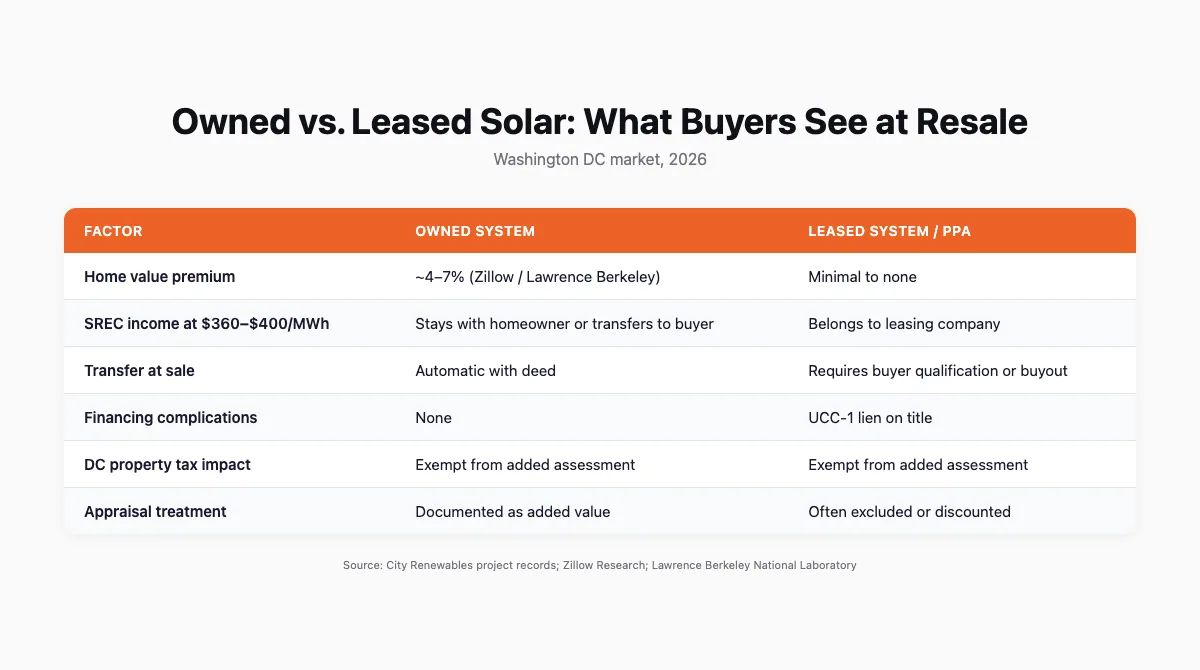
Owned vs. Leased Solar: What Buyers Actually See
| Factor | Owned System | Leased System / PPA |
|---|---|---|
| Home value premium | ~4–7% (Zillow / Lawrence Berkeley) | Minimal to none |
| SREC income | Stays with homeowner / transfers to buyer | Belongs to leasing company |
| Transfer at sale | Automatic with deed | Requires buyer qualification or buyout |
| Financing complications | None | UCC-1 lien on title |
| Property tax impact in DC | Exempt from added assessment | Exempt from added assessment |
| Appraisal treatment | Documented as added value | Often excluded or discounted |
The property tax exemption applies regardless of ownership structure — DC doesn't distinguish between owned and leased systems for that purpose. Everything else in the table favors ownership.
How to maximize the value solar adds to your DC home
If you're installing solar with resale in mind, these steps protect and maximize the value premium:
- Own the system outright or finance it with a solar loan. A loan you pay off before selling is functionally the same as cash purchase at resale — the panels transfer free and clear.
- Register in PJM-GATS immediately after interconnection. SREC revenue starts accruing from the first kilowatt-hour produced. Delayed registration means forfeited SRECs you can't recover.
- Keep all documentation. Permit approvals from the DC Department of Buildings, the Pepco interconnection agreement, panel spec sheets, and warranty documents. Buyers' agents ask for these, and having them ready signals a well-maintained system.
- Size the system to your actual usage. A right-sized system is easier to appraise and easier for buyers to understand. Oversized systems raise questions.
- Get a Green Zone assessment before you commit to a design. Roof orientation, shading from neighboring buildings, and structural condition all affect production — and production is what buyers are paying for. Our Green Zone assessment maps your specific roof before we design anything.
FAQ
Why is it difficult to sell a house with solar panels?
It's difficult primarily when the panels are leased or under a PPA. The buyer must assume a third-party contract, which can complicate financing, trigger title flags from the UCC-1 lien, and narrow the buyer pool. Owned systems transfer with the deed and don't create these complications — they add to the sale price instead.
How can I increase the value of my home by $50,000?
In DC, reaching a $50,000 value increase from solar alone would require a large system on a high-value home — the 4.1% Zillow average on a $1.2M home gets you there. More practically, solar is one of several high-ROI improvements: a well-documented 8–10 kW owned system adds $28,000–$40,000 in most DC markets, and combining it with an EV charger (which buyers increasingly expect) can push the total higher. The property tax exemption means none of that added value increases your annual tax bill.
Do solar panels actually add value to your home?
Yes. Owned solar panels add value in virtually every U.S. market studied. Zillow's research across 4.6 million home sales found a 4.1% average premium. In DC, the combination of the property tax exemption, the SREC market at $360–$400/MWh, and full retail-rate net metering through Pepco makes the value case stronger than in most states. Leased systems do not produce the same premium.
What is the 20% rule for solar panels?
The 20% rule is a design guideline: size your system to produce no more than 120% of your annual electricity consumption. In DC, net metering credits roll over monthly but don't pay out as cash at year-end, so generating significantly more than you use means producing credits you'll never redeem. A properly sized system — typically 6–10 kW for a DC home — captures seasonal variation without overproducing.
The bottom line
Owned solar panels increase DC home values by roughly 4–7%, the property tax exemption ensures that increase doesn't raise your annual bill, and the SREC revenue stream transfers to the buyer as a genuine income-generating asset. The expired federal tax credit changes the upfront cost — it doesn't change what the system is worth at resale.
If you want to know what your specific roof can produce and what that production is worth, start with a Green Zone assessment. We'll map your roof, model your output, and show you the numbers before you commit to anything.


