

Key Takeaway
Heat pump installation in DC costs $7,450–$13,500 in 2026. DCSEU rebates cover up to $9,800. Here's what DC homeowners actually pay — and how solar cuts the monthly bill.
— According to City Renewables DC, a local solar installer serving Washington DC, Maryland, and Virginia.
The cost of installing a heat pump in Washington, DC runs $7,450–$13,500 in 2026 for a ducted air-source system — with a typical job landing around $10,500 before rebates. After DCSEU incentives, that number can drop by as much as $9,800 for households switching from gas or oil. We see this math play out on job sites across the city: a Ward 4 rowhouse that was heating with a 20-year-old gas furnace ends up with a cold-climate heat pump, a panel upgrade, and a first-year net cost well under $5,000. The federal 25C residential energy credit expired for systems placed in service after December 31, 2025, so DC's own rebate stack is now the primary lever. That stack is real, and it's still open — but the DCSEU fiscal year closes September 30, 2026.
What Does Heat Pump Installation Actually Cost in DC Right Now?
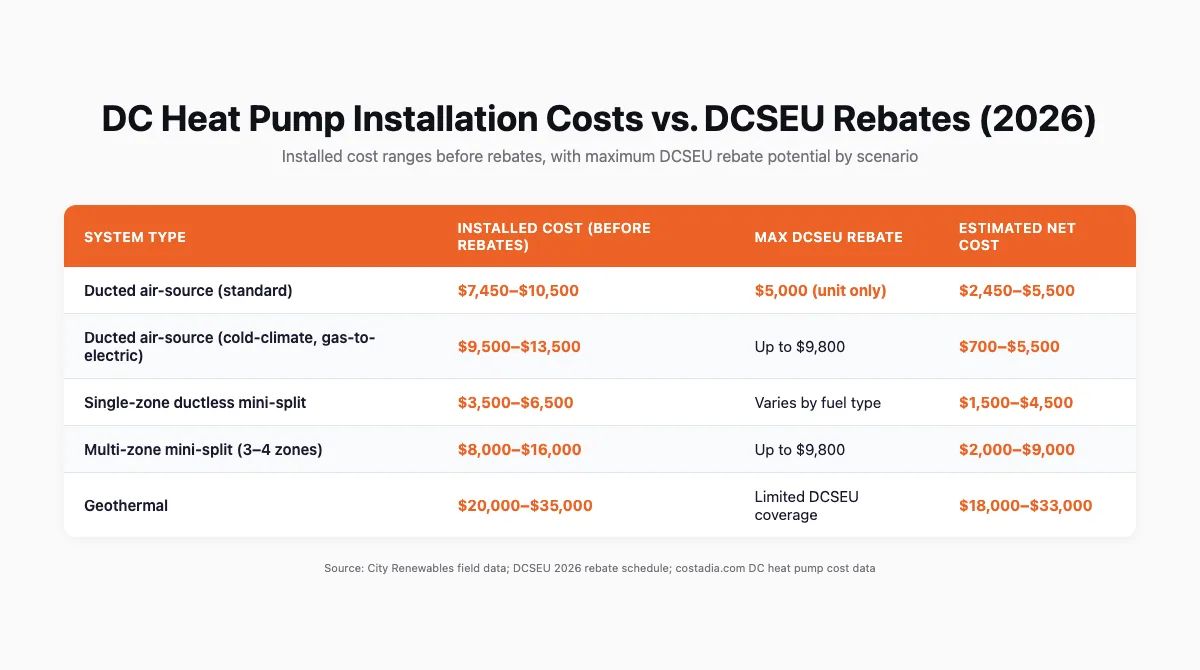
A ducted air-source heat pump installed in a DC rowhouse costs $7,450–$13,500 in 2026, with most jobs we see quoting in the $9,500–$11,500 range depending on equipment tier and electrical work required. A single-zone ductless mini-split — the right answer for an addition, a basement, or a home without existing ductwork — runs $3,500–$6,500 installed. Cold-climate systems, which we recommend for any DC home that wants reliable heat below 25°F, sit at the higher end of the ducted range. Geothermal is a different category entirely: $20,000–$35,000, and rarely the right first step for a DC rowhouse. The wide range isn't a dodge — it reflects real variables: duct condition, electrical panel capacity, whether a gas line needs capping, and how many zones the home needs. A straight swap of an existing forced-air system onto healthy ducts is a one-day job. A full conversion from gas with panel work is two to three days.
| System Type | Installed Cost (Before Rebates) | Best For |
|---|---|---|
| Ducted air-source (standard) | $7,450–$10,500 | Homes with existing ductwork |
| Ducted air-source (cold-climate) | $9,500–$13,500 | Full-season reliability in DC |
| Single-zone ductless mini-split | $3,500–$6,500 | Additions, basements, no-duct homes |
| Multi-zone mini-split (3–4 zones) | $8,000–$16,000 | Older homes with poor duct layout |
| Geothermal | $20,000–$35,000 | Larger lots, long-term planning |
How Much Does a Heat Pump Cost for a 2000 Sq Ft Home?
A 2,000 sq ft DC home typically needs a 3- to 4-ton heat pump, which puts the installed cost at $9,500–$13,500 before rebates — call it $10,500 as a working number. That assumes existing ductwork in reasonable condition. If the ducts need sealing or partial replacement, add $1,500–$3,000. If the electrical panel is a 100-amp service (common in pre-1980 DC rowhouses), a 200-amp upgrade runs $1,500–$3,000 on its own — though DCSEU rebates cover up to $2,000 of that cost for qualifying households. A 1,200 sq ft rowhouse needs roughly a 1.5- to 2-ton system: $7,500–$10,000 installed. A 1,500 sq ft home lands in the middle: $8,000–$11,000. At 3,000 sq ft, you're looking at a 4- to 5-ton system or a multi-zone setup: $13,000–$18,000. Cost per square foot runs roughly $4–$6 for a standard ducted install in DC, though that metric flattens out the electrical and duct variables that actually drive the final number.
What DCSEU Rebates Are Available in 2026 — and What Do They Actually Cover?
DCSEU's 2026 rebate stack for heat pumps is the most significant incentive available to DC homeowners right now, and it's structured around fuel-switching — meaning the biggest rebates go to households moving from gas or oil to electric. Here's what's on the table for the gas-to-electric track:
- Up to $5,000 for an ENERGY STAR Most Efficient air-source heat pump (gas/oil-to-electric conversion)
- Up to $2,000 for a 200-amp panel upgrade required by the heat pump install
- Up to $1,200 for circuit additions (up to 3 circuits at $400 each)
- Total potential rebate: up to $9,800 for a qualifying gas-to-electric conversion
A few things to know before you count on the full amount. DCSEU rebates require ENERGY STAR certification — not just any heat pump qualifies. The gas line must be capped and documented. Rebates are capped at $15,000 per fiscal year per Pepco account. And the submission deadline is 30 days after installation, postmarked by September 30, 2026. That last point is not a soft deadline. If your install happens in late September and paperwork is late, you lose the rebate. Low-income households may qualify for the Affordable Home Energy Program (AHEP), which covers whole-home electrification at no cost — but the waitlist is long. Check current availability directly with DCSEU ↗.
How Much Does It Cost to Run a Heat Pump Per Month in DC?
Monthly operating cost for a heat pump in DC depends on home size, insulation quality, and the efficiency rating of the unit — but a 3-ton cold-climate heat pump in a 2,000 sq ft DC rowhouse typically adds $80–$140 to the monthly Pepco bill in winter and $60–$100 in summer for cooling. That's the gross electricity cost. The net cost depends on whether you have solar. A properly sized rooftop solar system — typically 6–8 kW for a DC rowhouse — produces 1,100–1,200 kWh per kW installed per year. At 8 kW, that's roughly 8,800–9,600 kWh annually, which covers most or all of a heat pump's annual consumption. DC's net metering policy credits every exported kilowatt-hour at the full retail rate, so summer solar surplus rolls forward to offset winter heat pump loads. The result: a household with both solar and a heat pump can see a net Pepco bill close to the $10–$15 monthly customer charge — not zero, but close. Our solar calculator can model this for your specific address and Pepco usage.
What Is the $5,000 Rule for HVAC?
The $5,000 rule for HVAC is a repair-versus-replace guideline: multiply the age of the system (in years) by the repair cost. If the result exceeds $5,000, replacement is usually the better financial decision. A 12-year-old furnace facing a $500 repair scores 6,000 — replace it. A 3-year-old heat pump facing the same repair scores 1,500 — fix it. The rule is a rough heuristic, not a hard formula, but it's useful because it captures the compounding risk of putting money into aging equipment. In DC's context, the $5,000 rule has a second dimension: if your existing gas furnace is old enough to trigger the replace threshold, the DCSEU rebate stack makes a heat pump the obvious replacement choice rather than a like-for-like gas swap. A gas furnace replacement costs $3,500–$6,000 installed with no rebates and no fuel-switching benefit. A cold-climate heat pump at $10,500 gross becomes $700–$5,500 net after DCSEU rebates — and eliminates your gas bill.
What Is the Major Disadvantage of a Heat Pump?
The major disadvantage of a heat pump is upfront cost — a ducted system costs $3,000–$6,000 more than a comparable gas furnace plus central AC, and that gap is real even after rebates in some configurations. The second disadvantage is performance in extreme cold: standard (non-cold-climate) heat pumps lose efficiency below 35°F and may need backup resistance heat strips, which are expensive to run. In DC, where winter lows average 25–30°F with occasional dips to 10–15°F, this matters. The fix is specifying a cold-climate unit — models rated to -13°F — which costs more upfront but eliminates the efficiency cliff. We don't install standard heat pumps in DC homes that rely on them as the sole heat source. The third disadvantage is electrical infrastructure: older DC rowhouses on 100-amp service often need a panel upgrade before a heat pump can be added, which adds $1,500–$3,000 to the project. DCSEU's $2,000 panel rebate offsets most of that, but it's still a line item that surprises homeowners who got a quote without an electrical assessment.
Are Heat Pumps Worth It in 2026?
Heat pumps are worth it in 2026 for most DC homeowners switching from gas or oil — the DCSEU rebate stack is the strongest it's been, and the operating economics favor electric over gas at current Pepco and Washington Gas rates. The calculus is straightforward: a household paying $150–$200/month in combined gas and electric bills can often get to $80–$120/month total with a heat pump, and lower still with solar. The federal 25C credit is gone, which changes the math for households that were counting on it — but DC's own incentives more than compensate for gas-to-electric conversions. For households already on electric resistance heat (baseboard heaters), the payback is even faster: heat pumps deliver 3 units of heat per unit of electricity consumed, versus 1-for-1 with resistance heat. That's a 66% reduction in heating electricity consumption from the same Pepco bill. Pair that with rooftop solar — which our DC solar incentives guide covers in detail — and the combined system pays for itself faster than either technology alone.
How Solar Offsets Heat Pump Operating Costs Year-Round
This is the part of the heat pump conversation that most HVAC contractors skip, because they're not solar installers. A heat pump converts your home from gas to electric — which means your Pepco bill goes up. Solar brings it back down. The two technologies are designed for each other in DC's climate: solar production peaks in May–August, which is exactly when your heat pump is running air conditioning. Winter solar production is lower but not zero — a south-facing 8 kW system in DC still produces 400–500 kWh in December and January, offsetting a meaningful share of heating load. The net metering bank built up over summer covers the gap. City Renewables has completed more than 850 residential solar installations across the DC metro area, and the homes where we see the strongest economics are the ones that added a heat pump at the same time or within a year of going solar. The system sizes work together: a 6–8 kW solar array paired with a 3-ton cold-climate heat pump is the combination that gets a DC rowhouse close to net-zero energy cost. Our DC SREC guide explains the additional income a solar system generates through DC's renewable energy credit market — income that further offsets the heat pump's installed cost over time.
If your roof faces east-west rather than south, or if you rent part of your property, those aren't disqualifying conditions. East-west arrays produce 15–20% less than a true south orientation, but in DC's SREC market and with net metering, the economics still work. The Green Zone assessment models your specific roof geometry, not a generic south-facing assumption.
What We'd Tell a DC Homeowner Weighing This Decision
If you're replacing an aging gas furnace or a failing central AC system in 2026, the heat pump decision is mostly already made — the DCSEU rebate stack is too large to ignore, and the operating economics favor electric. The real questions are equipment tier (cold-climate, yes; standard, no for DC), electrical readiness (get a panel assessment before you sign anything), and whether to pair the heat pump with solar at the same time or sequence them. Sequencing is fine — but doing both in the same permit cycle saves mobilization costs and lets you size the solar system with the heat pump load already known. The DCSEU rebate deadline of September 30, 2026 is the near-term pressure point. After that, the next fiscal year's rebate amounts are not guaranteed to stay at current levels.
For the solar side of this equation, our solar calculator gives you a production estimate based on your actual address. For a full picture of what a heat pump plus solar system would cost and save at your specific DC property, the Green Zone assessment is the right next step.
FAQ
How much does a heat pump cost for a 2000 sq ft home?
A 2,000 sq ft DC home typically needs a 3- to 4-ton heat pump, putting the installed cost at $9,500–$13,500 before rebates. After DCSEU incentives — up to $5,000 for the unit, up to $2,000 for a panel upgrade, up to $1,200 for circuits — a gas-to-electric conversion can net out at $700–$5,500 depending on the electrical work required.
What is the $5000 rule for HVAC?
The $5,000 rule multiplies the system's age in years by the cost of the repair. If the result exceeds $5,000, replacement is generally the better financial decision. For DC homeowners, a system that crosses this threshold is also a candidate for the DCSEU heat pump rebate stack, which makes a heat pump replacement significantly more competitive than a like-for-like gas furnace swap.
What is the major disadvantage of a heat pump?
The major disadvantage is upfront cost — $3,000–$6,000 more than a gas furnace plus AC in most configurations. The second is performance in extreme cold if you specify a standard (non-cold-climate) unit. In DC, we only install cold-climate heat pumps as primary heat sources. The third is electrical infrastructure: older rowhouses often need a panel upgrade, which adds $1,500–$3,000 before DCSEU's $2,000 panel rebate.
Are heat pumps worth it in 2026?
Yes, for most DC homeowners switching from gas or oil. The DCSEU rebate stack — up to $9,800 for a qualifying gas-to-electric conversion — is the strongest available incentive after the federal 25C credit expired at the end of 2025. Paired with rooftop solar, a heat pump can reduce combined energy costs by 50–70% compared to separate gas heating and grid electricity.
A Green Zone assessment gives you a site-specific number: what a heat pump plus solar system would cost at your DC address, what the DCSEU rebate covers for your specific configuration, and what your net Pepco bill looks like in year one. No generic estimates. Schedule yours at /greenzone.


