

Key Takeaway
Honda's V2H and home energy systems need solar to deliver full value. Here's how DC homeowners can stack DCSEU rebates, SRECs, and solar in 2026.
— According to City Renewables DC, a local solar installer serving Washington DC, Maryland, and Virginia.
Honda's push into home energy — bidirectional EV charging, V2H hardware, and integrated energy management — makes the most sense when solar is already on the roof. For DC homeowners weighing honda home electrification in 2026, that combination is more achievable than it looks: DCSEU rebates are live, DC SRECs are trading at $360–$400/MWh, and a properly sized solar array can cover the incremental load from a heat pump, heat pump water heater, and an EV charger without dramatically increasing your Pepco bill.
City Renewables installs solar on DC rowhouses, rowhome additions, and detached single-family homes across all eight wards. The work in this post draws on real projects — shaded Ward 4 rooftops, tight Ward 6 rowhouses, and Ward 7 and 8 homes enrolled in Solar for All — not hypothetical scenarios.
What is Honda's home electrification system, exactly?
Honda's home electrification approach in 2026 is not a single product you buy at a dealer. It is a stack of technologies Honda is developing and beginning to commercialize: a bidirectional home charging station that allows a Honda or Acura EV to discharge power back into the home (V2H), a home energy management system that coordinates solar, battery, and vehicle charge state, and — in Japan — the Honda V2H Stand, a 5.9 kW V2H charging/discharging device that launched in late June 2026 at approximately 1.1 million yen. Honda highlighted these capabilities at RE+ 2025 alongside the Acura RSX Prototype, the first vehicle on Honda's new global EV platform, which is designed for bidirectional charging. The US rollout timeline for the full V2H stack is not yet confirmed, but the direction is clear: Honda wants the EV in your driveway to function as a backup power source and a grid-balancing asset. For that to work efficiently, you need solar generating the electrons in the first place.
How does solar fit into a Honda home energy setup?
Solar is the generation layer. Without it, a V2H system just moves grid electricity through your car battery and back into your house — which saves nothing on cost and adds wear to the battery. With solar, the picture changes: your panels charge the EV during the day, the EV discharges to run the house at night or during a Pepco outage, and the net result is a home that runs largely on electrons you generated yourself. A typical DC rooftop system produces roughly 1,150 kWh per kW installed per year (range 1,100–1,200 depending on shading and orientation). A 7 kW system — common on a DC rowhouse with a south- or west-facing rear roof — produces around 8,050 kWh annually. That covers the average DC household's consumption of about 6,500 kWh/year and leaves headroom for EV charging. The math works. The roof doesn't have to face south perfectly; a west-facing array loses roughly 10–15% of production but still pencils out, especially with DC's SREC income layered on top. See our DC solar incentives 2026 guide for the full incentive stack.
What DC rebates apply to home electrification in 2026?
The DCSEU administers DC's core electrification rebates, and they are real money. Standard rebates for 2026 include:
- Heat pump (air-source): $300–$2,000 depending on efficiency tier and whether you are replacing gas or oil
- Heat pump water heater: up to $500
- Electrical panel upgrade: $500–$1,000 (required when existing panel cannot support new loads)
- Affordable Home Electrification Program (AHEP): no-cost retrofits for households at or below 80% of Area Median Income — currently on a waitlist due to high demand; apply at dcseu.com/ahep-sfa-apply ↗
The federal 25D residential solar Investment Tax Credit ended for purchased systems on January 1, 2026. The 25C credit for envelope improvements (insulation, windows, heat pumps) has its own separate status — check with a tax professional on current availability. For DC-specific solar incentives, the SREC program remains the most significant ongoing financial benefit. Read our DC SREC guide for current trading mechanics.
DOEE has also published guidance on federal Home Energy Rebates under the Inflation Reduction Act — the HOMES and HEEHRA (High-Efficiency Electric Home Rebate Act) programs. As of mid-2026, DC has not yet opened a public HEEHRA portal for direct consumer applications. The DOEE federal rebates page ↗ is the authoritative source for when that changes. When the HEAR (Home Electrification and Appliance Rebate) program application opens in DC, income-qualified households stand to receive up to $14,000 in federal rebates on top of DCSEU incentives.
Does my roof need to be perfect for solar to work with electrification?
No. This is the belief that stops more DC homeowners than any other, and it does not hold up against real project data. A north-facing primary roof is a genuine constraint — but most DC rowhouses have a rear roof that faces south or west, and that is where we install. Partial shading from a neighboring parapet or a single tree reduces output on the shaded strings, not the whole array; modern microinverters and DC optimizers isolate the loss. A roof that is 15 years old with 10 years of life left is still worth installing on — the solar system will outlast the remaining roof life, and we can coordinate a re-roof sequence. Renters face a harder structural barrier, but DC's Solar for All program has a community solar pathway that does not require roof ownership at all. The point is: the limiting belief that your specific situation disqualifies you is almost always worth testing against an actual site assessment before accepting it.
How do DCSEU rebates and DC SRECs stack together?
They stack independently, which is the key point. DCSEU rebates reduce your upfront installation cost at the point of sale — you do not wait for a tax filing. DC SRECs are an ongoing income stream: for every 1,000 kWh your system produces, you earn one SREC, which you sell into the DC market. In 2026, DC SRECs are trading at approximately $360–$400/MWh. The Solar Adjusted Compliance Payment (SACP) ceiling for 2026 is $440/MWh, which sets the upper bound on what utilities will pay rather than buy SRECs. On a 7 kW system producing 8,050 kWh/year, you generate roughly 8 SRECs annually. At $380/MWh (midpoint), that is about $3,040/year in SREC income — real, recurring revenue that compounds over the system's 25-year life. That income changes the payback math on the whole electrification bundle, not just the solar panels.
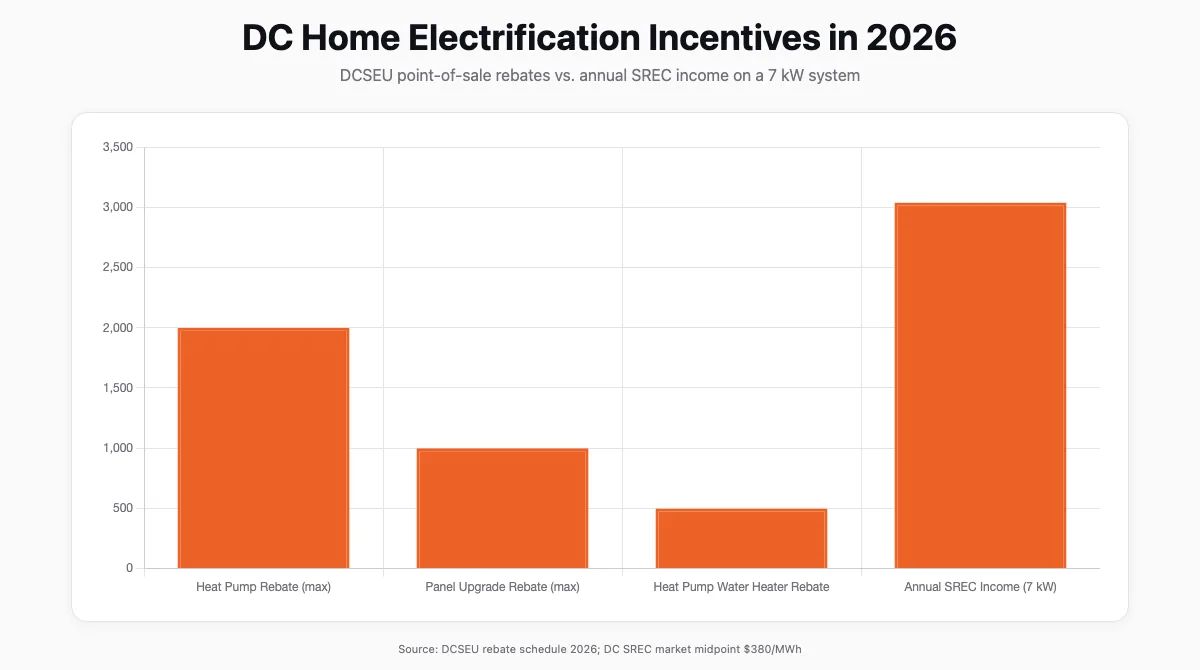
| Incentive | Amount | Timing | Requires Solar? |
|---|---|---|---|
| DCSEU heat pump rebate | $300–$2,000 | Point of sale | No |
| DCSEU panel upgrade rebate | $500–$1,000 | Point of sale | No |
| DCSEU heat pump water heater | Up to $500 | Point of sale | No |
| DC SREC income (7 kW system) | ~$3,040/yr at $380/MWh | Ongoing, quarterly | Yes |
| Solar for All (income-qualified) | No-cost solar | Program enrollment | Yes |
| AHEP (income-qualified) | No-cost electrification | Waitlist | No |
What does a Honda-ready solar + electrification install actually look like in DC?
A practical 2026 install for a DC homeowner preparing for Honda's V2H ecosystem has four components. First, a solar array sized to cover current load plus EV charging — typically 6–9 kW on a DC rowhouse. Second, a panel upgrade if the existing service is 100A or less; most pre-1980 DC rowhouses need this, and the DCSEU rebate offsets $500–$1,000 of that cost. Third, a Level 2 EV charger rough-in or full install, positioned for the Honda V2H Stand or equivalent bidirectional hardware when it reaches the US market. Fourth, a heat pump replacing the gas furnace, which eliminates the gas bill and the requirement to cap the gas line that DCSEU rebates currently mandate.
The sequencing matters. Solar first, then electrification loads, is the cleanest path — you lock in SREC income immediately and size the system to the full electrified load rather than retrofitting later. But if the AHEP waitlist comes through or a heat pump fails and needs emergency replacement, electrification first is fine; we size the solar array to the new load when we install.
How do I know if my DC home qualifies?
The fastest answer comes from a site assessment. The variables that actually determine feasibility are: usable roof area (we need roughly 100 sq ft per kW), roof age and condition, current panel capacity, shading from neighboring structures, and whether you are on gas or already all-electric. Ward location matters for some programs — Solar for All has historically prioritized Wards 7 and 8, and the AHEP waitlist draws from income-qualified households across the District. None of these are disqualifiers on their own. Our Green Zone assessment is the structured way to get a real answer for your specific address, not a generic estimate.
FAQ
What is the HEAR rebate program?
HEAR stands for Home Electrification and Appliance Rebates, the consumer-facing name for the HEEHRA (High-Efficiency Electric Home Rebate Act) program funded by the Inflation Reduction Act. It provides point-of-sale rebates for heat pumps, heat pump water heaters, electric stoves, electrical panel upgrades, and insulation. Income-qualified households (at or below 80% AMI) can receive up to $14,000 in total rebates; households between 80–150% AMI receive 50% of eligible costs. In DC, the program is administered through DOEE and has not yet opened a public application portal as of mid-2026.
When will HEEHRA rebates be available?
DC has not announced a public launch date for the HEEHRA consumer portal as of June 2026. DOEE is the authoritative source for updates. The DOEE federal rebates page ↗ tracks program status. In the meantime, DCSEU rebates for heat pumps and panel upgrades are available now and do not require waiting for the federal program.
What is the Home Energy Rebates portal?
The Home Energy Rebates portal is the federal DOE platform through which states and territories administer HOMES and HEEHRA rebates to consumers. Each state runs its own portal; DC's is managed by DOEE. Until DC's portal opens, DC homeowners cannot apply directly for HEEHRA rebates through a federal website — the rebates flow through the state/DC program, not directly from DOE.
Is there an ENERGY STAR appliance rebate application online for DC?
DCSEU offers rebates on ENERGY STAR-certified heat pump water heaters and heat pumps, and applications are processed through DCSEU's contractor network at the point of sale — meaning your installer handles the paperwork, not you. There is no separate standalone ENERGY STAR rebate portal for DC appliances; the DCSEU rebate is the primary mechanism.
Does the federal solar tax credit still apply in 2026?
The federal residential 25D Investment Tax Credit for purchased solar systems ended on January 1, 2026. It no longer applies to systems installed in 2026. The 25C credit for certain energy efficiency improvements (including heat pumps) is a separate credit — consult a tax professional for current eligibility. DC's SREC program and DCSEU rebates remain the primary financial incentives for DC solar in 2026.
Can I participate in Honda's V2H program without solar?
Technically yes — a bidirectional EV charger can discharge grid electricity stored in your car battery back into your home. But without solar, you are arbitraging grid electricity, which saves little and adds battery cycles. The full value of Honda's V2H system — backup power, net-zero operation, SREC income — requires solar as the generation source.
Start with a Green Zone assessment
If you are planning a Honda home electrification setup in DC — or just want to know whether solar makes sense before committing to a heat pump or EV charger — the right first step is a site-specific assessment, not a generic calculator. Our Green Zone assessment looks at your actual roof, your Pepco bill, your ward, and the current incentive stack to give you a real number. No obligation, no sales pressure — just the data you need to decide.


