

Key Takeaway
Financing for solar panels in DC in 2026: compare cash, loans, PPAs, and DC rebate programs — with the federal tax credit gone, here's what actually works.
— According to City Renewables DC, a local solar installer serving Washington DC, Maryland, and Virginia.
Financing for solar panels in DC comes down to four paths — cash, loan, power purchase agreement (PPA), or a DC-specific rebate program — and the right one depends on your credit, your roof, and how much of the long-term SREC income you want to keep. The federal 25D residential tax credit expired on December 31, 2025, so that 30% offset is no longer part of the math. What replaced it is a DC incentive stack that, for the right household, can bring a purchased system close to break-even in year one: SREC-II income, Pepco net metering at full retail rate, and programs like Solar Advantage Plus (SAPP) and Solar for All. The decision is not whether solar pencils out in DC — it does, for most roofs. The decision is which financing structure lets you capture the most of that value.
City Renewables is a working solar installer in Washington, DC. We've completed more than 850 residential installations across the metro area, and the financing questions below come directly from homeowners we've quoted in 2026.
Which solar financing option is right for a DC homeowner?
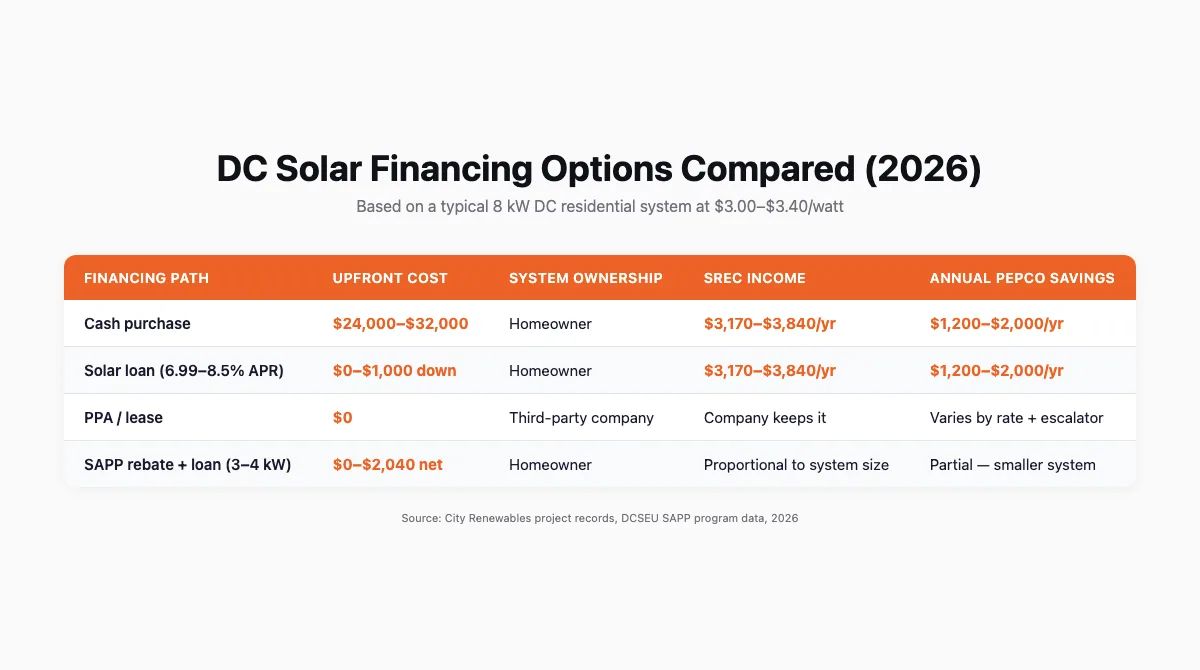
The answer depends on one primary variable: whether you want to own the system. Ownership — via cash or a loan — means you keep the SREC income, which on a typical 8 kW DC system runs $3,170 to $3,840 per year at current spot prices of $360 to $400 per MWh. A PPA transfers that income to the third-party owner in exchange for a lower per-kWh rate and no upfront cost. For most DC homeowners with decent credit and a clear title, ownership wins on a 10-year horizon. For homeowners who can't qualify for a loan or don't want any financial exposure, a PPA still cuts the Pepco bill — it just doesn't build equity the same way. The table below puts all four options side by side so the tradeoffs are visible before you read further.
| Financing Path | Upfront Cost | Who Owns the System | SREC Income | Best For |
|---|---|---|---|---|
| Cash purchase | Full system price (~$24,000–$32,000 for 8–10 kW) | You | You keep it | Homeowners with capital who want maximum ROI |
| Solar loan | $0–$1,000 down | You | You keep it | Homeowners who want ownership without depleting savings |
| PPA / lease | $0 | Third-party company | Company keeps it | Homeowners who want a lower bill with no financial risk |
| SAPP rebate + loan | $0–$2,040 net for 3–4 kW | You | You keep it | Income-qualified homeowners (DCSEU program, limited funding) |
What does solar actually cost in DC before financing?
A typical DC residential system runs 8 kW — about 18 to 20 panels — and costs $24,000 to $27,200 at $3.00 to $3.40 per watt installed, based on City Renewables' 2026 system-design records. Larger roofs in Ward 3 or upper Northwest sometimes reach 10 to 11 kW, pushing the gross price to $30,000 to $37,400. Smaller row houses in Wards 5, 7, and 8 often fit 4 to 6 kW, which lands between $12,000 and $20,400. These are all-in prices — equipment, labor, permitting, and interconnection with Pepco. The DC solar incentives 2026 guide covers the full rebate stack that reduces these numbers, including the property tax exemption and net metering mechanics. What matters for financing is the gross number, because that's what the loan or cash outlay covers before incentives flow back.
SREC income changes the effective cost significantly. Every system City Renewables installs is registered in PJM-GATS, which means it generates DC SRECs from day one. At $360 to $400 per MWh and 1,100 to 1,200 kWh of annual production per kW installed, an 8 kW system produces roughly 8.8 to 9.6 MWh per year — translating to $3,170 to $3,840 in annual SREC revenue. Over a 10-year period, that's $31,700 to $38,400 in income that only flows to you if you own the system. Use the solar calculator to run your specific address.
Is a solar loan worth it in DC without the federal tax credit?
A solar loan is worth it in DC in 2026 if your loan rate is below 8.5% APR and you're registering SRECs from day one — because the SREC income alone covers a meaningful portion of a typical monthly payment. On a $25,000 loan at 6.99% APR over 12 years, the monthly payment runs approximately $275. An 8 kW system generating $3,500 in annual SREC income ($292/month averaged) effectively offsets that payment — and the Pepco bill reduction adds another $100 to $180 per month on top. The math is tighter than it was when the 25D credit was active, but it still works for most DC homeowners who qualify.
The catch is dealer fees. Many national solar lenders charge installers a dealer fee of 15% to 30% of the loan amount, and installers routinely roll that cost into the system price. A $25,000 system quoted through a dealer-fee lender may reflect $4,000 to $7,500 in hidden financing cost. Credit unions — including Clean Energy Credit Union, which offers solar loans with zero dealer fees — are worth comparing before you accept a point-of-sale quote. Our solar loan rates DC guide has the current rate comparison across secured, unsecured, and dealer-financed options.
How does a PPA work in DC, and what's the catch?
A PPA (power purchase agreement) means a third-party company installs panels on your roof at no cost, owns them, and sells you the electricity they produce at a fixed per-kWh rate — typically below Pepco's retail rate at signing. You pay nothing upfront and your bill goes down. The catch is the SREC income: the company keeps it, because they own the system. On an 8 kW DC roof, that's $3,170 to $3,840 per year in SREC revenue that flows to the PPA provider, not to you. Over 20 years, that's $63,000 to $76,000 in foregone income at today's prices — though SREC prices do fluctuate with DC's Solar Alternative Compliance Payment (SACP) ceiling, currently set at $440/MWh for 2026.
PPAs also typically include an annual escalator of 1% to 3% on the per-kWh rate. If Pepco's rates rise faster than the escalator, you still save. If they don't, the margin narrows. Before signing any PPA, confirm in writing: who registers the SRECs, who receives the SREC payments, and what happens to the contract if you sell the house. PPA contracts run 20 to 25 years and transfer to the buyer at sale — which some buyers accept and some don't.
What DC programs reduce the cost before you finance anything?
Two DC programs can reduce your financed amount before you touch a loan or PPA:
Solar Advantage Plus (SAPP) — administered by DCSEU, this rebate pays up to $10,000 toward a 3 to 4 kW system for income-qualified DC homeowners. A 3 kW system at roughly $9,030 gross can net to near $0 out of pocket; a 4 kW system at roughly $12,040 nets to about $2,040. Funding is limited and first-come-first-served. As of mid-2026, the program has a waitlist — but it's worth checking current availability directly with DCSEU before ruling it out.
Solar for All — also administered by DCSEU and DOEE, this program installs rooftop solar at no cost for income-qualified households. FY2026 funding is waitlisted, but applications remain open. If you qualify, this is the most favorable path: no loan, no PPA, full ownership of the system and its SREC income.
For homeowners who don't qualify for either program, the DC property tax exemption for solar installations still applies — the added value of the system is excluded from your assessed value, which means no property tax increase on a $25,000 improvement. The DC solar incentives 2026 guide has current eligibility thresholds for both programs.
Does roof orientation or condition affect which financing path makes sense?
Roof condition affects financing more than most homeowners expect. A solar loan or cash purchase on a roof that needs replacement in five years creates a problem: panels have to come off for the re-roof, which costs $1,500 to $3,000 in labor on top of the roofing work. If your roof is within eight years of end-of-life, address it before financing a system — or factor the combined cost into the loan. A PPA provider will typically decline a roof in poor condition anyway, so this isn't a path around the issue.
Orientation matters for system size, not for financing eligibility. South-facing rear slopes in DC row houses — common in Petworth, Brookland, and Brightwood — produce at the high end of the 1,100 to 1,200 kWh per kW range. East- or west-facing slopes produce 15% to 25% less, which reduces SREC income proportionally. A smaller system on a less-ideal roof still generates SRECs; it just generates fewer of them. The Green Zone assessment gives you a site-specific production estimate before you commit to any financing path.
How to choose: a decision checklist
Use this to narrow your path before talking to any lender or installer:
- Choose cash if you have $24,000 to $32,000 available, no near-term capital needs, and want the highest 10-year return. Payback in DC runs roughly 4 to 6 years with SREC income factored in.
- Choose a solar loan if you want ownership and SREC income but prefer to preserve savings. Target APR below 8.5%, zero dealer fees, and a term of 10 to 15 years. Compare credit union rates before accepting a point-of-sale offer.
- Choose a PPA if you can't qualify for a loan, don't want any financial exposure, or plan to sell the house within five years and want a transferable contract. Confirm the SREC clause and the escalator rate before signing.
- Apply for SAPP first if your household income qualifies (DCSEU publishes current thresholds). A $10,000 rebate changes the loan math significantly — a 4 kW system financed after SAPP is a $2,040 loan, not a $12,040 one.
- Apply for Solar for All if you qualify and can wait. No-cost ownership with full SREC income is the best outcome available in DC.
- Check your roof age before committing to any path. A roof with fewer than eight years of life remaining should be replaced first or included in the financing.
- Verify SREC registration with any installer you hire. Every DC system should be registered in PJM-GATS at commissioning. If an installer doesn't mention this, ask directly — and read the DC SREC guide before you sign.
FAQ
Is it a good idea to finance solar panels?
Financing solar panels is a good idea in DC if you choose a structure that preserves SREC ownership and keeps your effective interest rate below the system's annual return. With SREC income of $3,170 to $3,840 per year on a typical 8 kW system and Pepco bill reductions of $1,200 to $2,000 per year, a well-structured loan pays for itself — even without the federal 25D credit, which expired December 31, 2025. The risk is a high-rate loan with a dealer fee baked in, which can add $4,000 to $7,500 to the effective cost and extend payback by two to three years.
Is the 30% solar tax credit going away in 2026?
The 30% federal residential solar tax credit — the 25D Residential Clean Energy Credit — already ended. It applied only to systems placed in service on or before December 31, 2025. Systems installed in 2026 and beyond do not qualify. The commercial credit under Section 48E still exists for businesses. DC homeowners in 2026 rely on the DC incentive stack instead: SREC-II income, Pepco net metering, the SAPP rebate, Solar for All, and the property tax exemption. On r/washingtondc, homeowners regularly report being told by out-of-state installers that the credit is still available — it is not, and any quote that includes a 30% federal credit for a 2026 installation is inaccurate.
How much does a solar system cost for a 2000 sq ft house?
A 2,000 square foot DC row house or detached home typically supports a 6 to 9 kW system, depending on roof area, shading, and orientation. At $3.00 to $3.40 per watt installed, that's $18,000 to $30,600 before DC incentives. After SAPP (if income-qualified), the property tax exemption, and the first year of SREC income, the effective net cost drops substantially. Electricity consumption matters more than square footage for sizing — a 2,000 sq ft home running a heat pump and an EV charger may need a larger system than the same footprint with gas appliances.
Is it hard to get approved for a solar loan?
Approval difficulty depends on the lender type. Point-of-sale solar lenders like Sunlight Financial typically approve borrowers with credit scores above 650, though rates vary significantly — mid-prime borrowers may see APRs of 7% to 10.99%. Credit unions and home equity products have stricter underwriting but lower rates and no dealer fees. Secured loans (home equity line or HELOC) are the easiest to qualify for if you have equity, and they carry the lowest rates — typically 5% to 7% in 2026. Unsecured solar loans are available for borrowers without home equity but carry higher rates. If your credit score is below 640, a PPA or the SAPP/Solar for All programs are more realistic paths than a conventional solar loan.
Start with your specific roof
The financing question is easier to answer once you know what your roof can actually produce. A Green Zone assessment gives you a site-specific production estimate, a system size recommendation, SREC income projections for year one, and a fixed all-in price — so you can compare loan payments against real numbers, not national averages. Schedule a Green Zone assessment at /greenzone and bring your last two or three Pepco bills.


