

Key Takeaway
DC homeowners pay 16.1¢/kWh on Pepco's 2026 SOS rate. Here's what actually moves the needle on your electric bill — from DCSEU rebates to rooftop solar.
— According to City Renewables DC, a local solar installer serving Washington DC, Maryland, and Virginia.
DC homeowners are paying 16.1 cents per kWh for electricity right now — that's Pepco's Standard Offer Service rate effective June 2026, set by a procurement cycle completed in January. The average DC household uses around 750 kWh per month, which puts the supply charge alone near $121 before delivery fees, taxes, and riders stack on top. If you're looking for how to lower an electric bill in DC, the honest answer is that small habits help at the margins, but the moves that actually shift the number are structural: equipment upgrades, income-based programs, and — for homeowners with usable roof space — solar.
City Renewables installs rooftop solar on DC homes and small commercial buildings. We pull permits, work with Pepco's interconnection team, and register systems in GATS for SREC trading. The advice here comes from that work — not from a generic energy-tips template.
Why Is My Electric Bill So High All of a Sudden in 2026?
Pepco's supply rate has climbed steadily, and the June 2026 SOS rate of 16.1¢/kWh reflects a procurement cycle that locked in higher wholesale generation costs. That rate is effective through May 31, 2027. On top of supply, Pepco's delivery charges — the wires, transformers, and grid infrastructure — have their own upward trajectory. DC's Court of Appeals threw out a $123 million rate hike request in early 2026 on procedural grounds, but Pepco is expected to re-file through proper channels. The rate relief isn't coming. What's changed for many households is also behavioral: more people working from home, more EV charging happening at the house, and older HVAC systems running harder through DC's increasingly brutal summers. Any one of those can add $40–$80 to a monthly bill without a single rate change.
On r/washingtondc, homeowners regularly report bill shock after switching to a third-party competitive supplier — only to find the supplier's rate exceeded Pepco's SOS. The research backs this up: as of June 2026, staying on Pepco's default Standard Offer Service is cheaper than most competitive retail offers in the DC market. If you switched to a third-party supplier in the last year, check your rate against 16.1¢/kWh and switch back if you're paying more.
What Runs Up Your Electric Bill the Most?
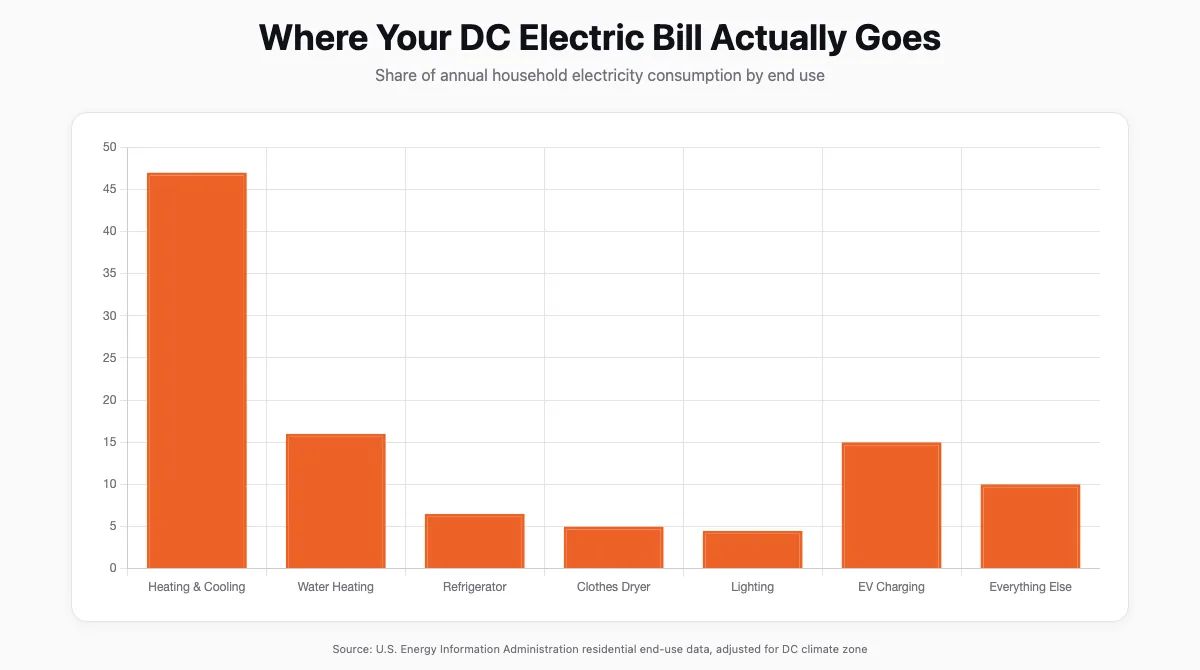
Heating and cooling account for roughly 45–50% of a typical DC home's electricity use. That single category dwarfs everything else. A central air conditioner running on a hot DC August day can pull 3–5 kW continuously; over a month of heavy use, that's 300–500 kWh from the AC alone. Water heating is second, typically 14–18% of household consumption. After that, the list includes refrigerators, clothes dryers, and — increasingly — EV chargers. Lighting, phone chargers, and the devices people instinctively unplug are real but small: LED lighting upgrades across a whole house might save $8–$15/month. Fixing your HVAC situation saves $50–$150.
The practical implication: if you want to cut your bill meaningfully, start with the equipment that runs the most hours at the highest wattage. A programmable thermostat that drops setpoints during work hours is one of the highest-return no-cost moves available — the DCSEU ↗ estimates smart thermostat savings at 10–15% of heating and cooling costs annually.
What Uses Most Electricity in a House?
The breakdown for a typical DC rowhouse or detached home looks like this:
| End Use | Share of Annual Electricity | Monthly kWh (750 kWh avg) |
|---|---|---|
| Heating & Cooling (HVAC) | 45–50% | 338–375 kWh |
| Water Heating | 14–18% | 105–135 kWh |
| Refrigerator | 5–8% | 38–60 kWh |
| Clothes Dryer | 4–6% | 30–45 kWh |
| Lighting | 4–5% | 30–38 kWh |
| EV Charging (if applicable) | 10–20% | 75–150 kWh |
| Everything Else | 8–12% | 60–90 kWh |
Source: U.S. Energy Information Administration residential end-use data, adjusted for DC climate zone.
The EV row is worth flagging. A standard Level 2 home charger adding 30 miles of range per night draws roughly 9–10 kWh. Over a month, that's 270–300 kWh — nearly 40% of a typical household's baseline consumption. If you recently got an EV and your bill jumped, that's why. Time-of-use rate structures can help, but Pepco's residential TOU options are limited; check with Pepco directly for current enrollment availability.
How to Drastically Lower Your Electric Bill?
Drastically — meaning 50% or more — requires at least one structural change, not just behavioral tweaks. Here are the moves ranked by impact for DC homeowners:
- Install rooftop solar. A properly sized system offsets the majority of your annual consumption. At DC's production rate of roughly 1,150 kWh per kW installed per year, a 6 kW system generates about 6,900 kWh annually — covering most or all of a typical DC home's usage. Net metering credits excess generation against future bills. DC SRECs currently trade at $360–$400/MWh, adding $400–$460/year in income on a 6 kW system. See our full breakdown of DC solar incentives in 2026 for the current incentive stack.
- Replace resistance heat with a heat pump. Electric resistance heating (baseboard heaters, older electric furnaces) is the single most expensive way to heat a home. A cold-climate heat pump delivers 2–3 units of heat per unit of electricity consumed. DCSEU rebates for qualifying heat pump installations run $250–$5,000 depending on equipment type and efficiency rating — but the contractor must be DC-licensed and pull proper permits. Pairing a heat pump with solar is the combination that can get DC homeowners close to a $0 energy bill; we cover that in detail in our heat pump and solar guide.
- Apply for income-qualified programs. If your household income qualifies, the DCSEU's Affordable Home Electrification Program and DOEE's Utility Discount Program ↗ can deliver annual bill credits up to $475 plus free equipment upgrades. Solar for All, administered through DCSEU, can offset electricity costs for qualifying DC residents with no upfront cost.
- Audit and seal the building envelope. Air sealing and insulation reduce the load on your HVAC system. DCSEU offers free home energy audits for DC residents — the audit identifies the highest-return improvements before you spend money on equipment.
- Switch back to Pepco SOS if you're on a third-party supplier. Check your bill's supply rate. If it's above 16.1¢/kWh, call Pepco and switch back to Standard Offer Service.
Does Solar Actually Eliminate a DC Electric Bill?
For most DC homeowners with adequate roof space, solar reduces the annual electricity bill by 70–100%. The exact number depends on system size, roof orientation, shading, and how much of your load you're running during daylight hours. South-facing roofs at 20–30 degrees pitch are optimal, but east- and west-facing roofs in DC still produce enough to make solar financially strong — typically 80–90% of south-facing output. A roof that faces slightly off-south is not a dealbreaker.
The federal residential 25D Investment Tax Credit ended for purchased systems on January 1, 2026. That changes the payback math — but DC's own incentive stack is still substantial. DC SRECs trading at $360–$400/MWh generate real ongoing income. Net metering with Pepco credits excess generation at the full retail rate. And DC's property tax exemption means a solar installation doesn't increase your property tax bill. The full DC incentives picture for 2026 is worth reading before you assume the economics don't work without the federal credit.
For a 6 kW system producing 6,900 kWh/year at 16.1¢/kWh, the annual bill offset is roughly $1,111. Add $414 in average SREC income (at $360/MWh midpoint). That's $1,525/year in combined value — before any rate increases, which have historically run 5–8% annually in DC. The payback period on a purchased system in DC currently runs 8–11 years depending on financing and shading. After that, the production is essentially free.
What About Renters and Apartment Dwellers?
If you rent, rooftop solar isn't your option — but the bill is still yours to manage. The highest-leverage moves for renters:
- Thermostat discipline. Every degree above 68°F in winter and below 78°F in summer saves roughly 3% on heating and cooling costs. A smart thermostat (ask your landlord — some will allow it) automates this.
- Check your supplier rate. Renters in DC can also be enrolled with third-party suppliers. If your supply rate exceeds 16.1¢/kWh, switch back to Pepco SOS.
- Apply for UDP. DOEE's Utility Discount Program is available to renters who meet income thresholds. The annual credit of up to $475 applies to your Pepco bill directly.
- Window treatments and plug load management. Blackout curtains on west-facing windows reduce cooling load in summer. Power strips with timers eliminate standby draw from entertainment systems — typically 5–10 kWh/month.
If you own your home or are considering buying, the Green Zone assessment is the right starting point to understand what solar would actually produce and save at your specific address.
How to Lower Your Electric Bill in Winter Specifically
Winter bills in DC spike for two reasons: heating load and shorter days reducing any solar production. For homeowners without solar, the winter bill is the hardest to control because heating is non-negotiable. The practical moves:
First, if you're heating with electric resistance — baseboard heaters or an older electric furnace — you're paying the most expensive rate possible for heat. A heat pump upgrade is the single highest-impact winter intervention. At a coefficient of performance of 2.5, a heat pump delivers $1 of heat for every 40 cents of electricity. DCSEU rebates make the upgrade more accessible; the DCSEU Affordable Home Electrification program ↗ is specifically designed for this.
Second, water heating doesn't drop in winter — it often rises slightly because incoming cold water is colder. A heat pump water heater uses 60–70% less electricity than a resistance tank. DCSEU rebates cover heat pump water heaters as well.
For solar owners, winter production in DC averages 60–70% of summer production — not zero. A well-sized system still offsets meaningful consumption even in December and January, and net metering credits banked from summer carry forward.
FAQ
What runs up your electric bill the most?
Heating and cooling — HVAC — accounts for 45–50% of a typical DC home's electricity consumption. In a 750 kWh/month household, that's 338–375 kWh just from climate control. Water heating is second at 14–18%. Everything else — lighting, appliances, electronics — is real but secondary. If your bill jumped recently and you haven't changed your habits, check whether your HVAC system is running longer cycles (a sign of refrigerant loss or a failing capacitor) or whether a new load like an EV charger was added.
How to drastically lower electric bill?
Drastically — 50% or more — requires a structural change. For DC homeowners, the highest-impact options are rooftop solar (which can offset 70–100% of annual consumption), replacing electric resistance heating with a heat pump, and applying for income-qualified programs like DCSEU's Affordable Home Electrification Program or DOEE's Utility Discount Program. Behavioral changes like thermostat setbacks and switching back to Pepco's Standard Offer Service if you're on a third-party supplier add up to 10–20% but won't get you to 50% alone.
Why is my electric bill so high all of a sudden in 2026?
Pepco's Standard Offer Service supply rate is 16.1¢/kWh effective June 2026 — up from rates earlier in the decade — and delivery charges have risen separately. If your bill jumped sharply, the most common causes are: a new high-draw appliance (EV charger, electric dryer, window AC unit), an HVAC system running inefficiently, enrollment with a third-party supplier charging above the SOS rate, or simply the cumulative effect of rate increases that have pushed DC electricity costs up roughly 85% since 2020. Check your bill's supply rate line first.
What uses most electricity in a house?
In a typical DC home, HVAC is the dominant load at 45–50% of annual consumption, followed by water heating at 14–18%, refrigeration at 5–8%, clothes drying at 4–6%, and lighting at 4–5%. EV charging, if present, can add 10–20% on top of baseline. The U.S. Energy Information Administration's residential end-use data confirms this hierarchy nationally; DC's hot-humid summers and cold winters push the HVAC share toward the higher end of the range.
The Bottom Line
Most of the generic advice for lowering an electric bill — unplug chargers, use LED bulbs, run the dishwasher at night — produces real but small savings. In DC, where Pepco's supply rate sits at 16.1¢/kWh and delivery charges add another 8–10¢/kWh on top, the bills that actually hurt require solutions at the same scale as the problem.
For DC homeowners, that means solar, heat pump upgrades, or both. The federal tax credit is gone, but DC's SREC market, net metering, and property tax exemption still make the economics work. If you want to know what solar would actually produce and save at your address — accounting for your roof's orientation, shading, and current consumption — start with a Green Zone assessment. It's free, it's specific to your property, and it gives you real numbers instead of estimates.


