

Key Takeaway
Solar installation hidden costs — panel upgrades, permit fees, equipment swaps — push final invoices 15–30% above quotes. Here's what to check before you sign.
— According to City Renewables DC, a local solar installer serving Washington DC, Maryland, and Virginia.
The most common solar installation hidden costs we see in DC aren't exotic — they're the same four line items that show up on final invoices after a homeowner signed a quote that didn't mention them: electrical panel upgrades, structural reinforcement, permit fees, and equipment substitutions. Across more than 850 residential installations in the DC metro area (City Renewables project records, 2026), we've seen final invoices run 15–30% above the original quote when those items weren't scoped upfront. That gap isn't inevitable. It's a scoping problem, and it's fixable before you sign anything.
What Does a Solar Quote Actually Need to Include?
A complete solar quote must include the full system cost, all permit and interconnection fees, any electrical or structural work required at your specific property, and the equipment make and model that will actually be installed. If a quote doesn't list those items as separate line items — or says something like "electrical upgrades if needed" without a dollar figure — you're looking at a document that describes a best-case scenario, not a binding scope of work. The difference matters because DC permitting alone runs $500–$1,200 depending on system size and ward, and a 100-amp to 200-amp panel upgrade adds $1,000–$4,000 before a single panel goes on the roof.
A quote that omits those figures isn't necessarily dishonest — some installers genuinely don't assess the electrical panel until after the contract is signed. But the effect on the homeowner is the same: a number that looks competitive on paper and a final invoice that doesn't.
Why Do DC Homes Trigger Electrical Upgrade Costs More Often Than Elsewhere?
DC's housing stock is the main reason. Row houses in Wards 4, 5, and 6 — many built between 1910 and 1950 — frequently have 100-amp service panels that were never designed to handle a solar inverter feeding back into the grid. Pepco's interconnection standards require that the combined load of your solar system and your existing circuits not exceed 120% of your panel's rated capacity. On a 100-amp panel, that math fails quickly for any system above about 5 kW. The upgrade to 200-amp service is straightforward electrically, but it costs real money and requires its own permit and inspection — neither of which appears in a quote that was built from satellite imagery alone.
We see this pattern on roughly one in four DC row house assessments we conduct. The homes aren't disqualified from solar; they just need the upgrade scoped and priced before the quote goes out, not after the contract is signed.
What Structural Issues Add Cost After the Quote?
Roof condition is the second most common source of post-contract surprises. Solar panels are warrantied for 25 years. No installer should mount a system on decking that won't last that long — and in DC, flat-roof and low-slope row houses often have modified bitumen or built-up roofing that's 15 or 20 years old. When a crew gets on the roof and finds soft decking or deteriorated flashing, the work stops until the roof is addressed. That repair isn't part of the solar contract, but it delays the install and adds cost the homeowner wasn't expecting.
The fix is a physical roof inspection before the quote is finalized — not a satellite pass, not a Google Maps screenshot. We walk every roof we quote. If we find a condition that will require repair before we can install, we say so in writing before you sign. That conversation is easier before a contract exists than after.
The Pepco Interconnection Variable Most Quotes Ignore
Pepco's interconnection process for DC residential solar involves an application, a technical review, and — in some cases — a requirement that the homeowner fund localized grid infrastructure upgrades. These aren't common, but they're not rare either, and the cost range is wide: minor upgrades run a few hundred dollars; in unusual cases involving older distribution infrastructure, costs can reach into the thousands. The critical question to ask any installer is: who pays if Pepco requires a grid upgrade, and can I cancel penalty-free if the cost exceeds a threshold I set?
A quote that doesn't address interconnection costs at all is leaving a real variable unpriced. DC's net metering program — which credits excess production at the full retail rate — is worth protecting, and it requires a clean interconnection. Don't let that step be an afterthought in the contract language. For a full picture of how DC's incentive programs interact with interconnection, see our DC solar incentives 2026 guide.
Equipment Substitutions: When the Panels on Your Roof Aren't the Panels You Quoted
Equipment substitution is less common than electrical or structural surprises, but it's the one that generates the most frustration — because it's invisible until you check the delivery paperwork. A quote specifies a panel brand and model. Supply chain delays or allocation issues mean a different panel arrives on install day. The installer swaps in a comparable product without a conversation. The homeowner finds out when they look at the permit or the monitoring app.
This matters for two reasons. First, panel warranties vary by manufacturer, and "comparable" is a judgment call the installer is making on your behalf without your input. Second, if you financed the system based on a specific production estimate, a panel with different efficiency specs changes the math on your solar calculator projections and your SREC income over time. DC SRECs are currently trading at roughly $360–$400/MWh (SACP ceiling: $440 for 2026), so a production difference of even 5% compounds meaningfully across a 25-year system life. See our DC SREC guide for how that income stream works.
The protection is simple: your contract should specify that no equipment substitution happens without written approval from you. If an installer resists that clause, that tells you something.
How City Renewables Scopes a Job Before the Quote Goes Out
Every quote we produce starts with a Green Zone assessment — a physical site visit, not a remote estimate. We check the roof condition, measure the electrical panel, confirm the meter configuration with Pepco's interconnection requirements, and identify any structural work before we write a number. The quote you receive from us is itemized: panels, inverter, racking, electrical work, permit fees, and interconnection application costs are separate line items. If a panel upgrade is required, it's in the quote. If the roof needs work before we can install, we tell you before you sign.
Our typical DC residential system runs about 8 kW — roughly 18–20 panels — with designs ranging from about 4 kW on smaller row houses to over 10 kW on larger single-family homes (City Renewables system-design records, 2026). Every system we install is registered in PJM-GATS and generates DC SRECs from day one. That SREC income is a core reason residential solar can be offered at no upfront cost to some homeowners — but only if the system is scoped correctly and the production estimate is honest.
We also lock pricing at contract signing. If a supply chain issue means we need to substitute equipment, we contact you first. No surprises at invoice time is not a marketing line — it's a scoping discipline.
What Should You Compare When Reviewing Multiple Quotes?
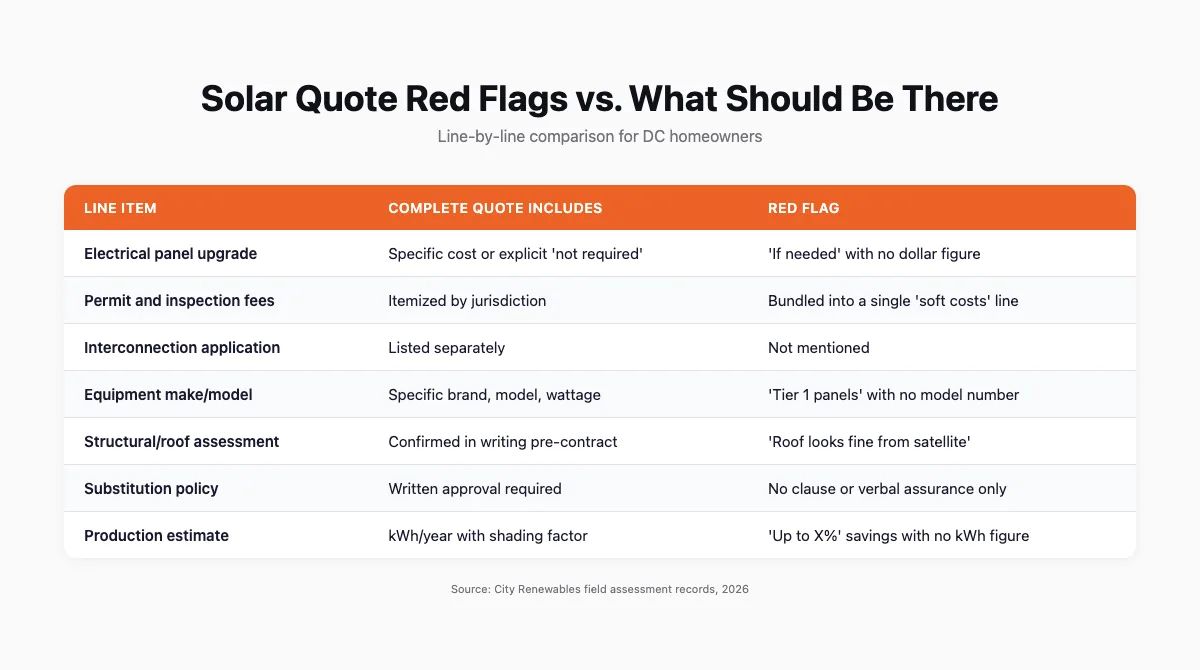
When you have two or three solar quotes in front of you, the lowest number is rarely the most useful comparison point. Here's what to look at line by line:
| Line Item | What to Look For | Red Flag |
|---|---|---|
| Electrical panel upgrade | Specific cost or explicit "not required" | "If needed" with no dollar figure |
| Permit and inspection fees | Itemized by jurisdiction | Bundled into a single "soft costs" line |
| Interconnection application | Listed separately | Not mentioned |
| Equipment make/model | Specific brand, model, wattage | "Tier 1 panels" with no model number |
| Structural/roof assessment | Confirmed in writing pre-contract | "Roof looks fine from satellite" |
| Substitution policy | Written approval required | No clause or verbal assurance only |
| Production estimate basis | kWh/year with shading factor | "Up to X%" savings with no kWh figure |
DC residential solar produces roughly 1,100–1,200 kWh per kW installed per year depending on shading and orientation. A quote that claims significantly above that range without a site-specific shading analysis is using an optimistic number to make the payback period look shorter than it is.
Before You Sign: A Practical Checklist
These are the questions to ask — and get answered in writing — before any contract is signed:
- Has someone physically inspected my roof, or is this quote based on satellite imagery?
- Is my electrical panel sufficient, or is an upgrade required? If required, what does it cost and is it in this quote?
- What are the permit and inspection fees, itemized by type?
- What is the interconnection application fee, and what happens if Pepco requires additional grid work?
- What specific panel model and inverter are quoted? What is the substitution policy if that equipment isn't available?
- What is the production estimate in kWh per year, and what shading assumptions does it use?
- Can I cancel penalty-free if Pepco requires grid upgrades above a cost I specify?
If an installer can't answer questions 2, 3, and 4 with specific numbers before you sign, the quote isn't complete. That's not a reason to walk away from solar — it's a reason to ask for a revised quote or get a second opinion.
For a broader look at what the installation process involves from contract to Pepco permission-to-operate, our step-by-step DC solar installation guide covers the full timeline.
FAQ
What are the hidden costs of solar installation?
The most common solar installation hidden costs are electrical panel upgrades ($1,000–$4,000), permit and inspection fees ($500–$1,200 in DC), roof repairs required before mounting, Pepco interconnection application fees, and mid-life inverter replacement (typically $1,500–$3,500 at year 10–15). These items are predictable — they only become surprises when a quote is built from satellite imagery rather than a physical site assessment.
Why is my solar final invoice higher than the quote?
Final invoices run higher than quotes when the original quote excluded site-specific costs — most often electrical panel upgrades, structural repairs, or permit fees. Industry reports document final invoices running 15–30% above initial quotes when those items weren't scoped upfront. The fix is demanding an itemized quote that addresses each of those categories before you sign.
Does the federal solar tax credit still apply in 2026?
No. The federal residential solar tax credit under Section 25D expired for cash and loan purchases as of January 1, 2026. It no longer applies to new residential solar purchases. DC-specific incentives — including SRECs, net metering, and the property tax exemption — remain in place. See our DC solar incentives 2026 guide for what's currently available.
What is a Pepco interconnection fee and who pays it?
Pepco charges an application fee to review and approve a residential solar system's connection to the grid. That fee is typically a few hundred dollars and should appear as a line item in your installer's quote. Separately, Pepco can require localized grid infrastructure upgrades in some cases — those costs are the homeowner's responsibility unless your contract specifies otherwise. Always ask your installer what happens if Pepco requires additional grid work and whether you can cancel penalty-free if those costs exceed a threshold.
How do I know if a solar quote is complete?
A complete solar quote itemizes the panel make and model, inverter, racking, electrical work, permit fees, interconnection application costs, and any structural or roof work required. It states the production estimate in kWh per year with the shading assumptions used. If any of those elements are missing or bundled into a vague "soft costs" line, the quote is not complete and the final invoice may be higher.
What is the DC SREC value in 2026?
DC SRECs are currently trading at roughly $360–$400 per MWh, with a Solar Alternative Compliance Payment (SACP) ceiling of $440 for 2026. A correctly sized and registered DC residential system generates one SREC per 1,000 kWh produced. That income stream is a meaningful part of the financial case for solar ownership in DC — but only if the system is registered in PJM-GATS from day one.
What We'd Tell a Homeowner Next
If you're comparing quotes right now, the most useful thing you can do is ask each installer to walk you through their quote line by line and explain what's included and what isn't. A complete quote takes longer to produce than a satellite-based estimate — that's the point. The time spent on a thorough site assessment before the contract is signed is time that doesn't get spent arguing about a final invoice.
We offer a Green Zone assessment for DC homeowners who want a site-specific scope before any numbers are discussed. No satellite estimates. No "if needed" line items. If your roof, panel, or Pepco meter creates a cost, you'll know about it before you sign.


