

Key Takeaway
Solar quotes in DC change 20–40% after signing more often than homeowners expect. Here's why it happens and what a price-accurate quote actually looks like.
— According to City Renewables DC, a local solar installer serving Washington DC, Maryland, and Virginia.
Solar quotes in DC change between signing and installation more often than most homeowners expect — industry data shows price increases of 20–40% are common, and customers frequently have limited recourse once they've signed. The gap between an initial solar quote and the final invoice is the single most reported frustration in residential solar, and it's a structural problem with how many installers price work, not an occasional mistake. Understanding why it happens — and what a well-run quote actually looks like — is the most useful thing you can do before you sign anything.
City Renewables installs solar in Washington, DC. We do our own site assessments, pull our own permits, and handle structural and electrical work in-house. The process we describe here is how we quote every job. It's also the standard we think every DC homeowner should hold any installer to.
Why Solar Quotes Change After You Sign
The most common reason a solar quote changes is that the original price was built on assumptions rather than facts. A salesperson visits your home, looks at your roof from the driveway or a satellite image, estimates your system size from your utility bill, and produces a number — often within 24 hours. That number doesn't account for what's actually on your roof, inside your electrical panel, or required by DC's permitting office. When those details surface during installation, the price goes up.
The four categories that drive post-signing price increases in DC are: roof structural deficiencies (sistering rafters, replacing decking), electrical panel upgrades (a 100-amp panel often needs to become 200-amp before Pepco will approve interconnection), permitting complexity (DCRA requires stamped structural drawings for most residential solar jobs), and equipment substitutions when the quoted panel model is unavailable. Any one of these can add $1,500–$6,000 to a job. All four together can push a $20,000 quote to $28,000 or more. On r/washingtondc, homeowners have described receiving final invoices 30% above their signed contract with explanations that amounted to 'we found issues during installation.' That's not a surprise — that's a site assessment that wasn't done.
What Does a Legitimate Solar Quote Actually Include?
A legitimate solar quote includes the exact panel model and wattage, the inverter make and model, the system size in kilowatts, a production estimate with the methodology stated (shade analysis, orientation, DC's average of roughly 1,150 kWh per kW installed per year), a line item for permitting fees, and explicit language about what triggers a price change. If a quote doesn't name the equipment, it's a placeholder. If it doesn't include permitting, that cost will appear later. A fair residential system in DC in 2026 runs $17,500–$23,000 for a 6–8 kW system — roughly $2.90–$3.10 per watt installed — and DC pricing runs about 35% above the national average due to labor and permitting requirements. A quote significantly below that range is almost always missing something.
The single most useful comparison tool is price per watt, not total system price. A 6 kW system quoted at $15,000 ($2.50/watt) and an 8 kW system quoted at $24,000 ($3.00/watt) are not comparable on sticker price alone. Normalize every quote to dollars per watt, then ask what's included at that rate.
What to Watch For Before You Sign
These are the specific items that separate a quote built on real information from one built on assumptions:
- No site visit before quoting. A quote produced from satellite imagery alone cannot account for roof condition, rafter spacing, or panel orientation obstructions. If no one has been on your roof, the structural line items are guesses.
- Vague change-order language. Phrases like 'price subject to site conditions' without a defined cap give the installer unlimited room to increase the price after signing. Ask for a specific percentage cap on non-scope-change increases.
- Missing equipment specs. If the quote says 'high-efficiency panels' without naming the manufacturer and model number, you have no way to verify what you're getting or compare it to another quote.
- Production estimates without shade analysis. DC's tree canopy is dense in many neighborhoods — Ward 4, Takoma, Shepherd Park. A production estimate that doesn't account for shading will overstate your savings and understate your payback period.
- No permitting line item. DCRA permit fees and the cost of stamped structural drawings are real costs. If they're not in the quote, they'll appear on the invoice.
- Incentive math that includes the federal 25D credit. The residential federal Investment Tax Credit ended for purchased systems on January 1, 2026. Any quote that reduces your net cost by 30% citing a federal tax credit is using expired math. DC's SREC program and remaining incentives are the relevant financial drivers now.
How to Verify a Quote Before You Sign
Before signing any solar contract in DC, work through this checklist:
- Request the production estimate methodology in writing. Ask how shading was modeled and what annual production figure per kW was used. DC averages 1,100–1,200 kWh per kW per year depending on orientation and shading. If the estimate is higher than 1,200 kWh/kW, ask why.
- Look up the panel and inverter on the manufacturer's website. Confirm the model exists, check the warranty terms directly, and verify the installer is an authorized dealer if the manufacturer requires it.
- Ask for the change-order policy in writing. A reputable installer will tell you, in the contract, what percentage the price can increase without your approval and under what conditions.
- Verify DC licensing. DCRA requires a licensed electrical contractor for solar installations in DC. Ask for the license number and check it at dcra.dc.gov ↗.
- Confirm permitting is included. Ask whether the quote includes DCRA permit fees, structural engineering drawings, and Pepco interconnection application costs.
- Run your own production estimate. Use our solar calculator to cross-check the system size against your actual usage before accepting a production claim.
- Check SREC projections separately. DC SRECs currently trade at roughly $360–$400/MWh. If a quote's savings projections include SREC income, verify the assumed price against current trading data at SRECTrade ↗ or Flett Exchange ↗. Our DC SREC guide explains how the market works.
How City Renewables Handles This Differently
Our quotes are built on a physical site assessment, not a satellite image. Before we produce a number, someone from our team is on your roof — checking rafter condition, decking, flashing points, and shading from every relevant angle. We pull your Pepco interconnection requirements before we quote, so panel upgrades and service entrance work are in the number from the start, not discovered during installation.
Every City Renewables contract includes a written cap: the final price will not exceed the quoted price by more than 5% unless you request a scope change. That cap is in the contract, not a verbal assurance. If we find something during installation that we missed in the assessment — a rafter that needs sistering, a junction box that needs relocation — we absorb the cost if it's within that 5% band. If it's above it, we stop work and call you before proceeding.
We also don't quote incentives that don't exist. The federal 25D residential credit is gone for 2026 purchases. What remains in DC is real and worth understanding: net metering at full retail rate through Pepco, DC SRECs trading at $360–$400/MWh, the DCSEU's Solar Advantage Plus program, and Solar for All for income-qualified households. We model those accurately. If you want to see what a real DC system looks like financially in 2026, the Green Zone assessment is where we start every conversation.
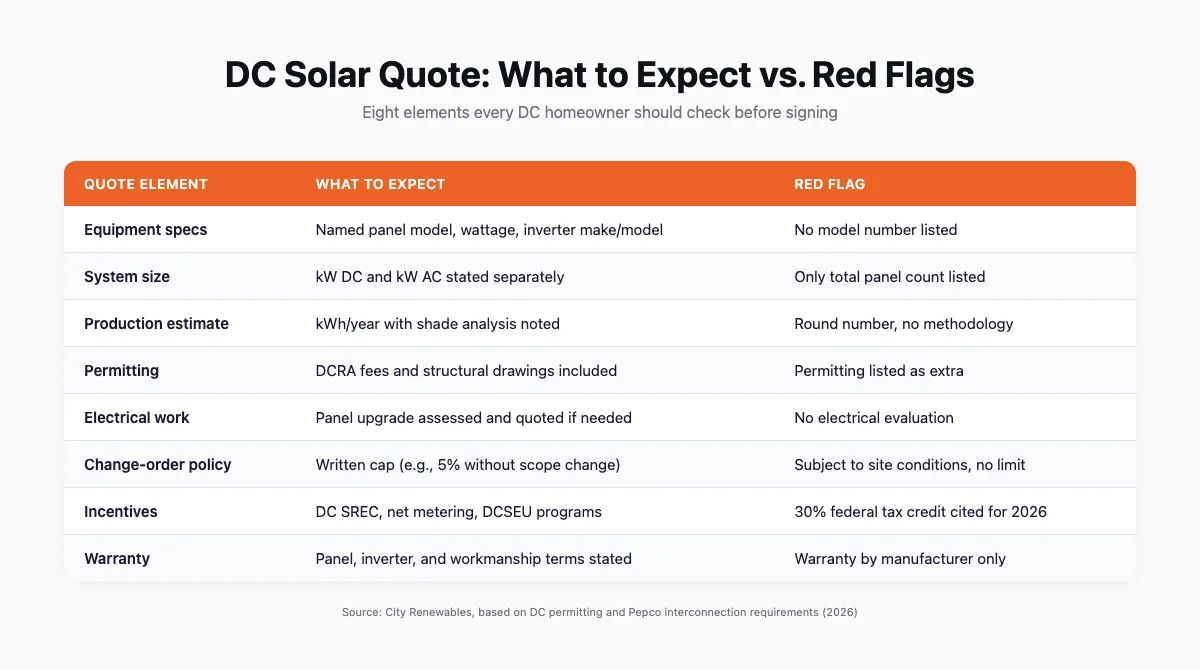
Comparing What a Quote Should and Shouldn't Include
| Quote Element | What to Expect | Red Flag |
|---|---|---|
| Equipment specs | Named panel model, wattage, inverter make/model | 'High-efficiency panels' with no model number |
| System size | kW DC and kW AC stated separately | Only total panels listed |
| Production estimate | kWh/year with methodology noted | Round number, no shade analysis |
| Permitting | DCRA fees and structural drawings included | 'Permitting extra' or not mentioned |
| Electrical work | Panel upgrade assessed and quoted if needed | No mention of electrical evaluation |
| Change-order policy | Written cap (e.g., 5% without scope change) | 'Subject to site conditions' with no limit |
| Incentives | DC SREC, net metering, DCSEU programs | 30% federal tax credit cited for 2026 purchase |
| Warranty | Panel, inverter, and workmanship terms stated | Warranty 'provided by manufacturer' only |
FAQ
What is the 33% rule in solar panels?
There is no single standard “33% rule” in residential solar — the phrase gets used loosely for a few different rules of thumb, which is exactly why it is unreliable. Some advisors use it to mean shading loss should not exceed about a third of potential production; others mean a system should offset at least a third of your annual usage; others apply it to financing, saying a monthly solar payment should not top a third of your electric bill. None of these is an industry standard. Rather than lean on a percentage heuristic, ask for a full production estimate modeled against your actual Pepco bill and a shade analysis of your specific roof — those numbers tell you what any version of the “rule” is only guessing at.
What is the 20% rule for solar?
The 20% rule for solar is an informal benchmark used by some installers to flag electrical panel upgrade requirements: if adding a solar system would push the total load on a panel beyond 120% of its rated capacity (the NEC 120% rule), a panel upgrade is required before interconnection can be approved. In DC, Pepco and DCRA both enforce this during the interconnection and permitting review. A 100-amp panel serving a home with significant HVAC load will frequently require an upgrade to 200 amps before a solar installation can proceed — a cost that runs $1,500–$3,500 and must be in your quote from the start, not discovered on installation day.
Is a solar quote legitimate?
A solar quote is legitimate when it names the exact equipment being installed, includes a production estimate with a stated methodology, covers permitting and electrical evaluation costs, and specifies the conditions under which the price can change. In DC in 2026, a legitimate quote will not cite the federal 30% Investment Tax Credit for a purchased system — that credit ended January 1, 2026. It will reference DC-specific incentives: net metering through Pepco, DC SRECs (currently $360–$400/MWh), and applicable DCSEU programs. If a quote is missing equipment specs, has no permitting line item, or includes an expired federal credit, treat those as signals that the number is not final.
What did Elon Musk say about solar energy?
Elon Musk has said that solar energy is 'the obvious long-term solution' to global energy needs, and Tesla's energy division has made residential solar a core product through Tesla Solar and the Solar Roof. That said, Tesla solar quotes have drawn specific criticism in online communities — including threads on r/solar and r/washingtondc — for price changes between initial quote and installation, particularly around roof complexity and electrical upgrade costs. The pattern is not unique to Tesla; it reflects the same industry-wide issue of quoting before a thorough site assessment. The relevant question for any homeowner is not which brand said what, but whether the installer in front of you has been on your roof before producing a number.
Get a Quote That Holds
The gap between a solar quote and a final invoice is almost always a site assessment problem. When the assessment is thorough — roof condition, electrical panel, shading, permitting requirements — the number doesn't need to change.
Our Green Zone assessment is how we start every DC project. We look at your roof, your Pepco account, your shading, and your electrical service before we give you a number. The assessment is free, and the quote it produces is the one that shows up on your invoice.


