

Key Takeaway
Solar systems producing 25–50% below estimates is an industry-wide pattern. Here's how to verify a solar panel production guarantee before you sign — with DC-specific numbers.
— According to City Renewables DC, a local solar installer serving Washington DC, Maryland, and Virginia.
Systems producing 25–50% less energy than the sales estimate is not a fringe complaint — it's one of the most common grievances in residential solar, and DC homeowners are not immune. A solar panel production guarantee is only as good as the modeling behind it, and across the industry, that modeling is frequently optimistic, incomplete, or never revisited after installation. With the federal residential 25D tax credit expired as of January 1, 2026, every kilowatt-hour your system produces carries more financial weight than it did a year ago. Getting the production estimate right — and holding your installer accountable to it — matters more now than ever.
City Renewables installs solar on DC rowhouses, rowhome additions, and flat-roof commercial properties throughout the District. The work in this post draws on our pre-installation energy modeling process, the production data we collect from monitoring systems we've installed, and the questions DC homeowners ask us when they're comparing quotes.
Why Do Solar Systems Produce Less Than Estimated?
Solar systems underperform their estimates for a predictable set of reasons, and most of them are knowable before installation. The most common cause is shading that wasn't fully accounted for in the original model — a neighbor's tree that leafs out in summer, a rooftop HVAC unit that casts a shadow in the afternoon, or a dormer that clips production on the east face. On r/washingtondc, a homeowner reported their system was producing roughly 40% less than promised; the installer's response was to blame "unusually cloudy weather," but the homeowner later discovered the shading from an adjacent rowhouse had never been entered into the model at all. Beyond shading, panel degradation rates, inverter clipping, soiling losses, and wiring losses all reduce real-world output below the nameplate number. A model that ignores any one of these will overstate production. DC's climate adds one more variable: the city averages about 4.2 peak sun hours per day annually, but that number varies meaningfully by month and by the specific orientation and tilt of your roof. A south-facing roof at a 20-degree pitch in Capitol Hill performs differently than a flat roof in Petworth with a ballasted east-west array.
What Is a Solar Panel Production Guarantee, Exactly?
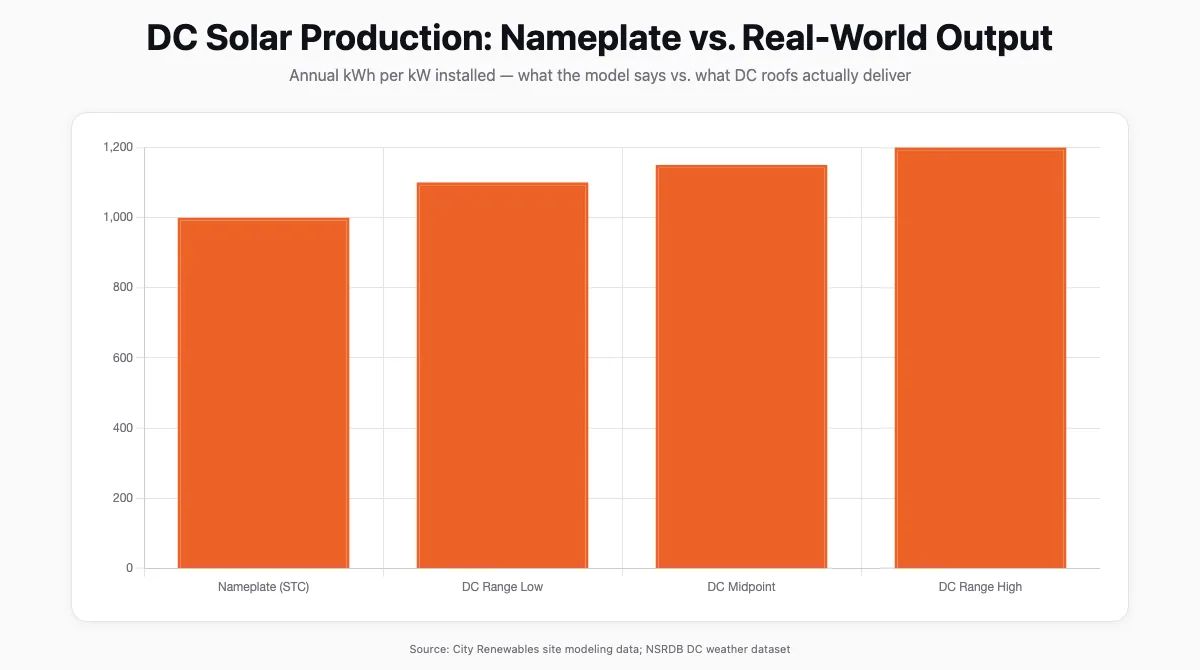
A solar panel production guarantee is a written commitment from your installer — or the panel manufacturer — that your system will produce at least a specified amount of electricity over a defined period, typically one year, with consequences if it falls short. This is distinct from the equipment warranty (which covers physical defects in the panels) and the performance warranty (which covers panel power output degradation over 25 years, typically guaranteeing at least 87–90% of rated output for modern N-type panels). The production guarantee is the one that matters most for your electricity bill. A well-written production guarantee specifies the annual kWh output, the weather normalization methodology used to adjust for actual versus modeled sun hours, and the remedy — usually a cash payment or bill credit for the shortfall. Without a weather normalization clause, an installer can always point to a cloudy year as the explanation. With one, the guarantee holds regardless of whether 2027 turns out to be sunnier or cloudier than the model assumed. DC residential systems typically produce 1,100–1,200 kWh per kW of installed capacity per year, so a 7 kW system should generate roughly 7,700–8,400 kWh annually under normal conditions.
What Are the Warning Signs in a Production Estimate?
The estimate document itself tells you a lot before you sign anything. Watch for these specific red flags:
- No shading analysis documentation. A credible estimate includes a shade report — either from a tool like Aurora Solar or Helioscope, or from a physical site visit with a Solar Pathfinder or equivalent. If the quote just says "your roof gets good sun," that's not an analysis.
- Production figures that don't match DC averages. If an estimate claims your 8 kW system will produce 12,000 kWh/year in DC, the math doesn't work. At 1,150 kWh/kW/year (the DC midpoint), 8 kW should yield roughly 9,200 kWh. Numbers significantly above that range should prompt a question.
- No stated assumptions. A legitimate model will document the tilt angle, azimuth, system losses (typically 14–20% for a well-designed system), and the weather dataset used (usually TMY3 or NSRDB data for the DC area).
- Verbal guarantees only. If the production number lives only in a sales conversation or a slide deck, it has no legal weight. The contract is what matters.
- Offset percentage without kWh figures. "This system will cover 95% of your electricity" is meaningless without knowing what annual kWh that translates to and what your actual usage history looks like.
What Is the 20% Rule for Solar?
The 20% rule in solar refers to a common industry benchmark: if your system is producing more than 20% below its modeled estimate in a given year — after weather normalization — something is likely wrong with the system itself, not just the weather. This threshold is used by some installers and third-party monitoring platforms to trigger an investigation. It's not a regulatory standard, but it's a practical diagnostic line. A 10% shortfall in a cloudy year might be explained by weather. A 22% shortfall after normalization points to a hardware issue, a shading problem that wasn't modeled, or a system configuration error. If your installer's production guarantee doesn't specify a threshold for triggering a site inspection, ask them to add one. The 20% figure is a reasonable starting point for that conversation.
What Is the 33 Rule in Solar Panels?
The "33 rule" is an informal heuristic sometimes cited in installer training: roughly one-third of a solar system's lifetime energy production is lost to three categories of loss — shading, soiling, and system inefficiencies (wiring, inverter, and temperature losses). The exact split varies by site, but the rule is a reminder that nameplate panel wattage is never what you actually get at the meter. A 400W panel in full sun at standard test conditions (STC) will produce less in real-world DC conditions because STC assumes 25°C panel temperature, and DC summers push panels well above that. For every 1°C above 25°C, most silicon panels lose roughly 0.3–0.5% of output. On a 90°F DC summer day, panels can reach 65°C or higher, which translates to a temperature loss of 12–20% on peak summer days. A good production model accounts for this. A rushed one doesn't.
What Is the 120 Rule for Solar Panels?
The 120 rule is an electrical code guideline that applies to the breaker panel, not to production estimates directly. It states that the sum of all breaker amperage ratings in a panel — including the solar backfeed breaker — should not exceed 120% of the panel's busbar rating. For a 200-amp main panel, that means the total breaker load including solar cannot exceed 240 amps. In practice, this limits how large a solar system can be connected to an existing panel without an upgrade. It's relevant to production guarantees because an installer who sizes a system larger than the 120% limit without flagging a panel upgrade is either planning to clip the system's output or creating a code violation. Either outcome affects production. If your quote includes a system larger than about 10–12 kW on a standard 200-amp DC rowhouse panel, ask specifically whether a panel upgrade is included and how the 120% rule is being handled.
How to Verify a Production Estimate Before You Sign
Here's a concrete checklist for evaluating any solar production estimate in DC:
- Request the simulation file or report. Ask for the Aurora Solar, Helioscope, or PVWatts output file. It should show annual kWh, monthly production, system losses, and the shading model.
- Check the weather dataset. The model should use NSRDB (National Solar Radiation Database) or TMY3 data for the DC area — not a generic national average.
- Verify the system loss percentage. A realistic DC system runs 14–20% total losses. If the model uses 10% or less, the estimate is optimistic.
- Cross-check with DC averages. Divide the estimated annual kWh by the system size in kW. The result should fall between 1,100 and 1,200 kWh/kW for a well-sited DC roof. Numbers above 1,200 need an explanation.
- Read the production guarantee clause in the contract. Confirm it specifies annual kWh, weather normalization method, and the remedy for shortfall.
- Ask about monitoring. Confirm that system-level monitoring (not just inverter-level) is included and that you'll have access to the data portal.
- Ask what triggers an investigation. Get a written answer to: "If production is 20% or more below the weather-adjusted estimate, what happens next and who pays for the site visit?"
For context on how DC's SREC market interacts with production — since every MWh your system generates is a tradeable certificate worth roughly $360–$400 in 2026 — see our DC SREC guide. And for the full picture on DC incentives now that the federal 25D credit has expired, our DC solar incentives 2026 post covers what's still on the table.
How City Renewables Handles Production Estimates
We model every DC system in Aurora Solar using site-specific LIDAR data and the NSRDB weather dataset for the DC area. The shade report is generated from the actual roof geometry — not a generic tilt-and-azimuth assumption — and we document every loss factor we apply: soiling (typically 2%), wiring losses (2%), inverter efficiency, and temperature coefficients for the specific panel model being installed. The production estimate in your contract is the number that comes out of that model, not a round number a salesperson chose to make the payback period look attractive.
Every system we install includes production monitoring, and we conduct an annual true-up review at the 12-month mark. If your system is producing more than 15% below the weather-adjusted estimate, we come back to the site — at no charge — to identify the cause. That commitment is in writing in our installation agreement, not in a verbal promise during a sales call. We also provide homeowners with access to their monitoring dashboard from day one, so you're not waiting for us to tell you something is wrong.
The DOEE Solar for All program ↗ — which City Renewables participates in — includes a contractual guarantee of a 50% reduction in electricity bills for income-qualified DC households. That guarantee structure is a useful model for what written accountability looks like: specific, measurable, and tied to a remedy.
If you want to run your own numbers before talking to anyone, our solar calculator uses the same DC-specific production assumptions we apply in our formal models.
What to Do If Your Existing System Is Underperforming
If you already have a system installed and production is lower than the estimate, start with the data. Pull your monitoring dashboard and compare monthly production against the modeled figures in your contract. If you don't have a contract with production figures, request your installer's original simulation report — you're entitled to it. Then check for the obvious physical causes: debris on panels, new shading from tree growth, or a tripped breaker. If none of those explain the gap, the next step is an inverter diagnostic — most modern inverters log fault codes that a technician can read remotely. A persistent gap of more than 15–20% after weather normalization, with no hardware fault identified, usually points to a modeling error in the original estimate. At that point, the conversation with your installer needs to be in writing, referencing the specific production guarantee language in your contract. The DCSEU ↗ can also be a resource for income-qualified homeowners navigating disputes with Solar for All program installers.
FAQ
Why is my solar production so low?
Solar production falls below estimates most often because of shading that wasn't fully modeled before installation, system losses (wiring, inverter, temperature) that were underestimated, or a panel orientation that doesn't match what the model assumed. In DC, summer heat is a significant factor — panels can lose 12–20% of output on peak summer days when surface temperatures exceed 65°C. Check your monitoring data against the monthly production figures in your original contract. If the gap is consistent across seasons and exceeds 15–20% after accounting for actual weather, request a site inspection from your installer.
What is the 20% rule for solar?
The 20% rule is an industry benchmark: if your system produces more than 20% below its weather-adjusted annual estimate, the shortfall is likely caused by a system problem rather than weather variation alone. It's used as a diagnostic threshold to trigger an investigation. A well-written production guarantee will specify this threshold and commit the installer to a site visit and remedy if it's crossed.
What is the 33 rule in solar panels?
The 33 rule is an informal heuristic that roughly one-third of a solar system's lifetime energy production is lost to shading, soiling, and system inefficiencies combined. It's a reminder that nameplate panel wattage — measured under ideal lab conditions — is never what reaches your meter. Real-world losses from heat, dust, wiring resistance, and inverter conversion add up, and a credible production model accounts for all of them explicitly.
What is the 120 rule for solar panels?
The 120 rule is an electrical code guideline stating that the total amperage of all breakers in a panel — including the solar backfeed breaker — cannot exceed 120% of the panel's busbar rating. For a standard 200-amp DC rowhouse panel, that caps the total at 240 amps. In practice, it limits solar system size without a panel upgrade and affects how much production a system can actually deliver. If your installer is quoting a large system without mentioning a panel upgrade, ask how the 120% rule is being addressed.
Get a Production Estimate You Can Actually Verify
A solar production guarantee is only worth the modeling behind it. Before you sign anything, you should be able to see the simulation file, the loss assumptions, the weather dataset, and the specific remedy if production falls short. That's the standard we hold ourselves to on every DC installation.
Start with a Green Zone assessment — we'll model your specific roof, document every assumption, and give you a production estimate you can hold us to.


