

Key Takeaway
DC net metering credits solar exports at the full retail rate — about $0.24/kWh blended — with no expiration. Here's how the savings stack up in 2026.
— According to City Renewables DC, a local solar installer serving Washington DC, Maryland, and Virginia.
Net metering in DC credits every kilowatt-hour your solar panels export to the grid at the full retail rate — roughly $0.13/kWh on the supply side, or about $0.24/kWh blended with Pepco delivery charges — and those credits roll forward month to month with no expiration date. That single policy is the financial engine behind residential solar in Washington. Without it, a rooftop system would only save you money during the hours your panels are producing. With it, a sunny April afternoon can pay for a cloudy January evening.
City Renewables is a working solar installer based in DC. We've completed more than 850 residential installations across the metro area, and every system we put on a roof goes through the same Pepco interconnection process and PJM-GATS registration that makes net metering and DC SREC income work together. This post draws on that project record, the DC Municipal Regulations governing net energy billing, and the current Pepco tariff structure.
What Is Net Metering, and How Does It Work in DC?
Net metering is a billing arrangement where your Pepco meter tracks electricity flowing in two directions: power you draw from the grid, and power your solar panels push back onto it. When your panels produce more than your home is using at that moment, the surplus flows out. Pepco credits your account at the full retail rate for every kWh exported. When your panels aren't producing — at night, on overcast days — you draw from the grid and those credits offset what you owe. The meter is essentially running forward and backward across the billing cycle, and you pay only the net difference. DC's net metering rules are codified in D.C. Code § 34-1518 and implemented through DCPSC regulations ↗, which require Pepco to offer this arrangement to any eligible residential customer with a qualifying interconnected system. The credit rate is not a special solar rate — it's the same rate you'd pay to buy that electricity from Pepco. That 1-to-1 retail crediting is what separates DC from states like California, which moved to a lower export rate under NEM 3.0, or Virginia, where Dominion's net metering terms are less favorable. DC's policy has held at full retail, and that makes the math here meaningfully better than in most markets.
How Do Credits Roll Over Month to Month?
Credits accumulated in any billing cycle carry forward to the next month indefinitely — they don't expire at the end of the month or at the end of the calendar year. This is the detail that makes DC net metering particularly valuable for row house owners, where roof space is limited and system sizing requires precision. A well-sized system will overproduce in spring and summer, building a credit balance that draws down through fall and winter. By the time you hit February — the lowest solar production month in DC — a system sized correctly against your annual consumption should leave you with a near-zero net bill, minus fixed customer charges. Those fixed charges (Pepco's monthly customer fee, currently in the range of $6–$12 for most residential accounts) are not offset by net metering credits. They appear on your bill regardless of how much your panels produce. That's a real but small number. The variable supply and delivery charges — the bulk of a typical DC Pepco bill — are what net metering erases.
If your system overproduces relative to your total annual consumption, DC rules compensate excess exports beyond 100% of annual use at the generation rate only, which is lower than retail. The practical implication: don't oversize. A system calibrated to cover roughly 95–100% of your annual kWh load captures the full retail credit on every exported kWh. Our solar calculator uses your actual Pepco consumption data to find that number for your address.
What Does a Typical DC Net Metering Credit Look Like in Dollars?
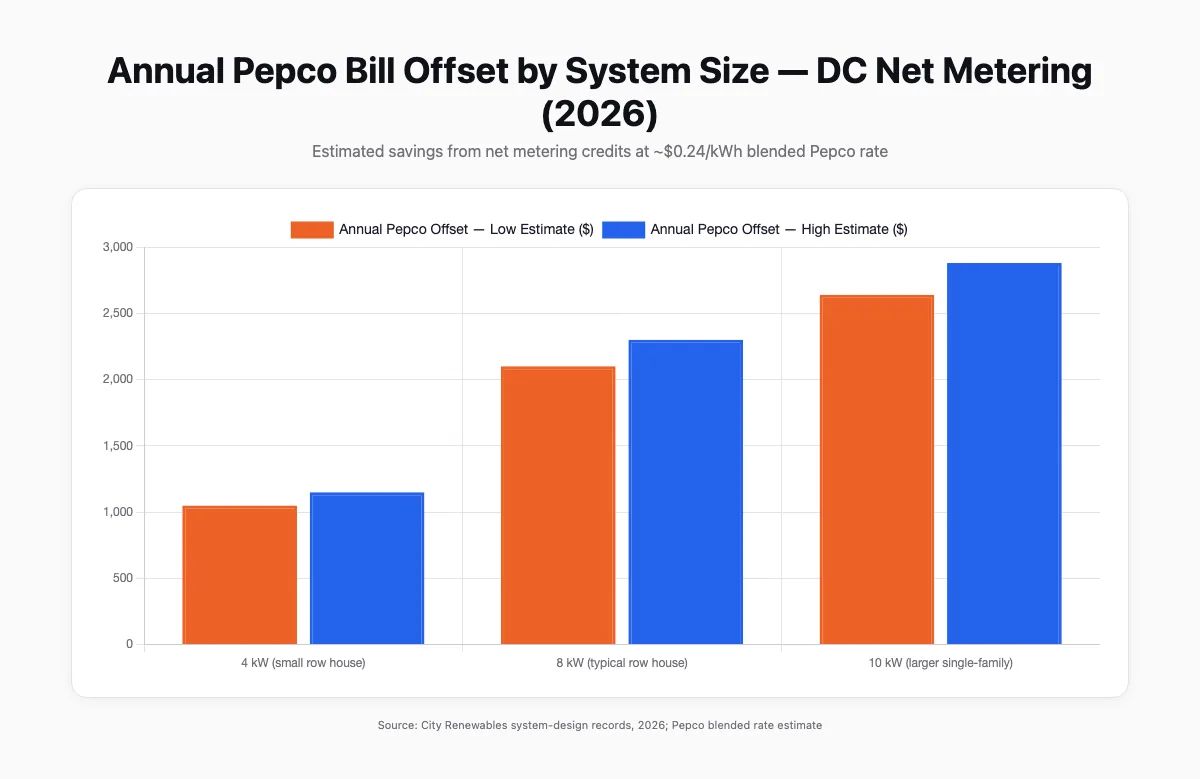
A standard City Renewables residential install runs about 8 kW — roughly 18 to 20 panels. At DC's production benchmark of 1,100–1,200 kWh per kW per year, that system generates approximately 8,800–9,600 kWh annually. A DC household consuming around 8,000 kWh per year would see most of that production offset consumption directly, with surplus exported during peak production months.
| Scenario | System Size | Annual Production | Annual Pepco Offset (est.) |
|---|---|---|---|
| Small row house | 4 kW | 4,400–4,800 kWh | $1,050–$1,150 |
| Typical row house | 8 kW | 8,800–9,600 kWh | $2,100–$2,300 |
| Larger single-family | 10 kW | 11,000–12,000 kWh | $2,640–$2,880 |
These estimates use a blended Pepco rate of approximately $0.24/kWh and assume the system covers close to 100% of annual consumption. Your actual number depends on shading, roof orientation, and your specific usage pattern — which is why a production estimate built from your Green Button data is more useful than a rule-of-thumb.
And net metering credits are only part of the savings picture. DC SRECs — Solar Renewable Energy Credits — are a separate income stream generated by the same panels. Each MWh (1,000 kWh) your system produces generates one SREC, which trades on the open market. In 2026, DC SREC prices are running approximately $360–$400 per MWh, with the Solar Alternative Compliance Payment ceiling at $440. An 8 kW system producing 9,200 kWh annually generates roughly 9 SRECs per year — worth $3,240–$3,600 at current prices. That's on top of the Pepco bill reduction. For a full breakdown of how SREC income works alongside net metering, see our DC SREC guide.
Does My Roof Orientation or Shading Disqualify Me?
No. Roof orientation affects production volume, not eligibility. A south-facing roof at a 30-degree pitch is the textbook optimum, but DC's row house stock is varied — east-west orientations, flat roofs, and partially shaded surfaces all produce real electricity, just at different rates. We've installed systems on north-facing rear slopes in Capitol Hill that still generate enough to cut Pepco bills by 40–60%. The question isn't whether your roof qualifies; it's how many panels fit and what they'll produce. A shading analysis using actual satellite imagery and hourly irradiance data answers that question before you sign anything. The same logic applies to renters and condo owners who can't install on their own roof — DC's community solar program ↗ lets you subscribe to a shared array and receive Pepco bill credits without owning a single panel.
What Are the Downsides of Net Metering?
The main downside of net metering is that it doesn't eliminate your fixed customer charges — you'll still owe Pepco's monthly service fee regardless of how much your panels produce. Beyond that, net metering credits only have full value if you consume them; exports beyond 100% of your annual consumption are compensated at the lower generation rate, not retail. There's also a structural critique worth naming: some grid economists argue that full retail net metering shifts transmission and distribution costs onto non-solar ratepayers, since solar customers reduce their gross bill without reducing their share of fixed grid infrastructure costs. That debate is real, and it's why states like California moved to lower export rates. DC hasn't made that move yet, but it's a policy risk worth understanding if you're evaluating a 25-year system. For most DC homeowners in 2026, though, the practical downside is modest: a small unavoidable fixed charge and the need to size your system carefully to avoid overproduction.
What Is the Purpose of Net Metering?
Net metering exists to make distributed rooftop solar economically viable for individual homeowners. Without it, a solar panel that produces electricity at noon when you're at work would generate value only if you had battery storage to hold it — and batteries add significant cost. Net metering lets the grid act as a virtual battery: you export surplus during the day, draw it back at night, and settle the difference on your bill. The policy was designed to accelerate residential solar adoption by ensuring that the economics work even for households that can't shift all their consumption to daylight hours. DC's version, governed by the CleanEnergy DC Omnibus Amendment Act ↗, is among the most favorable in the country — full retail crediting, indefinite rollover, and no capacity cap that would shut out new applicants.
Is Net Metering Worth It for Homeowners?
Net metering is worth it for DC homeowners who own their system. The credit rate — full retail, currently around $0.24/kWh blended — is high enough that a properly sized system can eliminate the variable portion of a Pepco bill entirely. Stack DC SREC income on top, and the financial case is strong even without the federal 25D Investment Tax Credit, which expired for systems placed in service after December 31, 2025. A purchased 8 kW system generating $2,200 in annual Pepco offsets and $3,400 in SREC income produces roughly $5,600 in combined annual value. At a typical installed cost of $28,000–$32,000 before any DC incentives, that's a payback period in the range of 5–7 years — and the system keeps producing for 25 years or more. Net metering is less compelling if you're in a lease or PPA, because in those arrangements the third-party owner captures the SREC income and you receive only the bill credit portion. Ownership is what makes the full stack work. For a complete look at what DC incentives remain available in 2026, see our DC solar incentives guide.
How Do I Apply for Net Metering Through Pepco?
The net metering application runs through Pepco's interconnection process, and in practice your installer handles it. Here's the sequence:
- System design and permit pull. Your installer submits plans to DCRA for a building permit. Pepco reviews the interconnection application in parallel.
- Pepco interconnection application. Filed by the installer, this includes system specs, single-line diagrams, and equipment certifications. Pepco has 30 days to respond for systems under 10 kW.
- Installation and inspection. DCRA inspects the completed installation. Pepco may conduct its own inspection or accept the DCRA sign-off.
- Meter upgrade. Pepco installs a bidirectional meter (or activates bidirectional capability on your existing smart meter) at no charge to you.
- PTO (Permission to Operate). Pepco issues written permission to turn the system on. Do not energize before PTO — it voids your interconnection agreement.
- GATS registration. Your installer registers the system in PJM-GATS so DC SRECs begin accruing from the first full production month.
City Renewables manages steps 1 through 6 on every install. The homeowner's main job is to be available for the DCRA inspection and to sign the Pepco interconnection agreement.
What Is the 20% Rule for Solar?
The 20% rule refers to a general sizing guideline: a solar system should not be sized to produce more than 120% of your annual electricity consumption, because exports beyond that threshold are compensated at the lower avoided-cost rate rather than full retail. In DC, the relevant threshold under net metering rules is 100% of annual consumption for full retail credit — exports beyond that are compensated at the generation rate only. The practical upshot is the same: size your system to cover your actual load, not to maximize panel count. For a DC row house consuming 7,500 kWh per year, that means a system in the 6–7 kW range, not 10 kW. Oversizing wastes money on panels whose output you can't fully monetize through net metering. It also dilutes your SREC yield per dollar invested, since you're generating more SRECs than your bill offset can absorb efficiently.
FAQ
What are the downsides of net metering?
The primary downside is that fixed customer charges — Pepco's monthly service fee — are not offset by net metering credits. You'll pay that fee regardless of production. A secondary downside is the overproduction penalty: exports beyond 100% of your annual consumption are credited at the generation rate, not retail, so oversizing a system reduces the value of those excess kWh. There's also a long-term policy risk: DC's full retail net metering rate could be revised by the PSC, as California's was under NEM 3.0. Systems installed today are not guaranteed the current rate for their full 25-year life.
What is the purpose of net metering?
Net metering lets solar homeowners use the grid as a virtual battery — exporting surplus electricity during peak production hours and drawing it back when panels aren't producing, settling the difference on a monthly bill. The policy exists to make rooftop solar financially viable without requiring expensive battery storage, and to accelerate distributed renewable generation on the grid.
Is net metering worth it for homeowners?
For DC homeowners who purchase their system, yes. Full retail crediting at roughly $0.24/kWh blended, combined with DC SREC income at $360–$400 per MWh, produces a combined annual value that supports a payback period of 5–7 years on a typical 8 kW system — without the federal 25D tax credit, which expired at the end of 2025. Net metering is less valuable in a lease or PPA, where the third-party owner retains SREC income.
What is the 20% rule for solar?
The 20% rule is a sizing guideline stating that a solar system should not exceed 120% of your annual electricity consumption, because production beyond that threshold earns a lower export rate. In DC, the relevant cutoff for full retail net metering credit is 100% of annual consumption. Size your system to match your actual load — not to fill every available roof surface — to maximize the value of every kWh your panels produce.
The Bottom Line
DC net metering is straightforward: full retail credits, indefinite rollover, no capacity cap shutting out new applicants. The policy is one of the strongest in the country, and it's the foundation that makes purchased residential solar financially sound here even after the federal 25D credit expired. The variables that determine your specific outcome — roof orientation, shading, consumption pattern, system size — are all measurable before you commit to anything.
If you want to see what net metering credits and SREC income look like with your actual Pepco usage attached, schedule a Green Zone assessment. We'll run a production estimate for your specific roof, size a system against your real consumption, and show you what the bill math looks like month by month.


