

Key Takeaway
DC community solar programs let any Pepco customer go solar without a roof. Here's how they compare to rooftop solar in 2026 — costs, savings, and who each option fits.
— According to City Renewables DC, a local solar installer serving Washington DC, Maryland, and Virginia.
DC community solar programs let any Pepco customer — renter, condo owner, or homeowner with a shaded or north-facing roof — subscribe to a share of a local solar farm and receive bill credits without installing a single panel. That is the answer to the decision most DC residents are stuck on: do I need a roof to go solar? You do not. In 2026, two active programs serve DC Pepco customers — Perch Energy and Groundswell's SharePower — and a third, Solar for All, targets income-qualified households with deeper discounts. Market-rate subscribers typically see 5–10% annual savings on their electricity costs. Income-qualified households in Solar for All can see substantially more.
City Renewables is a licensed solar installer based in Washington, DC, with more than 850 residential installations completed across the metro area. This post draws on what we see in the field and what our customers ask when they're deciding between community solar and a rooftop system.
What Are Your Options? Community Solar vs. Rooftop Solar at a Glance
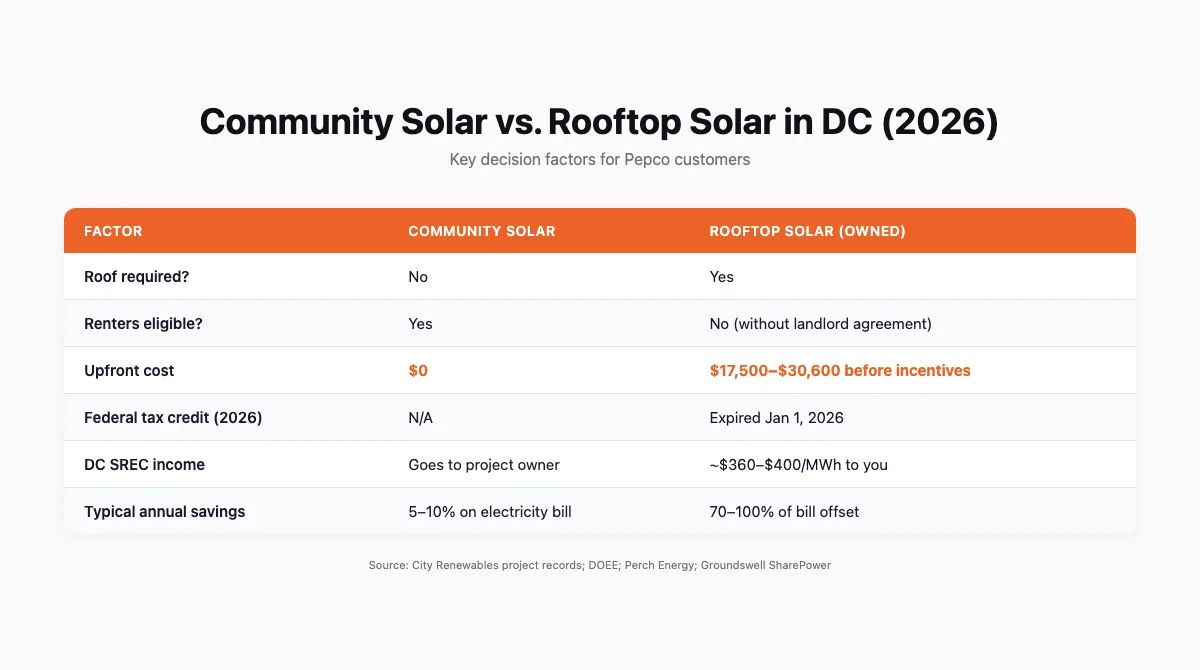
Before anything else, here is the core comparison. The right choice depends on your roof, your tenure, and how much of the economics you want to capture.
| Factor | Community Solar | Rooftop Solar (Owned) |
|---|---|---|
| Roof required? | No | Yes |
| Renters eligible? | Yes | No (without landlord agreement) |
| Upfront cost | $0 | $17,500–$30,600 before incentives |
| Federal tax credit (2026) | N/A | Expired Jan 1, 2026 |
| DC SREC income | Goes to project owner | Goes to you (~$360–$400/MWh) |
| Typical annual savings | 5–10% on electricity bill | 70–100% of electricity bill offset |
| Transferable if you move? | Cancel subscription | Stays with home (adds value) |
| Income-qualified program | Solar for All | Solar Advantage Plus (DCSEU) |
That table is the decision in compressed form. Community solar is the right starting point if you rent, if your roof is shaded or structurally complicated, or if you want zero commitment. Rooftop solar captures more of the economics — including DC SREC income and full net metering credits — if you own and your roof qualifies.
How Do DC Community Solar Programs Actually Work?
Community solar in DC works through community net metering: a solar farm generates electricity, that production is credited against the utility accounts of subscribers, and Pepco applies those credits to your monthly bill. You do not own equipment. You do not deal with permits or interconnection. You sign a subscription agreement, stay on Pepco's standard service, and see a line-item credit each month.
Perch Energy matches DC Pepco customers to local solar projects and passes through a discount on the energy produced — typically in the 5–10% range. Groundswell's SharePower operates similarly but with a flat-rate subscription model and a specific focus on community-rooted projects. Both programs have no upfront installation or maintenance costs. You can cancel if you move, though contract terms vary, so read the cancellation window before you sign.
The DC Solar for All program ↗, administered through DOEE and operated by Groundswell, is reserved for income-qualified households. Eligibility is based on income relative to the area median. Qualifying subscribers receive bill credits that go well beyond the 5–10% market-rate range — the program is designed to make solar savings meaningful for households that spend a disproportionate share of income on energy.
Who Should Choose Community Solar Over Rooftop?
Community solar is the right fit in four specific situations. First, you rent. Landlords in DC are not required to allow rooftop installations, and most won't. A community solar subscription requires nothing from your landlord — only a Pepco account in your name. Second, your roof is heavily shaded. Street trees in Ward 3 and Ward 4 are dense enough that some rooftops produce 30–40% less than an unshaded equivalent, which changes the math on a rooftop system significantly. Third, you're in a condo or co-op where the roof is common property. Fourth, you expect to move within three to five years and don't want to navigate a solar lease or loan transfer at closing.
On r/washingtondc, renters regularly ask whether solar is available to them at all — the assumption being that solar requires ownership. Community solar is the direct answer to that question.
If none of those four conditions apply to you, rooftop solar almost always captures more value. DC SRECs currently trade at roughly $360–$400/MWh, and that income flows to the system owner — not to community solar subscribers. A typical City Renewables rooftop system at 8 kW produces around 9,200 kWh per year (at 1,150 kWh per kW), which generates roughly 9.2 SRECs annually. At $380/MWh, that's approximately $3,496 per year in SREC income alone, on top of net metering credits. Community solar subscribers don't see that revenue stream. See our DC SREC guide for how that income works in practice.
What Does Community Solar Cost in DC?
Community solar subscriptions in DC have no upfront cost. You pay your normal Pepco bill, and the community solar credit reduces what you owe. The discount mechanism varies by provider: Perch Energy typically prices subscriber energy at a rate below Pepco's standard tariff, so the savings appear as a percentage reduction. SharePower uses a flat subscription fee structure.
The key number to watch is the discount rate relative to Pepco's current residential rate. Pepco's standard residential rate in 2026 runs approximately $0.16 per kWh for the energy supply component (the Standard Offer Service rate sits near 16.1¢/kWh as of mid-2026). A 10% discount on that saves a household using 700 kWh/month roughly $10–$11/month, or $120–$130/year. That is real money, but it is a fraction of what a rooftop system returns. The DC solar incentives guide covers the full stack of rooftop incentives still available in 2026 — including the DCSEU's Solar Advantage Plus program for income-qualified homeowners — now that the federal 25D tax credit has expired.
For income-qualified households, Solar for All changes the calculus entirely. The program is funded through DC's CleanEnergy DC Omnibus Amendment Act and is designed to deliver meaningful bill relief, not a marginal discount.
Does Community Solar Affect Your Pepco Account or Credit?
Community solar does not change your Pepco service agreement. You remain a standard Pepco residential customer. The solar farm's production is credited to your account through community net metering, which appears as a separate line item on your bill. You are not switching providers. You are not entering a power purchase agreement that encumbers your property.
This matters for renters specifically: a community solar subscription does not affect your lease, your landlord's property, or your security deposit. It is a billing arrangement between you and the subscription provider, settled through your existing Pepco account.
For homeowners considering a future rooftop installation, a community solar subscription does not preclude it. You can cancel the subscription when your rooftop system comes online. The two are not in conflict — though once your rooftop system is generating, the community solar credits become redundant.
What Rooftop Solar Delivers That Community Solar Cannot
Rooftop solar owned outright delivers three things community solar cannot: full net metering credits at the retail rate, DC SREC income registered in PJM-GATS, and a documented increase in property value. Every system City Renewables installs is registered in PJM-GATS from day one, and that SREC revenue is a core reason residential solar can be structured with no upfront cost for qualifying homeowners — the income stream is real and bankable.
Net metering in DC credits excess production at the full retail rate. On a well-sized 8 kW system, a DC homeowner can offset 70–100% of their annual electricity bill. That is not a 5–10% discount — it is near-elimination of the bill. And unlike a community solar subscription, the system stays with the property when you sell. Use our solar calculator to run the numbers for your address and roof size.
The federal 25D residential tax credit expired January 1, 2026, which removed a significant upfront incentive for purchased systems. But DC's own incentive stack — SRECs, net metering, Solar Advantage Plus for income-qualified homeowners, and the property tax exemption on added home value — remains intact. The rooftop economics still work; they just require a more careful look at the DC-specific numbers rather than a federal credit shortcut.
Decision Checklist: Choose Community Solar If…
Use this to settle the decision before you go further.
Choose community solar if:
- You rent and your landlord has not agreed to a rooftop installation.
- Your roof has significant shading from trees or neighboring structures that reduces production below 70% of optimal.
- You own a condo or co-op unit where the roof is common property.
- You plan to move within three years and want zero asset-transfer complexity.
- You are income-qualified and want to apply for Solar for All's deeper discounts.
Choose rooftop solar if:
- You own your home and plan to stay at least five years.
- Your roof has reasonable south, east, or west exposure with limited shading.
- You want to capture DC SREC income (currently ~$360–$400/MWh) in addition to net metering credits.
- You want to offset 70–100% of your electricity bill, not 5–10%.
- You want the system to add documented value to your property.
Consider both if:
- You own but your roof is partially shaded — a rooftop system sized to your unshaded area, supplemented by a community solar subscription for the remainder of your load, is a legitimate strategy some DC homeowners use.
FAQ
Why is it difficult to sell a house with solar panels?
Selling a home with solar panels is most complicated when the system is leased or under a power purchase agreement rather than owned outright. A solar lease is a lien-like encumbrance that transfers to the buyer — and many buyers, and their lenders, don't want to assume it. Owned systems (cash or loan, with the loan paid off or assumable) are straightforward: the system conveys with the property and adds to the appraised value. In DC, the property tax exemption on solar-added value means the buyer inherits the system's production and SREC income without a higher tax bill. The difficulty is almost always about ownership structure, not the panels themselves.
How can I increase the value of my home by $50,000?
A rooftop solar installation is one of the few home improvements with documented resale value in DC. The Lawrence Berkeley National Laboratory's research for the U.S. Department of Energy ↗ found that solar homes sell at a premium — roughly $4 per watt of installed capacity on average nationally. A 10 kW system at that rate adds approximately $40,000 in appraised value. In DC's market, where electricity rates are higher than the national average and SREC income is a real asset, the premium can reach or exceed $50,000 on larger systems. DC also exempts that added value from property taxes under the CleanEnergy DC Omnibus Amendment Act, so the gain doesn't increase your annual tax bill.
Do solar panels actually add value to your home?
Owned solar panels add value to DC homes — the evidence is consistent. The Berkeley Lab study tracked more than 22,000 solar home sales across eight states and found a persistent price premium for homes with owned systems. In DC specifically, the combination of high electricity rates, active SREC trading at $360–$400/MWh, and the property tax exemption on solar-added value makes the premium more durable than in lower-rate markets. Leased systems are a different story: appraisers typically assign little or no value to a leased system, and the lease obligation can complicate the sale.
What is the 20% rule for solar panels?
The 20% rule is an informal guideline suggesting that solar panels should not cover more than 20% of a roof's total area — but it is not a DC building code requirement or a Pepco interconnection rule. It originated as a rough structural and aesthetic heuristic. In practice, DC row houses are often sized at 4–8 kW, which covers a meaningful portion of the usable rear roof without approaching any structural limit. What actually governs system size in DC is the combination of your roof's usable square footage, shading analysis, your annual electricity consumption, and Pepco's interconnection capacity at your service address. A site-specific assessment matters more than any percentage rule of thumb.
The Bottom Line
Community solar is a real option for DC residents who can't or don't want to install rooftop panels — and Solar for All makes it genuinely valuable for income-qualified households. But if you own your home and your roof has reasonable exposure, rooftop solar captures significantly more of the economics: full net metering, DC SREC income, and a documented increase in property value that community solar subscriptions simply don't deliver.
If you want to know whether your roof qualifies and what a rooftop system would actually produce and earn at your address, start with a Green Zone assessment. It's a site-specific look at your roof capacity, shading, Pepco load, and preliminary system design — before any numbers are committed to.


