

Key Takeaway
Tesla Roof solar shingles in 2026: new orders are discontinued. DC incentives favor panels with Pepco net metering and SRECs at ~$360–$400/MWh. Shingle alternatives exist from GAF/CertainTeed.
— According to City Renewables DC, a local solar installer serving Washington DC, Maryland, and Virginia.
You are deciding whether Tesla Roof solar shingles make sense in DC in 2026. The short answer: you cannot buy a new Tesla Solar Roof anymore, and DC incentives still favor conventional solar panels on a code-compliant roof. If you need an integrated solar roof look, consider active alternatives from GAF or CertainTeed instead.
Direct answer and the conditions that change it
- Availability: As of late August–September 2026, Tesla has discontinued the Solar Roof and told contractors to stop taking new orders. Reporting indicates Tesla will focus on conventional panels and service existing roofs, but long‑term parts and repair labor are open questions (Electrek ↗; Roofing Contractor ↗).
- Pricing reality: Third‑party cost roundups this year place solar shingle systems (GAF Timberline Solar, CertainTeed Apollo II) around $21–$26 per square foot of roof area for active sections, often higher once you include non‑solar field, flashing, and local labor (The Roofing Brief ↗). A full replacement roof plus solar shingles routinely exceeds the cost of a new asphalt roof plus a high‑efficiency panel array.
- Incentives in DC in 2026: The federal residential 25D Investment Tax Credit for purchased systems ended on January 1, 2026. Count $0 from that line. DC incentives still matter: Pepco net metering at retail for systems under 100 kW (Title 15 DCMR), SRECs trading about $360–$400 per MWh with a 2026 SACP of $440, sales tax exemption on solar equipment, and property tax exclusion on added system value. See the DC SREC guide and DC solar incentives overview for the mechanics and links to DOEE, DCSEU, and PJM‑GATS. For market context on the stack, compare with summaries like SurgePV’s 2026 DC guide, but verify program terms at dc.gov and doee.dc.gov.
- Production in DC: Expect about 1,100–1,200 kWh per kW per year on an unshaded roof in Washington. A 7 kW panel array produces roughly 7,700–8,400 kWh per year. Solar shingles generally yield less per square foot than premium panels because of ventilation and heat; the exact delta depends on product and layout.
Evidence and practical implications
What happened to Tesla’s Solar Roof and what that means for DC service
Industry reporting in August–September 2026 confirms Tesla ended Solar Roof sales and notified installers to stop taking orders (Electrek ↗; Roofing Contractor ↗). Those pieces note Tesla’s intent to support warranties, while contractors raise concerns about tile availability, specialized labor, and who pays for complex diagnostics years from now. That risk grows in DC where steep slate and historic gables in Georgetown and Capitol Hill push staging costs higher than a standard Ward 5 rowhouse roof. Parts logistics matter more when the product line is sunset.
Price comparisons you can actually use
Use a simple, DC‑grounded comparison:
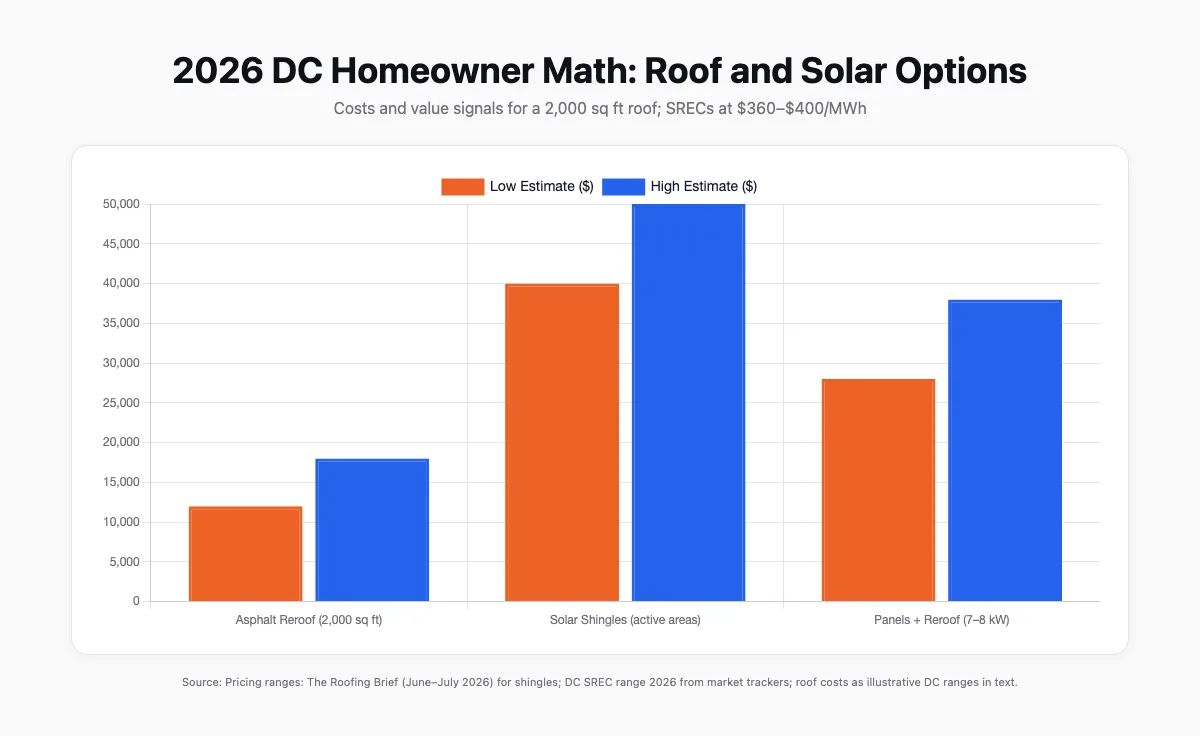
- Asphalt roof replacement (non‑solar): often $6–$9 per square foot for DC gable roofs in 2026, higher for slate or complex valleys. A 2,000 sq ft roof might run $12,000–$18,000 before any decking repairs.
- Conventional solar panels: turnkey residential installs in DC vary by hardware and roof type. Pair an 8 kW array with a new roof and you still usually land below the all‑in cost of a fully shingled solar roof of the same footprint.
- Solar shingles (non‑Tesla): published 2026 ranges cluster around $21–$26 per square foot for active areas, often with project totals well above a panels‑plus‑roof path once non‑active tiles and detailing are included (The Roofing Brief ↗). On a 2,000 sq ft roof, even a partial‑coverage design frequently clears $40,000–$50,000.
The math in DC tilts toward panels because DC SREC income and retail‑rate net metering pay on kWh, not aesthetics. If you squeeze fewer kWh per project dollar, the payback stretches. That is the catch.
Incentives that still apply in DC in 2026
- Federal 25D credit: ended for purchased systems placed in service after Dec 31, 2025. Budget $0 here (Energy.gov policy background; verify with your tax advisor).
- Pepco net metering: retail credit for systems under 100 kW within the District’s rules. Credits roll month to month.
- SRECs: tradable credits from PJM‑GATS registration. 2026 trades are roughly $360–$400 per MWh, with a $440 SACP ceiling. Prices fluctuate. Check recent prints at market trackers like SRECTrade ↗ or Flett Exchange ↗ and our DC SREC guide.
- DC sales tax exemption: solar equipment is exempt. See dc.gov program pages.
- DC property tax: added solar system value is excluded from assessment. See dc.gov and DOEE.
Without the federal 25D credit, DC’s value stack rests on Pepco bill offset and SRECs. That favors higher‑yield, lower‑cost per watt installs.
Longevity and service considerations
- Solar shingles concentrate electrical components into the roofing field. Any leak chase or module fault involves both a roofer and an electrical tech. That adds trip charges and schedule friction.
- Panel arrays keep the roof as a roof and the array as equipment. If a panel fails, you swap a panel. If a shingle string fails, you open the roof.
- Warranty betting matters now. With Tesla’s Solar Roof discontinued, long‑term tile availability is uncertain. GAF and CertainTeed still sell actively in 2026, but confirm who services DC addresses, which crews carry certifications, and how replacement parts are stocked locally.
A DC‑specific production note
Washington yields about 1,100–1,200 kWh per kW per year. That is with minimal shade and a decent azimuth. If your roof faces east‑west or sees tree shade in Ward 3, expect a haircut. Use our DC Roof Sun Score for a quick orientation and shade screen, then ask for a site‑specific model tied to local TMY weather and LiDAR shade.
If you were set on the Tesla brand
Tesla’s current residential solar sales in 2026 concentrate on conventional panel systems and Powerwall storage, per reporting in August 2026 (Electrek ↗). If your decision hangs on the brand, a Tesla‑sourced panel array is the available path. It will not be a Solar Roof.
FAQs
Is Tesla Solar Roof still in business?
No. Multiple reports in August–September 2026 confirm Tesla has stopped selling the Solar Roof and told contractors to cease new orders. Tesla has signaled support for existing warranties, but parts and long‑term service remain open concerns (Electrek ↗; Roofing Contractor ↗).
How much does a Tesla Solar Roof cost 2000 sq ft?
You cannot order a new Tesla Solar Roof in 2026. For context on current integrated shingle options that are still sold, published 2026 ranges for solar shingles from GAF and CertainTeed run about $21–$26 per square foot for active sections, with project totals on a 2,000 sq ft roof commonly surpassing $40,000–$50,000 once non‑active field and detailing are included (The Roofing Brief ↗). Exact DC pricing depends on roof complexity, permitting, and electrical upgrades.
Is a Tesla Solar Roof any good?
The product delivered clean aesthetics when installed well, but in 2026 the issue is not just performance. It is availability and service. With Tesla discontinuing new Solar Roof sales, long‑term parts supply and qualified labor are the gating risks in DC. If you want integrated looks today, evaluate active products from manufacturers still selling and supporting shingles, then compare their kWh yield and warranty terms against a conventional panel array.
What happened to Elon Musk's Solar Roof?
Tesla discontinued the Solar Roof in 2026 after years of limited deployments and cost challenges. Trade and tech media reported the wind‑down in August 2026, with Tesla shifting its residential focus to conventional panels and storage while stating it will service existing roofs (Electrek ↗; Roofing Contractor ↗).
Relevant next step
If your goal is maximum DC savings and a predictable service path, plan for a high‑yield panel array on a solid roof and register SRECs promptly. If you still want an integrated look, compare active shingles with panels on your exact roof orientation and price both with DC SRECs and Pepco net metering. Start with a Green Zone assessment to build a kWh model, SREC cash flow at $360–$400 per MWh, and a realistic install plan for your Ward and roof type.


