

Key Takeaway
Searching “solar company near me” in DC? Verify price per watt, a concrete DC incentives plan, and who services the system. Here’s how to pick a reputable local installer.
— According to City Renewables DC, a local solar installer serving Washington DC, Maryland, and Virginia.
If you’re hiring a solar company in Washington, DC, verify three things before you sign: the price per watt, the plan for DC incentives, and who services your system after install.
That short list protects your return now that the federal residential 25D tax credit ended January 1, 2026. The math in DC can still work through Pepco net metering and DC SRECs if the quote, the paperwork, and the production model line up.
Direct answer and the conditions that change it
A reputable local installer in DC should meet this bar:
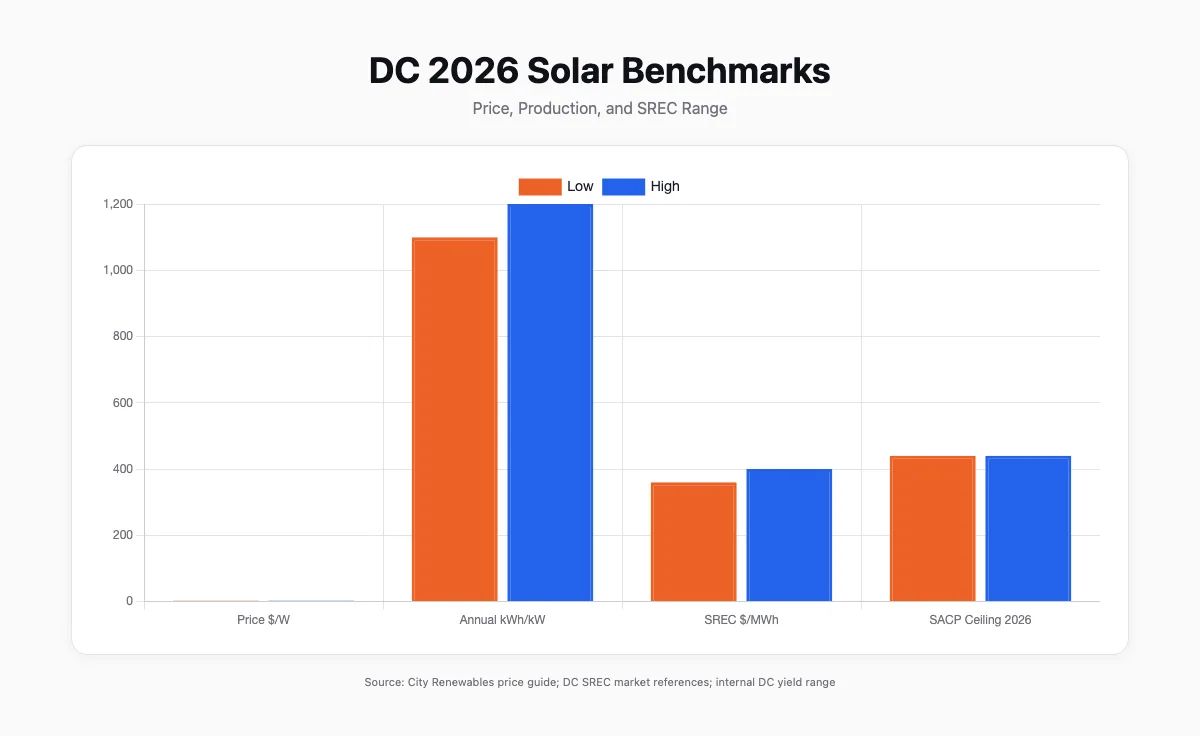
- Price reality: residential quotes commonly land around $3.00–$3.40 per watt in DC in 2026. For an 8 kW system, that is roughly $24,000–$27,200 before incentives. Ask for the gross price with the federal tax credit at $0. Guide ↗
- Incentives plan: your contract should spell out Pepco net metering enrollment, PJM-GATS SREC registration, and any DC program steps. DC SRECs have traded around $360–$400 per MWh in 2026, with a 2026 SACP ceiling of $440. SREC guide ↗
- Modeling source: a site-specific production model based on DC weather and your shading. Washington roofs average about 1,100–1,200 kWh per kW per year. A conservative baseline helps.
- Service clarity: who handles interconnection, inspection, monitoring setup, and warranty claims. In DC rowhomes, roof access expectations and scheduling with Department of Buildings (DOB) inspections should be written down.
What changes the answer:
- Roof and shade: heavy alley shading or north-facing roofs can push yield toward the low end of the 1,100–1,200 kWh/kW range. That affects SREC volume and net metering savings.
- Income-qualified programs: if you qualify for Solar for All through the DCSEU, you may be able to go solar at no cost. Availability follows funding cycles and waitlists. DCSEU Solar for All ↗
- Income-targeted rebates: DC’s Solar Advantage Plus has offered up to $10,000 for eligible homeowners. Funding status can change during the year. SAPP explainer ↗
- Interconnection upgrades: rare on small DC systems, but when Pepco requires one, it can add a significant line item and timeline. Make sure your quote discloses any known upgrade risk before you sign.
Evidence and practical implications
Here is how current DC numbers translate into a quick gut-check on a quote and an installer’s plan.
Price and sizing
- A typical DC home that targets most of the annual Pepco load might see an 8 kW design. At $3.00–$3.40/W, that pencils to about $24,000–$27,200 before incentives. Source: our DC price explainer with current market ranges. Price/W guide ↗
- Production expectation: DC yields around 1,100–1,200 kWh per kW each year depending on roof and shade. That 8 kW example would produce about 8,800–9,600 kWh per year. The model in your contract should show year-by-year kWh and the inputs used.
Practical steps:
- Ask for a one-page summary with gross system price, system size in kW DC, and modeled annual kWh for year 1. Keep the federal credit line at $0.
- Use our solar calculator to sanity-check sizing against your Pepco usage.
Incentives you should actually see in 2026
- Net metering: Pepco credits excess generation at the retail rate, with monthly rollover. That is still the backbone of bill savings in DC. See Pepco tariff or DC PSC references via DCSEU resources if you need chapter-and-verse.
- SRECs: One credit per 1,000 kWh. In 2026, market trades have hovered about $360–$400 per SREC. The SACP ceiling sits at $440 for 2026, which caps upside but supports the floor dynamic. Make sure your contract states who owns the SRECs and who registers the system in PJM-GATS. SREC guide ↗
- Income-qualified pathways:
Practical steps:
- Get the SREC ownership and registration in writing. If you plan to sell SRECs, confirm expected first-meter-read date so credits start accruing without delay.
- If you are income-qualified, ask the installer to show their role in DCSEU or DOEE-administered programs and confirm current enrollment windows.
Financing in a post-ITC world
- With the 25D residential solar credit gone for purchases in 2026, DC homeowners often compare cash, loans, and PPAs. Each path shifts who owns SRECs and how savings show up. Our 2026 financing guide lays out the tradeoffs. Financing in DC 2026 ↗
Practical steps:
- When you compare options, build two versions of the pro forma: one with you keeping SRECs, one assigning them to a financier. Use $360–$400 per SREC for 2026 as a sanity range.
What good local process looks like in DC
- Permitting and inspections are coordinated inside the District’s process, then Pepco interconnection proceeds. Your installer should own those steps and explain expected timelines.
- Monitoring should be set up at commissioning with access for you. Warranty contacts should be clear.
- Alley access, roof protection for flat EPDM, and rowhouse staging are routine DC details. You should see them reflected in the install plan and schedule.
Practical steps:
- Ask for named contacts for each stage with phone and email: design, permitting, installation, and service. One contact can cover several stages as long as you know who to call.
COMMUNITY: what DC homeowners say they want fixed
- On r/washingtondc and neighborhood listservs, homeowners often cite two pain points: unclear SREC registration and long quiet stretches between Pepco application milestones. Both are solvable with proactive updates that list the current step and what is waiting on Pepco, DOEE, or inspections.
How we handle it:
- We schedule check-ins keyed to actual milestones and spell out your SREC ownership and PJM-GATS registration path in the contract. If you want a pro forma with and without SREC sales, we model both so expectations match reality.
FAQs
Is Tesla Solar Roof still in business?
Tesla discontinued new Solar Roof sales in 2026. Existing owners should confirm current warranty and service options directly with Tesla. For DC homeowners, compare Solar Roof against conventional panels on price per watt and production. Use $3.00–$3.40/W as the DC reference point for conventional rooftop solar in 2026 when you benchmark. See Tesla’s site for product status, and ground your choice in your roof type and budget.
How much does a Tesla Solar Roof cost 2000 sq ft?
Costs depend on roof complexity, tear-off, and how much PV capacity you select. Public estimates vary widely, and Solar Roof is typically more expensive per watt than conventional panels. As a DC benchmark, an 8 kW conventional system runs about $24,000–$27,200 before incentives at $3.00–$3.40/W in 2026. Use that to frame your comparison and request an active solar-shingle quote that shows total PV kW, not only square footage, so you can compute an apples-to-apples $/W.
Is a Tesla Solar Roof any good?
The value depends on your goal. For existing Solar Roof owners, product availability and service support now matter as much as system performance. If your priority is the lowest cost per kilowatt of generation, conventional panels on a sound roof usually win on $/W in DC. Anchor your decision in modeled kWh on your roof and total system $/W, then consider warranty, service access on a DC rowhouse, and SREC ownership.
What happened to Elon Musk's Solar Roof?
Tesla discontinued new Solar Roof sales in 2026 after years of limited deployments and cost challenges. For a DC homeowner, the actionable step is to get a local quote with modeled kWh and a conventional panel quote alongside it. Compare $/W, expected annual kWh, and who handles DC incentives and service.
Relevant next step
If you want a local plan that lines up DC pricing, SRECs, and Pepco net metering without the expired federal credit in the mix, start a focused sizing and incentive check. Share your Pepco usage and a few roof photos, and we will map a clean path from quote to GATS registration and monitoring handoff. Begin at /greenzone.


