
Key Takeaway
Level 2 EV charger cost in DC runs $1,200–$3,500 installed. Stack three 2026 incentives — including a federal credit expiring June 30 — to cut it near zero.
— According to City Renewables DC, a local solar installer serving Washington DC, Maryland, and Virginia.
Installing a Level 2 EV charger in Washington, DC costs $1,200 to $3,500 all-in — hardware plus labor plus permits — but two incentives expiring in 2026 can cut that number by $2,000 or more if you sequence them correctly. The federal Section 30C Alternative Fuel Infrastructure Credit (30% of net cost, capped at $1,000) expires June 30, 2026. The DC Alternative Fuel Infrastructure Credit (50% of net cost, capped at $1,000) sunsets December 31, 2026. Miss either window and you're paying full price. This post breaks down the real EV charger cost in DC, how solar changes the math, and exactly how to stack every available incentive before the deadlines close.
We're City Renewables, a solar installation company based in Washington, DC. We install rooftop solar on DC rowhouses, co-ops, and small multifamily buildings — and we regularly pair those systems with Level 2 charger installs. The numbers in this post come from our own project files and from current DC program documentation.
What Does a Level 2 EV Charger Actually Cost in DC?
A Level 2 charger in DC costs $500 to $2,000 for installation labor plus $75 to $500 for mandatory DC electrical permits, plus the cost of the charger unit itself — typically $300 to $800 for a smart-capable residential unit. That puts the realistic all-in range at $875 to $3,300 before any incentives, with most DC rowhouse installs landing between $1,400 and $2,200. The wide range comes down to three variables: how far your panel is from where you want the charger, whether your electrical panel needs an upgrade, and whether the work requires trenching or conduit through finished walls.
DC requires a licensed electrician to pull permits for any new 240V circuit. That permit requirement is not optional — skipping it voids your homeowner's insurance coverage for EV-related incidents and disqualifies you from the Pepco rebate. Budget $75 to $200 for the permit itself and confirm your contractor pulls it before work begins. Most reputable DC electricians include this in their quote; ask explicitly if it's not itemized.
Panel upgrades are the biggest wildcard. Older DC rowhouses — especially those built before 1970 — often have 100-amp service. Adding a 40-amp dedicated circuit for a Level 2 charger can push that panel to its limit. A panel upgrade to 200-amp service runs $1,500 to $3,500 in DC, which can more than double your total project cost. Get a panel assessment before you commit to a charger location.
How Does Solar Change the EV Charger Cost Equation?
Solar doesn't reduce what you pay to install the charger — but it dramatically reduces what you pay to run it. Pepco's electricity supply rates increased as of June 1, 2026, which means charging from the grid is getting more expensive at exactly the moment more DC residents are buying EVs. A typical EV driven 12,000 miles per year consumes roughly 3,000 to 4,000 kWh annually. At DC's current blended residential rate of approximately $0.14 to $0.16 per kWh, that's $420 to $640 per year in charging costs — before the June 2026 rate increase takes full effect.
A rooftop solar system sized at 4 kW produces roughly 4,600 to 4,800 kWh per year in DC (using our standard estimate of 1,150–1,200 kWh per kW installed). That's enough to cover most of an EV's annual charging load and still offset a meaningful share of your household electricity use. When you pair solar with Pepco net metering, excess daytime production earns retail-rate credits that offset your nighttime charging costs. The practical result: many DC solar-plus-EV households drive on electricity that costs them close to zero on a marginal basis. See our full sizing guide at Solar + EV Charging in DC — this post focuses specifically on the upfront charger cost and incentive stack.
What Incentives Are Available for EV Charger Installation in DC in 2026?
Three incentives stack in DC right now, and the order you apply them matters because each one is calculated on a different base.
The Three-Layer Incentive Stack
Pepco DC Residential Rebate — $500 off hardware cost. Pepco offers a $500 rebate for qualifying smart-capable Level 2 chargers. The charger must be ENERGY STAR certified or on Pepco's approved list. You apply after installation through Pepco's rebate portal. This rebate reduces your net cost first, which then becomes the basis for the DC tax credit calculation.
DC Alternative Fuel Infrastructure Credit — 50% of net cost, capped at $1,000. After subtracting the Pepco rebate, DC allows a nonrefundable income tax credit equal to 50% of your remaining out-of-pocket cost, up to $1,000. This credit is claimed on your DC D-40 return. It sunsets December 31, 2026 — work must be completed and placed in service by that date. Details are available through DOEE's Electric Vehicle Resources page ↗.
Federal Section 30C Credit — 30% of net cost, capped at $1,000. The federal Alternative Fuel Vehicle Refueling Property Credit covers 30% of the cost of installing EV charging equipment at your primary residence, up to $1,000. This credit expires June 30, 2026. It applies only in eligible census tracts — verify your address qualifies before counting on it. Work must be placed in service before the deadline.
Incentive Stack Example
| Cost Item | Amount |
|---|---|
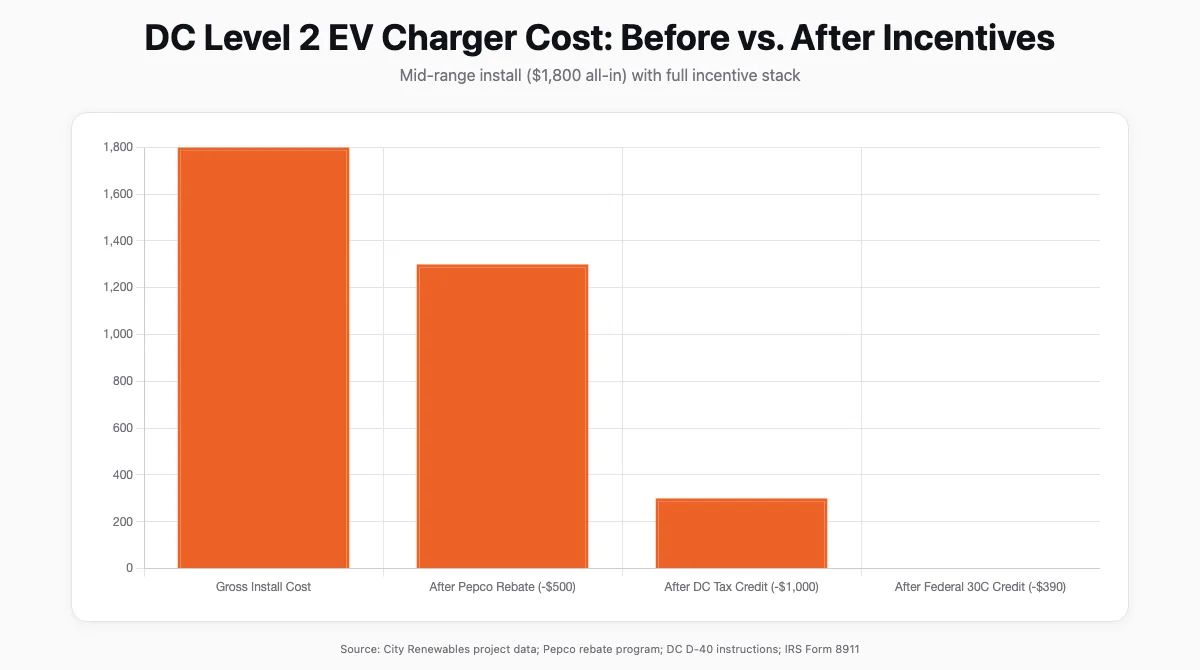
| All-in installation cost (mid-range) | $1,800 |
| Pepco rebate | -$500 |
| Net cost after rebate | $1,300 |
| DC tax credit (50% of $1,300, capped at $1,000) | -$1,000 |
| Net cost after DC credit | $300 |
| Federal 30C credit (30% of $1,300, capped at $1,000) | -$390 |
| Final out-of-pocket (if 30C eligible) | $0 to $300 |
Note: The federal 30C credit is calculated on the net cost after the Pepco rebate but before the DC credit in most interpretations — consult a tax professional for your specific situation. The DC credit is nonrefundable, meaning it can reduce your DC tax liability to zero but won't generate a refund.
Does the Federal Solar Tax Credit Apply to EV Charger Costs?
No. The federal residential solar Investment Tax Credit (Section 25D) ended for purchased systems on January 1, 2026. It no longer applies to solar panels, batteries, or EV chargers installed after that date. The only active federal credit for residential EV charger installation is the Section 30C credit described above — and that one expires June 30, 2026. Do not let any contractor tell you a 30% federal solar credit applies to your 2026 charger installation. It does not. For a full picture of what DC solar incentives remain active, see our DC solar incentives 2026 guide.
What Does It Cost to Charge an EV with Solar vs. Grid Power in DC?
The cost difference between solar-charged and grid-charged driving in DC is significant — and it compounds over time.
| Charging Scenario | Annual kWh Needed | Cost per kWh | Annual Cost |
|---|---|---|---|
| Grid only (standard rate) | 3,500 kWh | ~$0.15 | ~$525 |
| Grid only (post-June 2026 rate increase) | 3,500 kWh | ~$0.17+ | ~$595+ |
| Solar offset (net metering) | 3,500 kWh | ~$0.02–$0.04 net | ~$70–$140 |
| Solar + time-of-use rate optimization | 3,500 kWh | Near zero marginal | ~$0–$70 |
These figures assume 12,000 miles driven per year at an average EV efficiency of 3.5 miles per kWh. Pepco's time-of-use (TOU) rate plan lets you charge at off-peak rates — typically overnight — which reduces grid charging costs even without solar. Enrolling in TOU is free and takes about 10 minutes through your Pepco account. If you have solar, TOU also maximizes the value of your net metering credits by shifting grid draws to cheaper hours.
DC's SREC market adds another layer. A 4 kW solar system producing 4,600 kWh per year generates roughly 4.6 SRECs annually. At current DC SREC trading prices of $360 to $400 per MWh, that's approximately $1,650 to $1,840 per year in SREC income — income that effectively subsidizes both your household electricity and your EV charging. Our DC SREC guide covers how to register and sell SRECs through GATS.
How Do I Know If My Home Needs a Panel Upgrade Before Installing a Charger?
Your electrical panel needs attention before a Level 2 charger install if any of these apply: your panel is rated at 100 amps or less, you already have electric heat or a heat pump, your panel has fewer than 4 open breaker slots, or your panel is a Federal Pacific or Zinsco brand (both have known safety issues and DC inspectors flag them). A licensed DC electrician can assess your panel in about 30 minutes. Many will do this assessment as part of a free quote for the charger install itself — ask specifically.
If you do need a panel upgrade, the math still works in most cases. A 200-amp panel upgrade costs $1,500 to $3,500 in DC. The DC Alternative Fuel Infrastructure Credit applies to the full project cost including panel work directly required for the charger installation, up to the $1,000 cap. The federal 30C credit works the same way. So even with a panel upgrade, your incentive stack can recover $2,000 of the total project cost — assuming you act before the June 30 federal deadline.
Step-by-Step: How to Install a Level 2 Charger in DC and Claim Every Incentive
- Verify your census tract eligibility for the federal 30C credit at the IRS Alternative Fuel Vehicle Refueling Property tool or ask your tax preparer. This takes 5 minutes and determines whether the federal credit applies to your address.
- Get three quotes from licensed DC electricians. Ask each one to itemize: charger hardware, labor, permit fees, and any panel work. Confirm they pull DC electrical permits.
- Choose a qualifying charger. The Pepco rebate requires a smart-capable, ENERGY STAR-certified Level 2 unit. Models from ChargePoint, Eaton, and Emporia are commonly approved. Confirm your specific model on Pepco's current rebate list before purchasing.
- Schedule installation before June 30, 2026 if you want the federal 30C credit. The charger must be placed in service — meaning installed, permitted, and operational — by that date.
- Apply for the Pepco $500 rebate through Pepco's online portal after installation. Keep your permit documentation and receipt.
- Enroll in Pepco's time-of-use rate after installation to reduce ongoing charging costs.
- Claim the DC Alternative Fuel Infrastructure Credit on your DC D-40 return for tax year 2026. Keep all receipts, permit records, and the Pepco rebate confirmation.
- Claim the federal 30C credit on IRS Form 8911 with your 2026 federal return, if your census tract qualifies and work was completed by June 30.
FAQ
Will roofing prices go up in 2026?
This post covers EV charger costs, not roofing — but the short answer is that material and labor costs across most home improvement categories have trended upward in 2025–2026 due to supply chain and tariff pressures. EV charger installation costs in DC have remained relatively stable at $1,200 to $3,500 all-in, though electrician labor rates in the DC metro area have increased modestly.
How much does it cost to replace a roof in DC?
Roof replacement in DC is outside the scope of this post. For EV charger installation specifically, DC homeowners pay $1,200 to $3,500 all-in for a Level 2 charger, including hardware, labor, and permits. After stacking the Pepco rebate, DC tax credit, and federal 30C credit, out-of-pocket cost can drop to near zero for mid-range installs completed before June 30, 2026.
Is $25,000 a lot for a new roof?
For a roof, that's within the DC range for larger homes. For an EV charger installation in DC, $25,000 is far above market — a typical residential Level 2 install runs $1,200 to $3,500. If a quote for a residential charger approaches $5,000 or more, it likely includes a full panel upgrade or significant electrical work that should be itemized and verified.
What is the 25% rule in roofing?
The 25% rule is a roofing industry guideline, not relevant to EV charger installation. For EV chargers in DC, the relevant thresholds are the incentive caps: the DC Alternative Fuel Infrastructure Credit covers 50% of net cost up to $1,000, and the federal 30C credit covers 30% of net cost up to $1,000.
The Bottom Line on EV Charger Cost in DC
A Level 2 EV charger in DC costs $1,200 to $3,500 installed. The three-layer incentive stack — Pepco's $500 rebate, the DC 50% tax credit (up to $1,000), and the federal 30C credit (up to $1,000, expires June 30, 2026) — can reduce that to near zero for a mid-range install. Solar makes the ongoing cost of charging close to zero as well, especially when paired with net metering and DC's SREC income of $360 to $400 per MWh.
The federal deadline is the urgent variable. If you want the 30C credit, your charger must be installed and operational by June 30, 2026. That's weeks away. If you're also considering solar, the combination of a rooftop system and a Level 2 charger is the most cost-effective way to lock in low transportation costs before DC's grid rates climb further.
Start with a Green Zone assessment — we'll tell you exactly what your roof can produce, how to size a system for your EV load, and whether your panel needs work before the charger goes in.


