

Key Takeaway
Petworth and Brightwood are two of DC's best neighborhoods for rooftop solar — mostly outside historic districts, good south-facing rear roofs, and a history of community group buys. Here's the 2026 guide.
— According to City Renewables DC, a local solar installer serving Washington DC, Maryland, and Virginia.
Thirty-five Petworth homeowners went solar together in one group purchase — and each of them got a price no individual negotiation could have matched.
That's the short version of what happens when a neighborhood with tight row houses, south-facing rear roofs, and high Pepco bills decides to move. Petworth and Brightwood are two of the best-positioned neighborhoods in DC for rooftop solar — and outside of the historic overlays that slow down Capitol Hill and Georgetown, most homes here install with a standard permit, no historic review board.
Here's what you need to know before you get a quote.
Why Petworth and Brightwood Work Well for Solar
Ward 4 has a few things going for it that other DC neighborhoods don't.
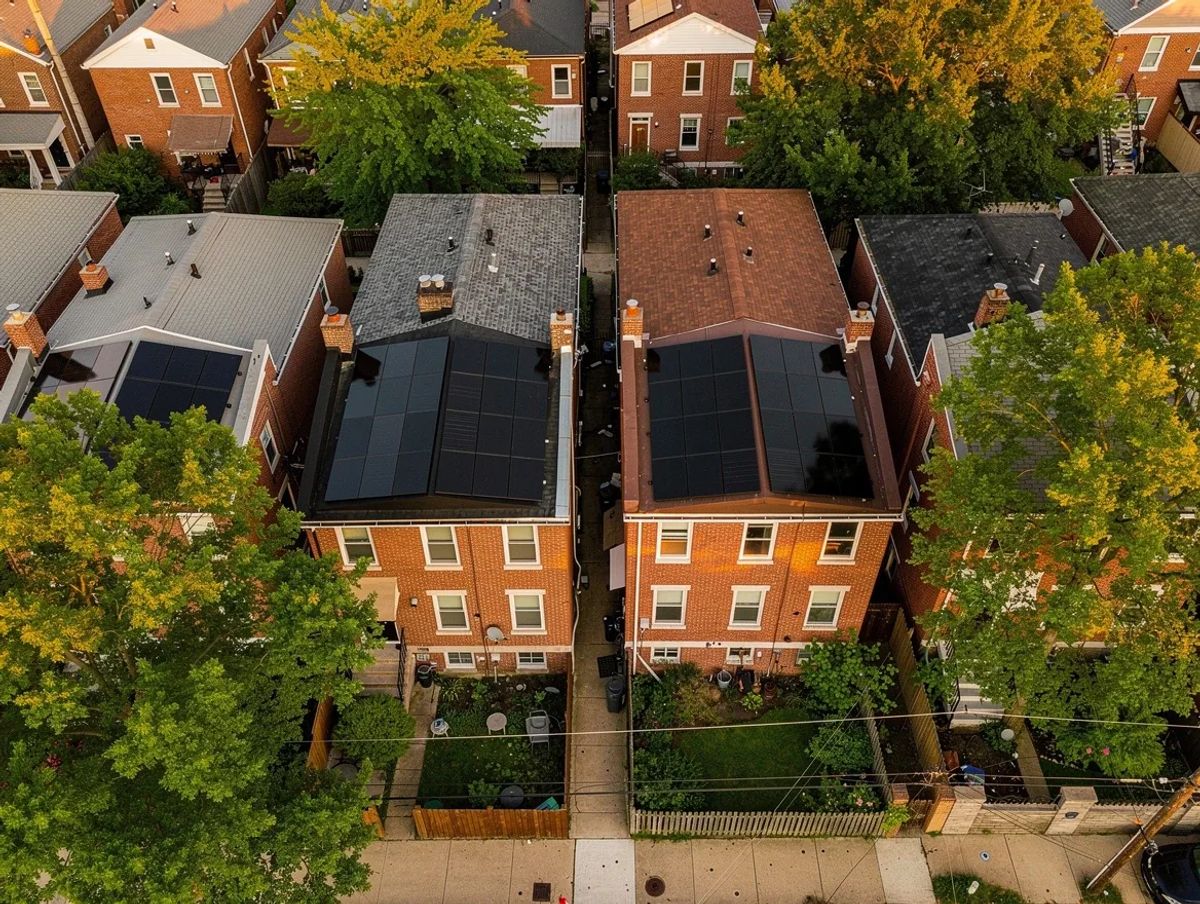
Roof orientation. Petworth and Brightwood are built on a grid rotated roughly 20 degrees from north-south. That means many rear roofs face southeast to southwest — directly into DC's solar window. You don't need a perfectly south-facing roof for solar to work. Anything within 45 degrees of south produces 90%+ of maximum output in DC's climate.
Roof space. Unlike Capitol Hill's narrow Federal-style row houses, Brightwood has a higher concentration of detached and semi-detached homes with larger, less-shaded roofs. Even standard Petworth row houses typically have enough rear slope to mount 12–20 panels — enough for a 5–8 kW system that offsets 80–100% of an average electric bill.
No historic review for most homes. Most of Petworth and Brightwood sits outside DC's historic district overlay. Standard solar installation goes through DCRA's normal permit process — roughly 4–6 weeks, no Historic Preservation Review Board appearance required. If you're in the small strip along upper Georgia Avenue that is overlay-designated, your installer will flag it. For most Ward 4 homeowners, it's a non-issue.
Electricity costs. Petworth and Brightwood homeowners pay Pepco's standard residential rate — the same rate that's increased in every rate case for the past decade. In 2026, the average DC residential customer pays over $160/month. A solar system offsets that directly.
The Numbers for a Typical Petworth Home
Every home is different. But here's a realistic range for a typical 3-bedroom Petworth or Brightwood row house:
| Item | Range |
|---|---|
| Annual electricity use | 8,000–10,000 kWh |
| System size | 6–9 kW |
| Panels | 15–23 panels |
| Pre-incentive cost | $22,000–$33,000 |
| Federal tax credit (30%) | –$6,600–$9,900 |
| SAPP rebate | up to –$10,000 |
| Net cost after incentives | ~$6,000–$17,000 |
| Payback period | 5–8 years |
| 25-year savings | $40,000–$70,000 |
Costs as of early 2026. SAPP availability subject to program funding. Federal 30% credit through 2034.
The SAPP (Solar Advantage Plus Program) rebate is the biggest variable here. It's income-tiered and project-specific — your installer will confirm eligibility and apply on your behalf. At maximum ($10,000), it cuts the net cost dramatically.
For a deeper breakdown of how DC's incentive stack works, see our DC Solar Incentives guide.
The One Thing That Catches Ward 4 Homeowners Off Guard
About 40% of Petworth and Brightwood homes still have 100-amp electrical service — and that's the detail that blindsides most Ward 4 homeowners mid-project. A modern solar system with 6–9 kW of panels and a home battery requires 200-amp service; if you're adding an EV charger too, you need 200 amps full stop. The upgrade — called a heavy-up — costs $3,000–$5,000 and adds 2–4 weeks to your timeline, plus a separate permit and PEPCO approval. The good news is that the DCSEU offers a rebate of $400–$2,000 for panel upgrades when combined with an electrification project, and your installer can bundle the paperwork. Ask every solar company you quote with: Does my current panel support this system? If they don't check your service capacity during the first site visit, find someone else.
Is Your Home Solar for All Eligible?
Ward 4 has one of the highest concentrations of Solar for All-eligible households in DC, making it worth checking before you spend a dollar on solar. Solar for All covers free panels, free installation, and free monitoring through 2032 for income-qualified homeowners and renters — the threshold is 80% of DC's Area Median Income (AMI), which for a family of four is roughly $107,000 in 2026. As of spring 2026, the single-family rooftop program is on a waitlist — FY2026 funding (through September 30) is limited — but apply now anyway, because waitlist applicants are contacted as funding opens and being on the list costs nothing. Apply at dcseu.com/ahep-sfa-apply ↗ or call (888) 586-3343. If you're above the income threshold, the standard incentive stack — 30% federal tax credit, SAPP rebate, SRECs, net metering — still delivers a 5–8 year payback for most Ward 4 homes.
SRECs: The Ongoing Income You Don't Hear About Enough
A typical 7 kW system in Petworth generates $2,400–$4,050 per year in SREC income on top of Pepco bill savings — income most homeowners don't hear about until after they've already signed a contract. Once your system is installed and interconnected with Pepco, every 1,000 kWh it produces generates one Solar Renewable Energy Credit (SREC). A 7 kW system produces 8,000–9,000 kWh per year, yielding 8–9 SRECs annually; DC SREC prices have ranged from $300–$450 per credit in recent years. This income isn't speculative: DC has a binding renewable portfolio standard that requires utilities to purchase a set percentage of SRECs each year or pay compliance fees, which keeps the DC SREC market one of the most reliable in the country. For current price tracking, see SRECTrade ↗ or ask your installer to include SREC brokerage in their proposal. For a deeper look, read our DC SREC guide.
What Petworth's Group Solar Buys Actually Showed
In the 2010s, DC Solar United Neighbors ran multiple group buys in Ward 4. The Petworth cohort — 35+ homeowners organized by resident Ross Margulies — achieved bulk pricing that individual quotes couldn't match. They also got coordinated site visits, a shared installer reference, and peer support through the permitting process.
DC Solar United Neighbors still runs co-op programs. If you want to go that route, sign up at solarunitedneighbors.org ↗ and watch for Ward 4 programs. We also offer free consultations for homeowners evaluating multiple quotes — book a time at cityrenewables.com/booking.
Timeline: Petworth Solar Start to Finish
Here's a realistic project timeline for a standard Petworth or Brightwood installation in 2026:
| Phase | Timeline |
|---|---|
| Site assessment + quote | 1–2 weeks |
| Contract + incentive applications | 1 week |
| Permit submission (DCRA) | 1–3 weeks |
| Pepco interconnection application | Concurrent with DCRA |
| Installation (1–2 day job) | 1–2 days |
| Pepco inspection + Permission to Operate | 2–6 weeks |
| Total: quote to live system | 2–4 months |
The new DC GRID Act (passed February 2026) is designed to speed up Pepco's interconnection review. In practice, installers working with Pepco's online portal are seeing approvals in the shorter end of that range.
For a full walkthrough of the permitting process, read our Pepco Approval Process guide.
Frequently Asked Questions
Does my Petworth row house need a historic review?
Most homes in Petworth and Brightwood do not. Only a small portion of Ward 4 falls within a historic district overlay. Your installer will verify during the site assessment. The DC GRID Act and the 2024 Resilient Properties Act have also streamlined historic review for solar — flush-mounted panels can now be approved administratively without a full HPRB hearing.
How many solar panels fit on a Petworth row house?
Typically 12–20 panels on the rear slope, depending on roof size and shading. If you have a detached garage with a south-facing roof, that adds more surface area. We design every system using satellite imagery and shading analysis before making any size recommendation.
Can I go solar if I'm renting part of my home?
Yes. If you own the property and occupy any portion of it, you qualify for all DC homeowner incentives. Rental income doesn't affect eligibility.
Is my block already full of solar installations?
No. Even on blocks where several homes have gone solar, the systems are sized per home and connect to the grid independently. Your neighbor's solar installation has no effect on yours.
What's the difference between Solar for All and SAPP?
Solar for All is free solar for income-qualified residents (80% AMI and below). SAPP is a rebate program (up to $10,000) for homeowners who purchase a system — regardless of income. The two programs cannot be combined, but if you're eligible for Solar for All, that's the better deal.
The Bottom Line
Petworth and Brightwood are straightforward markets for solar — good roofs, minimal historic constraints, solid incentive stack, and real community history of organized group purchases.
The variables that trip up Ward 4 homeowners are electrical service capacity (get that checked on day one) and Solar for All waitlist timing (apply now, even if you're not sure you qualify).
Find out how much your system would cost with our GreenZone tool — enter your address, get numbers in 60 seconds. Or book a consultation and we'll walk through it with you.


