

Key Takeaway
Pepco's interconnection review averages ~77 days. Here's the full DC solar utility interconnection timeline, why delays happen, and what your installer should be doing about it.
— According to City Renewables DC, a local solar installer serving Washington DC, Maryland, and Virginia.
Most DC homeowners who go solar expect to be generating power within a few weeks of installation. The reality: Pepco's interconnection review has historically averaged around 77 days, and that clock doesn't start until your installer submits a complete application. Add the Department of Buildings permit (3–6 weeks), and the solar utility interconnection timeline from signed contract to live system routinely runs 4–6 months. That gap is where most of the frustration in this industry lives — not in the panels, not in the financing, but in the weeks of silence between installation and the moment your meter actually runs backward.
City Renewables installs residential solar in Washington, DC. We pull permits, manage Pepco coordination, and handle net metering enrollment on every project we do. This post draws on that direct experience, plus the DC Public Service Commission's active proceedings in Formal Case No. 1050, which is reshaping how Pepco processes interconnection applications right now.
Why Does the Interconnection Process Take So Long?
Pepco must review every new solar system before it can export power to the grid. That review — called an Authorization to Install (ATI) followed by an Authorization to Operate (ATO) — involves engineering analysis of your local distribution circuit, confirmation that your inverter meets IEEE 1547 standards, and coordination with the DC Department of Buildings on permit status. None of that is bureaucratic padding. A system that exports power without proper review can create voltage and safety issues for neighboring properties. The process exists for real reasons.
But the volume of applications has grown faster than Pepco's review capacity. In November 2025, the DC Public Service Commission issued Order No. 22312 ↗, creating a Temporary Conditional Interconnection Program (TCIP) specifically to address the backlog. The Commission authorized Pepco to add temporary engineering staff and to begin distribution system upgrade work concurrently with permitting — a significant procedural change. The DOEE and DC Public Service Commission are both on record that interconnection speed is a constraint on the District's clean energy targets under the CleanEnergy DC Omnibus Amendment Act. Reform is underway, but it hasn't eliminated the wait.
What Does the Full Timeline Actually Look Like?
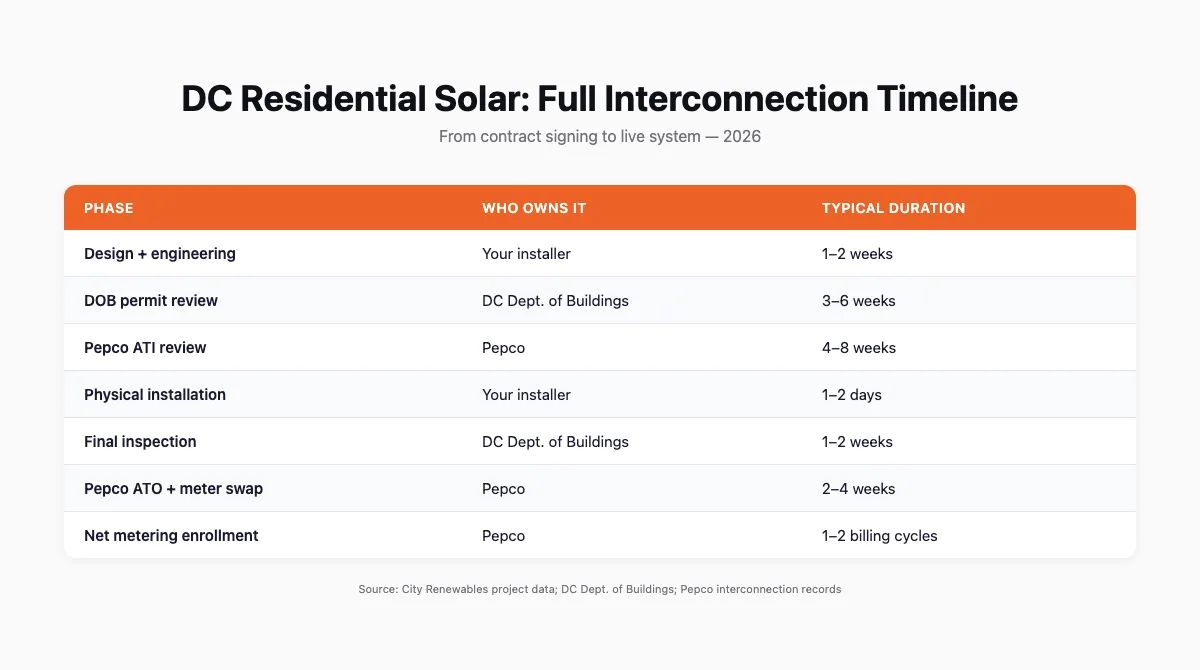
Here is a realistic sequence for a DC residential solar project in 2026:
- Design and engineering — 1–2 weeks after contract signing. Your installer produces single-line diagrams, load calculations, and a site plan.
- Department of Buildings permit application — Submitted electronically. Review typically takes 3–6 weeks. Your installer must hold a DC master electrician license to pull this permit.
- Pepco interconnection application — Submitted in parallel with or immediately after the DOB application. Pepco's historical average review time is approximately 77 days. The ATI (Authorization to Install) comes first and allows physical installation to proceed.
- Physical installation — 1–2 days of rooftop work, once ATI is in hand.
- Final inspection — DC Department of Buildings inspects the completed system. Scheduling can add 1–2 weeks.
- Pepco ATO (Authorization to Operate) — Pepco issues the ATO after confirming the inspection passed and the meter is ready. This is the step that allows you to turn the system on.
- Net metering enrollment — Pepco enrolls your account in net metering under DC's rules (Title 15, Chapter 9 of the DC Municipal Regulations ↗). Your billing switches to net metering on the next cycle.
Total realistic range: 14–22 weeks from contract to live system. Build 60–90 days into your plan for the utility process alone.
| Phase | Who Owns It | Typical Duration |
|---|---|---|
| Design + engineering | Your installer | 1–2 weeks |
| DOB permit review | DC Dept. of Buildings | 3–6 weeks |
| Pepco ATI review | Pepco | 4–8 weeks |
| Physical installation | Your installer | 1–2 days |
| Final inspection | DC Dept. of Buildings | 1–2 weeks |
| Pepco ATO + meter swap | Pepco | 2–4 weeks |
| Net metering enrollment | Pepco | 1–2 billing cycles |
Why Do Some Homeowners Not Find Out Until Months Later?
This is the industry-wide failure mode this post is about. The interconnection process is entirely invisible to the homeowner unless someone tells them what's happening. Your panels can be physically installed on your roof — wired, racked, inverter mounted — and produce zero exported power for months while the ATO sits in Pepco's queue. The system isn't broken. It's just not authorized to operate.
The problem is that many installers treat interconnection as an administrative afterthought. They submit the application, then go quiet. On r/washingtondc and in DCSEU community forums, DC homeowners have described discovering their system had been sitting inactive for 10–12 weeks — not because of any technical issue, but because no one had followed up with Pepco on a stalled application. Some found out only when they checked their Pepco bill and noticed no net metering credits. That's a real financial cost: a 6 kW system in DC produces roughly 6,900 kWh per year, or about 575 kWh per month. At current DC residential rates near $0.14/kWh, a two-month delay costs you around $160 in foregone bill credits — before you even count DC SREC value ↗, which runs $360–$400 per MWh in 2026.
What Should You Actually Expect From Your Installer?
A competent installer treats interconnection as a managed deliverable, not a waiting game. Before you sign a contract, ask these questions directly:
- Who submits the Pepco interconnection application, and when? It should be submitted within days of permit application, not after installation.
- What is your current average time from contract to ATO in DC? Any honest answer will be in the 14–22 week range. Shorter claims deserve scrutiny.
- How will I be notified of each milestone? You should receive confirmation when the DOB permit is approved, when the ATI is issued, when installation is scheduled, when the final inspection passes, and when the ATO is received.
- What happens if Pepco requests additional information or flags a technical issue? Your installer should have a named person who handles Pepco correspondence and a process for resolving deficiency notices quickly.
- Do you manage net metering enrollment, or does that fall to me? It should be managed by your installer.
If the sales rep can't answer these questions specifically, that's a signal about how the project will be managed once the contract is signed.
How City Renewables Handles Interconnection Differently
We assign every DC project a dedicated project manager before installation begins. That person owns the interconnection file from application submission through ATO — and they send you a written status update at every milestone. Not a form email. A specific note: "Your DOB permit was approved on [date]. Pepco ATI is in review; current queue is running approximately X weeks. We'll follow up with Pepco on [date] if we haven't received it."
We submit the Pepco interconnection application in parallel with the DOB permit application — not after installation, which is how delays compound. We track Pepco's queue actively and escalate stalled applications through the utility's expedite process when warranted. Since the DC PSC's TCIP order in November 2025, we've also been monitoring how Pepco's temporary staffing additions are affecting ATI and ATO processing times, and we update our timeline estimates accordingly.
We also set realistic expectations at the contract stage. We tell every customer: plan for 14–22 weeks from signing to live system. We'd rather you be pleasantly surprised by a faster outcome than blindsided by a normal one. And we walk you through how to read your DC solar incentives ↗ — including SREC registration through GATS — so you're not leaving money on the table during the wait.
Permitting costs in DC typically run $300–$600 and are bundled into your installation quote. Pepco's interconnection application fee is $0–$100 depending on system size. We itemize both in your contract so there are no surprises.
Does the Interconnection Delay Affect My SREC Earnings?
Yes, directly. DC SRECs are earned based on actual generation — one SREC per megawatt-hour produced. A system that isn't authorized to operate isn't generating, so it isn't earning SRECs. At 2026 trading prices of $360–$400/MWh, a 6 kW system that sits inactive for two extra months loses roughly $138–$154 in SREC value (6 kW × 1,150 kWh/kW/year ÷ 12 months × 2 months = approximately 1,150 kWh = 1.15 MWh × $120–$134 average two-month value). That's real money, and it compounds if the delay stretches longer.
SREC registration through PJM-GATS also requires your system to be live and metered. The sooner your ATO is in hand, the sooner that registration can be completed and the sooner your SRECs start accruing. See our DC SREC guide ↗ for the full registration process.
How to Verify Progress Before You Sign
Before committing to any installer, you can do a basic due diligence check:
- Confirm DC master electrician license. DC requires installers to hold this license to pull solar permits. Verify at the DC Department of Consumer and Regulatory Affairs license lookup.
- Ask for a sample project timeline. A real project timeline — not a marketing slide — will show permit submission dates, ATI receipt dates, installation dates, and ATO dates for a recent comparable project.
- Check DOB permit history. The DC Department of Buildings permit portal is public. You can search by address or contractor to see how recently an installer has pulled solar permits and whether any have been flagged for deficiencies.
- Ask who your project manager will be. Get a name and direct contact before signing. If the answer is "our team handles it," that's not an answer.
- Request a written communication schedule. It doesn't need to be elaborate — a simple list of milestones and how you'll be notified at each one is enough.
Use our solar calculator ↗ to model your system size and expected production before those conversations, so you're negotiating from a position of knowledge.
Frequently Asked Questions
How long does solar interconnection take?
For DC residential systems, Pepco's interconnection review has historically averaged approximately 77 days from a complete application submission. Combined with the DC Department of Buildings permit (3–6 weeks), physical installation (1–2 days), final inspection (1–2 weeks), and ATO issuance, the full timeline from contract to live system runs 14–22 weeks in most cases. Build 60–90 days into your plan for the utility process alone.
What is an interconnection agreement for solar?
An interconnection agreement is the formal contract between you, your installer, and Pepco that governs how your solar system connects to the distribution grid. In DC, it covers technical specifications (inverter standards, export limits), metering arrangements, and the conditions under which Pepco can disconnect your system. Pepco issues an Authorization to Install (ATI) and then an Authorization to Operate (ATO) as part of this process. Your installer manages the application; you sign the agreement.
Can I turn on my solar panels before interconnection approval?
No. Operating a grid-tied solar system without Pepco's Authorization to Operate violates your interconnection agreement and DC Public Service Commission rules. The system can be physically installed and tested in isolation, but it cannot export power to the grid — or in most cases operate at all — until the ATO is issued. Doing so risks disconnection and potential liability.
What causes solar interconnection delays?
The most common causes in DC are: incomplete applications (missing single-line diagrams, incorrect inverter documentation, or mismatched permit numbers), Pepco queue volume exceeding engineering staff capacity, distribution circuit capacity constraints that require additional study, and coordination gaps between the DOB permit process and the Pepco application. The DC PSC's November 2025 TCIP order directly addresses queue volume by authorizing Pepco to add temporary engineering staff through at least mid-2027.
Does interconnection delay affect my solar tax benefits?
The federal residential 25D Investment Tax Credit ended for purchased systems on January 1, 2026, so that credit is no longer a factor for new installations. DC SREC earnings, however, are directly affected — SRECs accrue only on actual generation, so every month your system sits inactive is a month of SREC value lost. At 2026 trading prices of $360–$400/MWh, that adds up quickly on a 6–8 kW system.
What is the Pepco interconnection application fee?
For residential distributed energy resource systems in DC, Pepco's interconnection application fee is $0–$100 depending on system size and application tier. This is separate from DC Department of Buildings permit fees, which typically run $300–$600 for a residential solar installation and are usually bundled into your installer's quote.
Start With a Realistic Picture
The interconnection timeline isn't a flaw in DC's solar program — it's a real process with real engineering behind it. What makes it painful is when installers treat it as someone else's problem and leave homeowners in the dark for months. You deserve to know exactly where your project stands at every step.
If you're weighing solar in DC and want a straight answer on what your roof can produce, what the timeline looks like, and what the numbers actually mean for your bill, start with a Green Zone assessment ↗. We'll give you a site-specific production estimate, a realistic project schedule, and a clear explanation of every approval step — before you sign anything.


