

Key Takeaway
Solar PPA lease terms transparency explained for DC homeowners: what escalator clauses, SREC forfeiture, and buyout terms actually mean before you sign.
— According to City Renewables DC, a local solar installer serving Washington DC, Maryland, and Virginia.
Most DC homeowners who end up locked into a bad solar deal didn't miss the fine print — they were never given time to read it. Across the industry, a consistent pattern shows up: a sales rep arrives, walks the roof, runs numbers on a tablet, and asks for a signature before the homeowner has had a chance to compare options or consult anyone. The decision at the center of that pressure is solar PPA lease terms transparency — specifically, whether you understand what you're agreeing to before the ink dries. The short answer: a purchased system (cash or loan) gives you ownership, SREC income, and no encumbrance on your title. A lease or PPA gives you lower upfront exposure but hands the financial upside to someone else for 20–25 years. Neither is automatically wrong. But you need the full picture before you choose.
City Renewables installs solar in Washington, DC — more than 850 residential systems to date — and we offer all three structures: purchase, loan, and PPA.
PPA vs. Lease vs. Purchase: What Each Structure Actually Means
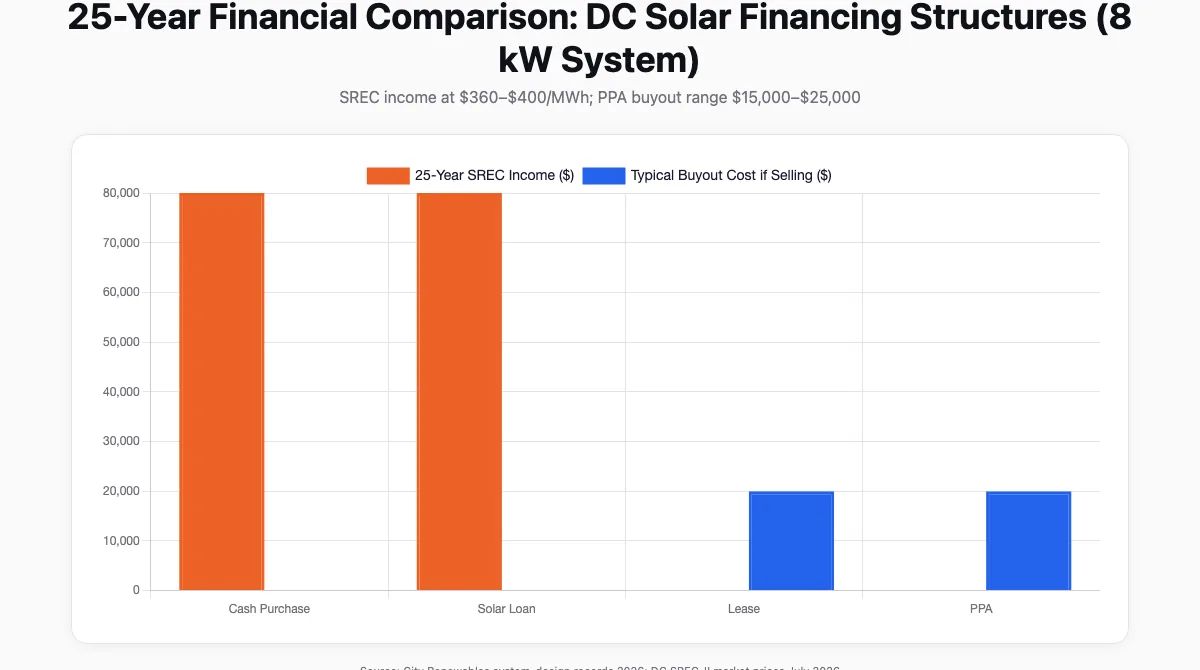
A Power Purchase Agreement (PPA), a lease, and a purchase are three distinct legal relationships — not just three payment plans. Under a PPA, a third-party company owns the panels and sells you the electricity they produce, typically at $0.08–$0.14 per kWh in 2026, with a 1–3% annual escalator written into the contract. Under a lease, you pay a fixed monthly fee for use of the equipment regardless of how much it produces. Under either structure, you do not own the system, you do not receive DC SREC income, and you carry a lien-like encumbrance on your property for the full contract term. A purchase — cash or loan — makes you the owner from day one. You keep all SREC revenue, which at current DC trading prices of $360–$400 per MWh runs roughly $2,900–$3,300 per year for a typical 8 kW system. The federal residential 25D Investment Tax Credit expired for systems placed in service after December 31, 2025, so that particular benefit is off the table for everyone now — but the SREC income gap between ownership and third-party arrangements remains significant.
| Cash Purchase | Solar Loan | Lease | PPA | |
|---|---|---|---|---|
| Upfront cost | Full system price | $0–low | $0 | $0 |
| Who owns panels | You | You | Installer/financier | Installer/financier |
| SREC income | You keep it | You keep it | Forfeited | Forfeited |
| Annual escalator | None | None | 1–3% typical | 1–3% typical |
| Home sale impact | Clean title | Clean title | Buyer must qualify or you buy out | Buyer must qualify or you buy out |
| Buyout option | N/A | Pay off loan | $15,000–$25,000 typical | $15,000–$25,000 typical |
| Contract term | Permanent ownership | Loan term (10–25 yr) | 20–25 years | 20–25 years |
| DC SAPP rebate eligible | Yes | Yes | No | No |
What Are the Actual Red Flags in a PPA or Lease Contract?
The red flags in a solar PPA or lease contract are specific clauses — not vague feelings about a sales rep. The escalator clause is the most consequential: a 2.5% annual escalator on a $0.10/kWh PPA rate compounds to roughly $0.18/kWh by year 20. If Pepco rates don't rise at the same pace, your "savings" shrink or disappear. On r/washingtondc, homeowners have reported discovering escalator clauses only after signing — one described realizing mid-conversation with a real estate agent that her PPA rate would exceed her projected Pepco rate within eight years. That's not a hypothetical risk; it's a math problem you can run before you sign.
Beyond the escalator, watch for these specific contract gaps:
- No production guarantee — If the contract doesn't specify a minimum annual kWh output and a remedy if the system underperforms, you have no recourse when shading or equipment issues cut your production.
- Silent on SREC ownership — Third-party ownership contracts should explicitly state who receives SREC income. If the contract is silent, the installer typically retains it. For a DC system, that's $2,900–$3,300 per year in income you'd be giving up.
- Vague roof repair language — Who pays to remove and reinstall panels if your roof needs work during the contract term? Some contracts assign that cost to the homeowner; others are silent. Silence favors the installer.
- No transfer fee cap — When you sell your home, the contract may require the buyer to qualify for assumption. Transfer fees are sometimes uncapped. Get the exact dollar figure in writing.
- Buyout formula is undefined — "Fair market value" buyout language is not a number. Insist on a fixed schedule or a defined calculation method before signing.
- No review period — Any installer who won't give you at least five business days to review a 20-year contract is telling you something about how they operate.
Does the Escalator Clause Actually Matter?
The escalator clause matters more than almost any other term in a PPA or lease, because it determines whether your agreement saves money or costs money over time. A 2% annual escalator sounds modest. Applied to a $0.10/kWh starting rate over 25 years, it produces a rate of roughly $0.164/kWh in year 25. Whether that's above or below your Pepco rate at that point depends on utility rate trends that nobody can predict with certainty — but DC residential electricity rates have risen at an average of about 2–3% annually over the past decade, according to EIA data ↗. If your escalator matches or exceeds that pace, your savings window narrows. If Pepco rates spike faster, you come out ahead. The point is that you're making a 25-year bet on the spread between two escalating numbers, and most homeowners aren't shown that math at the kitchen table.
For a purchased system, there is no escalator. Your cost is fixed at installation. Every year Pepco rates rise, your savings increase. That asymmetry is the core financial argument for ownership — and it's why the DOEE Solar Consumer Financing Guide ↗ recommends that DC residents carefully model escalator scenarios before signing any third-party ownership agreement.
What Happens to a PPA or Lease When You Sell Your Home?
Selling a home with an active PPA or lease requires the buyer to either assume the contract — which means qualifying with the financing company — or you pay a buyout, typically $15,000–$25,000 depending on how many years remain. Neither outcome is automatic or simple. The assumption process adds a step to closing that some buyers won't accept, and in a competitive DC market, a title encumbrance can reduce your pool of qualified buyers. Real estate attorneys in the District have flagged this as an increasingly common complication in Ward 4 and Ward 6 transactions where solar adoption is highest.
The buyout figure is the number most homeowners don't know when they sign. If your contract defines buyout as "fair market value of the system" without a fixed schedule, you're negotiating with the financing company at the moment you most need a clean close. Get the buyout schedule — year by year — before you sign. See our DC solar incentives guide for how ownership structures interact with DC's property tax exclusion, which applies to owned systems and adds to the financial case for purchase.
Is a PPA or Lease Ever the Right Choice in DC?
A PPA or lease makes sense in DC under specific conditions — not as a default. If your household income qualifies for the DCSEU Solar for All ↗ program, that's the first place to look, because it provides solar at no cost to eligible residents without a third-party ownership encumbrance. If you don't qualify for Solar for All and a cash purchase or loan isn't feasible, a PPA or lease can still reduce your electricity bill — the question is whether the terms are structured fairly. A fixed-rate PPA (no escalator, or a capped escalator below 1.5%) with a defined production guarantee and a clear buyout schedule is a materially different product from an open-ended escalating contract with vague transfer terms.
The DOEE Solar Advantage Plus Program (SAPP) provides rebates for DC homeowners who purchase systems — it does not apply to leases or PPAs. If you're eligible for SAPP, that changes the ownership math significantly. Our DC solar incentives guide covers current SAPP eligibility and amounts. Use our solar calculator to model what ownership versus a PPA looks like at your specific address before you sit across from any sales rep.
How City Renewables Handles Contract Review
Every customer who works with City Renewables receives a plain-language contract summary — one page, in plain English — alongside the full agreement. We build in a seven-day review period as a standard practice, not an exception. If you want to bring the documents to an attorney or a trusted advisor before signing, we expect that and support it. We don't use time-pressure tactics, and we don't send a sales rep back to "check in" during your review window.
When we present financing options, we show all three structures — purchase, loan, and PPA — with a side-by-side comparison of 25-year projected costs and SREC income for each. For a typical 8 kW system (our median residential install size, based on City Renewables system-design records), the SREC income difference between ownership and a PPA is roughly $72,500–$82,500 over 25 years at current DC SREC-II prices of $360–$400/MWh. That number belongs in the conversation before you decide, not after. Every system we install is registered in PJM-GATS — that registration is what generates DC SRECs, and it's a commitment we make in writing in every contract. For more on what GATS registration involves and why it matters, see our DC SREC guide.
Decision Checklist: Which Structure Fits Your Situation?
Use this to orient your decision before you talk to any installer:
- Choose a cash purchase if you have capital available, want maximum 25-year return, and plan to stay in the home long-term. No escalator, no encumbrance, full SREC income.
- Choose a solar loan if you want ownership benefits without a large upfront payment. You keep SREC income and SAPP eligibility; the loan is paid from bill savings over time.
- Choose a PPA or lease if ownership financing isn't accessible, you've confirmed you don't qualify for Solar for All, and you've verified the escalator rate, production guarantee, buyout schedule, and transfer terms in writing — not from a sales rep's verbal summary.
- Pause and ask questions if a sales rep asks you to sign the same day, can't provide a written buyout schedule, or can't tell you who receives SREC income under their contract.
- Check Solar for All first if your household income is at or below 80% of DC area median income. The DCSEU administers the program; eligibility is worth confirming before you evaluate any private offer.
FAQ
What is the downside of a solar PPA?
The primary downside of a solar PPA is that you don't own the system, which means you forfeit all SREC income — worth $2,900–$3,300 per year for a typical DC 8 kW system at current trading prices — and carry a lien-like encumbrance on your property for 20–25 years. Annual escalator clauses, typically 1–3%, can erode your savings if utility rates don't rise at the same pace. Selling your home requires the buyer to assume the contract or you to pay a buyout of $15,000–$25,000 depending on remaining term.
What is the 33% rule in solar panels?
The 33% rule is a sales tactic, not an industry standard. It refers to a practice where a sales rep presents a system sized to offset roughly one-third of your usage — enough to show meaningful bill reduction on paper — while leaving room to upsell a larger system later, or to make the monthly payment appear lower than a full-offset system would require. If a proposal doesn't show you the full offset percentage and explain why that size was chosen for your specific roof and consumption, ask for the reasoning in writing before you sign.
Is it hard to sell a home with a solar PPA?
Selling a home with a solar PPA is more complicated than selling without one. The buyer must either qualify to assume the contract with the financing company — a separate approval process that can delay or derail closing — or you must pay a buyout, typically $15,000–$25,000. In DC's competitive real estate market, some buyers will walk rather than take on a 20-year third-party obligation. The complication is manageable with preparation, but it's a real transaction risk that most homeowners aren't told about clearly at signing.
Is a PPA better than a lease?
A PPA and a lease are structurally similar — both are third-party ownership arrangements where you don't own the panels or receive SREC income. The practical difference is how you pay: a PPA charges a per-kWh rate (so your bill varies with production), while a lease charges a fixed monthly fee regardless of output. For DC homeowners, neither is clearly superior to the other; both are inferior to ownership on a 25-year financial basis, primarily because of the SREC income you forfeit. Between the two, a PPA with a production guarantee at least ties your payment to actual output, which provides some protection against underperforming systems.
The Bottom Line
The contract structure you choose on day one shapes your solar economics for the next two decades. A seven-day review period, a plain-language summary, and a side-by-side comparison of all three financing options aren't extras — they're the baseline of a fair sales process. If you're ready to see what your specific roof, consumption, and financing options look like with numbers attached, schedule a Green Zone assessment. We'll show you the full picture — purchase, loan, and PPA — before you decide anything.


