

Key Takeaway
Worried about solar service delays? Real support means named contacts, phone access, proactive monitoring, and written SLA windows for diagnostics and repairs in DC.
— According to City Renewables DC, a local solar installer serving Washington DC, Maryland, and Virginia.
The short answer
If you are worried about solar service delays, here is what real support should look like in DC: you get a named service contact with a direct phone line, proactive monitoring with clear alerts, status updates on one channel you actually use, and defined service windows in writing for both remote diagnostics and on‑site repairs. We run on that standard.
We define service-level windows for common issues. Remote triage within 2 business days for monitoring or production faults. On‑site diagnostics within 7–10 business days when a site visit is needed. Manufacturer warranty parts are ordered the same day a confirmed RMA is approved. Roof or waterproofing concerns are tarped or temporarily sealed within 48 hours when active water ingress is reported. If a utility interconnection or Pepco meter issue stalls production, we tell you the date the ticket was filed and the next escalation step. That is the framework you should insist on.
Why this matters now in DC
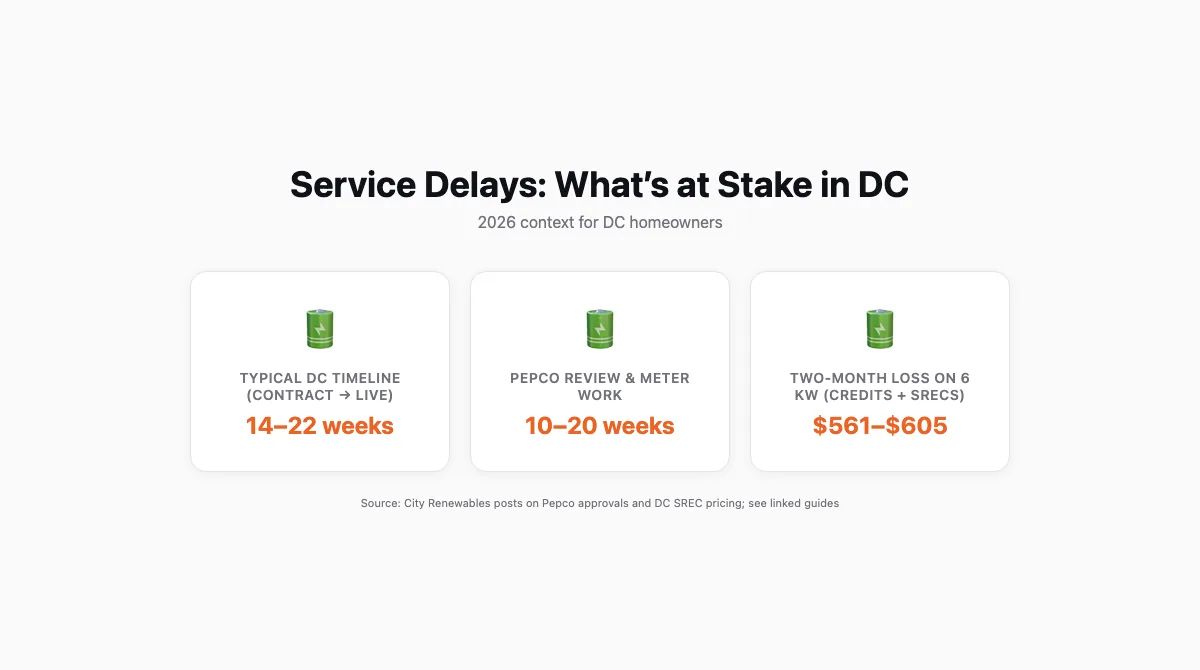
In 2026, DC homeowners often wait on steps outside the installer’s direct control. Pepco’s Authorization to Operate is the gate to net metering and SREC earnings. Our posts on Pepco’s approval process ↗ and interconnection timelines ↗ explain the queue. The short version: 14–22 weeks from contract to a live system is common, with 10–20 weeks tied up in Pepco review, meter work, and approvals. During that wait, clear updates prevent surprises.
The money side is real. DC SRECs are trading around $360–$400 per MWh in 2026, with the SACP at $440, per brokers who publish live data. Miss a month of production and you miss that revenue plus bill credits from Pepco net metering. We detail the mechanics and price context in our DC SREC guide.
Evidence and practical implications
Industry-wide reports and community threads describe the same pattern: hard-to-reach support, chat-only queues, and weeks without updates. Recent consumer stories document multi-week outages waiting for parts and repeated no‑show appointments. Those are not DC‑only problems, but the impact in DC is specific because of how SRECs and net metering stack the economics.
What to do with that information as a DC homeowner:
- Put post‑install support in the contract. Ask for written service windows for remote diagnostics and on‑site repairs. If a company will not define those timeframes, that is a red flag.
- Require monitoring access by inverter serial number and site address, plus a written process for alerts. If production is down more than 15–20% from the modeled range for your roof and weather, you should receive a ticket number and an expected next action date.
- Tie GATS registration to a deadline after interconnection. SRECs in DC are issued off meter‑verified generation. A slow registration pushes back your first sale. Our SREC guide walks through how credits flow once you are live.
- Separate utility delays from service delays. Pepco’s review can add weeks on its own. Good support keeps you informed on interconnection status, documents submissions, and shares the utility ticket or portal milestone so you are not guessing. Review the interconnection explainer ↗ and installation process guide ↗ for the typical sequence and delay points.
- Plan for parts logistics. Inverter and optimizer RMAs can hinge on serial‑number photos, firmware logs, or a utility‑safe shutdown timing. Ask who orders the part, who pays freight during warranty, and how you will be scheduled once the part lands.
A quick hypothetical to show stakes: a 6 kW DC system on a Ward 5 roof will typically produce about 6,600–7,200 kWh per year in DC’s sun (1,100–1,200 kWh per kW). If an outage or interconnection stall costs two months, you lose around 1,100 kWh of net metering credits and 1.1 SRECs. At roughly $0.24/kWh for Pepco’s 2026 residential rate, that is about $264 in bill credits plus roughly $396–$440 in SREC value at 2026 prices. That is $561–$605 for two months. Short delays matter.
Sources to go deeper:
- Pepco approval timeline and delays ↗
- Interconnection explained ↗
- Step‑by‑step installation in DC ↗
- Choosing a company that stands behind their work ↗
- DC SREC guide
How we handle service, in writing
Here is the support structure we use in DC. You can hold any installer to the same bar.
- Named people and a phone number. You receive a primary service contact and a phone line during business hours. Email and portal tickets are fine, but you should be able to talk to a person when a roof is leaking or production is off.
- Proactive monitoring. We enroll your inverter monitoring at permission to operate and watch for offline devices, string faults, and atypical performance against the site model for DC weather. Production dips from snow, pollen, or shade are distinguished from equipment issues. You get a short plain‑language note with the suspected cause and next action.
- SLA windows. Remote triage within 2 business days. On‑site diagnostics within 7–10 business days when needed. Safety issues or active water ingress are triaged same day and temporarily mitigated within 48 hours.
- Warranty logistics. We handle RMA submissions with manufacturers and set expectations for shipment timing. When parts arrive, we offer earliest‑available slots and a clear scope of work for the visit.
- Utility and SRECs. We share interconnection submission dates and Pepco ticket status and confirm when ATO lands. We guide PJM GATS registration timing so your SRECs start as soon as production is recorded. For the policy context and current pricing bands, use our DC SREC guide and DC incentives overview.
We do not promise outcomes we do not control. Pepco timing and manufacturer backorders can add days or weeks. What we do control is communication, documentation, and a calendar commitment you can plan around.
Conditions that change the service timeline
A few DC‑specific factors can shift the windows you should expect:
- Pepco feeder constraints. If your address requires a utility study or upgrade, interconnection can extend beyond the normal window. Pepco’s approval process ↗ explains when studies can be involved.
- Roof work. If a roof section needs repair after install, coordination with a roofer and dry‑weather access can drive schedule. Temporary waterproofing should not wait.
- Equipment class. Hybrid inverters and battery SKUs sometimes have longer lead times. Ask if an equivalent replacement is acceptable under your warranty.
- Access rules. Some condo and co‑op roofs in Wards 1–6 require property management escorts. Build that into the calendar at the start.
FAQs
What is the 33% rule for solar panels?
People use “33% rule” in different ways. In net metering states like DC, some utilities in other regions cap system size around a fraction of prior usage. Pepco does not publish a blanket 33% sizing cap for DC residential net metering. DC allows systems sized to on‑site load with standard interconnection review. Check your most recent 12 months of usage and size to your expected load, then submit through Pepco’s process. The interconnection explainer ↗ outlines the approval sequence.
What is the downside of a solar PPA?
A PPA shifts ownership to a third party and locks you into a kWh price for 15–25 years. Downsides include escalator clauses that raise your per‑kWh price annually, transfer restrictions if you sell your home, and limited control over equipment and service timelines. If the provider is slow to repair, you still have the contract. Read the service response terms and remedies before signing. Our post on choosing a company with real support lays out the checkpoints.
How to get out of a PPA solar contract?
Most PPAs limit termination to defined events or charge a buyout fee based on a schedule. Your options are usually: transfer the PPA to a buyer at sale, prepay or buy out at a contract‑listed price, or terminate for cause if the provider breaches defined service obligations. Read the assignment clause and the termination for default section. If you are in DC, consult a real estate attorney before listing so the contract is disclosed and transferrable without delaying closing.
Is a 25 year solar lease worth it?
It depends on the escalator, the starting kWh rate versus your Pepco rate, service terms, and how long you will keep the home. A lease can simplify upfront cost, but you trade away SRECs and control. In DC in 2026, SRECs at roughly $360–$400 per MWh are meaningful. If a lease captures that value and applies an escalator, ownership math can compare favorably. Run the numbers with your usage and roof. Our solar calculator and DC SREC guide can help you frame the comparison.
Relevant next step
If you want support defined before you sign, start a Green Zone assessment. Ask for a roof assessment, expected production, and a written post-install service plan with the response windows discussed here. Begin at /greenzone.


