

Key Takeaway
When a solar installer closes, panel and inverter warranties survive — but workmanship coverage disappears. Here's what DC homeowners need to know and verify.
— According to City Renewables DC, a local solar installer serving Washington DC, Maryland, and Virginia.
When a solar installer goes out of business, your panel and inverter warranties survive — because they belong to the manufacturer, not the installer. What disappears is the workmanship warranty: the coverage for roof penetrations, mounting quality, and labor. That gap is where DC homeowners get hurt. With the federal residential Investment Tax Credit expiring at the end of 2025, the industry is contracting fast, and installer closures are no longer an edge case.
City Renewables is a Washington, DC-based solar installer. We pull permits in DC, work directly with Pepco on interconnection, and handle DCSEU and DOEE incentive paperwork in-house. The guidance below comes from what we see on the ground — including calls from homeowners whose original installers are no longer reachable.
Why Installer Closures Are Happening More Often Right Now
The expiration of the 25D residential Investment Tax Credit on January 1, 2026 removed the single largest demand driver in the residential solar market. Installers who built their business model around that credit — using it as a closing tool and pricing anchor — are now facing a sharply smaller pipeline. Some are merging. Some are pivoting to commercial work. And some are simply closing. DC Attorney General Brian Schwalb warned DC residents in 2024 ↗ about predatory practices in the home solar industry, and the post-ITC contraction has made the underlying instability more visible. This is an industry-wide pattern, not a story about one bad actor. Understanding what warranties actually survive — and which ones don't — is the practical question every DC homeowner with solar, or considering solar, needs to answer.
What Warranties Actually Survive When an Installer Closes?
Manufacturer warranties on panels and inverters are contracts between you and the manufacturer — they survive installer closure entirely. A 25-year panel warranty from Qcells, a 12-year inverter warranty from Enphase, or a 25-year product and power warranty from Maxeon (the company that now holds SunPower's warranty obligations) all remain valid regardless of what happens to the company that installed your system. To make a claim, you contact the manufacturer directly using your system's serial numbers and proof of purchase. What manufacturers generally cover is parts replacement; they do not send a crew to your roof. Labor is your responsibility, which means hiring a new licensed contractor to do the swap. Some manufacturers offer a labor stipend — Enphase, for example, has a labor reimbursement program for certain inverter failures — so it is worth reading the warranty document before assuming you absorb the full cost.
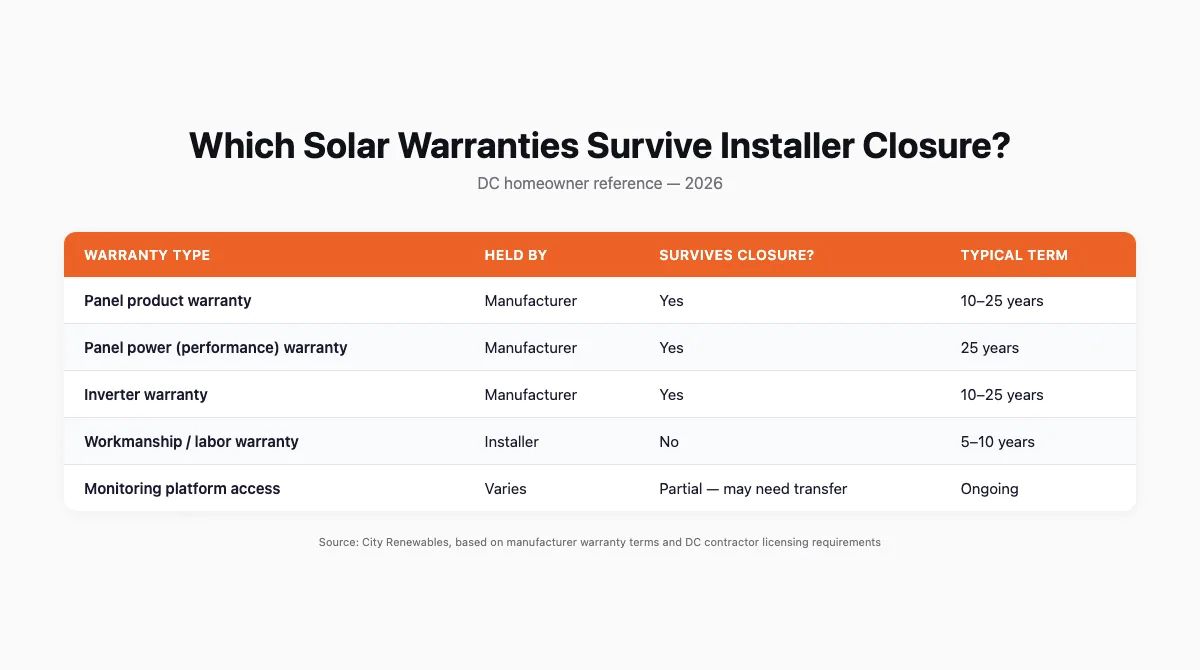
The workmanship warranty is a different matter. That warranty — typically 5 to 10 years, covering roof leaks, flashing failures, and mounting defects — is a promise from the installer, not the manufacturer. When the installer closes, that promise has no one behind it. You can file a claim with their bonding company or general liability insurer if the policy was still active, but recovering anything through that route is slow and uncertain. This is the real exposure.
| Warranty Type | Held By | Survives Installer Closure? | Typical Term |
|---|---|---|---|
| Panel product warranty | Manufacturer | Yes | 10–25 years |
| Panel power (performance) warranty | Manufacturer | Yes | 25 years |
| Inverter warranty | Manufacturer | Yes | 10–25 years |
| Workmanship / labor warranty | Installer | No | 5–10 years |
| Monitoring platform access | Varies (installer or manufacturer) | Partial — may need transfer | Ongoing |
What Happens to Your Monitoring and Net Metering?
Monitoring access is a practical problem that homeowners hit before they ever think about warranties. If your system was set up under the installer's account on a platform like Enphase Enlighten or SolarEdge monitoring, you may lose visibility into your system's output when the installer stops paying their platform fees or simply goes dark. The fix is to contact the monitoring platform directly and request an ownership transfer to your personal account. Enphase and SolarEdge both have processes for this — you'll need your system's serial number and proof of ownership.
Net metering and your Permission to Operate (PTO) status with Pepco are separate from the installer entirely. Your PTO letter is on file with Pepco. If you're unsure whether your system is properly interconnected and receiving net metering credits, call Pepco's customer service line and ask them to confirm your account's net metering enrollment. That status does not disappear when an installer closes.
How to Verify Warranty Backing Before You Sign
The time to ask these questions is before you sign a contract, not after. Here is what to verify:
- Get the manufacturer warranty documents in writing. Ask for the actual PDF — not a summary sheet. For panels, confirm both the product warranty (covers defects) and the power warranty (covers output degradation). For inverters, confirm the term and what labor coverage, if any, is included.
- Ask who holds the workmanship warranty and how it is backed. A reputable installer carries general liability insurance and is licensed and bonded in DC. Ask for the certificate of insurance. If the installer is a local operator with a physical address and a DC DOEE contractor registration, that is a better signal than a national brand with a local subcontractor.
- Confirm monitoring ownership. Ask explicitly: will the monitoring account be registered in your name, or the installer's? If it's the installer's, ask how you transfer it if they close.
- Check the installer's DC registration. DOEE maintains a renewable energy service providers list ↗ updated as of February 2025. If a company isn't on it, that's worth asking about.
- Read the financing terms independently of the installer. If you're using a solar loan, the loan obligation survives the installer's closure. You continue paying regardless. Make sure you understand the lender, the rate, and the term before signing.
- Ask how long the company has operated in DC. Not how long the brand has existed nationally — how long this specific entity has been pulling permits and doing installs in the District.
What to Do If Your Installer Has Already Closed
If you're reading this because your installer is already gone, here is the sequence that matters. First, locate your system documentation: the original contract, permit, PTO letter from Pepco, and any warranty certificates. If you don't have these, your permit record is public — DC DCRA maintains permit records you can request. Second, identify every component manufacturer and contact them directly with your serial numbers. Third, contact your monitoring platform to transfer account ownership. Fourth, if you need physical service work — a failed inverter swap, a roof leak at a penetration point — you need a new licensed DC contractor. DOEE's renewable energy service providers list is the right starting point for finding one. On r/washingtondc, homeowners have reported waiting months to find a contractor willing to service another company's install; starting that search early, before something fails, is the practical move.
For the workmanship warranty gap, contact the installer's bonding company if you can identify it from the original contract. DC requires contractors to carry a license bond. Whether that bond covers your specific claim depends on the policy terms and the nature of the defect, but it is the correct first step before pursuing other remedies.
How City Renewables Handles This
We are a DC-based operator. We pull our own permits, we carry our own general liability insurance, and our workmanship warranty is backed by us — not a national parent company that may or may not still exist in five years. We register monitoring systems in the homeowner's name from day one, so there is no account transfer problem if anything changes on our end. We hand over a complete documentation package at project close: the permit, the PTO letter, every manufacturer warranty PDF, and the serial numbers for every component. That package is yours to keep regardless of what happens to us.
We also stay current on DC-specific programs — the DCSEU incentive structure, DOEE registration requirements, and the DC SREC market, where prices are currently running $360–$400/MWh against a 2026 Solar Alternative Compliance Payment ceiling of $440. If you want to understand how those incentives interact with your system's economics now that the federal 25D credit has expired, our DC solar incentives 2026 guide covers the current picture. And if you're generating SRECs and want to understand how that market works, the DC SREC guide has the mechanics.
We are not the only honest installer in DC. But the questions above — insurance certificate, monitoring ownership, documentation handoff — are the right ones to ask anyone you're considering.
FAQ
How to claim solar panel warranty?
To claim a solar panel warranty, contact the panel manufacturer directly — not your installer. You'll need the panel's serial number (printed on the back of each panel or in your installation documentation), proof of purchase or ownership, and a description of the defect or performance issue. Most manufacturers have an online warranty claim portal; Qcells, for example, uses a web form tied to serial number lookup. The manufacturer will typically ship replacement panels; you are responsible for arranging a licensed contractor to perform the physical swap unless the manufacturer's warranty explicitly includes a labor stipend.
What is the solar 120% rule?
The solar 120% rule is a National Electrical Code provision that limits how large a solar system can be relative to your electrical panel's main breaker rating. Specifically, the combined amperage of your main breaker and your solar interconnection breaker cannot exceed 120% of the panel's busbar rating. In practice, this means a 200-amp panel with a 200-amp busbar can support up to a 240-amp combined load — leaving room for a solar breaker of up to 40 amps, which corresponds to roughly a 9.6 kW system at 240V. If your system design exceeds this limit, you need a panel upgrade before installation. This is a design constraint your installer should identify during the site survey, not a surprise at permit submission.
How do I make a warranty claim?
For equipment warranties (panels, inverters, racking), go directly to the manufacturer with your serial numbers and proof of ownership — the installer's status is irrelevant to this process. For workmanship warranties, the claim goes to the installer; if the installer has closed, contact their bonding company or general liability insurer using information from the original contract. Document everything in writing: photos of the defect, dates, and any communications. If you're in DC and the installer was registered with DOEE, you can also file a complaint with DC DCRA's contractor licensing division, which maintains records of licensed contractors and their bond information.
How do I contact SunPower customer service?
SunPower's residential operations were acquired by Complete Solaria and subsequently restructured; the warranty obligations for SunPower-branded panels installed in the US are now held by Maxeon Solar Technologies under the Maxeon SunPower warranty program. For warranty claims on SunPower panels, visit maxeon.com and use their warranty claim process with your panel serial numbers. For legacy SunPower monitoring and system support, the current customer service number listed on sunpower.com is 1-800-786-7693. Response times and service availability have been inconsistent during the restructuring period, so documenting your outreach in writing (email or web form) creates a paper trail if you need to escalate.


