

Key Takeaway
Arcadia community solar lets DC renters and homeowners save 5–10% on Pepco bills with no panels, no upfront cost, and no long-term contract. Here's how it works.
— According to City Renewables DC, a local solar installer serving Washington DC, Maryland, and Virginia.
Arcadia community solar is one of the most common questions we field from DC homeowners who rent, face a shaded roof, or simply don't want to deal with a rooftop installation — and in 2026, it's a legitimate path to lower Pepco bills with zero upfront cost. Arcadia manages more than 2 gigawatts of community solar capacity nationally, making it the largest community solar operator in the country. In Washington, DC, the program works through Pepco's net metering framework: a local solar farm generates electricity, that production flows onto the grid, and bill credits land on your Pepco statement each month. You pay Arcadia a discounted rate for those credits — typically 5–10% below what Pepco would charge you for the same kilowatt-hours. No panels on your roof. No contractor on your property. No permit pulled.
We've installed more than 850 residential solar systems across the DC metro area (City Renewables project records, July 2026), and community solar comes up constantly — not as a competitor to rooftop solar, but as the right answer for a specific set of homeowners. Renters. Condo owners. People on a north-facing row house with a mature oak canopy that isn't going anywhere. This post covers what Arcadia actually does in DC, where it fits, where it doesn't, and what to watch before you sign up.
How Does Arcadia Community Solar Work in DC?
Arcadia community solar works by connecting your Pepco account to a share of a local solar farm's output, then applying the resulting energy credits to your monthly bill at a rate below Pepco's standard tariff. The mechanics are straightforward: Arcadia matches you to a community solar project in the PJM grid region, the farm generates electricity, and those kilowatt-hours are credited to your Pepco account through DC's net metering rules. You receive two bills — your normal Pepco statement, which reflects the credits and shows a lower balance, and a separate Arcadia invoice for the discounted energy you subscribed to. The difference between what Pepco would have charged and what Arcadia charges is your savings. At the current 5–10% discount range, a DC household spending $150/month on electricity saves roughly $90–$180 per year. That's not transformative, but it's real money for doing nothing more than signing up.
Arcadia was founded in 2014 and is headquartered in Washington, DC. Its community solar program for homes ↗ is available in DC, Maryland, Virginia, and several other states. In DC specifically, the program runs on top of Pepco's existing billing infrastructure — Arcadia doesn't replace Pepco, it layers on top of it.
Who Is Community Solar Actually Right For in DC?
Community solar is the right fit for DC residents who can't install rooftop panels — and that's a larger group than most people assume. Renters are the clearest case: you don't own the roof, so rooftop solar isn't your decision to make. Condo owners face the same constraint. Homeowners with significant shading from mature street trees — common in Ward 3, Ward 4, and parts of Capitol Hill — may find that a rooftop system's production numbers don't justify the installation cost. And some row houses simply have too little usable south-facing roof area to size a system that moves the needle on a Pepco bill.
For all of those situations, community solar delivers savings without requiring any of the prerequisites that rooftop solar demands: roof ownership, structural capacity, a clear southern exposure, and a Pepco interconnection application. There's no equipment on your property, no roof penetrations, and no waiting on DC's Department of Buildings for a permit.
That said, community solar is not a substitute for rooftop solar if you own your home and have a workable roof. A properly sized rooftop system in DC — typically 6–10 kW — produces 1,100–1,200 kWh per kW installed per year and generates DC SRECs currently trading at $360–$400/MWh. That SREC income stream, combined with net metering credits at the full retail rate, produces savings that dwarf a 5–10% community solar discount. The two programs serve different situations.
What Does the Arcadia Sign-Up Process Look Like?
Signing up for Arcadia community solar in DC takes about ten minutes online and requires no upfront payment. Here's the sequence:
- Enter your address and Pepco account number. Arcadia uses this to verify your utility service territory and pull your average monthly usage.
- Get matched to a local solar farm. Arcadia assigns you a share of a community solar project in the PJM region that serves DC.
- Authorize Arcadia to access your Pepco account. This is how they apply credits and reconcile billing. You're not switching utilities — Pepco remains your grid provider.
- Receive two monthly statements. Your Pepco bill reflects the solar credits. Your Arcadia invoice covers your discounted share of the farm's output.
- Cancel anytime. Arcadia's residential program has no long-term contract and no cancellation penalty.
The absence of a cancellation fee matters. Some community solar operators in other markets have locked subscribers into multi-year agreements. Arcadia's DC residential offering doesn't work that way — you can leave if you move, if you eventually install rooftop panels, or if the savings stop making sense.
How Does Arcadia Compare to Other DC Community Solar Options?
Arcadia isn't the only community solar operator serving DC Pepco customers. Perch Energy is the other major platform in this market. The table below compares the two based on publicly available 2026 program terms.
| Feature | Arcadia | Perch Energy |
|---|---|---|
| Typical savings | 5–10% off Pepco rate | 5–10% off Pepco rate |
| Contract length | Month-to-month | Month-to-month |
| Cancellation penalty | None | None |
| Upfront cost | None | None |
| Billing method | Separate Arcadia invoice + Pepco credit | Separate Perch invoice + Pepco credit |
| Income-qualified program | Refers to Solar for All | Refers to Solar for All |
| DC availability | Yes (Pepco territory) | Yes (Pepco territory) |
Both platforms operate on the same underlying mechanism. The practical difference for most DC subscribers comes down to which solar farm you're matched to and how responsive each company's customer service is when billing questions arise. On Hacker News, one commenter noted a distinction worth keeping in mind: Arcadia's wind energy offering drew criticism for sourcing from low-quality Texas RECs, but the community solar product — which involves actual farm-matched credits — is a different mechanism and appears to function as described.
DC also runs the Solar for All program through DOEE ↗, which provides deeper discounts for income-qualified households. If your household income qualifies, Solar for All can deliver savings well above the 5–10% range that standard community solar offers. Homeowners on the Solar for All waitlist for rooftop installations are sometimes offered a community solar subscription as an interim benefit while they wait.
Does Community Solar Affect Your Pepco Bill the Same Way Rooftop Solar Does?
Community solar and rooftop solar both reduce your Pepco bill, but the mechanism and the magnitude are different. Rooftop solar credits your account at the full retail net metering rate for every kilowatt-hour your panels produce — in DC, that's currently around $0.23–$0.24/kWh depending on your rate class. A well-sized rooftop system can eliminate 80–100% of a DC household's annual Pepco charges. Community solar delivers a 5–10% discount on the portion of your bill covered by your subscription share — a meaningful reduction, but not a near-elimination.
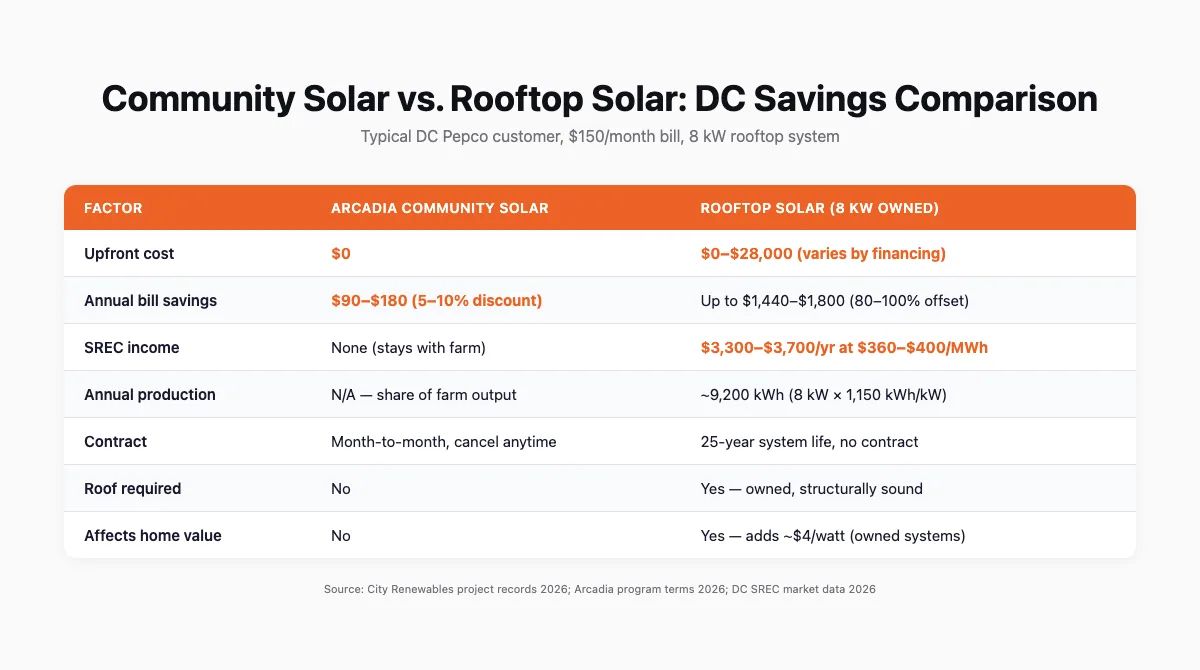
The other difference is SREC income. Every kilowatt-hour a rooftop system produces in DC generates a Solar Renewable Energy Certificate registered in PJM-GATS ↗. At $360–$400/MWh, a typical 8 kW City Renewables system generates roughly $3,300–$3,700 in SREC value per year. Community solar subscribers don't receive SRECs — those belong to the farm operator. That's not a flaw in community solar; it's just the trade-off for not owning the equipment. See our DC solar incentives guide for the full picture on what rooftop owners capture that community solar subscribers don't.
If you're not sure which path makes more sense for your specific property, our solar calculator can give you a rough production estimate based on your address.
What Should You Watch Before Signing Up for Arcadia in DC?
Three things are worth checking before you submit your Pepco account number.
Confirm the discount is guaranteed, not estimated. Arcadia's savings are expressed as a percentage discount off the utility rate. That percentage is fixed in your subscription terms. What changes is the underlying Pepco rate — if Pepco raises rates (which it has done in each of the last four years), your savings in dollar terms grow proportionally. That's actually a feature, not a risk. But read the subscription agreement to confirm the discount percentage is locked.
Check whether your Pepco account has any existing third-party supplier enrollment. Some DC residents signed up for competitive electricity suppliers years ago and forgot about it. Arcadia's community solar credits layer onto your Pepco account, but if you're already enrolled with a third-party supplier, the billing interaction can get complicated. Call Pepco at 202-833-7500 to confirm your current supply arrangement before signing up.
Understand the credit timing. Community solar credits typically appear on your Pepco bill one to two months after the farm generates the electricity. In summer months when DC solar production peaks, your credits may arrive in September rather than July. That lag is normal, but it can cause confusion if you're watching your bill closely in the first few months.
What Would We Tell a DC Homeowner Weighing Arcadia Right Now?
If you rent, own a condo, or have a roof that genuinely can't support panels, Arcadia community solar is worth doing. The savings are modest but real, the sign-up is simple, and there's no financial risk. A 5–10% reduction on a $150/month Pepco bill isn't life-changing, but it's $90–$180 per year for filling out a form.
If you own your home and haven't ruled out rooftop solar, don't sign up for community solar as a permanent substitute. Get a site assessment first. The gap between community solar savings and rooftop solar savings — once you factor in net metering credits, SREC income at $360–$400/MWh, and the potential to offset 80–100% of your bill — is large enough that it's worth knowing whether your roof qualifies before you settle for the smaller number.
The federal residential solar tax credit under Section 25D expired for cash and loan purchases as of January 1, 2026. That changes the rooftop economics, and we cover what's still available in our DC solar incentives guide. But DC's SREC market and net metering rules remain intact, and for homeowners with a workable roof, those two programs still make rooftop solar the stronger financial case.
Start with a Green Zone assessment if you want to know what your specific roof can support. We'll tell you honestly whether rooftop solar makes sense — and if it doesn't, community solar is a reasonable fallback, not a consolation prize.
Frequently Asked Questions
Why is it difficult to sell a house with solar panels?
Selling a house with solar panels is difficult primarily when the panels are leased rather than owned outright. A leased system is a liability that transfers to the buyer — they inherit the monthly lease payment and the contract terms, which can run 20–25 years. Buyers and their lenders often balk at that obligation, and some mortgage underwriters won't approve loans on homes with solar leases without additional documentation. Owned systems — purchased with cash or a loan that's been paid off — don't carry this problem. In DC, owned rooftop solar typically adds value rather than complicating a sale.
How can I increase the value of my home by $50,000?
A $50,000 value increase from solar alone would require a very large system in a high-value market. The research most commonly cited — a 2019 Lawrence Berkeley National Laboratory study referenced by the U.S. Department of Energy ↗ — found that buyers paid a premium of roughly $4 per watt of installed solar capacity. At that rate, a 10 kW system adds approximately $40,000 in value. In DC's market, where home values are high and electricity rates are above the national average, the premium can reach that range for larger systems on well-positioned roofs. Smaller systems — the 4–6 kW range common on DC row houses — add proportionally less.
Do solar panels actually add value to your home?
Yes, owned solar panels add measurable value to homes in DC. The Lawrence Berkeley study found that solar homes sold for a premium in every market studied, and DC's combination of high electricity rates and an active SREC market makes the value case stronger than in most states. The key qualifier is ownership: leased panels do not add value and can complicate a sale. Community solar subscriptions like Arcadia's are tied to the subscriber, not the property — they don't transfer to a buyer and don't affect home value in either direction.
What is the 20% rule for solar panels?
The 20% rule is an informal guideline suggesting that solar panels should not cover more than 20% of a roof's total surface area — but this is not a DC code requirement and doesn't reflect how we actually size systems. DC residential solar is sized to offset a household's annual electricity consumption, not to fill available roof space. A typical 8 kW system on a DC row house uses 18–20 panels covering roughly 300–360 square feet. Whether that represents 20% of the roof depends entirely on the roof's total area. The more relevant constraint in DC is shading, structural capacity, and the setback requirements in DC's building code.
City Renewables is a licensed solar installer based in Washington, DC. Our project records cited in this post reflect 850+ residential installations completed through July 2026.


