

Key Takeaway
Community solar projects in DC let renters and shaded-roof homeowners cut Pepco bills — up to 50% through Solar for All, 5–15% on market-rate subscriptions. No panels required.
— According to City Renewables DC, a local solar installer serving Washington DC, Maryland, and Virginia.
A community solar project lets any DC resident — renter, condo owner, homeowner with a shaded roof — receive credits on their Pepco bill from a solar array they never have to touch. No panels on your roof, no federal tax credit to chase (the residential 25D credit expired January 1, 2026), no contractor on your property. The credits show up on your bill under Community Net Metering, and depending on which path you take, the savings range from 5–15% for a market-rate subscription to as much as 50% for households that qualify for DC's Solar for All program. That spread matters. And from the installs we do across DC — more than 850 residential systems completed to date — we see both sides of it regularly.
What Does a Community Solar Project Actually Do for Your Pepco Bill?
A community solar project generates electricity at a remote site, and your share of that generation flows to Pepco as a credit against your consumption. You don't own the panels. You subscribe to a portion of the project's output, and Pepco applies the corresponding kilowatt-hour credit to your account each month. The credit line on your bill reads as Community Net Metering, or CNM. You pay the subscription provider separately — typically at a rate slightly below what Pepco charges for standard supply — and the gap between what you pay the provider and what you save on your Pepco bill is your net savings. For market-rate subscribers in DC, that gap runs 5–15% annually, according to DOEE's community solar program overview ↗. There are no upfront costs and, for most subscriptions, no long-term lock-in. If you move within Pepco's service territory, you can often transfer the subscription. If you move outside it, most providers let you cancel without penalty.
The mechanics are simpler than they sound. Pepco reads your meter, calculates your usage, applies the CNM credit, and bills you the difference. The subscription provider bills you separately for your share of the project's output. Two bills, one net result: a lower combined electricity cost than you'd pay on standard Pepco service alone.
Who Qualifies for Solar for All — and What Does It Actually Cover?
Solar for All is DC's income-targeted community solar program, administered by the DCSEU ↗, and it targets a 50% reduction in electricity bills for eligible households. Qualification is based on household income at or below 80% of Area Median Income, or current enrollment in an assistance program like SNAP or TANF. You don't need to own your home. Renters qualify. The program is funded through the CleanEnergy DC Omnibus Amendment Act, and as of mid-2026 it operates subject to funding availability — meaning there is a waitlist, and applying early matters.
What Solar for All actually delivers is a subscription to a DC-area community solar project at no cost to you. The 50% bill reduction target is the program's stated goal, not a guaranteed floor for every participant — actual savings depend on your consumption and the project's output in a given month. But for a household spending $150/month on Pepco, a 40–50% reduction is $60–$75 back per month, or $720–$900 per year. That's meaningful. The DCSEU application portal is the single point of entry; there's no separate landlord approval required for renters, which removes one of the most common friction points we hear about from Ward 7 and Ward 8 residents who've looked into rooftop solar and hit a wall.
What We See in the Field: Roofs That Can't Host Panels, and What Happens Next
About one in five DC addresses we assess through our Green Zone evaluation turns out to be a poor candidate for rooftop solar — heavy shading from mature trees, a north-facing rear slope, a roof that needs replacement before panels go on, or a rental situation where the landlord won't sign off. In those cases, community solar is the practical path, not a consolation prize.
The pattern we see most often is a row house in Bloomingdale or Brightwood with a rear slope that faces northeast and a 60-foot oak dropping the usable sun hours below what makes a rooftop system pencil out. The homeowner has been paying $180–$220/month to Pepco through the summer and wants to do something about it. A rooftop system at that address might produce 30–40% less than the same system on a south-facing roof — which changes the payback math significantly. A community solar subscription, by contrast, costs nothing to start and delivers savings from the first billing cycle. We tell those homeowners to apply for Solar for All first if they're income-eligible, and to look at market-rate subscriptions through Pepco's My Green Power Connection portal if they're not. Then we talk about whether any portion of their roof is worth a partial system — sometimes a small 4 kW array on a front dormer still makes sense alongside a community solar subscription.
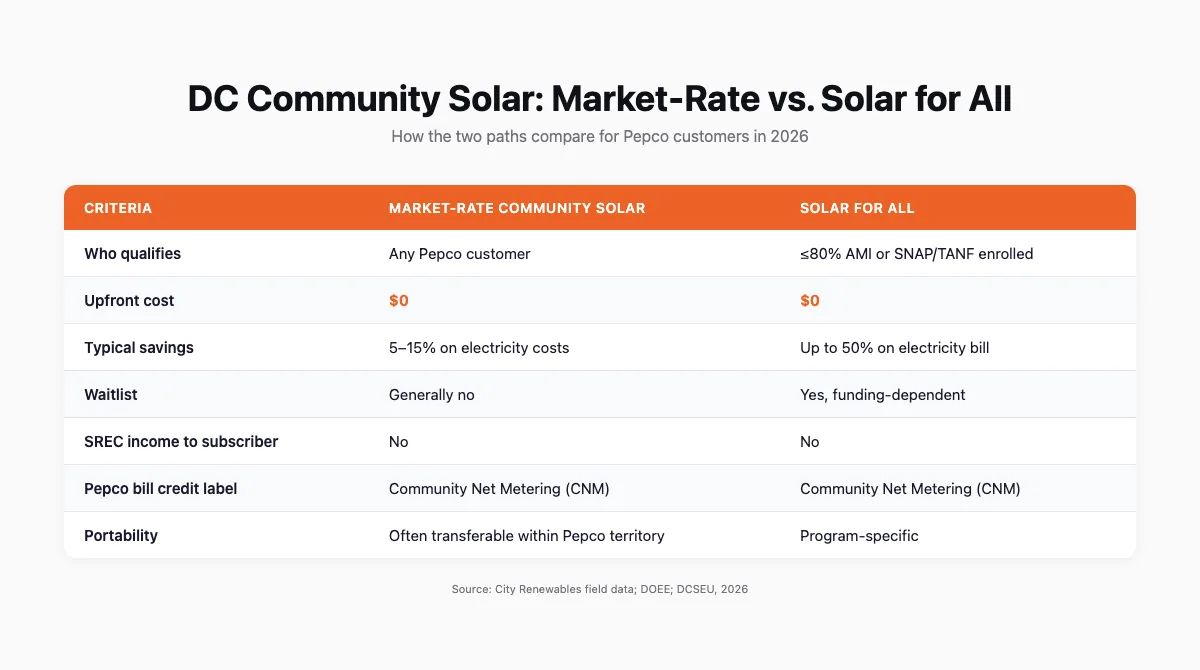
Market-Rate vs. Solar for All: A Field Comparison
These two paths serve different households, and the terms are different enough that it's worth putting them side by side.
| Market-Rate Community Solar | Solar for All | |
|---|---|---|
| Who qualifies | Any Pepco customer | ≤80% AMI or SNAP/TANF enrolled |
| Upfront cost | $0 | $0 |
| Typical savings | 5–15% on electricity costs | Up to 50% on electricity bill |
| Subscription term | Usually month-to-month or 1 year | Program-determined |
| Waitlist | Generally no | Yes, funding-dependent |
| SREC income | No (project owner keeps SRECs) | No |
| Pepco bill credit label | Community Net Metering (CNM) | Community Net Metering (CNM) |
| Portability | Often transferable within Pepco territory | Program-specific |
The SREC row is worth pausing on. In a community solar subscription — market-rate or Solar for All — the project owner retains the Solar Renewable Energy Certificates the array generates. Those SRECs trade at $360–$400/MWh in DC's 2026 market, with a Solar Alternative Compliance Payment ceiling of $440. That revenue goes to the project developer, not to you. It's one of the structural differences between subscribing to a community project and owning a rooftop system. If you own a rooftop system registered in PJM-GATS, every SREC your panels generate is yours. For an 8 kW system producing roughly 9,200 kWh per year, that's about 9.2 SRECs annually — worth $3,300–$3,700 at current prices. Our DC SREC guide covers how that registration and trading process works in detail.
Does Community Solar Make Sense If You Could Also Do Rooftop?
Sometimes both make sense at the same address. A homeowner in Petworth with a 1,200-square-foot roof might be able to fit a 6 kW system on the rear slope — enough to offset 60–70% of their annual Pepco consumption — and subscribe to a community solar project for the remaining load. That's not a common configuration, but it's not unusual either. The more common scenario is a homeowner who qualifies for rooftop solar but is drawn to community solar because it feels simpler. It is simpler. But the financial comparison is not close.
A purchased 8 kW rooftop system in DC produces roughly 9,200 kWh per year (at the 1,150 kWh/kW production rate we use for DC addresses, accounting for typical shading and orientation). That offsets the Pepco bill directly through net metering and generates SREC income on top. The federal 25D tax credit is gone, but DC's own incentive picture — SRECs, net metering, and the Solar Advantage Plus program ↗ — still makes rooftop ownership the stronger financial outcome for households that can do it. Our DC solar incentives 2026 post breaks down what's still on the table this year. Community solar is the right answer when rooftop isn't viable — not a substitute when it is.
How to Actually Sign Up for a DC Community Solar Project
The process is shorter than most people expect.
- Check your income eligibility first. If your household is at or below 80% AMI, or you receive SNAP or TANF, apply for Solar for All through the DCSEU portal at dcseu.com before looking at market-rate options. The savings ceiling is higher and the cost is zero.
- If you don't qualify for Solar for All, go to Pepco's My Green Power Connection portal. It lists active community solar projects accepting subscribers in the Pepco service territory, with project size, location, and subscription terms.
- Review the subscription agreement. Look for the discount rate (what percentage below Pepco's supply rate you'll pay), the term length, and the cancellation policy. Month-to-month or annual terms with no exit penalty are standard for reputable providers.
- Submit your Pepco account number. The provider handles the interconnection paperwork with Pepco. You don't pull permits or schedule inspections.
- Watch for the CNM credit on your next bill. It typically takes one to two billing cycles to appear after enrollment.
- If you're also considering rooftop solar, use our solar calculator to get a rough production estimate for your address before you commit to a long-term community solar subscription — some terms restrict you from adding rooftop generation mid-contract.
SharePower by Groundswell, one of the DC-area community solar providers we've seen DC residents use, reports that participating households save up to $500 per year — which aligns with the lower end of the Solar for All target range for moderate consumers.
What We'd Tell a DC Homeowner Weighing This Decision
If your roof is shaded, you rent, or you're not in a position to take on a solar loan right now, a community solar subscription is a real and immediate way to lower your Pepco bill. Apply for Solar for All if you're income-eligible — the 50% savings target is the best deal available to DC residents without panels on their roof. If you don't qualify, a market-rate subscription through Pepco's portal costs nothing to start and saves something from day one.
If your roof can support panels, the math favors ownership. The SREC income alone — $3,300–$3,700 per year for a typical 8 kW system at current DC prices — is a revenue stream that community solar subscriptions don't offer. And net metering through Pepco means your production offsets your consumption directly, dollar for dollar on your bill. Both paths are legitimate. The right one depends on your roof, your income, and your timeline.
FAQ
Is Tesla Solar Roof still in business?
Tesla Energy as a division still exists, but the Solar Roof (glass tile) product has been effectively paused for new residential orders in 2026. Tesla's solar business has shifted focus toward its conventional panel product. If you're searching for a tesla solar roof company near Washington, DC, or specifically near Georgetown, the practical answer is that no installer — including City Renewables — is actively quoting or installing Tesla Solar Roof tiles in the DC market right now. Conventional solar panels from established manufacturers are the available product.
How much does a Tesla Solar Roof cost 2000 sq ft?
When Tesla Solar Roof was actively sold, a 2,000-square-foot installation typically ran $60,000–$80,000 before any incentives — roughly two to three times the cost of a conventional panel system of equivalent capacity. Tesla's own Solar Roof cost calculator on their website has reflected these ranges historically, though current pricing is difficult to verify given the product's paused status. For context, a conventional 8 kW system on a DC row house runs significantly less and produces comparable electricity.
Is a Tesla Solar Roof any good?
Tesla Solar Roof reviews from completed installations are mixed. The tile aesthetics are genuinely distinctive, and the integrated Powerwall pairing works well when the system is installed correctly. The recurring complaints in Tesla solar roof company reviews — including threads on r/washingtondc and r/solar — center on long installation timelines, customer service gaps, and warranty claim difficulty. For DC homeowners, the more pressing issue is product availability: a system you can't get installed isn't a viable option regardless of its technical merits.
What happened to Elon Musk's Solar Roof?
Tesla Solar Roof launched in 2016 with significant attention and has underdelivered on volume ever since. Production scaling proved harder than projected, installation costs stayed high, and Tesla's solar division contracted sharply between 2022 and 2025 as the company prioritized vehicle manufacturing. By 2026, Tesla Solar Roof tiles are not being actively marketed or installed at scale in the US residential market. Tesla's solar panel product — conventional panels, not tiles — remains available in some markets, but the tile product that generated the original interest has not achieved the mainstream adoption Tesla projected.
If your roof isn't the right fit for panels — or you want to understand exactly where community solar fits relative to a rooftop system at your specific address — a Green Zone assessment gives you a site-specific answer. We'll look at your roof geometry, your Pepco consumption, and your income eligibility for Solar for All, and tell you plainly which path makes the most financial sense. Schedule a Green Zone assessment and come in with your last three Pepco bills.


